Blog

  • How to Prepare Your Home for an Emergency Septic Pumping Appointment in Hesperia

    Checklist steps to prepare home septic pumping before an emergency crew arrives
    Following these steps before the crew arrives can speed up an emergency septic pumping visit.

    When sewage is backing up or the alarm is sounding, the fastest fix starts before the truck arrives. If you prepare your home for septic pumping emergencies, the crew can get to work the moment they pull up instead of spending the first hour hunting for a buried tank lid. This guide walks you through exactly what to do, in order, from the first sign of trouble to the moment the truck leaves. It is written for Hesperia homeowners and small landlords who want a calm plan instead of a panicked scramble.

    The good news is that most of the prep costs nothing but a little effort. The steps below can shave real time off an emergency visit, protect your yard and your plumbing, and give you the documentation you need if you own rental property.

    First Moves When Sewage Is Backing Up

    Before you prepare anything for the crew, stop making the problem worse. A septic backup means the tank or the line to it cannot accept more water. Every flush, every load of laundry, and every shower adds to what is already coming back into the house.

    Do these things in the first ten minutes:

    1. Stop all water use in the house. That means no flushing, no dishwasher, no laundry, and no showers.
    2. Keep people and pets away from any standing sewage, inside or outside. Raw sewage is a health hazard, not just a mess.
    3. If your system has a pump and the alarm is going off, press the silence button if there is one, but do not assume the problem is solved. The alarm means the tank level is too high.
    4. Call a local septic crew and describe what you are seeing. Backup in the lowest drain, gurgling toilets, or wet ground over the tank are all details worth mentioning.

    However, do not add chemicals or drain cleaner to a backed-up system. Those products do nothing for a full tank and can make the pumped waste harder to handle. The waste from your tank gets trucked to a treatment plant, according to New Hampshire Department of Environmental Services, so what goes into the tank matters.

    Why Preparation Speeds Up an Emergency Visit

    Preparation speeds up an emergency septic visit because the slowest part of many jobs is not the pumping itself; it is finding and reaching the tank. A pump truck can empty a residential tank fairly quickly once the lid is open. Getting to that lid is where jobs stall.

    The first step of a proper pumping job is locating and uncovering the tank. On a house you have owned for years, that might be simple. On a property you just bought, or a rental you rarely visit, nobody may know where the tank sits. Lids in the High Desert are often buried under compacted dirt, gravel, or landscaping, and some are deeper than you would guess.

    Therefore, every minute you spend on the steps below is a minute the crew does not spend probing your yard with a rod at 9 p.m. That matters most in a true septic backup emergency, when sewage is actively rising in a tub or shower drain and you want the truck working, not searching.

    How to Prepare Your Home for Septic Pumping: A Step-by-Step Checklist

    To prepare your home for an emergency septic crew, focus on three things: access to the tank, access for the truck, and information about the system. Handle those and you have done most of what a homeowner can do. Here is the full checklist, roughly in order of importance.

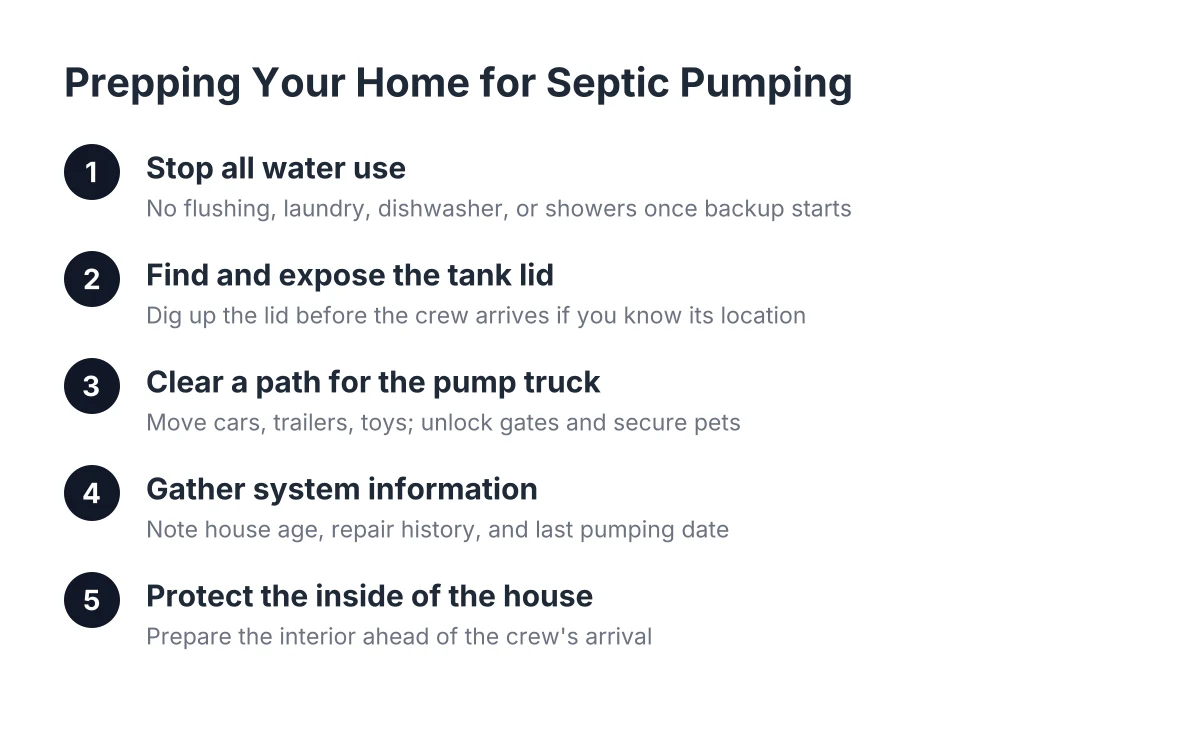
    Find and expose the tank lid if you can

    If you know where the tank is, dig up and expose the lid before the crew arrives, weather and daylight permitting. This is the single most useful thing a homeowner can do. Locating a buried tank can take significant time, and time is the one thing you do not have during a backup.

    Look for these clues if you are not sure where the tank sits:

    • The point where the main sewer line exits the house, usually on the side with the bathrooms. Tanks typically sit at least 10 feet from the building, a minimum distance most local regulations require, according to Minnesota Pollution Control Agency.
    • A rectangle of grass or dirt that looks different from the rest of the yard, greener, browner, or slightly sunken.
    • Old inspection records, a property survey, or a septic permit from the county. If you bought the house recently, check your closing documents.
    • Concrete or plastic lids, risers, or capped pipes sticking a few inches above grade.

    If you cannot find it, say so on the phone. A crew that offers septic tank locating as a service can find it, but knowing in advance changes how they plan the visit. Do not dig blindly with heavy equipment; hand tools and a probe are safer around buried pipes.

    Clear a path for the pump truck

    Next, think about the truck. A pump truck is large and heavy, and its hoses only reach so far. Walk your driveway and yard and clear anything in the way: parked cars, trailers, trash cans, kids' toys, and low-hanging branches over the driveway.

    In addition, unlock any gates between the street and the tank. If the tank sits behind a fence, measure or estimate the distance from where the truck can park to the tank lid, and mention it when you call. Long hose runs are usually workable, but the crew wants to know before they arrive, not after.

    For landlords, this step often means coordinating with a tenant. Ask them to move vehicles, secure dogs, and leave the side gate open. A dog in the yard is one of the most common reasons a crew has to wait at the curb.

    Gather what you know about the system

    While you wait, write down everything you know about the septic system. Crews handling an emergency call want the same background a company would gather before any inspection: the age of the house, any repair history, when the tank was last pumped, and whether the property sits on high ground or in a low spot.

    For example, "three-bedroom house built in the 1980s, tank is somewhere in the front yard, no idea when it was last pumped, we bought it two years ago" is genuinely useful. It tells the crew to expect a heavy sludge load and to budget time for locating. Most emergency backup calls trace back to a tank that went unpumped far past its service interval, so an honest "I don't know" is more helpful than a guess.

    If your system has an alarm panel, note what the lights show and whether the alarm is audible or silenced. On pump-equipped systems, technicians typically check the pump, alarm lights, and alarm sound before pumping anything out, so that information helps them plan.

    Protect the inside of the house

    Meanwhile, deal with what is happening indoors. Move rugs, boxes, and anything absorbent away from floor drains, tubs, and the lowest toilets. If sewage has already surfaced, block off the room from kids and pets and ventilate it.

    Keep water use at zero until the tank is pumped. As a temporary measure between the backup and the truck's arrival, some homeowners on pump systems use a utility pump and hose to lower the tank level while repairs are arranged. That is a stopgap, not a fix, and it only applies if you can safely access the tank; when in doubt, wait for the professionals.

    What the Crew Does When They Arrive

    A typical emergency pumping visit follows a predictable order: confirm the tank location, open the lid, assess the levels, pump, and then check what caused the backup. Knowing the sequence keeps the visit calm instead of chaotic, which is the whole point of preparing.

    Suppose a Hesperia landlord gets a Saturday night call from a tenant about a shower drain full of gray water. In that scenario, a prepared owner has already told the tenant to stop water use, texted the crew a photo of the exposed lid from last year's service, and unlocked the gate remotely. The truck arrives, hooks up, and pumps. An unprepared owner in the same situation might spend the first hour on the phone trying to figure out where the tank even is.

    After pumping, the crew looks at what the tank tells them. Heavy sludge and scum layers point to a long-overdue pumping. Water flowing back into the tank from the drain field side points to a drain field problem, which pumping alone will not fix. High water with a working outlet may point to a clogged inlet line. This is where an honest local operator matters; you want a plain explanation of what they saw, not a scare pitch.

    One trade-off worth naming: emergency septic service after hours usually costs more than a scheduled daytime visit, and pumping a tank does not repair a failed drain field or a broken pump. If the crew finds a bigger problem, get the findings in writing and take a breath before authorizing major work. A second opinion on a repair quote is reasonable, and a trustworthy crew will not punish you for asking.

    Preparing Rental Properties Before an Emergency Ever Happens

    Landlords can prepare their rental homes for a septic emergency long before one happens, and the payoff is measured in shorter vacancies and calmer tenant calls. If you own one to five septic-served rentals around Hesperia, a small amount of file-building now saves hours during a crisis.

    Keep a simple septic file for each property with:

    • A sketch or photo showing where the tank and lids sit, ideally taken while the lid was exposed during pumping operations.
    • Dates of past pumpings and copies of invoices, which also help at sale time or during a pre-lease inspection.
    • Gate codes, dog information, and the tenant's preferred contact method.
    • Notes on the system type, especially if it has a pump, alarm, or other mechanical parts.

    Also, brief your tenants. A one-page sheet telling them to stop water use and call you at the first sign of slow drains can turn a full backup into a minor incident. Tenants often run the dishwasher and two more loads of laundry after the first gurgle because nobody told them what a septic warning looks like.

    Finally, schedule ahead. The U.S. Environmental Protection Agency recommends a professional inspection at least once every three years for a standard system, and once a year for systems with pumps, float switches, or other mechanical components. Penn State Extension notes that an active family of four generally does well with pumping every two to three years, a reasonable planning baseline for a family-occupied rental. If the unit has a garbage disposal, expect more sludge; the Massachusetts Department of Environmental Protection recommends annual pumping for households with disposals.

    What Emergency Pumping Costs Compared to Waiting

    Routine septic tank pumping is the cheap option; the emergency it prevents is the expensive one. According to Angi, septic tank pumping averages $427, with a range of $250 to $1,250 or more depending on tank size and location. After-hours emergency work generally runs higher than a scheduled visit, and cleanup of sewage inside a home adds its own costs.

    By contrast, the EPA estimates septic repair or replacement typically costs between $5,000 and $15,000. That gap is the entire argument for maintenance. Regular pumping is the single most important thing an owner can do to extend the life of a septic system, and it is the difference between a planned $400 line item and a five-figure surprise.

    As of 2026, that math has not changed for High Desert properties. A backup that soaks a rental's flooring can also mean lost rent during cleanup and repairs, which often costs a small landlord more than the septic work itself.

    Prepare Your Home Now So the Emergency Never Owns You

    The best time to prepare your home for a septic emergency is a normal Tuesday when nothing is wrong. Find the tank, photograph the lid location, save a local septic number in your phone, and put the next pumping on the calendar. If you just bought a house in Hesperia and have no idea when the tank was last serviced, treat that unknown as your trigger; a pumping now resets the clock and shows the crew exactly where everything sits.

    None of this replaces professional judgment. If sewage is entering living space, if the ground over the tank is soggy, or if the alarm keeps returning after a pump-down, bring in a septic professional rather than improvising. However, the homeowner who has cleared the gate, exposed the lid, and stopped the water is the one whose emergency ends the same night it started.

    If you need your septic tank serviced, Hesperia Septic can help.

    Prefer to talk it through? Call (760) 249-7872 — a quick call is usually the fastest way to get a straight answer for your situation.

    Related Reading

  • Septic Tank Lid Replacement Terms Explained: A Plain-English Glossary

    septic tank lid replacement glossary

    If you own a home in Hesperia and a contractor just told you your tank lid is cracked, this septic tank lid replacement glossary is for you. It explains the words you will see on quotes, inspection reports, and service calls in plain English. Use it to understand what a provider means, ask sharper questions, and spot a problem before it turns into a septic backup. No entry takes more than thirty seconds to read.

    • Septic Tank Lid: the cover over your tank's opening
    • Riser: a pipe that brings the lid to ground level
    • Access Port: the opening the lid covers
    • Concrete Lid: the heavy traditional cover
    • Polyethylene (Plastic) Lid: the lighter modern cover
    • Safety Lid or Locking Lid: a lid that resists being opened by kids
    • Gasket or Lid Seal: the seal that keeps gases in and water out
    • Septic Tank Locating: finding where your tank and lid sit underground
    • Excavation: digging down to reach a buried lid
    • Septic Tank Pumping: emptying the tank with a vacuum truck
    • Septic System Inspection: a check of the tank, lids, and parts
    • Baffle: the fitting inside the tank that directs flow
    • Effluent: the liquid that leaves the tank
    • Drain Field: the underground area that absorbs treated water
    • Scum and Sludge Layers: the waste layers pumpers measure
    • Service Quote or Scope of Work: the written list of what you are paying for

    Septic Tank Lid Replacement: Parts and Hardware Glossary

    These are the words you will hear most often during a septic tank lid replacement, from the cover itself to the seal that keeps it tight. This part of the septic tank lid replacement glossary covers the hardware.

    Septic Tank Lid

    A septic tank lid is the removable cover that closes off the opening on top of your septic tank. It keeps people, pets, and debris out of the tank and keeps sewer gases in. Lids crack from age, vehicle traffic, or careless digging, and a damaged lid is a safety hazard because a person can fall through it. If a provider says your lid needs replacing, they mean the cover itself, not the whole tank.

    Riser

    A riser is a wide pipe that extends from the tank opening up to ground level, so the lid sits at or near the surface. Without a riser, the lid may be buried a foot or more underground, and every service visit starts with digging. Adding a riser during a lid replacement costs more up front but makes future septic tank pumping faster and cheaper because no excavation is needed. Many homeowners add one the first time a crew has to dig.

    Access Port

    An access port is the opening in the top of the septic tank that the lid covers. Most tanks have one or two ports, one over each compartment, and a pumper needs to open at least one to empty the tank. If an inspector says a port is inaccessible, it means something is blocking it, such as a deck, concrete, or landscaping. Knowing how many ports your tank has tells you how many lids you may eventually replace.

    Concrete Lid

    A concrete lid is the traditional heavy cover found on older septic tanks, often weighing enough that one person cannot lift it safely. Concrete lasts for decades but eventually cracks, spalls, or crumbles at the edges. A cracked concrete lid should be replaced rather than patched, because a patch can hide how weak the rest of the slab has become. If your home is older, expect this to be the type you have.

    Polyethylene (Plastic) Lid

    A polyethylene lid is a modern septic cover made of heavy-duty plastic, usually paired with a riser of the same material. It is light enough for one person to handle, resists cracking, and often includes screw-down fasteners. Providers frequently suggest swapping a broken concrete lid for a plastic riser-and-lid kit. The lighter lid also makes routine septic tank pumping simpler for whoever services the tank next.

    Safety Lid or Locking Lid

    A safety lid is a septic cover designed with locks, screws, or safety nets so children and animals cannot open it or fall in. Falls into septic tanks are rare but can be fatal, which is why many areas expect secure lids; check your local code. If a provider quotes a safety lid, they are addressing a real risk, not padding the bill. Ask how the lid secures and whether you can still open it for service.

    Gasket or Lid Seal

    A gasket is the rubber or foam seal between the lid and the riser or tank opening. A good seal keeps sewer gas from escaping and keeps rainwater and soil from getting into the tank. If you smell septic odors in your yard near the lid, a failed seal is one of the first things to check. Replacing a gasket is a small job, but a badly warped lid may need full replacement to seal again.

    Finding and Opening the Tank: Septic Tank Lid Replacement Glossary Terms

    Before anyone can replace a lid, they have to find it and get to it. These terms describe that work.

    Septic Tank Locating

    Septic tank locating is the process of finding where your tank, lids, and access ports sit underground. Crews use property records, probing rods, or electronic locators to pinpoint the spot without tearing up the whole yard. If you bought your Hesperia home without septic paperwork, locating is often the first line on a quote. Once the tank is found, mark the spot so you never pay to find it twice.

    Excavation

    Excavation means digging down through soil to expose a buried septic lid or tank top. It can be hand digging for a shallow lid or machine work for a deep one, and depth drives the labor involved. A quote that includes excavation tells you your lid is buried and there is no riser. This is the moment many homeowners choose to add a riser so the digging never happens again.

    Septic System Inspection

    A septic system inspection is a check of the tank, lids, baffles, and liquid levels to judge the system's condition. Inspectors open the lids, so a cracked or stuck lid often gets discovered during an inspection rather than by the homeowner. Buyers ordering an inspection before a home sale should ask the inspector to note lid condition specifically. A bad lid found now is a cheap fix compared to one found after someone steps on it.

    Inside the Tank

    You do not need to be an expert on what happens under the lid, but these terms come up on almost every service report.

    Septic Tank Pumping

    Septic tank pumping is the removal of the waste inside your tank using a vacuum truck. The crew opens the lid, lowers a hose, and empties the solids and liquid so the tank can keep working. Pumping is when most lid problems get found, because it is the one time the lid comes off. If a pumper says your lid crumbled during removal, that is normal wear on old concrete, not carelessness.

    Baffle

    A baffle is a fitting inside the septic tank that directs incoming and outgoing flow so solids stay in the tank. The outlet baffle matters most, because it keeps sludge from washing out to the drain field and clogging it. Inspectors check baffles through the access port whenever the lid is off. A missing or broken baffle is a separate repair from the lid, so read your quote line by line.

    Effluent

    Effluent is the liquid that flows out of the septic tank after solids settle to the bottom. It travels to the drain field, where the soil filters it. The word sounds technical, but it just means the partly treated wastewater leaving your tank. If a report says effluent levels are high, the tank may be overdue for septic tank pumping or the drain field may be struggling.

    Drain Field

    A drain field is the network of buried pipes and gravel or soil that absorbs and filters the liquid leaving your septic tank. It is the most expensive part of the system to replace, which is why protecting it matters. A failing drain field shows up as soggy grass, odors, or slow drains all over the house. Lid work does not touch the drain field, so a lid quote should not include drain field repairs unless a problem was found.

    Scum and Sludge Layers

    Scum and sludge layers are the two waste layers inside a septic tank: scum floats on top, and sludge settles on the bottom. Pumpers measure both to decide whether the tank needs emptying. Thick layers mean the tank is overdue for service, and letting them build up can push solids into the drain field. These measurements only happen when the lid is open, which is one more reason a working lid matters.

    Pricing and Paperwork

    Service Quote or Scope of Work

    A service quote, sometimes called a scope of work, is the written list of exactly what a provider will do and what each part costs. For lid work, a clear quote separates locating, excavation, the lid or riser parts, and labor. Vague one-line quotes make it hard to compare providers or question a charge. Ask for the scope in writing before the truck arrives, and ask what happens if the crew finds more damage once the lid is off.

    Using These Terms

    What this septic tank lid replacement glossary gives you is the ability to read a quote line by line and know what each charge covers. You can now ask a provider whether the price includes locating, excavation, or a riser, and understand the answer. That is usually all it takes to feel in control of the job instead of confused by it.

    If you need your septic tank serviced, Hesperia Septic can help.

    Prefer to talk it through? Call (760) 249-7872 — a quick call is usually the fastest way to get a straight answer for your situation.
    Related Reading

  • 7 Common Septic System Failures That Go Wrong Fast (and What to Do First)

    Sequence diagram of common septic system failure signs from overfull tank to sewage backup
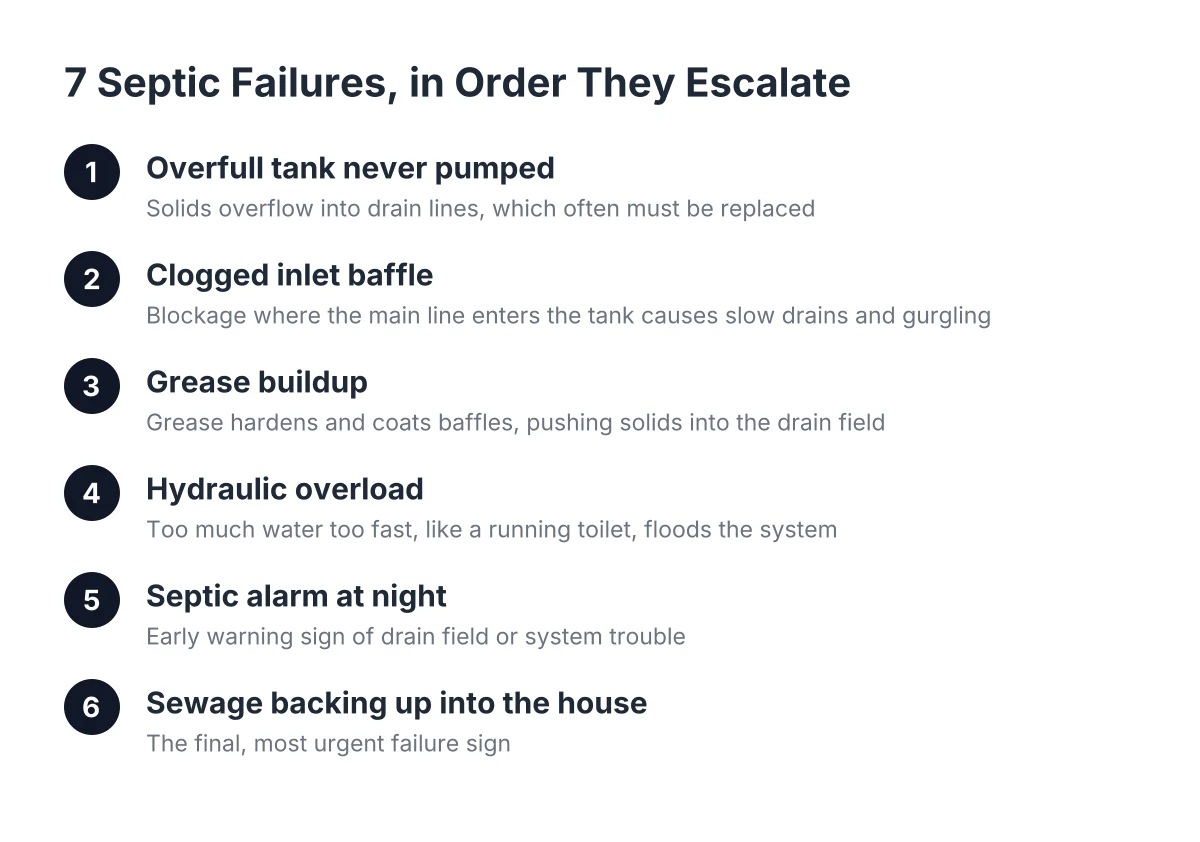
    The seven common septic system failure signs covered in this guide, roughly in the order a local crew sees them.

    Sewage in the shower drain does not schedule an appointment. When it happens, it happens at 9 p.m. on a Sunday, and the homeowner is standing in the hallway wondering who answers the phone at that hour. The truth behind most of these emergencies is less dramatic than it feels in the moment. Common septic system failure signs follow a predictable list, and almost every one of them starts small and cheap before it turns urgent and expensive. Understanding the signs of septic system failure helps you catch problems early. This article walks through the seven failures that go wrong fast, what each one looks like from inside the house, and what to do in the first hour.

    Here is the part worth holding onto: septic systems rarely fail without warning. They fail without anyone noticing the warning. If you know what the early signs look like, you can catch nearly all of these problems while they are still a service call instead of a dig-up.

    Why Common Septic System Failures Feel Sudden but Rarely Are

    A septic backup feels like it came out of nowhere. In most cases, it did not. The tank fills with solids over months and years, drains slow down gradually, and odors come and go until one day the system has no room left and wastewater takes the only exit available, which is back up your pipes.

    A conventional septic system has two main components, the septic tank and the drain field, according to the U.S. Environmental Protection Agency. The tank separates solids from liquid; the drain field disperses the clarified liquid into the soil. Almost every failure on the list below comes down to one of those two parts getting overloaded, clogged, or ignored.

    With that in mind, here are the seven common septic system failures that turn into after-hours phone calls, roughly in the order a local crew sees them.

    1. The Overfull Tank That Nobody Pumped

    The single most common cause of septic system failure is the simplest one: the tank was never pumped, or nobody knows when it last was. Solids build up until they overflow into the drain lines, and once those lines clog with solids, they usually cannot be cleaned out; they have to be replaced. That is the moment a routine septic tank pumping visit becomes a five-figure repair.

    This is why the question "how often should the tank be pumped" matters more than any other on this list. For an active family of four, pumping every two to three years is generally advisable because of the higher volume of solids and water the household produces, according to Penn State Extension. A family of two produces less, so the interval can stretch longer, but the honest answer depends on tank size and habits, which is exactly what an inspection tells you.

    Suppose a homeowner in Hesperia bought their house three years ago and the seller "thought" the tank was pumped before closing. Nothing is wrong yet, drains work fine, no smell in the yard. That homeowner is the ideal candidate for a pump-out and inspection now, because the alternative is finding out the hard way that the seller guessed wrong.

    2. A Clogged Inlet Baffle Blocking the Line Into the Tank

    Sometimes the tank itself is fine and the blockage sits right at the front door. The inlet baffle is the fitting where your home's main line enters the tank, and a clogged inlet baffle is a common cause of septic backups, according to the Washington State Department of Health. It should be one of the first things checked when the line into the tank is blocked.

    From inside the house, this looks identical to a full tank: slow drains, gurgling toilets, and eventually a backup at the lowest fixture. The good news is that a baffle clog is often a fast fix once the tank lid is open. The bad news is that homeowners cannot diagnose it from the bathroom, which is why the first call should be to a septic crew, not a snake-and-hope attempt that pushes the clog deeper.

    3. Grease Building Up Until the System Chokes

    Grease is the quiet killer of septic systems and commercial grease traps alike. It goes down the drain warm and liquid, then cools and hardens in the tank and lines. Over time it coats baffles, plugs filters, and forms a scum layer thick enough to push solids into the drain field. Recognizing early septic system failure signs, including unexpected grease buildup, prevents costly repairs down the road.

    For homeowners, the fix is behavioral: pour grease into a can, not the sink. For restaurants and small commercial kitchens in the High Desert, the stakes are higher because a choked grease trap can shut down service during a dinner rush and put health code compliance at risk. Recurring grease trap pumping on a set schedule is what keeps a single-location kitchen off the emergency list.

    4. Hydraulic Overload: Too Much Water, Too Fast

    A septic system can only absorb so much water per day, and flooding it counts as a failure mode even when nothing is broken. Back-to-back laundry loads, long guest weekends, and leaking fixtures all push the tank past its working volume, which forces water out before solids have settled.

    The sneakiest version is a leak you cannot hear. A single running toilet can send as much as 200 gallons of extra water per day into a septic system, according to the U.S. Environmental Protection Agency. That is a small lake pushed through your drain field every week, and the field will eventually stop absorbing it.

    If drains slow down only after heavy water use and recover overnight, hydraulic overload is the likely suspect. Spread out laundry, fix running toilets, and if the symptom persists, have the tank levels checked.

    Early Warnings and Drain Field Septic System Failure Signs

    The drain field is the expensive half of the system, and drain field failure is what people usually mean when they ask what a failed septic system means. The soil stops accepting water, so wastewater either surfaces in the yard as soggy, foul-smelling patches or backs up toward the house. Once a field is saturated with solids, pumping the tank buys time but does not fix the field.

    Cost is the reason this failure deserves respect. The EPA estimates septic repair or replacement typically runs $5,000 to $15,000, far more than routine pumping, according to the U.S. Environmental Protection Agency. Soil matters too; a percolation test has to confirm how well the ground drains before a new system goes in, according to University of Nebraska-Lincoln Extension, and High Desert soil does not always cooperate.

    Watch for grass that is greener over the field than anywhere else in the yard, standing water with a sewage smell, or squishy ground in dry weather. Any of those signs means stop adding water and get a professional look before it becomes a replacement conversation.

    6. The Septic Alarm Going Off at Night

    If your system has a pump, floats, or other mechanical parts, it likely has an alarm, and that alarm going off is the system telling you the water level is too high or a component quit. It is not an instant catastrophe, but it is a countdown. Most systems have some reserve capacity, so the immediate move is to cut water use to near zero and make the call.

    Broken floats and failed pumps are maintenance items, not mysteries. The U.S. Environmental Protection Agency recommends that alternative systems with electrical float switches, pumps, or mechanical components be inspected once a year, compared with at least once every three years for a standard system. An annual check is what keeps the alarm from ever sounding at 2 a.m.

    Here is a realistic scenario: say the alarm sounds on a Friday evening in Hesperia. The household stops laundry and dishes, limits flushes, and calls for emergency septic service that night. In that scenario, a crew that answers after hours can pump the tank down, check the floats, and turn a weekend disaster into a Saturday morning repair.

    7. Sewage Actively Backing Up Into the House

    This is the failure everyone fears, and it is where the first six items end up if they go unhandled. When sewage backs up into tubs, showers, or floor drains, the system has no capacity left at all. What you do in the first hour matters.

    • Stop all water use immediately. Every flush and every load of laundry adds to what is coming back.
    • Keep people and pets away from any wastewater inside or outside; treat it as contaminated.
    • Do not run chemical drain cleaners or additives. There is no product to put in a septic tank that breaks down solids fast enough to stop an active backup, and harsh chemicals can kill the bacteria the tank depends on.
    • Call a local septic crew, not a general plumber, and describe what you see: which fixtures backed up, any yard odors, and whether an alarm is sounding.

    Pumping the tank relieves the pressure and stops the backup in most cases. What happens to that waste afterward is regulated; pumped septic waste is trucked to a sewage treatment plant for disposal rather than handled on site, according to the New Hampshire Department of Environmental Services.

    Staying Off the Emergency List in 2026

    More than one in five U.S. households depend on individual septic systems or small community cluster systems to treat their wastewater, according to the U.S. Environmental Protection Agency, and most of those households never have a backup. The difference is not luck. It is a known pumping date, a working record of the system, and attention to the small signs: slow drains, gurgles, and odors.

    If you do not know when your tank was last pumped, that is your starting point for 2026. Schedule a pump-out and inspection, write down the date and tank location, and set the next interval based on what the crew finds. One honest limitation is worth stating: no article can diagnose your specific system, and anything involving a suspected drain field problem, a repeated backup, or system design belongs with a licensed professional who can open the tank and look. The list of common septic system failures is short. Staying off it is mostly a matter of not letting item number one happen to you.

    If you need your septic tank serviced, Hesperia Septic can help.

    Prefer to talk it through? Call (760) 249-7872 — a quick call is usually the fastest way to get a straight answer for your situation.
    Related Reading

  • How a Septic Maintenance Schedule Prevents Emergency Backups in Hesperia, CA

    Cost range chart comparing septic tank pumping to drain field repair costs
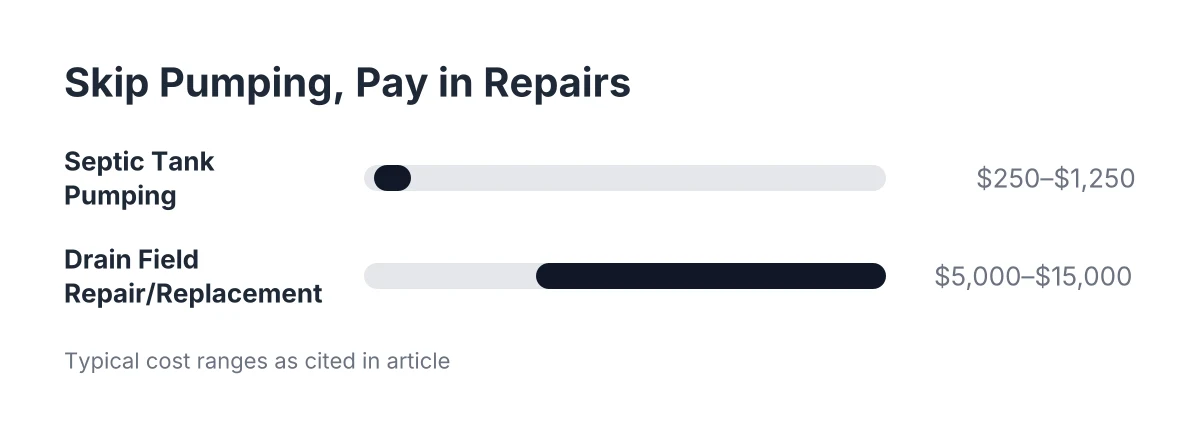
    Routine pumping costs far less than the drain field repairs that follow a neglected septic system, as this guide explains.

    If sewage is backing up right now, stop running water, keep everyone away from the affected drains, and call a local septic crew. That is the short answer for a crisis. The longer answer, and the one that matters more once the mess is cleaned up, is that a real septic maintenance schedule prevents most of these emergencies from ever happening. Most late-night backup calls trace back to a tank that went years past its pumping interval, not to bad luck. This guide covers both sides: what to do tonight if your system is failing, and how to set up a schedule so you are not making that call again.

    This is written for two kinds of readers in Hesperia. The first is a homeowner who just watched a drain back up. The second is a landlord, restaurant manager, or property owner who got the call from a tenant or a health inspector and needs the problem handled without being on-site. Both end up in the same place: a plan that keeps the tank pumped before it fails.

    What to Do Right Now if Sewage Is Backing Up

    If sewage is actively backing up into a house or building on a septic system, the first move is to stop adding water. Every flush, load of laundry, or running faucet pushes more wastewater into a tank that has nowhere to put it. Cutting water use buys you time and limits the damage while help is on the way.

    Here is the order of operations while you wait for a crew:

    1. Stop all water use in the building. No flushing, no showers, no dishwasher, no laundry.
    2. Keep people and pets away from any standing sewage, indoors or in the yard. Raw sewage carries bacteria and is a health hazard.
    3. If the backup is indoors, open windows for ventilation and move anything salvageable out of the affected area.
    4. Do not open the septic tank lid yourself. Tank gases are dangerous, and an open tank is a fall hazard.
    5. Note what you saw and when: which drains backed up first, any gurgling, any smell outside, whether an alarm is sounding.
    6. Call a local septic company and describe exactly what is happening.

    That last step matters more than most people expect. A crew that knows you have sewage in a hall bathroom, a gurgling floor drain, and a wet patch over the tank can show up with the right expectations. Vague calls get slower, messier visits.

    One honest caveat: not every backup is the septic system. A clog in the line between the house and the tank can look identical from inside the building. A clogged inlet baffle is a common cause of septic backups and one of the first things to check when a line into the tank is blocked, according to the Washington State Department of Health. Additionally, a professional can tell the difference on-site; guessing from the bathroom cannot.

    Why the Septic Alarm Is Going Off, and What It Means

    A septic alarm going off means the water level in your tank or pump chamber is higher than it should be. It does not mean sewage is about to erupt in the next five minutes, but it does mean the system needs attention soon, usually within a day. Treat it as a warning shot, not a false alarm.

    First, silence the alarm if there is a silence button, but do not disconnect power to the system. Then cut back water use hard, the same as you would in an active backup. In many cases the high level came from a surge: a houseful of guests, back-to-back laundry loads, or a fixture leak. According to the U.S. Environmental Protection Agency, a single leaky or running toilet can push as much as 200 gallons of extra water per day into a septic system. That alone can trip an alarm on a system that was otherwise fine.

    However, if the alarm keeps sounding after you have cut water use for several hours, assume something failed: a pump, a float switch, or a tank that is simply full. Systems with pumps and float switches need more attention than gravity systems in general. The EPA recommends that alternative systems with electrical floats, pumps, or mechanical components be inspected about once a year, compared with at least once every three years for a standard system.

    How to Build a Septic Maintenance Schedule and Prevent Emergencies

    A septic maintenance schedule prevents emergencies by removing the root cause before it becomes a crisis. Backups almost never come out of nowhere. Sludge settles at the bottom of the tank and scum floats at the top, year after year. When those layers get thick enough, solids push into the outlet and toward the drain field, and the system stops accepting water. The backup you see on a Saturday night was building for years.

    A conventional system has two main parts, the septic tank and the drain field, as the U.S. Environmental Protection Agency describes it. The tank exists to hold solids back so only liquid moves on to the drain field. Once solids escape the tank, the drain field starts to clog, and that is the failure that gets expensive. Pumping on schedule is what keeps solids where they belong.

    The math is lopsided. According to Angi data, septic tank pumping averages $427, with a typical range of $250 to $1,250 depending on tank size and location. Compare that with what happens when a drain field fails: the EPA estimates septic repair or replacement typically runs $5,000 to $15,000. A maintenance schedule is the cheapest insurance a septic owner can buy, and it is not close.

    There is also a compounding effect that owners rarely see coming. A neglected system does not just risk one big failure. It burns through filters and pumps faster, needs pump-outs more often once problems start, and turns every small issue into a service call. Regular pumping and periodic professional inspection beat additives and quick fixes every time; the tank is a biological system, and there is no product you pour down a drain that removes accumulated sludge.

    What a Realistic Schedule Looks Like

    The EPA baseline is a professional inspection at least once every three years for a standard household system. Pumping frequency depends on tank size, household size, and water habits. Penn State Extension notes that an active family of four generally does well pumping every two to three years because of the higher volume of solids and wastewater they produce. A retired couple in the same house might stretch that interval; a rental with six tenants might shorten it.

    For Hesperia properties, a workable 2026 schedule looks like this:

    • Standard residential system: professional inspection every three years at minimum, pumping on the interval your pumper recommends based on measured sludge levels.
    • Busy household of four or more: plan on pumping roughly every two to three years, per the Penn State Extension guidance.
    • System with a pump, float switch, or aerobic components: annual inspection, per EPA guidance, plus whatever the maintenance agreement on an advanced treatment system requires. If your system came with a service contract, follow it.
    • Rental property: inspection when tenants turn over, plus the regular pumping interval. Tenants rarely report early warning signs.
    • Commercial grease trap: pumping on the interval your health inspector expects, tracked in writing.

    The honest trade-off is that a schedule means paying for service when nothing is visibly wrong. That is exactly the point. Septic problems develop gradually and silently; by the time you can see or smell one, the cheap fix window has usually closed.

    The Warning Signs a Schedule Catches Early

    Between scheduled visits, certain symptoms mean the system is asking for help. None of them are emergencies yet, and that is the value of catching them now instead of in six months.

    • Drains throughout the building run slow, not just one fixture.
    • Gurgling from toilets or drains when other fixtures run.
    • Sewage odor in the yard, near the tank, or inside the building.
    • Unusually green or soggy grass over the drain field.
    • Standing water or wet soil near the tank lids.
    • Any septic alarm activation, even one that stops on its own.

    For example, one slow bathroom sink is probably a hair clog. Every drain in the house running slow at the same time points at the tank or the line to it. That distinction is worth remembering because it determines whether you need a drain snake or septic tank pumping.

    When a scheduled inspection catches a rising sludge level or a worn baffle, the fix is a routine visit at a routine price. When a backup catches it for you, the fix involves after-hours rates, cleanup, and sometimes a drain field that took damage. The whole argument for maintenance fits in that comparison.

    Landlords, Restaurants, and RV Owners: Scheduled Service Without Babysitting It

    Non-residential septic service runs on the same principle as residential: a schedule prevents the fire drill. The difference is that landlords, restaurant managers, and RV owners usually cannot be on-site, and the consequences of a failure include health code citations and habitability complaints, not just a bad weekend.

    Suppose you manage a rental in Hesperia and a tenant texts about a sewage smell in the yard. Without a service history, you are starting from zero: no idea where the tank is, when it was last pumped, or whether this is a full tank or a failing drain field. With a pumping record and a known tank location, one phone call gets a crew out, and you handle the whole thing remotely. That is the practical payoff of a schedule for an owner who is not on the property.

    Restaurants and commercial kitchens carry an extra layer. A grease trap that misses its pumping interval does not just risk a backup; it risks an inspector flagging it. Keeping grease trap pumping on a fixed calendar, with dated service records, turns a compliance risk into a filing task. Ask your pumper for documentation of each visit, since proof of proper waste handling is what an inspector or a lawyer will eventually want to see.

    RV and holding tank owners in the High Desert face a simpler version of the same problem: a holding tank has no drain field, so it fills on a predictable clock. Scheduling a pump-out before a trip, or on a set interval for a cabin, beats discovering a full tank when guests arrive. The pattern is identical across all of these cases. One local crew, one recurring schedule, no fire drills.

    When It Fails Anyway: What Emergency Septic Service Looks Like

    Even well-maintained systems can fail. Tree roots invade lines, baffles crack, pumps burn out, and heavy winter rains can saturate a drain field that was working fine in September. When that happens, emergency septic service exists to stop the immediate problem: a crew comes out, locates and opens the tank, pumps it down to relieve pressure on the system, and assesses what actually failed. Pumping the tank resolves many backups on the spot; if the drain field or a component failed, at least the sewage stops rising while you plan the repair.

    Here is an illustrative scenario. Say a Hesperia homeowner notices the master bathroom toilet gurgling on a Friday, ignores it, and wakes Sunday to sewage in the shower pan. In that scenario, the emergency visit involves after-hours pumping, indoor cleanup, and possibly a follow-up dig to inspect the baffles. Now run the same scenario with a maintenance schedule: an inspection eighteen months earlier flags a sludge layer near the outlet, the tank gets pumped that week, and the Sunday backup never happens. Same house, same system, entirely different weekend and bill.

    There are limits to what any article can diagnose. If your system is backing up repeatedly despite recent pumping, if sewage is surfacing over the drain field, or if you suspect a collapsed line, you need a professional on-site, and possibly an evaluation of the drain field itself. Repeat failures usually mean something structural, and no schedule fixes a broken component.

    Setting Up Your Schedule This Week

    Getting from reactive to scheduled takes one service visit and about twenty minutes of record-keeping. Here is the sequence for a Hesperia property owner starting from scratch in 2026:

    1. Find out where your tank is. If you do not know, a septic company can locate it; many owners of older High Desert properties have never seen their lids.
    2. Get the tank pumped and inspected in the same visit. Ask the crew to note the sludge level, the tank's apparent condition, and anything that needs attention.
    3. Write down the date, what was done, and the recommended interval. Keep it with your home or property records.
    4. Put the next inspection on your calendar now. Three years out for a standard system, one year for anything with a pump or floats.
    5. Fix water leaks promptly. A running toilet quietly overloads the tank, and it shortens every interval you just set.
    6. For rentals and commercial properties, tell your pumper you want recurring service, so the reminder comes from them, not from a tenant complaint.

    None of this is complicated, which is why it is easy to postpone. A septic maintenance schedule prevents the two outcomes every septic owner dreads: sewage in the building, and a five-figure drain field replacement. The system under your yard fails slowly and then suddenly. A calendar reminder and a pumping visit every few years is what keeps the sudden part from happening at your property.

    If you need your septic tank serviced, Hesperia Septic can help.

    Prefer to talk it through? Call (760) 249-7872 — a quick call is usually the fastest way to get a straight answer for your situation.
    Related Reading

  • Grease Trap Pumping for Residential Kitchens in Hesperia, CA: Stop Septic Emergencies

    Diagram of steps in residential grease trap pumping kitchen service process
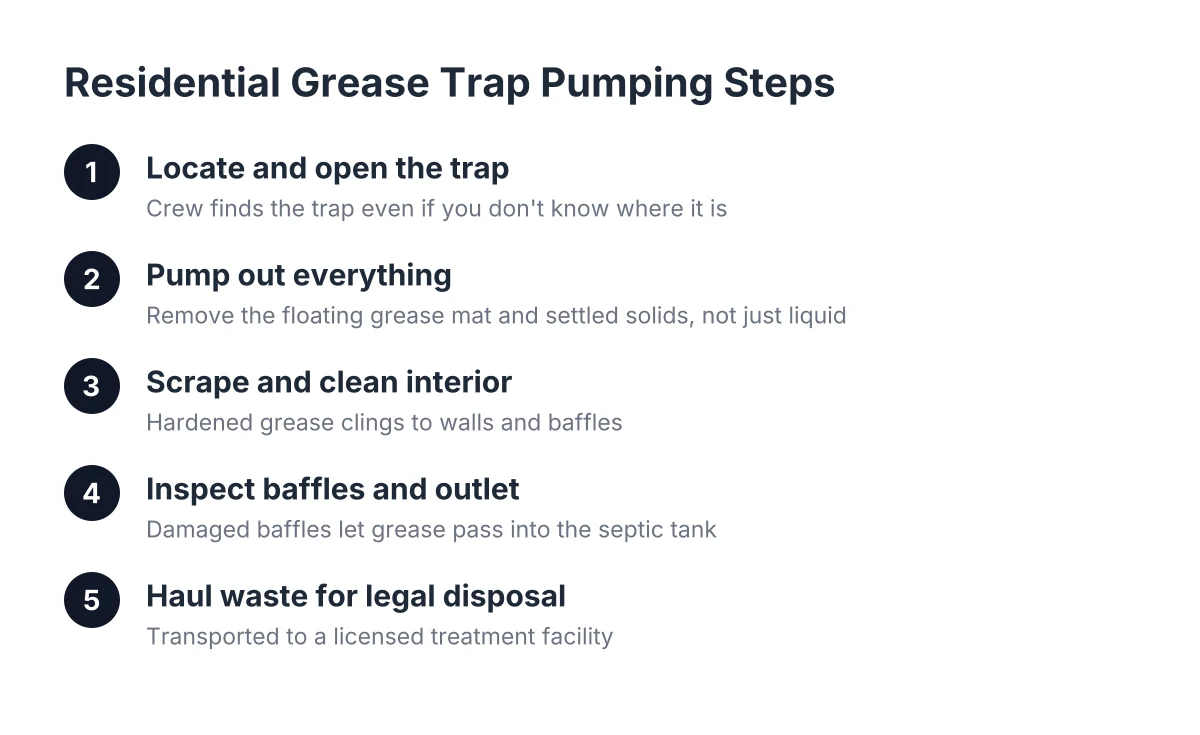
    Here’s what a typical residential grease trap pumping service call involves, step by step.

    Most septic emergencies in Hesperia, CA start in the kitchen. Grease goes down the drain, hardens in the tank or the trap, and months later you have a backup at the worst possible time. That is why grease trap pumping in the kitchen matters more than most property owners realize. Whether you own a home with a heavy-use kitchen, manage a rental with septic, or run a small food operation out here in the High Desert, keeping grease out of your septic system is the single cheapest way to avoid an after-hours crisis. This guide explains how residential grease traps work, when they need pumping, what the service looks like, and how a local Hesperia crew handles the call when things have already gone wrong.

    Why Grease Is the Hidden Cause Behind So Many Septic Backups

    Grease does not dissolve, and it does not flow away. When hot cooking fat goes down the drain, it cools somewhere in your plumbing or your tank and sticks there. Over time it builds into a solid layer that blocks flow and starves your system.

    The scale of the problem is bigger than most people think. According to the U.S. Environmental Protection Agency, grease from restaurants, homes, and industrial sources is the most common cause of reported sewer blockages, responsible for 47% of cases. Nearly half of all blockages trace back to fats, oils, and grease.

    Inside a septic tank, the layers form the same way every time. According to the U.S. Environmental Protection Agency, fats, oils, and grease float to the top and form a scum layer, solids sink to the bottom as sludge, and the liquid in the middle is called effluent. When the scum layer gets thick enough, grease starts escaping into the drain field. Once grease clogs the soil out there, you are no longer talking about a pump-out. You are talking about a repair, and the EPA estimates septic tank repair or replacement typically costs between $5,000 and $15,000. Pumping is cheap by comparison.

    Cutting back on the grease and paper that go down the drain is the most effective way to slow scum buildup and stretch the time between pump-outs. However, once grease is already in the tank or trap, the only fix is physical removal.

    How Grease Trap Pumping in the Kitchen Prevents Septic Failure

    A residential grease trap is a small holding box installed on the kitchen drain line, before wastewater reaches the septic tank. As greasy water flows in, the trap slows it down. The grease cools, floats to the top, and stays behind while the cleaner water continues on to the septic system.

    Think of it as a filter for fats, oils, and grease. The trap can only hold so much. Once it fills past a certain point, grease starts flowing straight through, which defeats the purpose of having one. That is when the trap needs pumping.

    Not every home in Hesperia has a grease trap. They are common in properties with commercial-style kitchens, guest houses, rentals with heavy kitchen use, and small food operations run from a residential property. If you are not sure whether your property has one, a septic inspection can locate it along with your tank. Many owners inherit a trap with a property purchase and never learn it exists until it overflows.

    If your home has no separate trap, your septic tank itself is doing the grease-catching job. That makes regular septic tank pumping even more important, because every pan you rinse adds to the scum layer.

    Warning Signs Your Grease Trap or Septic Tank Is Overloaded

    Grease problems announce themselves before they turn into a full backup. Catch these early and you schedule a routine pump-out. Miss them and you are searching for 24 hour septic service at 11 p.m.

    Watch for these signs at any Hesperia property you own or manage:

    • Kitchen sink drains slower than the rest of the house
    • A rancid or sour smell near the kitchen drain, cleanout, or trap lid
    • Gurgling from the sink when the dishwasher or washing machine runs
    • Water backing up into the sink when nothing is running
    • Standing water or a greasy sheen near the trap or tank lid outside
    • Slow drains across the whole house, which points to the septic tank rather than just the trap

    The last one matters most. In addition to trap problems, whole-house slow drains suggest the septic tank itself is full or the drain field is struggling. Most emergency backup calls happen because a tank went years past its service interval and the sludge and scum layers finally choked off the flow. If drains are slow everywhere and there is an odor in the yard, treat it as urgent.

    For landlords, tenant complaints are your early warning system. Suppose a tenant texts you about a smell near the kitchen and a slow sink. That is worth a service call this week, not a note for next quarter. A pump-out you schedule costs less than the emergency version, and far less than a habitability dispute.

    What Happens During Residential Grease Trap Pumping in the Kitchen

    Residential grease trap pumping is a straightforward service call. A crew arrives with a vacuum truck, opens the trap, removes all the contents, scrapes the hardened grease off the walls and baffles, checks that the trap components are intact, and closes it back up. Most residential traps take under an hour once the lid is open.

    Here is the process step by step:

    1. Locate and open the trap. If you do not know where it is, the crew can find it, the same way they locate a buried septic tank.
    2. Pump out everything, not just the liquid. The floating grease mat and the settled solids are the whole point. Skimming liquid off the top and leaving the grease behind is a bad pump-out.
    3. Scrape and clean the interior. Hardened grease clings to walls and baffles and rebuilds the blockage fast if it stays.
    4. Inspect the baffles and outlet. Damaged baffles let grease pass straight through to your septic tank.
    5. Haul the waste for legal disposal. Grease and septic waste get transported by truck to a licensed treatment facility rather than handled on-site, consistent with how the New Hampshire Department of Environmental Services describes septic disposal.

    That last step matters if you answer to a health inspector or need records for a rental property. Ask the crew for documentation of the service and disposal. A legitimate local operation provides it as a matter of course, and it becomes your paper trail for compliance.

    The same principle applies to septic tank pumping itself. During an inspection, floating globs of kitchen grease in the tank should be scooped out and thrown away, not stirred back into the system. A thorough pump-out removes the sludge at the bottom and the scum at the top, because those solids cause the problems, not the water.

    How Often Does a Residential Grease Trap Need Pumping?

    A residential grease trap needs pumping whenever grease and solids fill about a quarter of its depth, and for most heavy-use kitchens that means a service every few months rather than once a year. Usage drives the schedule. A trap serving a home kitchen that fries often fills faster than one behind a light-use rental.

    There is no single correct interval, so use the trap itself as the guide. Open the lid, or have a crew do it during a septic visit, and look at how thick the grease mat is. If it is approaching a quarter of the trap depth, pump it. Waiting longer lets grease bypass the trap and load your septic tank instead.

    Your habits move the number more than anything else. For example, a household that scrapes pans into the trash and wipes them with a paper towel before rinsing might double the time between pump-outs. A household with a garbage disposal moves the other direction; the Massachusetts Department of Environmental Protection recommends annual septic pumping for homes with disposals regardless of tank size, because disposals push far more solids into the system.

    For the septic tank itself, Penn State Extension advises that an active family of four generally pump every two to three years. Pair the trap schedule with the tank schedule and one local crew can handle both in a single visit, which is the low-effort setup most landlords and small operators want.

    One caution on shortcuts. Additives sold to dissolve grease or sludge lack strong scientific backing, according to research summarized by Washington State University Extension. Money spent on additives is better spent on an actual pump-out.

    What Grease Trap and Septic Pumping Costs in Hesperia, CA

    Costs vary by trap size, tank size, access, and how bad the buildup is, so treat any number here as a general planning figure rather than a quote. For septic tank pumping specifically, Angi data puts the average at $427, with a range of $250 to $1,250 or more depending on tank size and location. Residential grease trap pumping on its own is typically a smaller job than a full tank pump-out, since traps hold far less volume.

    Timing changes the price more than anything else. A pump-out you book in advance costs less than the same truck arriving at midnight. Emergency and same-day service commands a premium in 2026, as it always has, because the crew is dropping everything to get to you. That is the strongest financial argument for a maintenance schedule: the planned version of this service is always the cheap version.

    A word about searching for the cheapest septic tank pumping near me. The lowest bid sometimes means a partial pump-out, where the crew removes liquid and leaves the sludge and scum that actually cause backups. You pay less today and call again in six months. Ask any company you hire whether they remove the full contents, clean the trap or tank walls, and provide disposal documentation. Those three questions separate a real service from a cheap skim.

    For decision-making, weigh the numbers side by side. A few hundred dollars for scheduled pumping, versus the EPA's $5,000 to $15,000 estimate for repair or replacement if grease ruins a drain field. The math is not close.

    When Grease Has Already Caused a Backup: The Emergency Call

    Sometimes you find this article too late, and sewage is already backing up into the house or the septic alarm is going off. Here is what to do in the next ten minutes, before the truck arrives:

    1. Stop using water. Every flush, shower, and dishwasher cycle pushes more wastewater toward the blockage. Shutting off water use is the only reliable way to slow a septic backup temporarily.
    2. Keep people and pets away from any sewage, indoors or in the yard. Raw sewage is a health hazard, not just a mess.
    3. Do not pour anything down the drain. Chemical drain openers do not clear grease blockages in a trap or tank, and they make the tank contents hazardous for the crew.
    4. Call a local septic crew and describe what you see. Slow drains everywhere, sewage at the lowest drain, odor in the yard, alarm sounding. Those details tell the crew what to bring.

    This is where working with a local, septic-focused company in Hesperia pays off. An emergency septic service call gets triaged over the phone: the person answering walks you through shutting down water use, asks where the backup is showing, and gets a truck moving. A national call center reads a script and books you a window. A local crew that answers at night knows the difference between an alarm that can wait until morning and sewage rising in a hall bathroom.

    One honest limitation: pumping fixes a full tank or a loaded trap, but it does not fix everything. If grease has already migrated into and clogged the drain field, or if the tank has a structural problem, you need a diagnosis and possibly a repair specialist. A good pumping crew tells you that on-site instead of pumping the tank and hoping.

    One Local Crew for the Trap, the Tank, and the Rental Down the Road

    If you own or manage more than one drain-dependent property, the goal is to stop treating septic as a fire drill. The properties that never generate 2 a.m. calls are the ones on a schedule.

    Consider an illustrative setup for a Hesperia landlord with a rental on septic plus a small food operation in a converted residential building. In that scenario, one local crew handles grease trap cleaning at the food site every few months, pumps the rental's septic tank on the interval its usage calls for, and keeps disposal records for both. The health inspector gets paperwork, the tenants get working drains, and the owner never has to be on-site for a service visit. A single restaurant can release between 800 and 17,000 pounds of grease into the sewer system each year, according to Wastewater Digest, so even a small food operation generates enough grease to justify a standing schedule rather than reactive calls.

    The same logic scales down to a single home. Residential grease trap pumping and septic tank pumping use the same truck, the same crew, and often the same visit. Combining them costs less than two separate emergencies, and it turns your septic system from a background worry into a line item you handle once every couple of years.

    Grease is patient. It builds up quietly until the night it does not. Getting the trap pumped, keeping fats out of the drain, and putting your tank on a real schedule are the three moves that keep a Hesperia septic system boring. Boring is exactly what you want.

    If you need your septic tank serviced, Hesperia Septic can help.

    Prefer to talk it through? Call (760) 249-7872 — a quick call is usually the fastest way to get a straight answer for your situation.
    Related Reading

  • Emergency Plumber Near Me? For Septic Backups in Hesperia, Call the Right Crew First

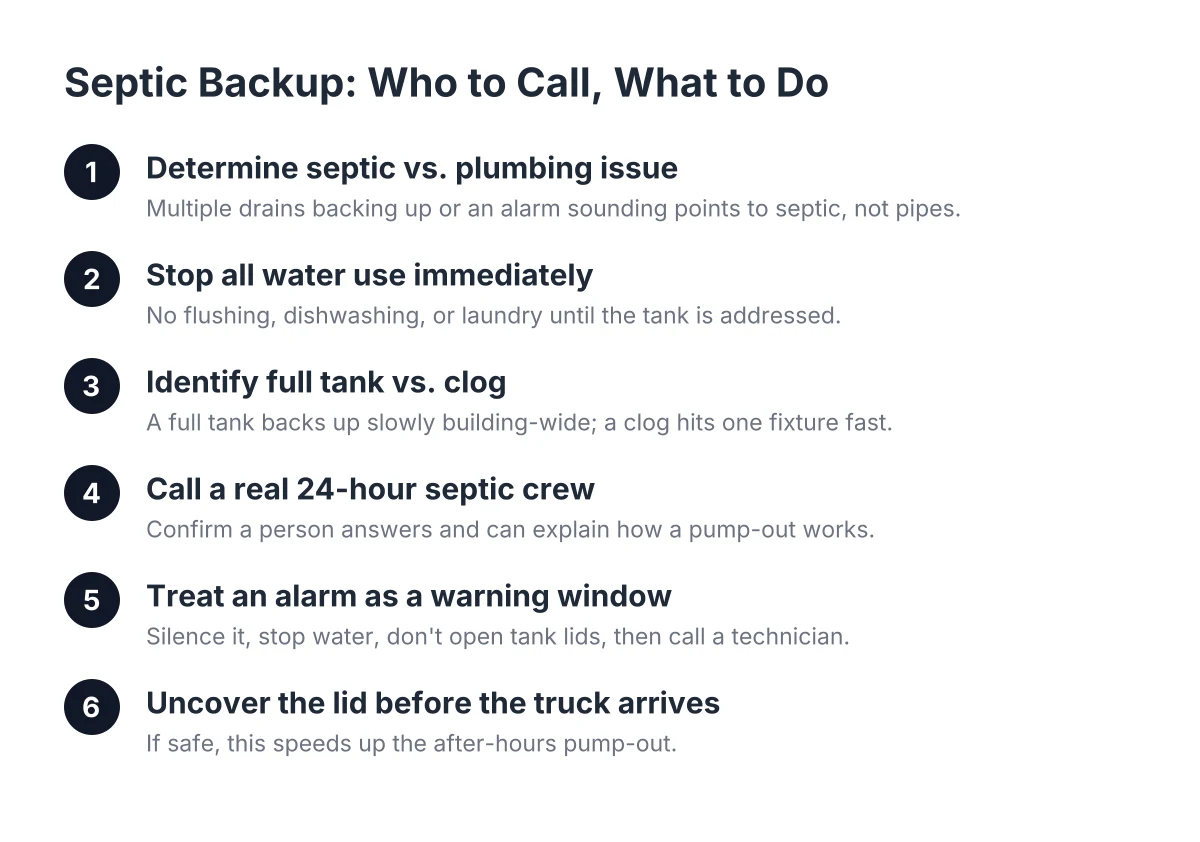
    Steps for handling a septic backup emergency call in Hesperia, from diagnosis to pump-out
    Follow this sequence before making a septic backup emergency call in Hesperia.

    Sewage is backing up, the septic alarm is going off, or a tenant just called about a smell you cannot ignore. The first instinct is to search for an emergency plumber near me and call whoever answers. Here is the problem: if your Hesperia property is on a septic system, a plumber is often the wrong first call. When you need a septic backup emergency call, you need someone trained in septic systems, not just pipes. Plumbers work on the pipes inside the building. A backed-up septic tank sits outside, underground, and no amount of snaking a drain line will empty it.

    This matters even more if you are not a homeowner standing in the mess. Maybe you manage a restaurant and the health inspector flagged your grease trap. Maybe you own a rental in Hesperia and your tenant is texting photos of a backed-up shower at 9 p.m. Maybe you run an RV park and a holding tank is full with guests checked in. In all of those cases, you need someone who answers the phone after hours, tells you what to do right now, and shows up with a pump truck, not just a wrench.

    Below are eight things to know before you make that call. They will save you time, money, and at least one wrong dispatch.

    1. When to Call for a Septic Backup Emergency vs. Regular Plumbing

    The fastest way to waste an after-hours service fee is to send the wrong trade. If the property is on septic, and much of Hesperia and the High Desert is, a septic service should diagnose the problem first. A plumber only enters the picture if the issue turns out to be inside the building's own plumbing.

    Here is a quick way to sort it:

    • Multiple drains slow or backing up at once: likely the septic tank or the line to it. Call a septic crew.
    • One fixture clogged, everything else fine: likely an interior pipe problem. A plumber can handle that.
    • Septic alarm sounding or a red light on the control panel: septic system, full stop. Stop water use and call a septic technician.
    • Sewage or standing water over the tank or drain field: septic. Do not let anyone walk through it.

    Therefore, before you dial anyone, tell them the property is on a septic system. That one sentence changes the whole diagnostic approach, and a good dispatcher will route you correctly from the first call.

    2. Stop the water before you stop anything else

    A septic backup is driven by water going into a tank that has nowhere to put it. The single most effective thing you can do in the first five minutes costs nothing: stop adding water. No flushing, no dishwashing, no laundry, no running the bar sink.

    For a business, that means telling staff immediately. Suppose you run a small commercial kitchen in Hesperia and the floor drain starts gurgling during dinner service. In that scenario, the move is to pull the dish pit offline, switch to disposables where you can, and keep every drop of water out of the drain until the tank is pumped. That buys you hours instead of minutes.

    For a rental, call the tenant and give them the same instruction. It is the only temporary fix that reliably works. Additives, plunging, and hot water flushes do not empty a full tank; only septic tank pumping does.

    3. Full or clogged? The answer changes who you call

    Wondering whether your septic tank is full or clogged is the right question, because the fix is different for each. A full tank backs up slowly and affects the whole building; the lowest drains go first, and you may smell sewage outside near the tank. A clog usually hits one line or one fixture and comes on fast.

    However, most emergency backup calls trace back to the same root cause: the tank went too long without pumping, and sludge built up until wastewater had nowhere to go. If you cannot remember the last pump-out, treat "full" as the working theory. As a general reference for when to pump a septic tank, Penn State Extension notes that an active family of four generally needs pumping every two to three years. A busy restaurant grease trap fills far faster than that and runs on its own schedule.

    4. What "24-hour septic service" should actually mean

    Plenty of listings promise around-the-clock help. The useful test is simpler: does a person answer the phone at night, and can they explain what happens next? Real emergency septic service starts with calm triage over the phone. A crew that knows the work will ask where the backup is showing, whether the alarm is on, and whether you know where the tank is, before a truck ever rolls.

    Be cautious with national call centers that rank for emergency plumber near me searches but have no truck within a hundred miles of Hesperia. They sell your call to whoever bids on it. A local septic crew, by contrast, knows High Desert soil, knows how deep tanks sit out here, and does not need directions to your street.

    As of 2026, the smartest filter is a short phone conversation. If the person on the line cannot describe how a pump-out works, keep dialing.

    5. A septic alarm is a warning, not yet a disaster

    If your septic alarm is going off, the system is telling you the water level is too high, usually because a pump failed or the tank is at capacity. Treat a red alarm light as urgent: stop water use immediately and call a septic technician. The alarm exists to give you a window before sewage backs up into the building. Use that window.

    For example, say a landlord gets a tenant call about a beeping box on the side of a Hesperia rental. The right instructions to give over the phone are short: silence the alarm if there is a button, stop all water use, and do not open any tank lids. Then the landlord calls a septic crew, not a general handyman, and never has to drive out at midnight.

    For non-standard systems, the maintenance bar is higher. According to the U.S. Environmental Protection Agency, alternative septic systems with float switches, pumps, or mechanical parts should generally be inspected once a year.

    6. Grease traps and holding tanks: when to place a septic backup emergency call

    Backup emergencies are not only residential. A grease trap that overflows during service can shut a kitchen down, and a health inspector's citation puts you on a clock whether the trap is technically "overflowing" or not. The same goes for RV holding tanks at a park with guests on site. These are pump-truck jobs, and the crew that handles septic tank pumping in Hesperia typically handles grease trap pumping and RV or holding tank pump-outs with the same equipment.

    In addition, ask any service you call for documentation of proper waste disposal. Pumped waste gets trucked to a treatment facility rather than processed on site, according to New Hampshire Department of Environmental Services, and the paper trail matters if an inspector asks. For a restaurant or RV park, that receipt is your compliance record.

    If your operation needs pumping on a repeating schedule, say so on the first call. Turning an emergency into a standing monthly or quarterly service is how you stop having this fire drill twice a year. A timely septic backup emergency call that leads to preventive maintenance saves far more than the cost of the service itself.

    7. Dig up the lid before the truck arrives, if you safely can

    Locating a buried septic tank can eat a surprising amount of an emergency visit. If you know where your tank is, and the lid is under a foot of dirt rather than concrete, exposing it before the crew arrives shortens the job. Property records, a previous pumping receipt, or the cleanout pipe location can all point you to it.

    However, know your limits here. Never open the lid yourself; the gases inside a septic tank are dangerous, and an open tank is a fall hazard. If you do not know where the tank is, say that on the phone. Septic tank locating is a normal part of the service, and guessing with a shovel in the dark helps no one.

    8. Why the after-hours pump-out is still the cheap option

    Emergency service costs more than a scheduled visit, and that stings at 11 p.m. Keep the alternative in view. According to Angi, routine septic tank pumping averages $427, with a range of $250 to $1,250 or more depending on tank size and location. Compare that with what happens when a failing system goes unaddressed: the U.S. Environmental Protection Agency estimates septic repair or replacement typically runs $5,000 to $15,000.

    Therefore, even a premium after-hours pump-out is the inexpensive outcome. The expensive outcome is a flooded drain field, a contaminated crawl space, or a restaurant closed by the county. More than one in five U.S. households rely on septic or small cluster systems, according to the U.S. Environmental Protection Agency, and the ones that avoid five-figure repairs are the ones that treat backups as urgent and maintenance as routine. The EPA recommends a professional inspection at least once every three years for the average household system.

    The short version for the 2 a.m. search

    When you are typing emergency plumber near me with sewage rising in a drain, here is the whole playbook in one list:

    1. Stop all water use in the building immediately.
    2. Figure out if it is one fixture (plumber) or the whole system (septic crew).
    3. Tell whoever you call that the property is on septic, and describe what you see.
    4. Do not open tank lids or walk through standing sewage.
    5. If you can safely expose the tank lid, do it; if not, tell the crew.
    6. Get a disposal receipt if you need it for compliance.
    7. Before the truck leaves, ask about a maintenance schedule so this does not happen again.

    A backed-up septic system in Hesperia is a solvable problem, usually within hours, when the right local crew answers the phone. The mistake is not the backup itself; almost every tank backs up eventually if it goes unpumped long enough. The mistake is spending the first hour of the emergency talking to a call center three states away. Know who handles septic in your area before you need them, and the worst night of your property's year becomes one phone call and one pump truck.

    If you need your septic tank serviced, Hesperia Septic can help.

    Prefer to talk it through? Call (760) 249-7872 — a quick call is usually the fastest way to get a straight answer for your situation.
    Related Reading

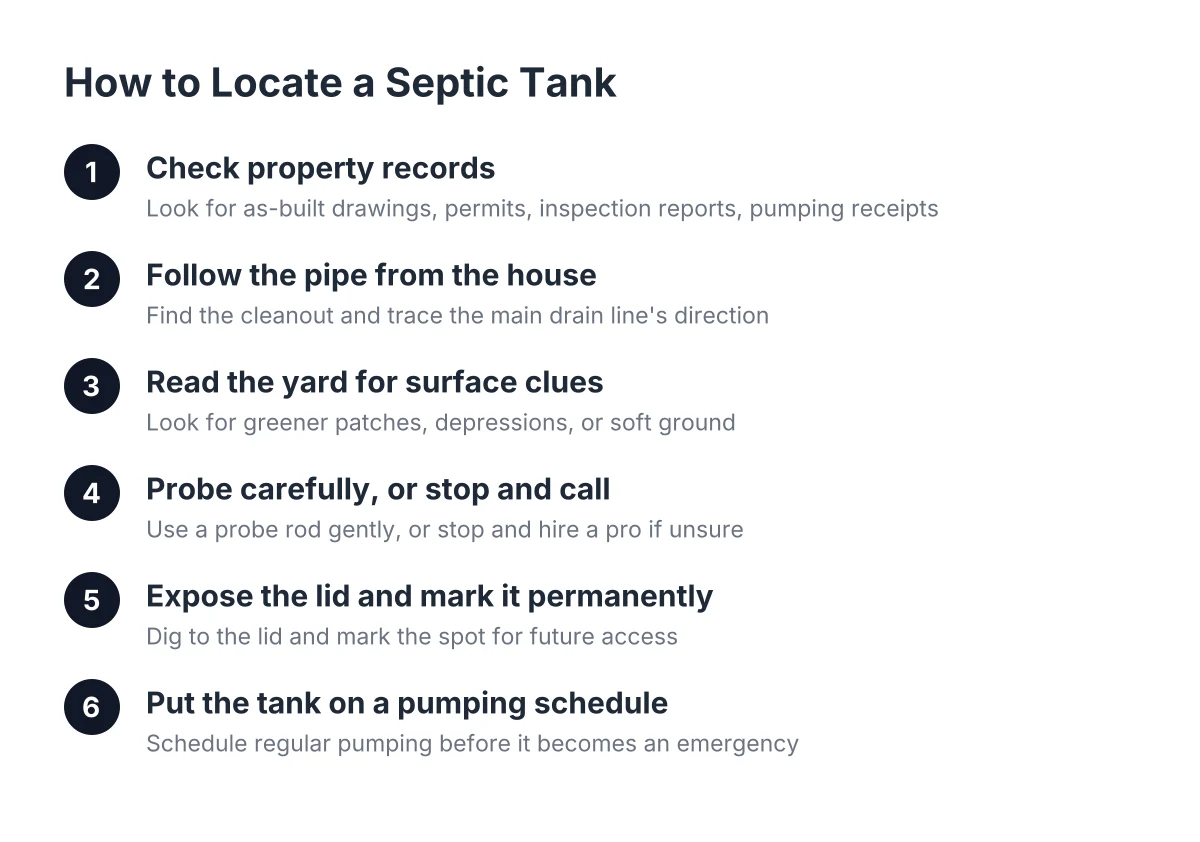
  • Septic Tank Locating Service: Why It Matters Before a Pumping Emergency

    Six-step process diagram for a septic tank locating service, from records to scheduling
    The six-step process this guide recommends for locating and marking a septic tank before an emergency.

    A septic tank locating service finds and marks your buried tank before you need it pumped, and that matters more than most property owners realize. When sewage backs up at a rental at 9 p.m. and nobody knows where the tank sits, the crew spends the first hour of an emergency call probing dirt instead of pumping waste. For a landlord in Hesperia with tenants calling about a smell, that lost hour is the difference between a quick pump-out and a long night. This guide walks you through locating your tank now, step by step, so an emergency call goes fast later.

    Here is why this deserves an hour of your time. Most emergency backup calls happen because a tank sat unpumped far past its service interval, and by the time drains slow down, the tank is already full. If the crew then has to hunt for the tank, dig it up, and expose the lid before they can even drop a hose, you pay for that time. Many pumping companies charge extra to dig out access. Knowing the location, and ideally having the lid exposed, cuts both the bill and the downtime.

    Step 1: Check Your Property Records First

    Start with paper before you start with a shovel. Many septic-served properties in the High Desert have records that show exactly where the tank was installed.

    Look for these, in this order:

    • The property's "as-built" drawing or septic permit, often on file with the San Bernardino County health or environmental agency
    • Your home inspection report from when you bought the property
    • Prior pumping receipts or invoices, which sometimes note the tank location or access notes
    • The seller's disclosure packet, if you bought the rental recently

    For a small landlord, this step pays off twice. First, it may hand you the location for free. Second, it builds the paper trail you want anyway; a folder with the permit, the as-built, and pumping receipts is exactly what you need for habitability questions or a pre-lease turnover.

    However, records fail often out here. Older Hesperia properties may predate good record keeping, and additions or regrading can make an old drawing useless. If the records come up empty or don't match the lot, move to the physical clues.

    Step 2: Follow the Pipe From the House

    The main sewer line leaves the building in a straight line toward the tank, so the building itself is your best clue. In a crawl space or basement, find where the main drain exits the foundation. Outside, look for a cleanout pipe, which is a capped pipe sticking a few inches out of the ground near the house.

    That cleanout matters. A technician who can see a cleanout, or who at least knows the general vicinity of the tank, can trace the pipe and find the tank far faster than one starting blind. Note where it is and which direction the line seems to run.

    In addition, keep distance rules in mind while you look. Most local regulations require at least 10 feet between a septic system and the building it serves, according to the Minnesota Pollution Control Agency. So start your search about 10 to 25 feet out from the foundation, in line with the exit point of the drain.

    Step 3: Read the Yard for Surface Clues

    Next, walk the yard slowly and look at the ground itself. Buried tanks leave hints, especially in High Desert soil where vegetation is sparse.

    Watch for:

    • A rectangular patch where grass or weeds grow greener or faster than the surrounding dirt
    • A shallow depression or a slight mound that doesn't match the rest of the grade
    • Concrete lids or risers partially covered by decades of blown sand
    • Areas where snow melts first in winter, or where the ground feels softer underfoot

    Also rule areas out. Tanks don't sit under driveways, patios, or additions in a properly built system, and the drain field usually sits downhill from the tank. Suppose you own a three-unit rental off Main Street in Hesperia; if the lot slopes toward the back fence, the tank likely sits between the house and that lower ground, on the line you traced in Step 2.

    Step 4: Probe Carefully, or Stop and Call

    If the clues point to a spot, you can confirm it with a thin metal probe rod pushed gently into the soil. A buried concrete or fiberglass tank feels like a flat, hard surface at a consistent depth, usually within a couple feet of grade.

    Be careful here. Probing hard can crack an older concrete lid or damage inlet and outlet pipes, and the connection points where pipe meets tank are the vulnerable spots. If the ground fights you, or you have no confident target area, stop. This is the point where a professional septic tank locating service earns its fee, and it is also the honest limitation of the do-it-yourself route: guessing wrong and digging random holes costs more than paying someone with the right tools.

    When to Call a Professional for Septic Tank Locating

    A professional locating crew traces the sewer line from the house with detection equipment, pinpoints the tank and its lids, and marks them so pumping access is immediate. Some methods involve flushing a small transmitter that gets detected from the surface. The result is a marked, confirmed location instead of an educated guess.

    For a rental owner, the practical benefit is that this happens without you on site. The crew works from the cleanout and the yard; your tenant doesn't need to do anything beyond letting them access the property. Ask for the location to be documented, even a simple photo with measurements from two corners of the house, so it goes in your property file.

    Septic Tank Locating Service Costs and Savings

    Locating a septic tank is a modest cost compared to pumping, and often a company will fold it into a pumping visit. As a rough illustrative range, standalone locating might run from under a hundred dollars to a few hundred if the line is long or the tank is deep. Compare that against the pumping itself, which averages $427 nationally with a typical range of $250 to $1,250 depending on tank size and location, according to Angi. Paying a small locating fee once beats paying a dig-out surcharge on every future visit.

    There is a bigger number to keep in mind too. The EPA estimates septic repair or replacement typically costs $5,000 to $15,000, and a septic pump replacement cost on a system with a pump chamber lands in serious money as well. Damage from digging blind, or from a contractor trenching over an unmarked tank during a fence or pool project, is exactly how those bills happen.

    Step 5: Expose the Lid and Mark It Permanently

    Once the tank is found, dig down to the access lid and either install a riser or mark the spot so nobody has to search again. A riser brings the lid to grade level, which means every future pumping visit starts immediately, with no digging fee.

    At minimum, do this:

    1. Measure from two fixed points on the building to the lid, and write it down.
    2. Take photos showing the lid relative to the house and fences.
    3. Sketch the tank and drain field on a simple site map for each rental you own.
    4. Share the map with your property manager or a trusted tenant contact.

    As a result, when a tenant calls about slow drains while you're two hours away, you can tell the septic crew exactly where to go. That is the difference between a supervised project and a service call that handles itself.

    Step 6: Put the Tank on a Schedule Before It Becomes an Emergency

    Locating the tank is the setup; a service schedule is the payoff. The EPA recommends a professional inspection at least every three years for the average household, and Penn State Extension notes that an active family of four generally needs the tank pumped every two to three years. A rental with steady occupancy behaves like an active household, so plan accordingly.

    Therefore, treat the first pumping after locating as your baseline. The crew can tell you how full the tank was and suggest an interval for that property. From then on, septic tank pumping becomes a calendar item instead of a tenant complaint, and an emergency septic service call becomes something you rarely need. If a backup does happen, call a septic professional first to diagnose it; a plumber only comes into play if the problem turns out to be inside the building's own plumbing.

    One more scenario worth naming. Say you're planning a shed, carport, or paving project at one of your Hesperia units in 2026. Confirm the tank and drain field location before any equipment rolls in. Knowing exactly where the system sits can prevent thousands of dollars in damage from a single misplaced trench.

    The Bottom Line for Hesperia Property Owners

    A septic tank locating service is cheap insurance against an expensive night. Records, the pipe path, and yard clues will find many tanks; professional locating handles the rest without guesswork. Once the tank is found, marked, and on a pumping schedule, an emergency stops being a scramble. The crew shows up, goes straight to the lid, and pumps, whether or not you're anywhere near the property.

    If you need your septic tank serviced, Hesperia Septic can help.


    Prefer to talk it through? Call (760) 249-7872 — a quick call is usually the fastest way to get a straight answer for your situation.
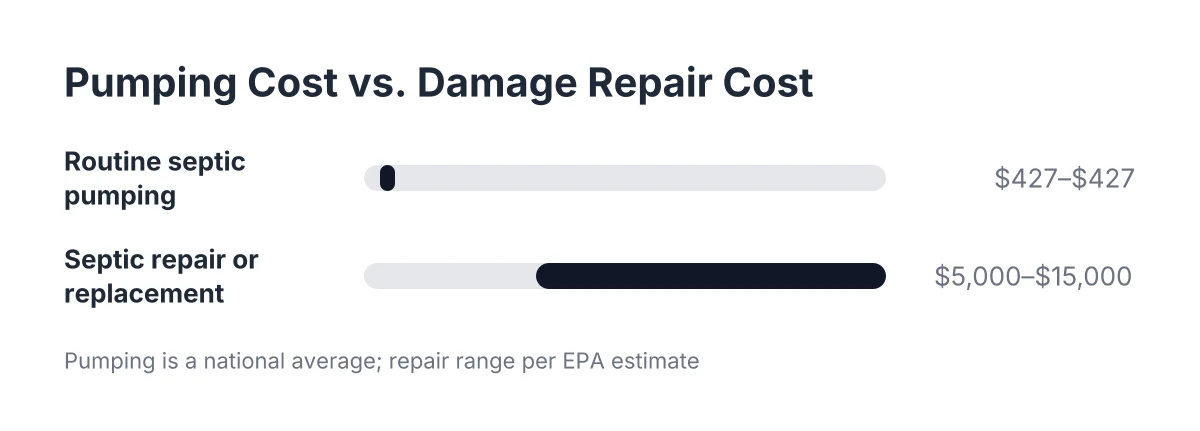
    Related Reading

  • DIY RV Tank Pumping: Portable Waste Disposal Options for High Desert Travelers

    Diagram of steps for portable RV tank dumping from tank type to legal waste disposal
    The step-by-step process for DIY portable RV tank dumping, from tank ID to legal disposal.

    If you own an RV, a remote cabin, or a patch of High Desert land with a holding tank on it, sooner or later the tank fills up and you have a choice to make. You can handle DIY RV tank dumping yourself with portable equipment, or you can call a mobile pump-out service that comes to you. Both work. Both have real trade-offs in cost, mess, and legality. This guide walks through the DIY route step by step, exploring portable RV tank dumping options, then shows you where the line sits between a job you can do yourself and one that belongs to a local septic crew with a vacuum truck.

    This matters most in places like Hesperia and the surrounding High Desert, where dump stations are spread thin and some properties sit far enough out that many crews skip them. Knowing both options before your black tank hits full is the whole game.

    Step 1: Figure Out What Kind of Tank You Actually Have

    Before you buy any equipment, confirm what you are dealing with. An RV has a black tank for toilet waste and a gray tank for sink and shower water. A cabin or a piece of raw land might have a standalone holding tank, a true septic tank with a drain field, or nothing at all.

    This step trips up land buyers more than anyone else. Suppose you just bought two acres outside Hesperia with an old travel trailer parked on it and no records from the seller. You do not know if that pipe in the ground leads to a holding tank, a buried septic tank, or a straight illegal discharge. In that scenario, a septic tank locating service and inspection is worth the money before you pump anything, because pumping the wrong system the wrong way can damage it or put you on the wrong side of county rules.

    If you have a standard RV with labeled valves, you can move to Step 2. If you have an unknown buried tank, stop and get it located and inspected first.

    Step 2: Portable RV Tank Dumping Methods Explained

    DIY portable RV tank dumping comes down to three portable options, each suited to a different situation. Here is how they compare:

    • Portable tote tank. A wheeled plastic tank, usually 15 to 40 gallons, that you fill from your RV's outlet and tow slowly to a dump station. Cheapest option, no power needed, but heavy when full and slow if your black tank is bigger than the tote.
    • Macerator pump. An electric pump that grinds waste into slurry and pushes it through a small-diameter hose, sometimes 100 feet or more, uphill if needed. Ideal when your RV parks far from a cleanout or dump point. Costs more, needs 12-volt power, and clogs if the tank holds wipes or other trash.
    • Gravity dump with a sewer hose. The classic 3-inch hose straight into a dump station or an approved home septic cleanout. Free beyond the hose itself, but only works when the RV can park right at the connection and the outlet sits higher than the inlet.

    Match the method to your setup. A weekend traveler who passes a dump station on the way home needs nothing more than a good sewer hose. A cabin owner parking a trailer 80 feet from a septic cleanout is a macerator candidate. Someone boondocking on their own High Desert land with no legal dump point nearby should skip to Step 6, because none of these methods solve the disposal problem.

    Step 3: Gear Up and Protect Yourself

    However you dump, the supply list is short and the same mistakes cause most of the mess. Wear disposable nitrile gloves. Keep a dedicated bin for sewer gear so hoses never mix with fresh water equipment.

    You will want:

    1. Clear elbow fitting, so you can see when the flow runs clean
    2. Quality sewer hose with locking bayonet fittings, not a bargain hose that splits
    3. Separate garden-style hose for tank rinsing, clearly marked, never used for drinking water
    4. Gloves, paper towels, and a small spray sanitizer for fittings

    Skipping the clear elbow is the most common rookie mistake. Without it, you are guessing when the tank is empty, and guessing usually means leaving solids behind.

    Step 4: Dump the Black Tank First, Then the Gray

    Always empty the black tank before the gray tank. The gray water, which is mostly soapy sink and shower water, then rinses your hose and fittings on its way out.

    Connect the hose, check both ends are locked, and open the black valve fully. Let it drain until the clear elbow shows the flow slowing, then close it. Next, open the gray valve and let it flush the line. If your rig has a built-in tank flush, run it now; if not, a rinse wand down the toilet helps knock loose the solids stuck to the tank floor.

    Solids are the whole problem in any waste tank. Material that never breaks down, like wipes, paper towels, and feminine products, is what jams hoses and pumps. This is true whether the pump is your $200 macerator or a professional vacuum truck. What you flush decides how hard every future pump-out will be.

    Step 5: Dispose of the Waste Legally

    This is where portable RV tank dumping gets less convenient than it looks on YouTube. Black tank waste is sewage, and it must go to an approved point: a public dump station, a sewer cleanout on a property connected to city sewer, or in some cases a properly functioning septic system with the owner's permission and local rules allowing it.

    Do not dump on open ground, into a dry wash, or down a storm drain. Even gray water has rules; for example, spraying graywater through sprinklers is not a legal disposal method under standard graywater regulations, according to the Arizona Department of Environmental Quality. California and San Bernardino County have their own requirements, so verify local rules before treating your land as a disposal site.

    Also think twice before dumping into an unknown septic tank on a property you just bought. A large slug of RV waste into a tank that has not been pumped in years can push solids into the drain field, and the EPA estimates septic repair or replacement typically costs between $5,000 and $15,000. That is an expensive shortcut.

    Step 6: Know When Mobile Pump-Out Service Beats DIY

    Mobile RV tank pumping means a truck with a vacuum pump and storage tank comes to your rig, cabin, or campground and hauls the waste to a treatment facility. Waste pumped this way is trucked to a sewage treatment plant for disposal, according to the New Hampshire Department of Environmental Services, which takes the legality question off your plate entirely.

    Call a pro instead of doing it yourself when:

    • Your rig or cabin sits on remote land with no legal dump point within reasonable towing distance
    • You run a campground or host multiple rigs, where holding tank service on a schedule beats a dozen individual tote trips
    • The tank is a large buried holding tank, not a 40-gallon RV tank, and portable gear cannot move that volume
    • You have a backup, a stuck valve, or suspected damage, where forcing a DIY dump can make things worse
    • You physically cannot wrestle a 300-pound full tote tank, which is a legitimate reason, not a failure

    As a rough illustration, say a cabin owner near Hesperia has a 250-gallon holding tank and the nearest dump station is 25 miles away. Hauling that out in a 30-gallon tote means eight-plus round trips. One visit from a mobile rv pumping service near me search solves it in an hour, and many local crews handle RV holding tank pumping alongside residential septic work, so remote properties are not out of range for them.

    Step 7: Set a Schedule So This Never Becomes an Emergency

    Whichever route you pick, put tank service on a calendar instead of waiting for the gauge, which lies constantly once sensors get coated. Full-time RV living usually means dumping every few days to a week. A cabin holding tank fills on a predictable cycle once you track a season of use.

    For a permanent septic system on your property, the same logic applies at a longer interval; Penn State Extension notes that for an active family of four, pumping every two to three years is generally advisable. Regular pumping remains the only proven way to remove accumulated solids. Additives do not replace it, and skipping it is how drain fields die.

    Where DIY Ends and a Local Crew Begins

    DIY handles the routine well: a healthy RV, a nearby dump station, and an owner willing to do slightly gross work carefully. A tote tank or macerator pays for itself within a season for a frequent traveler. If your macerator setup ages out or the built-in pump on an older rig fails, an rv black water tank replacement or pump swap is a manageable weekend project for a handy owner, though persistent leaks or cracked tanks are worth a professional opinion.

    Mobile service wins on volume, distance, legality, and unknowns. If you searched "mobile rv tank pumping service near me" because your tank is full on a remote High Desert parcel, or because you bought land with a mystery tank and zero paperwork, that is exactly the situation a local Hesperia septic crew exists for. They can locate the tank, inspect it, tell you what you actually own, and pump it through proper access instead of guesswork.

    The honest summary: learn diy rv tank dumping for the routine dumps, and know a local pump-out crew for everything the portable gear cannot reach. As of 2026, disposal rules keep tightening, so the "dig a hole" era is over. Plan for legal disposal from the start and the tank never runs your trip.

    If you need your septic tank serviced, Hesperia Septic can help.


    Prefer to talk it through? Call (760) 249-7872 — a quick call is usually the fastest way to get a straight answer for your situation.
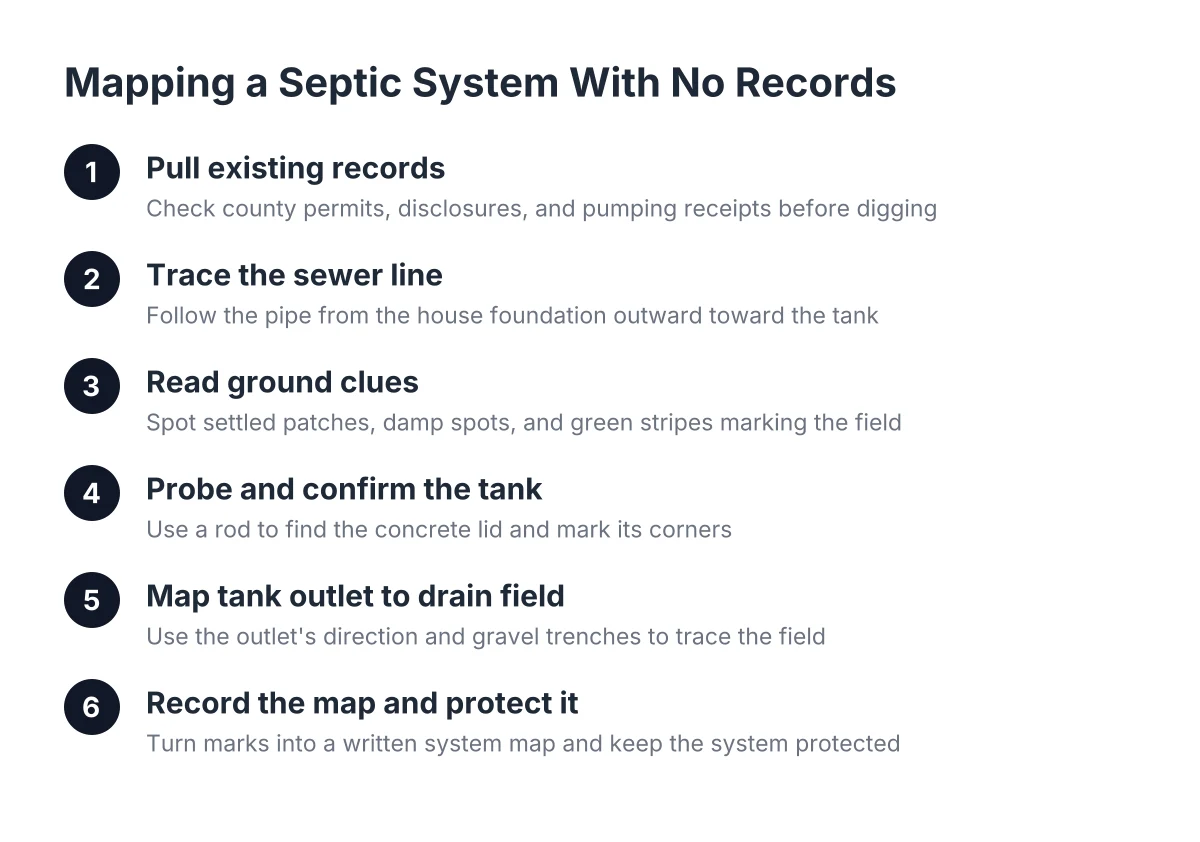
    Related Reading

  • What Happens If You Pump a Septic Tank Without Locating It First?

    Bar chart comparing septic pumping cost to repair cost when you pump before locating septic
    Locating a septic tank first is cheap insurance against repair costs that can run 10x the price of pumping.

    If you bought High Desert land with no septic records, you might be tempted to schedule pumping and figure the rest out later. But what happens if you pump a septic tank without locating it properly first? The short answer: you risk crushed lids, broken pipes, a pump truck stuck in soft sand, and a bill that dwarfs the pumping itself. For a property in Hesperia with no paperwork, no visible lid, and a seller who never confirmed anything, it is critical to pump before locating the septic system only after you know exactly where it sits. Locating the tank is not a side task. It is the first step of the job, and skipping it is where most of the damage happens.

    This guide walks through what actually goes wrong when pumping starts before locating, why properties with missing records carry the most risk, and how to sequence a locate, an inspection, and a pump-out so you get real answers about the system before you commit more money to the property.

    Why Locating Comes Before Pumping, Every Time

    A proper septic pumping job starts by finding and uncovering the tank, not by parking a truck and hunting with a shovel. That order exists for a practical reason. The crew needs to know exactly where the tank sits, where the lid is, where the inlet and outlet pipes run, and whether the ground around it can support a heavy vacuum truck.

    On a Hesperia property with records, that is straightforward. The county file or an as-built drawing shows the tank offset from the house, and the crew digs a small hole, opens the lid, and pumps. On a property with no records, none of that is known. The tank could be 10 feet from the back door or 40 feet out past a shed. The lid could be under six inches of soil or under a concrete patio someone poured in 1995.

    For context, most local regulations require at least 10 feet between a septic system and the building it serves, according to the Minnesota Pollution Control Agency. That gives you a starting zone, but a starting zone is not a location. Guessing inside that zone with heavy equipment is exactly how tanks get damaged.

    Septic tank locating solves this before any pumping starts. A locate-and-mark visit traces the sewer line out from the house, pinpoints the tank, flags the lid, and gives the pump crew a precise target. For a land buyer with no paperwork, that marked location becomes the first real document the property has ever had for its septic system.

    Damage and Risk When You Pump Before Locating Septic Systems

    Pumping a septic tank before locating it invites three kinds of damage: physical damage to the tank and its components, property damage from equipment placed in the wrong spot, and hidden system damage that never gets caught because nobody could see inside. Each one costs more to fix than the locate would have cost to prevent.

    Crushed lids and broken risers

    Older High Desert tanks often have concrete lids that have weakened over decades of soil pressure and moisture cycles. When a crew probes blindly or drives equipment over the unmarked tank area, that lid can crack or collapse. A collapsed lid is not a cosmetic problem. It is an open hole into a tank full of sewage, which is a safety hazard for anyone walking the property, including tenants.

    Repairing or replacing damaged tank components gets expensive fast. The EPA estimates septic repair or replacement typically runs $5,000 to $15,000, far more than routine pumping. Compare that to the roughly $427 national average for a septic tank pumping visit, according to Angi data, and the math is clear. The cheapest part of this whole process is doing it in the right order.

    Damaged inlet and outlet pipes

    The pipes entering and leaving the tank are its most fragile points. The fill around where a pipe penetrates the tank needs thorough compaction when the tank is set, according to Onsite Installer, precisely because that connection point is prone to settling and damage. Decades later, on an old tank with unknown installation quality, those connections may already be marginal.

    A shovel or probe rod driven into an unlocated pipe can crack it. The outlet pipe matters most; it sits lower than the inlet because solids float on top of the liquid, and only liquid should exit toward the drain field, as the University of Nebraska-Lincoln Extension explains. Break that outlet, or knock its baffle loose during a blind dig, and solids can wash into the drain field. Once solids clog a drain field, you are into the repair-and-replacement price range, not the pumping price range.

    A stuck pump truck and torn-up ground

    Vacuum trucks are heavy. Before positioning one, a careful technician walks the ground personally instead of trusting anyone's word that it is solid, especially after rain. High Desert soil can look firm and still give way, and a truck that sinks near an unmarked tank can crush the tank itself on the way down.

    Without a marked location, the driver is guessing at both the tank position and the safe approach path. That guess can mean ruts across a rental yard, a broken irrigation line, or a truck parked directly over the tank it came to pump.

    The No-Records Problem Makes Every Risk Worse

    Every risk above gets multiplied when the property has no septic records. You do not know the tank's location, age, material, size, or last service date. You do not know whether it has one compartment or two, whether the baffles are intact, or whether the previous owner ever pumped it at all.

    That last unknown matters more than buyers expect. A tank that has never been pumped since installation can still appear to function. Toilets flush, drains drain, and nothing smells. Meanwhile, solids build toward the outlet and the baffles clog. A tank can look fine from the surface while sitting nearly solid with sludge inside, and only opening the lid and looking reveals it.

    Here is a hypothetical that will feel familiar to anyone shopping High Desert rentals. Suppose you are in escrow on a three-bedroom rental in Hesperia built in the 1970s. The seller says the septic "works fine" but has no service records and cannot point to the lid. You could close and hope, or you could order a locate and inspection before your contingency period ends. Say the locate finds the tank under a gravel parking area the previous owner added, and the inspection finds sludge near the outlet baffle. In that scenario, you now have a written report to negotiate with, a marked tank location for every future service visit, and a pumping scheduled before a tenant ever moves in. The alternative was discovering all of it through a sewage backup during a tenancy.

    What a Locate-First Visit Actually Looks Like

    A locate-and-pump sequence on a no-records property in Hesperia typically follows a clear order. Knowing the steps helps you schedule it efficiently, which matters when you are working against an escrow clock or a vacancy you want to fill.

    1. Trace the sewer line. The crew starts at the house, usually at a cleanout, and follows the main drain line out toward the tank. Locating equipment tracks the line underground so nobody digs on a guess.
    2. Pinpoint and mark the tank. Once the line reaches the tank, the crew marks the tank footprint and the lid position with flags or paint. You now have a documented location you can photograph and keep in your property file.
    3. Expose the lid. The crew digs down to the access lid. Depth varies from a few inches to a few feet depending on how the site was graded over the years.
    4. Inspect before and during pumping. With the lid open, the technician checks liquid level, sludge depth, baffle condition, and signs of leaks or root intrusion. Pumping without this visual check hides the true condition of the system, which defeats the purpose for a buyer who needs answers.
    5. Pump and document. The tank gets pumped, the contents get hauled by truck to a treatment plant for disposal, according to the New Hampshire Department of Environmental Services, and you get documentation of what was found.

    For a small landlord, that documentation earns its keep twice. It supports the purchase decision now, and it becomes the baseline service record for the property going forward. Every future pumping visit is faster and cheaper because the tank is already mapped.

    One trade-off worth knowing: exposing the lid yourself before the truck arrives can reduce the bill, since crews commonly charge extra for digging out access. On a no-records property, though, do not dig until the tank has been professionally located. Digging blind is how the damage in this article happens.

    What Happens If You Pump an Old Tank the Wrong Way

    Even after the tank is found, pumping a neglected tank carries its own risks if it is rushed. This is where a no-records property differs from one with a normal service history, and it is worth understanding what happens if you pump a long-neglected tank carelessly.

    First, heavy sludge buildup changes the job. A tank that went a decade or more without service may hold compacted solids that need agitation and extra time to remove. A quick surface pump that leaves the sludge layer behind gives you a receipt but not a serviced tank, and the inspection findings will be incomplete.

    Second, old concrete tanks that have sat full for years can be structurally fragile. A careful crew watches the tank walls and baffles as the level drops, because pumping is the only time anyone can see those components. If a baffle is deteriorated or missing, you want that noted in writing before you close on the property, not discovered after solids reach the drain field.

    Third, if the system includes a pump or other mechanical components, those need their own care. A septic pump should never be tested dry; the tank must hold water before any pump test runs, or the test itself can wreck the pump. Systems with pumps, float switches, or other mechanical parts should also be inspected once a year, according to the EPA, which is a real ownership cost to factor into your numbers on the property.

    Protecting Your Investment After the Locate

    Once the tank is located, marked, inspected, and pumped, a few habits keep the system from becoming a surprise expense again. For a landlord running one to five septic-served rentals around Hesperia, these are the items worth building into your process:

    • Record the location permanently. Photograph the marked tank and lid with reference points, measure offsets from the house corners, and keep it with the property file. Consider adding a riser so the lid is reachable without digging next time.
    • Set a pumping schedule based on occupancy. Penn State Extension notes that an active family of four generally needs pumping every two to three years. A rental with full-time tenants behaves like an owner-occupied home, not a vacation cabin.
    • Watch water waste between visits. A single leaky or running toilet can push as much as 200 gallons of extra water per day into a septic system, according to the EPA. In a rental, that toilet runs until a tenant reports it, so check fixtures at every turnover.
    • Account for garbage disposals. Homes with disposals generate significantly more sludge; the Massachusetts Department of Environmental Protection recommends annual pumping for those households. If your rental has a disposal, budget accordingly or remove it.
    • Mark the tank before any site work. Knowing the exact tank location before a project like a swimming pool, an addition, or new paving prevents thousands of dollars in damage. Give the marked location to every contractor who brings equipment onto the lot.

    In addition, keep the tank location in mind for anything involving a well. A septic tank sited close to a well can contaminate drinking water if it leaks, which is one more reason the locate report matters on rural High Desert parcels.

    When to Bring In a Professional Instead of Guessing

    Some situations on a no-records property go beyond what any owner should handle alone. If the tank turns out to sit under a structure or paving, if the inspection finds a failing tank or saturated drain field, or if you are planning new construction that needs a percolation test and a designed system, you need licensed help. Installing or replacing a system requires certification beyond a pumping operation, including knowledge of soil types, percolation rates, and local regulations, as the New Hampshire Department of Environmental Services notes. A percolation test must be performed before installing a system to confirm the soil drains properly, per the University of Nebraska-Lincoln Extension, and that is county-regulated work.

    Also worth confirming early: whether the property is on septic at all. Homes inside city sewer districts connect directly to municipal treatment, according to the Environmental Finance Center Network, while unsewered High Desert parcels rely on septic. Parts of Hesperia have both situations, so verify before you pay for a locate.

    The bottom line for a buyer holding a property with no septic paperwork is simple. What happens if you pump without locating first is damage, guesswork, and missing information at exactly the moment you need certainty. What happens when you locate first is the opposite: a marked tank, a documented condition, a clean pump-out, and a property file that finally tells the truth about what is buried in the yard. As of 2026, with repair costs running several times the price of routine service, doing this in the right order is the cheapest decision you will make on the property.

    If you need your septic tank serviced, Hesperia Septic can help.

    Prefer to talk it through? Call (760) 249-7872 — a quick call is usually the fastest way to get a straight answer for your situation.

    Related Reading

  • Septic Tank Locating vs. Drain Field: How to Map a System With No Records

    Diagram of steps for mapping septic system tank and drain field locations without records
    The step-by-step process this guide uses to locate a septic tank and drain field without records.

    Buying High Desert land with no septic records means you own two mysteries, not one. There is a buried tank somewhere, and there is a drain field somewhere else, and neither shows up on the paperwork the seller handed you. This guide walks through septic tank locating, drain field mapping, and the process of mapping septic systems to help you piece together the full system layout step by step, so you know exactly what is in the ground before you close escrow or break ground on a remodel.

    First, a quick frame. According to the U.S. Environmental Protection Agency, a conventional septic system has two main components: the septic tank and the drain field. The tank is where solids settle and get pumped out. The drain field is a network of perforated pipes laid over gravel and buried in soil, where the clarified liquid soaks away. Finding one without finding the other leaves your map half done, and around Hesperia, where lots are large and old installs went undocumented, half a map can cost you.

    Step 1: Pull Whatever Records Exist Before Anyone Digs

    Start at the desk, not in the dirt. Even properties with "no records" often have a partial paper trail, and any scrap narrows the search area.

    Check these sources in order:

    • San Bernardino County records. Ask for the septic permit or as-built drawing tied to the parcel. Older Hesperia properties may have nothing on file, but it costs you a phone call to find out.
    • The seller's disclosure and past pumping receipts. A pumping invoice from any prior owner usually notes tank access and sometimes a sketch.
    • The original builder or a neighbor with a similar-era home. Tract-built homes in the same area often placed tanks in a consistent spot relative to the house.

    An as-built drawing typically shows the tank's distance from the foundation. Even a rough sketch turns a whole-yard search into a ten-foot circle. If the county has nothing, note that too; a lender or permit office may require a professional inspection anyway, and you will want to know that before escrow deadlines tighten.

    Step 2: Trace the Sewer Line From the House Outward

    Every septic system starts at one pipe. A single sewer line collects all household drains and carries them to the tank, according to the US EPA. Find where that pipe exits the house, and you have your starting direction.

    Go into the crawlspace or look along the foundation for the main sewer line, usually a 3 to 4 inch pipe heading away from the building. Outside, look for a cleanout, a capped pipe sticking up near the foundation. The tank almost always sits along the straight line the pipe points toward.

    However, do not stop searching close to the house. Tanks are set some distance out from the foundation, not tucked against it, so extend your search line well into the yard. On a typical Hesperia lot, that line can run a surprising distance before it hits the tank.

    Step 3: Read the Ground for Tank and Drain Field Clues

    Next, walk the property slowly and look for what the soil is telling you. High Desert ground gives away buried systems in a few ways:

    • A rectangular patch where the dirt settled slightly, or where weeds grow differently than the surrounding scrub
    • A low mound or a spot that stays damp when everything else is bone dry
    • Parallel green stripes in an otherwise brown yard, which often mark drain field lines fed by moisture below
    • Old concrete fragments, riser rings, or a lid edge barely showing at grade

    Those parallel stripes matter for mapping. When you can see multiple drain field lines, the tank generally sits at the point farthest from the field, since solids settle in the tank before liquid flows out to the pipes. Sketch what you see on paper with rough distances from the house. You are building the site map the previous owner never made.

    Step 4: Probe and Confirm the Tank Location

    Once the clues point to an area, confirm it by feel. Use a metal probe rod or a thin fiberglass rod, and push it into the soil every couple of feet along your suspected line. Soil over a tank gives way, then stops hard at the concrete lid, usually within a foot or two of the surface on older installs, though depth varies.

    Probe gently at an angle so you do not punch through a deteriorated lid or crack an inlet pipe. Old concrete lids on undocumented systems can be brittle. When the rod hits flat resistance in a rectangular pattern, you have found the tank. Mark the corners with flags or spray paint.

    If probing turns up nothing, this is the point where professional septic tank locating earns its fee. A crew can run a camera with a transmitter down the sewer line and trace the pipe electronically to the tank, then find the lid without trenching the whole yard. That service costs more than a probe rod, but it beats guessing with a backhoe.

    Step 5: Mapping Your Septic System From Tank Outlet to Drain Field

    Finding the tank is half the job. Now use the tank itself to find where the water goes. Locating the drain from the septic tank, meaning the outlet side, tells you which direction the drain field runs.

    Open the tank access once it is exposed, or have a professional do it, and identify the inlet and outlet. According to the University of Nebraska-Lincoln Extension, the outlet pipe sits lower than the inlet, since only liquid should leave toward the drain field. The outlet's direction is your drain field bearing.

    From there, the field usually fans out in parallel trenches. The US EPA describes the construction: a thick gravel layer, perforated pipes on top, more gravel, then soil over the whole assembly. Probing along the outlet bearing every few feet will find those gravel trenches; the rod drops through loose gravel instead of hitting undisturbed hardpan. Flag each line you find and add it to your sketch.

    Step 6: Turn Marks Into a Written System Map and Inspection

    Flags in the yard help the pumping crew. Paper helps you at closing. Convert your findings into a simple site map: tank corners and lid location with distances from two fixed points on the house, outlet direction, and each drain field line.

    For a purchase decision, pair the locate with a septic system inspection. An inspector can open the tank, check liquid levels and baffles, and give you a written report you can hand to a lender, the county, or your agent. The EPA recommends a professional inspection at least every three years for the average household, and a purchase is the natural moment to start that clock. If the system turns out to be failing, you want that leverage before closing, not after; the EPA estimates septic repair or replacement typically runs $5,000 to $15,000, far more than routine septic tank pumping.

    For example, suppose a buyer is in escrow on a 1970s Hesperia property with no county file and no visible lid. In that scenario, a typical sequence is a records check, a sewer line trace, a locate and mark on the tank, then an inspection with pumping so the inspector can see the empty tank. The whole thing usually fits inside a standard inspection contingency window, so the locate itself rarely delays the sale.

    Step 7: Protect the System You Just Mapped

    Finally, put your new map to work. Mark or install risers so the lid stays findable for the next pumping, and keep the map with your property records.

    Keep vehicles off both the tank and the drain field; repeated driving over either can crush pipes or collapse a lid. In addition, plan any future structure around the system, not the other way around. If a garage, shop, or pool would sit over the drain field, moving the planned structure is almost always cheaper than moving the septic system. Keep drainage ditches and any standing water directed away from the field so it does not flood.

    When Septic Tank Locating and Drain Field Mapping Need a Pro

    Some situations outgrow the probe rod. Call a professional locate crew when the sewer line takes turns you cannot trace, when the lot is large and the clues are absent, when the tank sits deeper than a hand probe reaches, or when a lender or the county requires documented results. Commercial properties with grease traps or holding tanks, like a restaurant or an RV park changing hands, have the same problem with higher stakes; an undocumented grease trap still has to be found before it can be pumped on a compliance schedule.

    There is a real trade-off to weigh. Paying for a professional locate and inspection on a property you might not buy feels like sunk cost. Against that, weigh what you are protecting: even routine septic tank pumping averages $427 according to Angi, and a hidden failing system can swing a purchase by five figures. On raw or older High Desert land with zero records, a documented locate and mark is usually the cheapest certainty available. And if there is any chance the system was abandoned, altered, or built without a permit, get a professional involved before you dig; an old tank with a compromised lid is a genuine safety hazard.

    Map the tank, map the drain field, put both on paper. That is the whole job, and once it is done, every future pumping, permit, and remodel on that property gets easier.

    If you need your septic tank serviced, Hesperia Septic can help.


    Prefer to talk it through? Call (760) 249-7872 — a quick call is usually the fastest way to get a straight answer for your situation.

    Related Reading