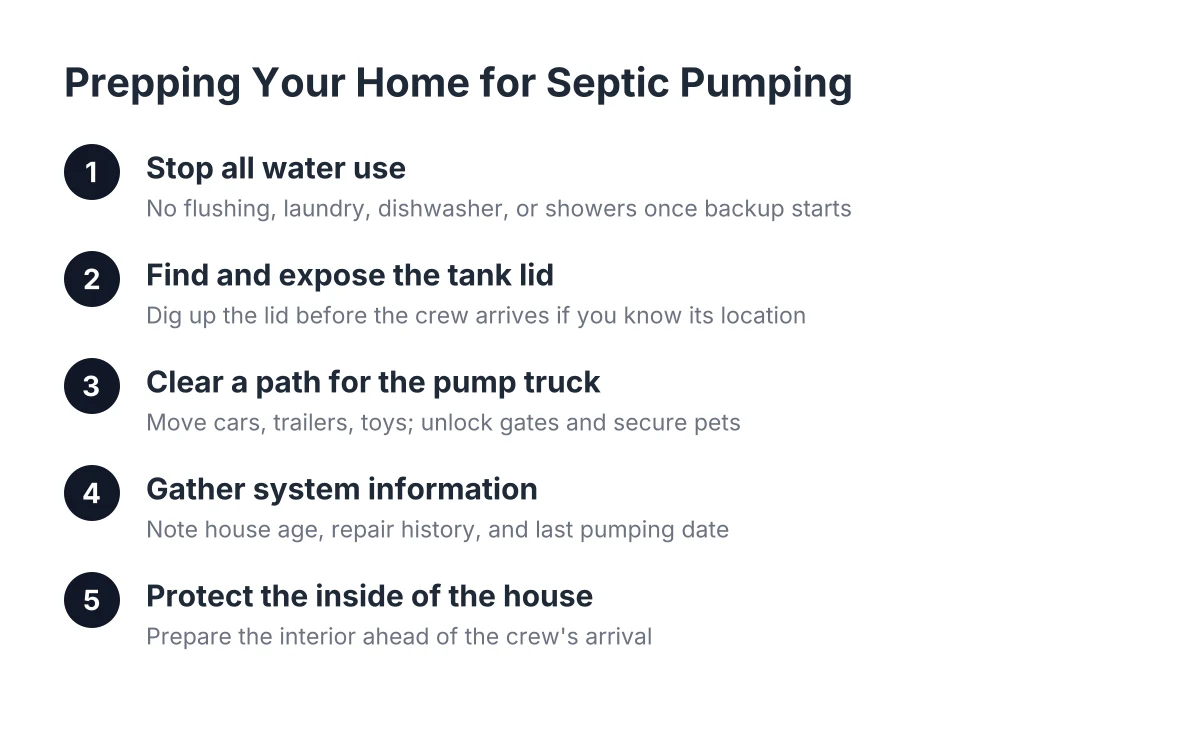
When sewage is backing up or the alarm is sounding, the fastest fix starts before the truck arrives. If you prepare your home for septic pumping emergencies, the crew can get to work the moment they pull up instead of spending the first hour hunting for a buried tank lid. This guide walks you through exactly what to do, in order, from the first sign of trouble to the moment the truck leaves. It is written for Hesperia homeowners and small landlords who want a calm plan instead of a panicked scramble.
The good news is that most of the prep costs nothing but a little effort. The steps below can shave real time off an emergency visit, protect your yard and your plumbing, and give you the documentation you need if you own rental property.
First Moves When Sewage Is Backing Up
Before you prepare anything for the crew, stop making the problem worse. A septic backup means the tank or the line to it cannot accept more water. Every flush, every load of laundry, and every shower adds to what is already coming back into the house.
Do these things in the first ten minutes:
- Stop all water use in the house. That means no flushing, no dishwasher, no laundry, and no showers.
- Keep people and pets away from any standing sewage, inside or outside. Raw sewage is a health hazard, not just a mess.
- If your system has a pump and the alarm is going off, press the silence button if there is one, but do not assume the problem is solved. The alarm means the tank level is too high.
- Call a local septic crew and describe what you are seeing. Backup in the lowest drain, gurgling toilets, or wet ground over the tank are all details worth mentioning.
However, do not add chemicals or drain cleaner to a backed-up system. Those products do nothing for a full tank and can make the pumped waste harder to handle. The waste from your tank gets trucked to a treatment plant, according to New Hampshire Department of Environmental Services, so what goes into the tank matters.
Why Preparation Speeds Up an Emergency Visit
Preparation speeds up an emergency septic visit because the slowest part of many jobs is not the pumping itself; it is finding and reaching the tank. A pump truck can empty a residential tank fairly quickly once the lid is open. Getting to that lid is where jobs stall.
The first step of a proper pumping job is locating and uncovering the tank. On a house you have owned for years, that might be simple. On a property you just bought, or a rental you rarely visit, nobody may know where the tank sits. Lids in the High Desert are often buried under compacted dirt, gravel, or landscaping, and some are deeper than you would guess.
Therefore, every minute you spend on the steps below is a minute the crew does not spend probing your yard with a rod at 9 p.m. That matters most in a true septic backup emergency, when sewage is actively rising in a tub or shower drain and you want the truck working, not searching.
How to Prepare Your Home for Septic Pumping: A Step-by-Step Checklist
To prepare your home for an emergency septic crew, focus on three things: access to the tank, access for the truck, and information about the system. Handle those and you have done most of what a homeowner can do. Here is the full checklist, roughly in order of importance.
Find and expose the tank lid if you can
If you know where the tank is, dig up and expose the lid before the crew arrives, weather and daylight permitting. This is the single most useful thing a homeowner can do. Locating a buried tank can take significant time, and time is the one thing you do not have during a backup.
Look for these clues if you are not sure where the tank sits:
- The point where the main sewer line exits the house, usually on the side with the bathrooms. Tanks typically sit at least 10 feet from the building, a minimum distance most local regulations require, according to Minnesota Pollution Control Agency.
- A rectangle of grass or dirt that looks different from the rest of the yard, greener, browner, or slightly sunken.
- Old inspection records, a property survey, or a septic permit from the county. If you bought the house recently, check your closing documents.
- Concrete or plastic lids, risers, or capped pipes sticking a few inches above grade.
If you cannot find it, say so on the phone. A crew that offers septic tank locating as a service can find it, but knowing in advance changes how they plan the visit. Do not dig blindly with heavy equipment; hand tools and a probe are safer around buried pipes.
Clear a path for the pump truck
Next, think about the truck. A pump truck is large and heavy, and its hoses only reach so far. Walk your driveway and yard and clear anything in the way: parked cars, trailers, trash cans, kids' toys, and low-hanging branches over the driveway.
In addition, unlock any gates between the street and the tank. If the tank sits behind a fence, measure or estimate the distance from where the truck can park to the tank lid, and mention it when you call. Long hose runs are usually workable, but the crew wants to know before they arrive, not after.
For landlords, this step often means coordinating with a tenant. Ask them to move vehicles, secure dogs, and leave the side gate open. A dog in the yard is one of the most common reasons a crew has to wait at the curb.
Gather what you know about the system
While you wait, write down everything you know about the septic system. Crews handling an emergency call want the same background a company would gather before any inspection: the age of the house, any repair history, when the tank was last pumped, and whether the property sits on high ground or in a low spot.
For example, "three-bedroom house built in the 1980s, tank is somewhere in the front yard, no idea when it was last pumped, we bought it two years ago" is genuinely useful. It tells the crew to expect a heavy sludge load and to budget time for locating. Most emergency backup calls trace back to a tank that went unpumped far past its service interval, so an honest "I don't know" is more helpful than a guess.
If your system has an alarm panel, note what the lights show and whether the alarm is audible or silenced. On pump-equipped systems, technicians typically check the pump, alarm lights, and alarm sound before pumping anything out, so that information helps them plan.
Protect the inside of the house
Meanwhile, deal with what is happening indoors. Move rugs, boxes, and anything absorbent away from floor drains, tubs, and the lowest toilets. If sewage has already surfaced, block off the room from kids and pets and ventilate it.
Keep water use at zero until the tank is pumped. As a temporary measure between the backup and the truck's arrival, some homeowners on pump systems use a utility pump and hose to lower the tank level while repairs are arranged. That is a stopgap, not a fix, and it only applies if you can safely access the tank; when in doubt, wait for the professionals.
What the Crew Does When They Arrive
A typical emergency pumping visit follows a predictable order: confirm the tank location, open the lid, assess the levels, pump, and then check what caused the backup. Knowing the sequence keeps the visit calm instead of chaotic, which is the whole point of preparing.
Suppose a Hesperia landlord gets a Saturday night call from a tenant about a shower drain full of gray water. In that scenario, a prepared owner has already told the tenant to stop water use, texted the crew a photo of the exposed lid from last year's service, and unlocked the gate remotely. The truck arrives, hooks up, and pumps. An unprepared owner in the same situation might spend the first hour on the phone trying to figure out where the tank even is.
After pumping, the crew looks at what the tank tells them. Heavy sludge and scum layers point to a long-overdue pumping. Water flowing back into the tank from the drain field side points to a drain field problem, which pumping alone will not fix. High water with a working outlet may point to a clogged inlet line. This is where an honest local operator matters; you want a plain explanation of what they saw, not a scare pitch.
One trade-off worth naming: emergency septic service after hours usually costs more than a scheduled daytime visit, and pumping a tank does not repair a failed drain field or a broken pump. If the crew finds a bigger problem, get the findings in writing and take a breath before authorizing major work. A second opinion on a repair quote is reasonable, and a trustworthy crew will not punish you for asking.
Preparing Rental Properties Before an Emergency Ever Happens
Landlords can prepare their rental homes for a septic emergency long before one happens, and the payoff is measured in shorter vacancies and calmer tenant calls. If you own one to five septic-served rentals around Hesperia, a small amount of file-building now saves hours during a crisis.
Keep a simple septic file for each property with:
- A sketch or photo showing where the tank and lids sit, ideally taken while the lid was exposed during pumping operations.
- Dates of past pumpings and copies of invoices, which also help at sale time or during a pre-lease inspection.
- Gate codes, dog information, and the tenant's preferred contact method.
- Notes on the system type, especially if it has a pump, alarm, or other mechanical parts.
Also, brief your tenants. A one-page sheet telling them to stop water use and call you at the first sign of slow drains can turn a full backup into a minor incident. Tenants often run the dishwasher and two more loads of laundry after the first gurgle because nobody told them what a septic warning looks like.
Finally, schedule ahead. The U.S. Environmental Protection Agency recommends a professional inspection at least once every three years for a standard system, and once a year for systems with pumps, float switches, or other mechanical components. Penn State Extension notes that an active family of four generally does well with pumping every two to three years, a reasonable planning baseline for a family-occupied rental. If the unit has a garbage disposal, expect more sludge; the Massachusetts Department of Environmental Protection recommends annual pumping for households with disposals.
What Emergency Pumping Costs Compared to Waiting
Routine septic tank pumping is the cheap option; the emergency it prevents is the expensive one. According to Angi, septic tank pumping averages $427, with a range of $250 to $1,250 or more depending on tank size and location. After-hours emergency work generally runs higher than a scheduled visit, and cleanup of sewage inside a home adds its own costs.
By contrast, the EPA estimates septic repair or replacement typically costs between $5,000 and $15,000. That gap is the entire argument for maintenance. Regular pumping is the single most important thing an owner can do to extend the life of a septic system, and it is the difference between a planned $400 line item and a five-figure surprise.
As of 2026, that math has not changed for High Desert properties. A backup that soaks a rental's flooring can also mean lost rent during cleanup and repairs, which often costs a small landlord more than the septic work itself.
Prepare Your Home Now So the Emergency Never Owns You
The best time to prepare your home for a septic emergency is a normal Tuesday when nothing is wrong. Find the tank, photograph the lid location, save a local septic number in your phone, and put the next pumping on the calendar. If you just bought a house in Hesperia and have no idea when the tank was last serviced, treat that unknown as your trigger; a pumping now resets the clock and shows the crew exactly where everything sits.
None of this replaces professional judgment. If sewage is entering living space, if the ground over the tank is soggy, or if the alarm keeps returning after a pump-down, bring in a septic professional rather than improvising. However, the homeowner who has cleared the gate, exposed the lid, and stopped the water is the one whose emergency ends the same night it started.
If you need your septic tank serviced, Hesperia Septic can help.
Prefer to talk it through? Call (760) 249-7872 — a quick call is usually the fastest way to get a straight answer for your situation.
Leave a Reply