Tag: drain field failure

  • How Often Should Homeowners Pump a Septic Tank? A Step-by-Step Schedule

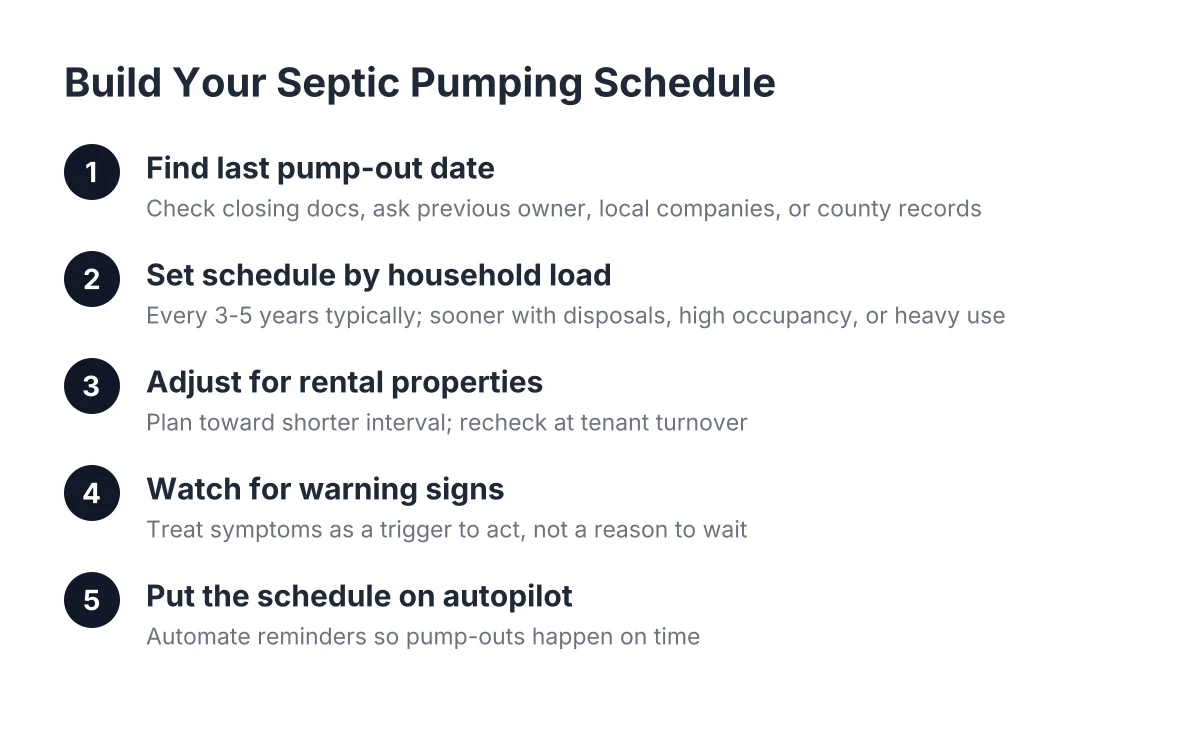
    Five-step process for building a septic pumping schedule for homeowners
    A step-by-step process for setting and maintaining a septic pumping schedule, as covered in this guide.

    If you just bought a house in Hesperia with a septic system, or you own a rental or two out here in the High Desert, the question of how often you need a septic pumping schedule probably nags at you. Nothing is wrong right now. The drains work. The yard smells fine. So it is tempting to put it off another year. The problem is that a septic tank fills whether you think about it or not, and the first obvious sign of trouble is usually the expensive one: a backup in the house or a soggy patch over the drain field.

    This guide walks you through how to build a pumping schedule you can actually stick to, step by step. No scare tactics, no pressure to buy things you do not need. Just the process a local crew that pumps tanks daily would recommend to a neighbor.

    Why Pumping Frequency Matters More Than Any Single Pump-Out

    A septic tank works by letting solids settle to the bottom as sludge while liquid flows out to the drain field. Over time the sludge layer grows. Once it gets deep enough, solids start escaping into the drain field, and that is where the real damage happens.

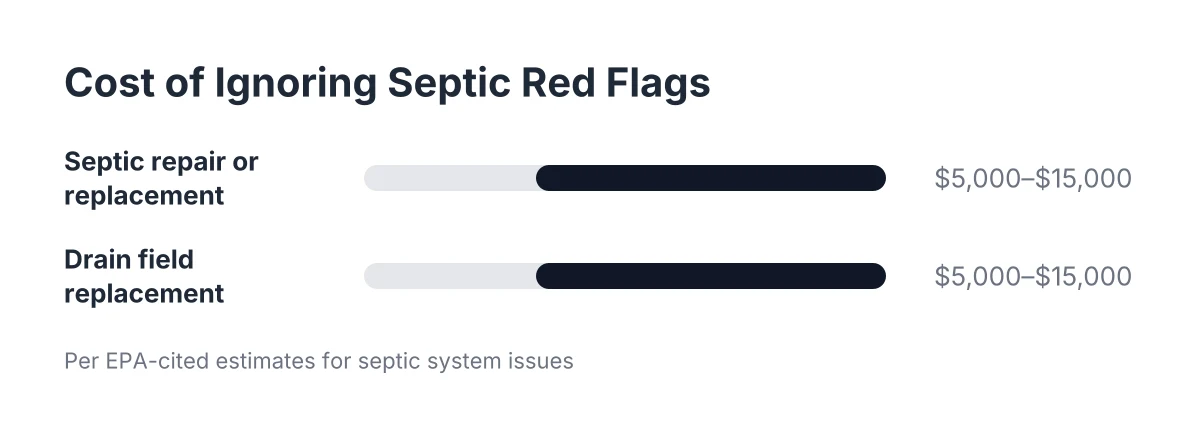
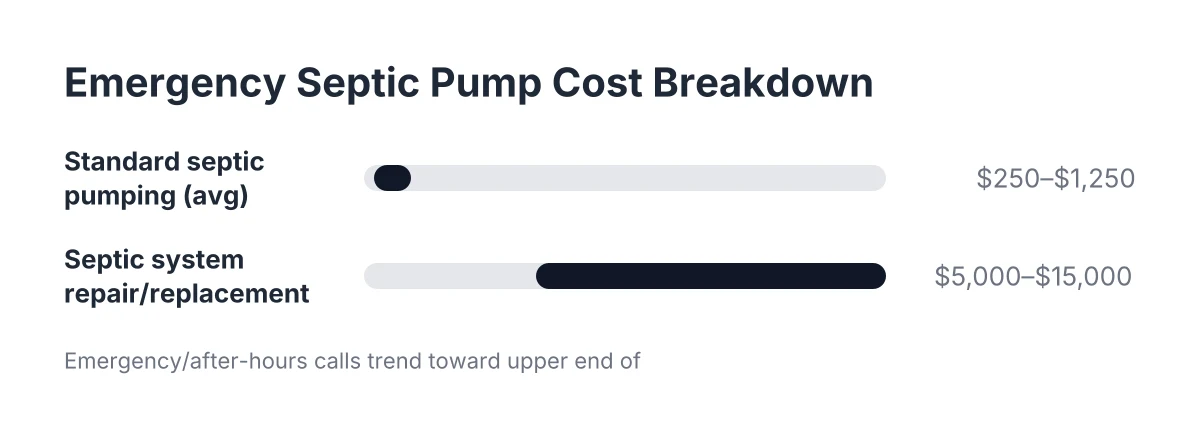
    Here is the math that should drive your decision. According to Angi, septic tank pumping averages $427, ranging from $250 to $1,250 or more depending on tank size and location. Meanwhile, the U.S. Environmental Protection Agency estimates septic repair or replacement typically costs between $5,000 and $15,000. Skipping a few hundred dollars in routine service to risk a five-figure repair is the worst trade in home ownership.

    Therefore, the goal is not to pump as rarely as possible. The goal is to pump on a schedule matched to your household, so you never find out the hard way that you waited too long.

    Step 1: Find Out When the Tank Was Last Pumped

    Start by digging up the tank's service history, because your schedule begins from the last pump-out, not from today. If you bought the house recently, check your closing documents and inspection report. Many buyers in Hesperia find a septic inspection or pumping receipt tucked into escrow paperwork and never noticed it.

    If the paperwork turns up nothing, try these in order:

    • Ask the previous owner or their agent directly; a quick email often gets an answer.
    • Call local septic companies and ask if they have a service record for the address.
    • Check with San Bernardino County for any permits or septic records on file.
    • Ask longtime neighbors; on septic streets, people remember whose truck was in whose driveway.

    If you still cannot confirm a date, treat the tank as overdue and schedule a pump-out now. That gives you a clean starting point, and the crew can tell you the tank's condition while it is open. For a landlord who inherited three rentals with zero records, this first baseline pump-out per property is the single most valuable step in this whole guide.

    Step 2: Creating Your Septic Pumping Schedule Based on Household Load

    How often should homeowners pump a septic tank? For most households, pumping every three to five years keeps sludge at a safe level, and the U.S. Environmental Protection Agency recommends a professional inspection at least once every three years. Your exact interval depends on tank size, how many people use the system, and what goes down the drains.

    Think of it as a simple ratio: more people and more water use fill the tank faster; a bigger tank buys you more time. A retired couple in a three-bedroom house fills a tank far slower than a family of six in the same house. Neither the calendar alone nor the tank alone tells the story; the combination does.

    Certain factors shorten the interval:

    • A garbage disposal. Ground-up food waste becomes sludge fast. The Massachusetts Department of Environmental Protection recommends annual pumping for homes with garbage disposals, regardless of tank size.
    • High occupancy. More people means more wastewater and more solids.
    • Heavy laundry and water use. Constant loads push water through the tank before solids fully settle.
    • An alternative system. Systems with pumps, float switches, or mechanical parts should be inspected once a year, according to the U.S. Environmental Protection Agency.

    However, do not guess in a vacuum. A crew that opens the tank can measure the actual sludge layer and tell you whether your interval should be three years, five years, or something in between. That measured answer beats any chart on the internet, including this one.

    Step 3: Adjust the Schedule for Rental Properties

    Rental properties need a tighter septic pumping schedule than owner-occupied homes, because you do not control what goes down the drains. Tenants change, occupancy shifts, and nobody calls you when the toilet gurgles until it becomes a Saturday night emergency. For a rental, plan toward the shorter end of whatever interval fits the household size.

    Consider a common Hesperia scenario. A landlord owns two septic-served rentals. One has a single tenant; the other houses a family of five with a garbage disposal. Same tank size, same street, wildly different schedules. The first property might go four or five years between pump-outs. The second may need service every year or two.

    For each rental, do three things:

    1. Get a baseline pump-out and note the sludge level the crew reports.
    2. Set the next service date based on that reading and the current occupancy.
    3. Re-check the schedule whenever tenants turn over, ideally with a pump-out or inspection between leases.

    A pump-out at turnover also protects you in a dispute. Documented septic service before a new lease makes it clear that a later clog came from use, not from a neglected system. Keep the invoices with your property records; they matter at sale time too.

    Step 4: Watch for Signs You Waited Too Long

    Warning signs mean the tank is already past due, so treat them as a trigger to act, not a reason to wait and see. Between scheduled pump-outs, you or your tenants should watch for:

    • Drains that run slow throughout the house, not just one fixture
    • Gurgling sounds from toilets or drains
    • Sewage odors inside, near the tank, or over the drain field
    • Wet, spongy, or unusually green grass above the drain field
    • Sewage backing up into tubs or floor drains, which is an emergency

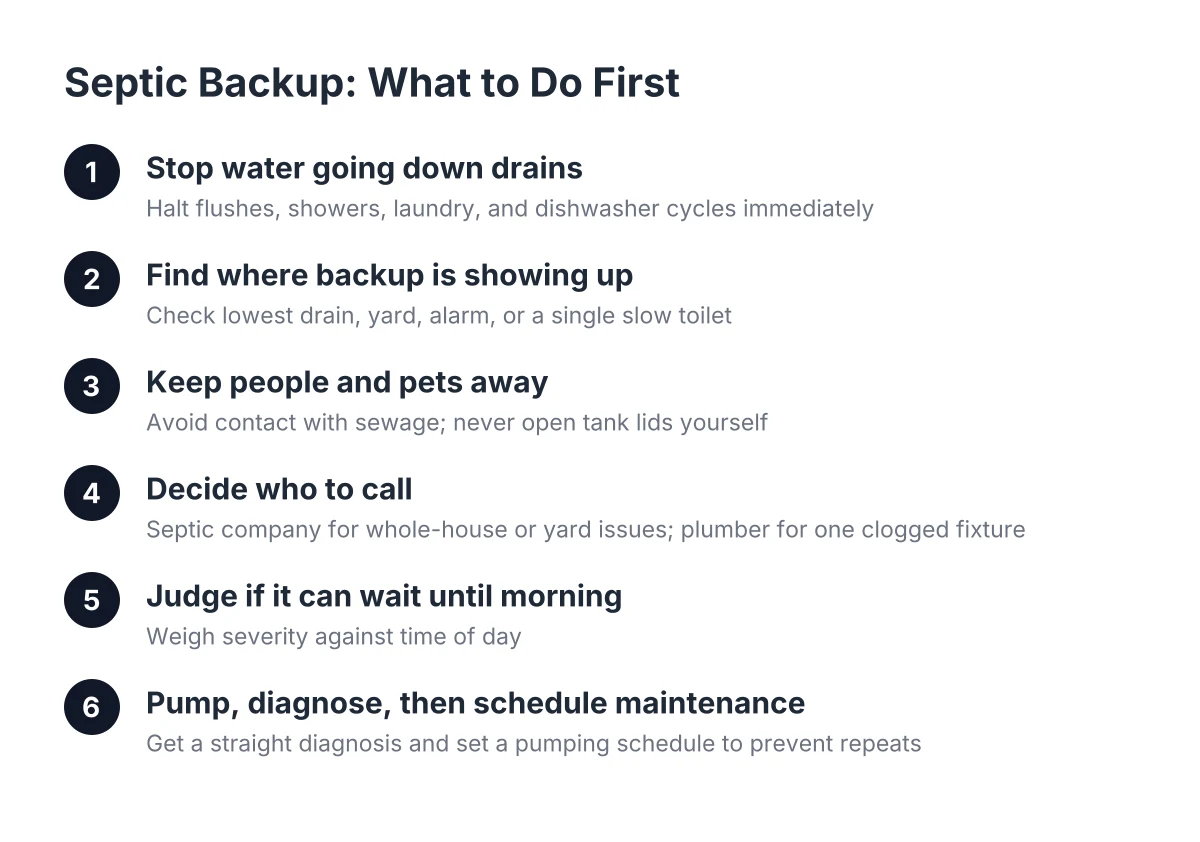
    For example, a slow kitchen drain by itself is probably a plumbing clog. Slow drains in every room of the house at once point to the septic system. If you see backup or standing sewage, stop running water and call for emergency septic pumping; running more water only pushes the problem further into the house.

    One honest caveat: pumping does not fix everything. If a drain field has already failed, pumping the tank buys time but does not repair the field. That is a situation where you need a professional assessment of the whole system, not just a truck and a hose.

    Step 5: Put the Schedule on Autopilot

    The final step is removing memory from the equation, because "a few years ago" is how every overdue tank starts. Most homeowners who end up with a backup did not decide to skip pumping; they just lost track. Beat that by making the schedule automatic.

    First, write down the date of your baseline pump-out and the sludge level the crew reported. Next, set a calendar reminder for the interval they recommend, and set a second reminder six months earlier so you have time to schedule without rushing. Then ask the septic company whether they keep service records and send reminders; a local outfit that works Hesperia tanks daily usually tracks this for repeat customers.

    For landlords, add septic dates to the same system you use for lease renewals and insurance. If a property manager handles day-to-day issues, make sure they know which properties are on septic and who to call, so a tenant complaint about slow drains gets routed correctly the first time.

    Know Your Tank Before You Set the Schedule

    The interval depends on the tank itself, not just the household. If you are not sure what is buried in your yard, these guides fill in the picture:

    Fixed Intervals vs. Inspections: Which Approach Defines a Septic Pumping Schedule?

    The best answer to how often should homeowners pump is both: keep a fixed interval as your default, and let inspections fine-tune it. The interval keeps you from drifting into "we'll get to it," while a measured sludge reading every few years tells you whether your interval is right for the way the house is actually used.

    In practice, that looks like this for 2026 and beyond. Pump now if you have no record of the last service. Ask the crew for the sludge level and a recommended interval. Put that date on the calendar, and adjust when life changes: a new tenant family, a new garbage disposal, or a house that goes from two occupants to six.

    Handled this way, septic tank pumping becomes a line item you plan for, like registration on a truck, instead of a crisis you react to. You will never be the house on the street with the smell in the yard, and your rentals will never lose a tenant to a preventable backup. That is the whole point of a schedule: a few hundred dollars on your terms, instead of thousands on the tank's terms.

    If you need your septic tank serviced, Hesperia Septic can help.

    Related Reading

  • 8 Signs Your Septic Tank Needs Pumping or Emergency Service Today

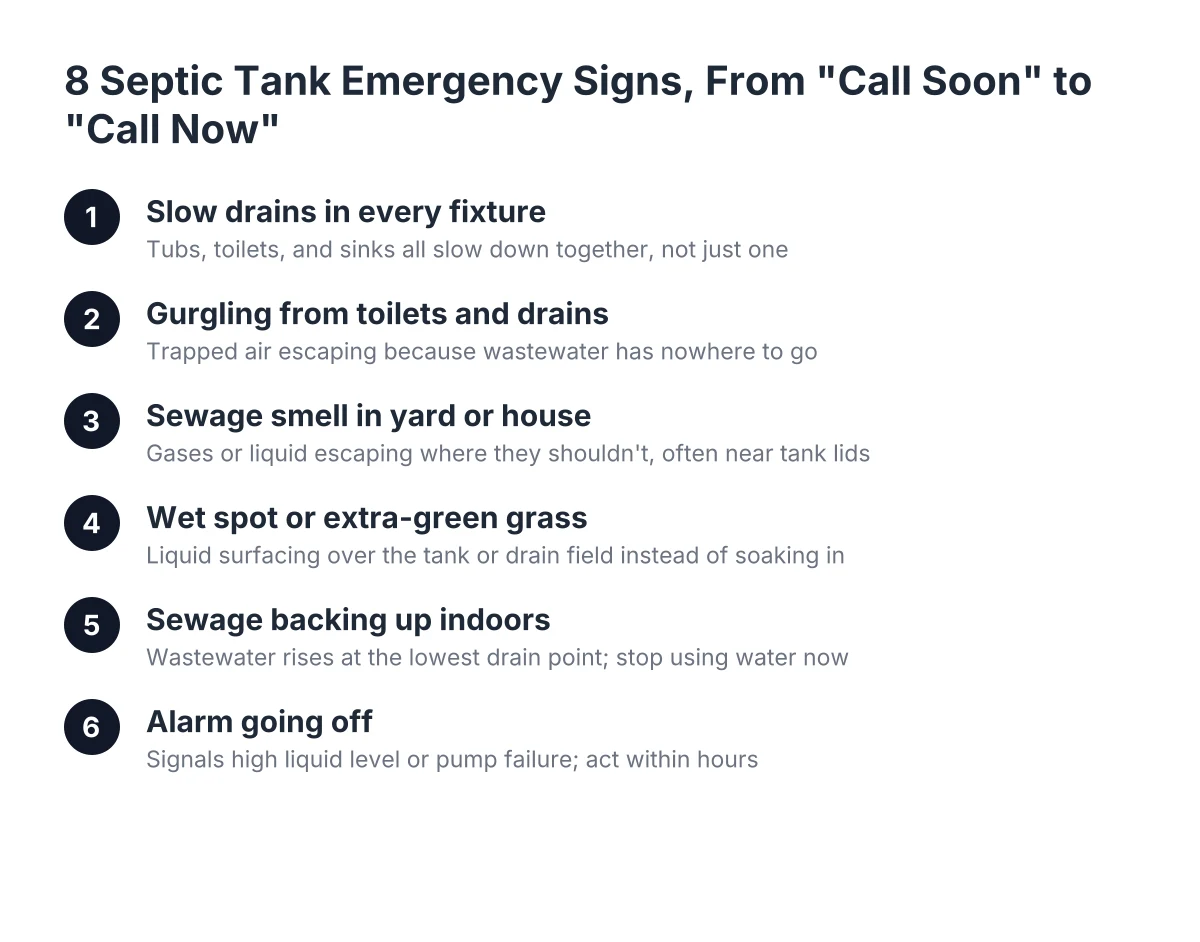
    Sequence of septic tank emergency signs from slow drains to alarm sounding
    The warning signs a septic tank needs pumping, ordered from earliest symptom to true emergency.

    A septic system rarely fails without warning. It sends up signals first, sometimes for weeks. The problem is that most people in Hesperia do not know which signals mean "schedule septic tank pumping soon" and which mean "get a crew out today before sewage ends up in the hallway." Understanding septic tank emergency signs helps you match the symptom to the likely cause and decide how fast to act. This guide walks through the signs your septic tank is full, backing up, or heading toward a bigger failure, so you can respond appropriately.

    That matters whether you live on the property or not. Homeowners usually notice trouble in the shower drain. Landlords and small business owners often hear about it secondhand, from a tenant texting about a smell or a health inspector flagging a grease trap. Either way, the symptoms below tell the same story.

    Here are the eight warning signs, roughly in order from "call soon" to "call now."

    1. Slow drains in every fixture, not just one

    One slow sink is usually a plumbing clog. Slow drains in every fixture at once, tubs, toilets, and sinks together, point to the septic system, not the pipes. When the tank fills past its working level or the outlet line clogs, the whole house drains against a backed-up tank, and everything slows down together.

    Run a quick test: flush a toilet on one end of the house while a sink drains on the other. If both struggle, the problem sits downstream of the house, in the tank or the drain field. This is one of the earliest and most reliable signs your septic tank needs to be pumped, and catching it here usually means a routine pump-out instead of an emergency call.

    2. Gurgling sounds from toilets and drains

    Gurgling is trapped air escaping through your plumbing because wastewater has nowhere to go. When the tank is full or the outlet is clogged, water pushes air back up the lines, and you hear it bubble through the toilet or a floor drain.

    Pay attention to timing. Gurgling after a laundry cycle or a long shower means the system is struggling with normal water volume. That is a full-tank symptom, and it tends to show up days or weeks before an actual backup. Treat it as your early warning, not background noise.

    3. Sewage smell in the yard or inside the house

    A septic tank smell in the yard, that rotten-egg odor near the tank lids or over the drain field, means gases or liquid are escaping where they should not. Outside, it often signals a tank at capacity or a leak at the lid or lines. Inside, odor from drains usually means gases are pushing back through the plumbing because the tank cannot vent or drain normally.

    For landlords, this is often the first septic tank emergency signs you hear about. A tenant in Hesperia reports "a sewer smell out back," and you are managing it from another city. Take that call seriously. Odor rarely resolves on its own, and it is one of the classic signs your septic tank is getting full or has a failing component. An inspection or pump-out now beats a habitability complaint later.

    4. A wet spot or extra-green grass over the tank or drain field

    In the High Desert, a soggy patch of ground that nobody is watering is hard to miss. A wet spot over the septic tank or drain field means liquid is surfacing instead of soaking into the soil. Sometimes the culprit is a tank so full that effluent escapes at the lid. Other times it is a saturated or failing drain field.

    Look for a strip of grass or weeds noticeably greener than everything around it, standing water with no irrigation source, or mushy soil near where the tank sits. These are textbook drain field failure symptoms. This one matters because pumping fixes a full tank, but a failed drain field is a different, larger project. According to the U.S. Environmental Protection Agency, septic repair or replacement typically runs $5,000 to $15,000, which is exactly why you want to catch problems while pumping can still solve them.

    5. Sewage backing up into tubs, showers, or floor drains

    Sewage in the house is the line between "schedule service" and "emergency." Wastewater always backs up at the lowest point first, usually a ground-floor tub, shower, or floor drain. If you see gray or black water rising there, the tank or main line is full and the system has nowhere left to send waste.

    Stop using water immediately. Every flush, load of laundry, and shower adds to what is already backing up. This is the point where emergency septic pumping is the right call, not a drain cleaner or a plunger. Backups are also a health issue; raw sewage indoors needs cleanup as well as pumping.

    6. Septic tank emergency signs: The alarm is going off

    If your system has an alarm, it exists for one reason: the liquid level in the tank is higher than it should be, or a pump has failed. Do not silence it and move on. An alarm gives you a short window, often less than a day of normal water use, before high water becomes a backup.

    Cut water use to the minimum and get the system looked at. Systems with pumps, float switches, or other mechanical parts also need more regular attention; the U.S. Environmental Protection Agency recommends inspecting those alternative systems once a year, compared with at least once every three years for a standard tank.

    7. You cannot remember the last pump-out, or you just took over the property

    Sometimes the biggest warning sign is not a symptom at all. It is a blank spot in the records. If you cannot answer "when was this tank last pumped," assume the answer is "too long ago." This comes up constantly with rental properties and small commercial buildings. A new owner takes over a Hesperia rental, the previous owner left no septic records, and nobody even knows where the tank is buried.

    In that situation, a septic inspection and tank locating visit answers the question directly. A crew finds the tank, checks sludge levels, and tells you whether you are due. That single visit turns an unknown into a maintenance schedule, which is exactly what an out-of-town landlord or restaurant manager wants: one less thing to babysit. Grease traps deserve the same treatment; if an inspector flagged yours, waiting only makes the citation worse.

    8. Extra water is overloading the system

    A septic tank can be "full" because of sludge, or because too much water is hitting it too fast. According to the U.S. Environmental Protection Agency, a single leaky or running toilet can send as much as 200 gallons of extra water per day into a septic system. That alone can push a marginal tank into backup territory.

    Before assuming the worst, check for these water sources:

    • A toilet that runs or hisses between flushes
    • A dripping faucet or a water softener that cycles constantly
    • Laundry habits, like running five loads back to back on a Saturday
    • Irrigation or roof runoff draining toward the tank or drain field

    Fixing the water problem sometimes buys the system relief. However, if symptoms continue after the extra water stops, sludge in the tank is the likely cause, and pumping is the fix.

    How do I know if my septic tank is full or actually failing?

    A full septic tank causes slow drains, gurgling, odors, and backups that improve immediately after septic tank pumping. A failing system shows the same symptoms, but they return within days or weeks of a pump-out, often with wet ground or sewage surfacing over the drain field. Pumping fixes full; it only postpones failing.

    That distinction is the whole point of septic system troubleshooting: match the symptom to the cause before spending money. As a rough guide, one or two early signs, slow drains and gurgling, usually mean the tank needs to be emptied. Multiple signs at once, especially odors plus wet ground plus backups, suggest the drain field or another component is involved.

    There is an honest limit to what you can diagnose from the surface, though. Sludge levels, baffle condition, and drain field saturation can only be confirmed by opening the tank. If symptoms persist after pumping, or you see sewage surfacing outdoors, bring in a professional rather than guessing. Older properties add another wrinkle; some old types of septic systems, like undersized single-compartment tanks or cesspools, fail in ways a modern tank does not, and they need an experienced eye.

    What to do when you spot the signs your septic tank is in trouble

    React based on severity, not panic. Early symptoms buy you time to schedule; backups and alarms do not.

    1. Sewage indoors or an alarm sounding: stop all water use and call for emergency septic pumping the same day.
    2. Odors, gurgling, or slow drains house-wide: cut back water use and schedule pumping within days, not weeks.
    3. Wet spots or surfacing sewage outside: keep people and pets away and request an inspection along with the pump-out.
    4. No records or a new property: schedule septic tank locating and an inspection to establish a baseline.

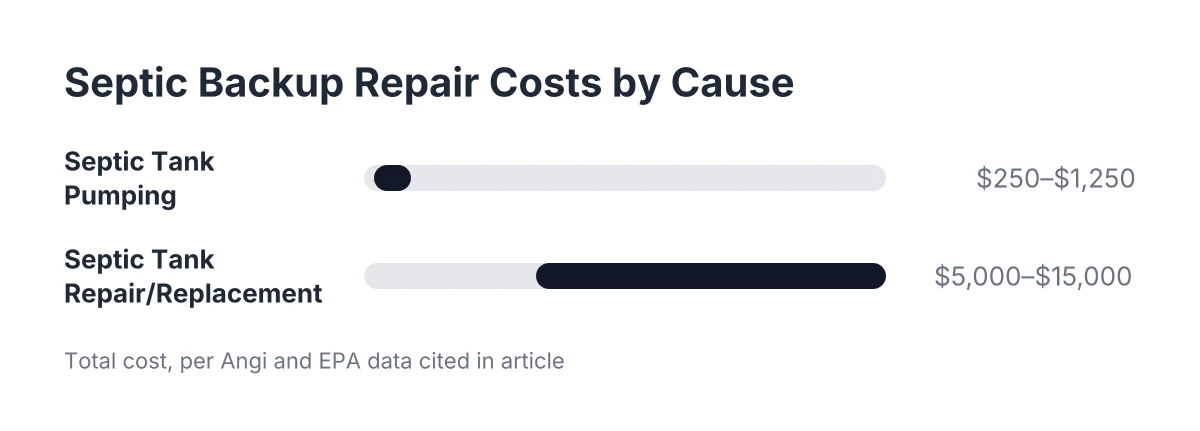
    Cost-wise, catching it early pays. According to Angi, septic tank pumping averages $427, typically ranging from $250 to $1,250 depending on tank size and location. Compare that with the EPA's $5,000 to $15,000 estimate for repair or replacement, and the math argues for acting on the first sign, not the fifth.

    One last note for anyone managing property with Spanish-speaking tenants: if a tenant mentions a problem with the "alcantarillado," that is sewer in Spanish, though on a septic property the complaint almost always traces back to the tank or drain field, not a city line. The signs your septic tank sends are the same in any language: slow drains, bad smells, wet ground, and backups. Read them early, and a Hesperia crew with a pump truck can usually handle the rest in a single visit.

    If you need your septic tank serviced, Hesperia Septic can help.

    Related Reading

  • Septic Tank Capacity Guide: Choosing the Right Size for Hesperia Homes

    septic tank size rental

    If you own rental property in Hesperia, or you're staring down a septic system that keeps backing up, understanding septic tank size rental options and requirements matters more than most owners realize. This septic tank capacity guide walks through how tank capacity works, how to figure out what size your property has, and how to tell whether your problems come from an undersized tank, a neglected one, or a system that has genuinely reached the end of its life. Just as important, it covers the part most articles skip: when capacity is not the problem at all, and a straightforward septic tank pumping is all you need.

    That last point deserves emphasis up front. Plenty of Hesperia property owners get told they need a bigger tank or a whole new system when the real issue is a tank that has not been pumped in years. Before you spend serious money, you should understand how capacity, usage, and maintenance fit together. This guide is written for owners who are already committed to fixing the problem and want to get it right the first time.

    Why Tank Capacity Matters More for Rental Properties

    Septic tank capacity is the working volume of the tank, measured in gallons, that holds wastewater long enough for solids to settle before liquid moves out to the drain field. When a tank is too small for the household using it, solids get pushed out to the drain field before they settle. That is how drain fields fail early.

    Here is why this hits landlords harder than owner-occupants. You do not control how many people live in the unit or how much water they use. A tank that was sized for a retired couple in 1985 may now serve a family of six. According to the U.S. Environmental Protection Agency, average indoor water use can reach up to 70 gallons per person per day, and every one of those gallons enters the septic system.

    Do the math on a four-bedroom rental. Six occupants at 70 gallons each is 420 gallons flowing into the tank every day. A small or aging tank handles that load poorly, especially if it is already half full of accumulated sludge. The result is the phone call every landlord dreads: slow drains, a smell in the yard, or sewage backing up into the tub while you are two hours away.

    Capacity also matters at turnover. If you are re-leasing a unit and the incoming tenants are a larger household than the last one, the same tank will fill faster and need pumping more often. Knowing your tank's actual capacity lets you plan service instead of reacting to emergencies.

    How Septic Tank Size Rental Requirements and Sizing Work

    Septic tank size guidelines in most jurisdictions tie minimum tank capacity to the number of bedrooms in the home, not the number of current occupants. Bedrooms are a proxy for potential occupancy. A three-bedroom house is assumed to house more people than a two-bedroom house, so it requires a larger minimum tank.

    Common residential tanks in the High Desert fall in the 1,000 to 1,500 gallon range, with smaller and larger tanks on older or unusual properties. The general pattern in septic tank size and capacity charts looks like this:

    • Smaller homes with one or two bedrooms typically sit at the lower end of tank capacity.
    • Three-bedroom homes, the most common configuration, usually require a mid-range tank, often around 1,000 gallons in many jurisdictions.
    • Four and five-bedroom homes step up from there, since more bedrooms mean more potential daily flow.
    • Adding bedrooms, an ADU, or a second unit on the parcel usually triggers a requirement for more capacity.

    Treat any generic septic tank capacity chart as a starting point, not a final answer. San Bernardino County sets its own requirements, and the county, not a chart on the internet, decides what passes inspection. If you are permitting new construction, an addition, or a septic system replacement in 2026, the county's current standards govern the design, and a qualified designer or contractor should run the numbers.

    Soil matters too. Hesperia sits on High Desert soil that ranges from fast-draining sand to compacted spots that percolate slowly. Percolation results shape the drain field design more than the tank, but the tank and field work as one system. An oversized tank paired with an undersized field still fails.

    Septic Tank Capacity Per Person: The Practical View

    Bedroom-based sizing is what the code uses, but as an owner, the per-person view is more useful day to day. Every additional occupant adds daily flow and speeds up sludge buildup. Two properties with identical 1,000 gallon tanks can need service on completely different schedules based on who lives there.

    For example, a Hesperia landlord with two rentals might pump one tank every few years and the other far more often, simply because one house has two occupants and the other has seven. Same tank capacity, different reality. This is why smart owners track occupancy alongside pumping dates for each property.

    Using This Septic Tank Size Rental Guide to Find Your Tank Size

    The fastest way to find your septic tank's capacity is to check the permit records San Bernardino County holds for your parcel, which usually list tank size and system layout. If no records exist, a service crew can locate the tank, open it, and estimate capacity from its dimensions during a pump-out.

    Start with paperwork. When you bought the property, the disclosures or inspection report may have listed the tank size. County environmental health records are the next stop; many systems in the Hesperia area were permitted, and those permits describe the installed tank.

    However, plenty of High Desert properties have no useful records at all. Older homes, owner-built systems, and parcels that changed hands several times often come with nothing but a vague wave toward the backyard. If that is your situation, septic tank locating is the first real step. A crew finds the tank, exposes the lids, and can measure the tank while pumping it.

    Measuring during a pump-out is the most reliable field method. Once the tank is empty, its length, width, and depth are visible, and capacity is simple geometry. You also learn the tank's material and condition at the same time, which matters for the replacement question covered below. Ask the crew to note the estimated capacity on your service record so you have it for every future decision.

    Keep that record. As a small landlord, your septic file for each property should include tank location, estimated capacity, pumping dates, and any problems observed. That file turns every future service call from a mystery into a routine appointment, and it gives you documentation if a tenant dispute or habitability question ever comes up.

    Is Your Tank Too Small, Too Full, or Too Far Gone?

    A backed-up septic system in Hesperia usually traces to one of three causes: a tank overdue for pumping, a tank undersized for current occupancy, or a failing drain field. Only the third typically points toward replacement. Pumping resolves the first, and management changes or added capacity address the second.

    This is the honest part of any septic tank capacity guide, and the part that protects you from unnecessary upsells. The symptoms of all three problems overlap. Slow drains, gurgling, odors, and backups can come from any of them. What separates them is what the crew finds when the tank is opened.

    Consider the difference in cost. Angi reports that septic tank pumping averages $427, ranging from $250 to $1,250 or more depending on tank size and location. The EPA estimates septic tank repair or replacement typically costs between $5,000 and $15,000. Confirming which problem you actually have is worth far more than the price of a pump-out and inspection.

    Signs the Problem Is Just an Overdue Pump-Out

    A tank that is simply full behaves badly, then behaves fine after pumping. If drains run slow across the whole house, the tank has not been pumped in years, and the crew finds heavy sludge but a structurally sound tank and a dry drain field area, you probably do not need anything more than a pumping schedule.

    The U.S. Environmental Protection Agency recommends a professional septic inspection at least once every three years for the average household. For a rental with heavy occupancy, treat that as a ceiling, not a target. Tie inspections to tenant turnover when you can; an empty unit is the easiest time to service the system without disrupting anyone.

    Signs the Tank Is Undersized for the Household

    An undersized tank fills fast and pushes solids toward the drain field. The tell is a pattern: the system works fine after pumping, then problems return within months instead of years. If the crew pumps the tank and you are calling them back the same year with the same tenants, capacity and usage are out of balance.

    You have options short of a new tank. Fixing leaking toilets and fixtures cuts daily flow. Spreading out laundry loads helps. In some cases, adding tank capacity or upgrading the system makes sense, and that is a conversation to have with a designer working under current San Bernardino County requirements.

    Signs the Drain Field Is Failing

    Drain field failure looks different. Watch for soggy or unusually green patches over the field, sewage odor outdoors that persists after pumping, or backups that return within days of a pump-out. A drain field that cannot accept water anymore will send it back toward the house or up to the surface, no matter how big the tank is.

    Therefore, if pumping buys you only days of relief, stop pumping and start evaluating. Repeated emergency pump-outs on a dead field are money spent on a symptom. At that point, a full inspection and a conversation about replacement or field repair is the responsible move, both for your budget and for your tenants.

    What Replacement Involves When Capacity or Condition Falls Short

    When inspection confirms the tank is cracked, collapsed, or badly undersized, or the drain field has failed, replacement moves from fear to project. In San Bernardino County, that means permits, a site evaluation, a system design sized to the home, installation, and final inspection before the system goes back into service.

    The permitting step is where capacity questions get settled for good. The county's environmental health process looks at bedrooms, lot conditions, and soil, then sets the required tank size and drain field dimensions. This is also where system type gets decided. Most Hesperia properties use a conventional septic system, a tank plus a gravity drain field. Where soil or site conditions rule that out, alternatives like an aerobic septic system or a mound septic system may come into play, though these are less common in High Desert conditions and cost more to install and maintain.

    For a small landlord, the practical concerns are timeline and tenant disruption. Excavation, tank setting, and field construction take days, not hours, and the yard will be torn up during the work. Plan around vacancy when possible. If the unit is occupied, coordinate portable facilities or temporary arrangements with your tenants before the backhoe arrives, not after.

    One caution: septic system design is not a do-it-yourself estimate. Soil percolation, setbacks from wells and property lines, and county code all interact, and getting it wrong means failed inspections and redone work. Use this article to understand the process and ask sharp questions, then let a qualified professional handle the design and permitting.

    It is worth remembering that septic is the norm out here, even though California overall has one of the lowest shares of homes on septic among U.S. states, at about 10 percent according to the U.S. Environmental Protection Agency. In Hesperia and the surrounding High Desert, unsewered parcels are common, so local crews deal with these systems, these soils, and this county's process constantly.

    A Working Owner's Plan: Capacity, Records, and a Service Rhythm

    Knowing your tank capacity is only useful if you act on it. The goal for a small rental owner is simple: no surprises, no emergency calls from tenants, and a paper trail for every property. Here is a plan you can run without babysitting it.

    1. Identify the tank on each property. Pull county records, or schedule septic tank locating if the records are missing.
    2. Get each tank pumped and measured. Record the estimated capacity, tank material, and condition on the invoice.
    3. Match capacity to occupancy. Note how many people live in each unit and flag any property where a small tank serves a large household.
    4. Set an inspection and pumping rhythm per property. Heavier occupancy means shorter intervals; tie service to lease turnover where you can.
    5. Keep every invoice and disposal record in the property file. Documentation of proper waste disposal protects you on compliance and habitability questions.
    6. Reassess whenever occupancy changes. New tenants with a bigger household means revisiting the schedule, not waiting for the smell.

    In addition, give your tenants one instruction that protects the system more than any other: the toilet and drains are not a trash can. Wipes, grease, and heavy garbage disposal use fill a tank with solids fast and shorten drain field life. A single paragraph in the lease about septic care costs you nothing and saves real money.

    If you also run a business out here, the same logic extends beyond houses. Grease trap pumping for a restaurant, RV and holding tank pumping for a cabin or travel trailer, and rental property septic service all follow the same principle: know the capacity, know the usage, and service on a schedule instead of in a crisis.

    The Bottom Line on Tank Size in Hesperia

    Capacity questions come down to three numbers: how big the tank is, how many people use it, and how long since it was last pumped. Most septic trouble in Hesperia traces to the third number, not the first. Pump and inspect before you assume the worst, because a $250 to $1,250 pump-out that solves the problem beats a five-figure replacement you did not need.

    At the same time, do not pump a dead system forever. When backups return within days, the field stays wet, or the tank itself is failing, replacement is the honest answer, and the county permitting process will set the right capacity for the property going forward. Either way, this septic tank capacity guide should leave you with the questions to ask and the records to keep, so the next septic decision on any of your properties is a planned one.

    If you need your septic tank serviced, Hesperia Septic can help.
    Related Reading

  • 7 Signs Your Septic System Needs Replacement, Not Just Another Pumping

    Checklist comparing signs a septic system just needs pumping versus signs it needs replacement
    Use this quick comparison to tell a routine pumping issue apart from true septic system failure.

    Nobody wants to hear that a tank pump-out will not fix the problem. However, some of the signs septic system failing are pumping problems, and some point to a system that has reached the end of its life. The difference matters, because pumping a tank runs a few hundred dollars while replacing a system runs thousands. This article lays out seven signs that separate the two, so you can push back on an unnecessary upsell or face a real replacement with your eyes open.

    Here in Hesperia and the High Desert, this question comes up constantly. More than one in five U.S. households depend on individual septic systems or small community cluster systems to treat their wastewater, according to the U.S. Environmental Protection Agency, and out here that share is higher. If you just bought land with no septic records, or you have maintained your system for years and something changed, the list below is for you.

    First, the honest baseline: most septic problems do not require replacement

    Most of what people call "septic failure" is actually a full tank, a clogged line, or a broken component. Septic tank pumping, a line clearing, or a baffle repair fixes the majority of calls a local crew runs. The U.S. Environmental Protection Agency estimates septic tank repair or replacement typically costs between $5,000 and $15,000, far more than routine pumping, so anyone telling you to replace should be able to show you evidence, not just say the word "failing."

    That is the standard to hold every recommendation against. A trustworthy crew will pump the tank, look at what happens next, and explain what they see in plain terms. If the tank fills back up from the drain field within hours or days of pumping, that is a system problem. If it takes years to fill again, pumping did its job.

    With that baseline set, here are the seven signs that point past pumping toward septic system replacement.

    1. The tank fills back up right after pumping

    This is the clearest sign on the list. A healthy tank sends liquid out to the drain field and fills gradually over years. If your tank is full again within days or weeks of a pump-out, the drain field is not accepting water, and the wastewater has nowhere to go.

    At that point, pumping is a bandage, not a fix. You can keep paying for pump-outs to buy time, but the underlying problem is septic drain field failure, and no amount of pumping repairs soil that will not drain. This is the moment to get a real inspection instead of scheduling another truck.

    2. Sewage surfaces in the yard over the drain field

    Wet, spongy ground, standing gray water, or a sewage smell over the drain field means effluent is rising instead of soaking down. In the High Desert this stands out fast; a green, lush stripe of grass in an otherwise dry Hesperia yard is a classic tell. The soil under the field has likely clogged with a black, tar-like layer called biomat.

    Occasionally, surfacing sewage traces back to a crushed pipe or a distribution box problem, which is a repair, not a replacement. However, if the whole field is soggy rather than one spot, the field itself has failed, and a new field or new system is usually the answer.

    How to know if signs septic system failing or truly a clog

    A clog shows up suddenly and usually affects the house first; drains slow down or back up all at once, often after heavy use. Failure develops gradually and shows up in the yard, with wet ground, odors, and a tank that stays full. A clog clears and stays cleared; a failing field gets worse every season no matter what you snake or pump.

    One practical test: have the tank pumped and the lines checked. If everything drains fine afterward and stays that way, you had a clog or a full tank. If symptoms return within weeks, you are looking at the system itself.

    3. Backups keep returning after every fix

    One backup after ten years is a maintenance event. Backups every few months, after you have already pumped the tank and cleared the lines, indicate signs septic system failing. Repeated septic backup means wastewater keeps hitting a wall somewhere, and pumping only resets the clock.

    For a homeowner who has kept up on maintenance for years, this pattern change is the signal to watch. Your system behaved for a decade, and now it does not. Something downstream of the tank, usually the field, has stopped doing its job.

    4. The tank itself is cracked, collapsed, or corroded

    Sometimes the field is fine and the tank is the problem. Older concrete tanks can crack or lose their baffles; steel tanks rust through; lids and risers crumble. During a pump-out, the technician can see the inside of the tank, and that view tells the story.

    A cracked tank leaks wastewater into the surrounding soil before treatment, and it can also let groundwater in, which overloads the field. Depending on the damage, this may mean replacing only the tank rather than the entire system, which is a meaningfully smaller job. Either way, patching a failing tank rarely holds.

    5. The system is past its expected lifespan and the problems are stacking up

    Septic system lifespan varies with soil, water use, and maintenance, but no system lasts forever. Drain fields in particular have a finite working life because the soil slowly clogs even with perfect care. Age alone is not a reason to replace; age plus recurring symptoms is.

    Think of it like a roof. You do not replace a 30-year-old roof that is not leaking, but you also stop paying for patches when leaks show up in three places at once. If an aging system needs a repair every year, replacement usually becomes the cheaper path over a five-year window.

    6. You bought property with no records and the inspection tells a bad story

    This scenario plays out across the High Desert every year. A buyer picks up five acres outside Hesperia, there is no visible lid or riser, the seller has no paperwork, and nobody can say when the tank was last pumped. The first step is a septic tank locating service to find and mark the tank, followed by an inspection with the tank open.

    What the inspection finds decides everything. Here is what typically separates a livable system from a replacement on a no-records property:

    • Solids near the outlet or a missing baffle: usually fixable with pumping and a repair.
    • A tank that is structurally sound but overfull: pump it and monitor.
    • Effluent standing at or above the outlet with a saturated field: the field has failed.
    • An undersized or homemade tank that never met code: plan on replacement.
    • Evidence of past surfacing, like stained soil or old repair trenches: budget for a new system.

    Therefore, if you are in escrow, get the locate and inspection done before you close, and get the findings in writing. A few hundred dollars for an inspection is cheap insurance against inheriting a five-figure problem. If the report is bad, you can renegotiate, ask for a credit, or walk.

    7. Well water tests or neighbors flag contamination

    A failing system does not just inconvenience you; it releases untreated wastewater into the soil. If a well water test shows bacteria or nitrates, or a neighbor reports odors and wet ground near your property line, take it seriously. Contamination signs mean the system is failing at its actual job, treating wastewater, even if your drains still work fine indoors.

    This is also where the county gets involved. In San Bernardino County, a failed system generally cannot be rebuilt informally; septic system permits go through the county's environmental health process, which reviews soil conditions and system design before approving a replacement. As of 2026, expect the permitting step to add time to the project, so start the paperwork early rather than after the yard floods.

    Signs your septic system just needs pumping, not replacement

    Signs your septic system needs to be pumped, rather than replaced, include slow drains throughout the house, gurgling pipes, mild odors near the tank lid, and a backup after years of no service. These symptoms come from a full tank, and a routine septic tank pumping visit resolves them. According to Angi data, the cost of septic tank pumping averages $427, ranging from $250 to $1,250 or more depending on tank size and location, which is a fraction of any replacement.

    In addition, the U.S. Environmental Protection Agency recommends the average household have its septic system inspected at least once every three years by a professional. Alternative systems with pumps or float switches should be inspected once a year, per the same EPA guidance. For a homeowner who plans ahead, that schedule catches most problems while they are still pumping problems, not replacement problems.

    Watch for these pump-it signals rather than panic signals:

    • Every drain in the house is slow, not just one fixture
    • Gurgling from toilets or drains after you run water
    • It has been years since the last pump-out, or you have no record of one
    • A single backup event with no yard symptoms afterward

    What replacement actually involves if you do need it

    The septic tank replacement process starts with a site evaluation and soil testing, then county permitting, then excavation and installation of the new tank and drain field. If you have heard the question "what are the 3 types of septic systems," it comes up here: conventional gravity systems, pressure-distribution systems, and alternative or engineered systems for difficult soils. The soil on your lot, not your preference, largely decides which type the county will approve.

    Timeline-wise, permitting and design usually take longer than the dig itself. During the work, you may need to limit water use or arrange temporary accommodations for a short stretch. It is a disruptive project, which is exactly why it should never be sold to you casually.

    One honest limitation: no article can diagnose your system from a distance. Soil conditions, tank construction, and field layout vary lot to lot across Hesperia, and a real answer requires opening the tank and looking. Use this list to ask sharper questions, not to skip the inspection.

    The bottom line for Hesperia property owners

    Learning to recognize signs septic system failing comes down to one pattern: symptoms that return after pumping point to the system, and symptoms that stay gone point to maintenance. One backup, one slow drain, or one odor near the lid is a service call. A soggy field, a tank that refills in days, and repairs stacking up year after year are the signs your septic system has run out of road.

    Either way, insist on evidence before you spend replacement money. A crew that opens the tank, shows you what it sees, and explains the difference between a pumping problem and a field problem is the crew worth listening to.

    If you need your septic tank serviced, Hesperia Septic can help.
    Related Reading

  • How Much Does Septic System Troubleshooting Cost?

    septic system cost

    There is no single honest answer to the question of septic system cost, because the price depends on what is actually wrong. A tank that just needs pumping is a different job than a drain field that has stopped taking water, and the gap between those two bills is wide. The three things that move the price most are what the problem turns out to be, how hard your tank is to reach, and whether you are calling on a normal schedule or in the middle of a backup. This guide walks through each of those factors in plain terms, so by the end you will know exactly what to tell a septic company to get a real number for your Hesperia property instead of a guess.

    What Drives the Septic System Cost of Troubleshooting

    Septic pricing is not random. When a crew quotes your job, they are weighing a handful of specific things. Here are the ones that matter.

    What the problem actually is

    This is the biggest lever by far. Slow drains and a sewage smell can mean a full tank that needs septic tank pumping, a clogged line, a failed baffle, or a drain field that is saturated and done. Pumping and cleaning sit at the low end of the scale. Repairs to tank components cost more. A full replacement of the tank or the leach field is the expensive version, and it is a different category of project entirely. You can get a rough read on which side you are on by the symptoms: if the problem started suddenly and the tank has not been pumped in years, pumping may solve it. If water pools over the drain field or the problem keeps coming back after pumping, you are likely looking at something bigger. An inspection tells you for sure, which is why troubleshooting usually starts there.

    How accessible your tank is

    Every septic job starts with finding and opening the tank. If your lids are at grade and you know where they are, the crew gets to work fast. If the tank is buried under two feet of soil, a patio, or landscaping, someone has to locate it and dig it up first, and that labor goes on the bill. Additionally, if you have no idea where your tank is, septic tank locating is its own step. Walk your yard before you call. If you can point to the lids, say so; it makes your quote tighter and cheaper.

    Emergency timing versus scheduled service

    A backup on a Saturday night costs more to fix than the same problem handled on a scheduled weekday visit. Emergency septic pumping means a crew drops what it is doing and comes out, and that urgency is priced in. You do not always get to choose; sewage backing into a tub is not a wait-until-Tuesday problem. But if your symptoms are early, slow drains, gurgling, a smell in the yard, calling before it becomes an overflow keeps you on the cheaper side of this line.

    Tank condition and how long it has been

    A tank pumped on a regular schedule empties fast. A tank that has been neglected for many years builds up a hardened layer of solids that takes extra time and effort to break up and remove, which is where septic tank cleaning goes beyond simple pumping. If you cannot remember the last time your tank was pumped, budget for the more involved version. If you have receipts from a service in recent memory, say so when you call.

    How much diagnosis the job needs

    Sometimes the problem is obvious. Sometimes it takes a septic system inspection to figure out whether the issue is in the tank, the line between the house and the tank, or the drain field. Diagnostic work adds cost up front, but it is usually money well spent because it keeps you from paying for the wrong fix. Guessing wrong on a septic problem is far more expensive than an inspection.

    Whether repair or replacement is on the table

    Queries like "cost of septic tank replacement" and "cost to install septic tank and leach field" describe a different project than troubleshooting. Replacement involves excavation, permits, materials, and sometimes soil testing, and each of those adds cost that a pump-out never touches. An aerobic septic system cost question is bigger still, since aerobic systems add mechanical components a conventional gravity system does not have. The honest news: most septic problems do not end in replacement. Get the system inspected before you assume the worst.

    Cost Factor Table

    Factor Pushes the price down when… Pushes it up when…
    Nature of the problem The tank just needs pumping or cleaning The drain field or tank itself has failed
    Tank access Lids are exposed and you know where they are The tank must be located and dug up
    Timing You schedule service before a crisis You need emergency response for a backup or overflow
    Tank condition The tank has been pumped on a regular schedule Solids have hardened after years of neglect
    Diagnosis needed Symptoms clearly point to one cause The crew must inspect and test to find the failure
    Repair vs. replacement A component fix restores the system The tank or leach field needs full replacement

    How to Get an Accurate Septic System Cost Estimate

    Phone estimates for septic work are educated guesses until someone sees your system. But you can make that guess much sharper by having the right information ready when you call.

    Before you pick up the phone, gather what you can:

    • Your symptoms, specifically. Slow drains in one bathroom is different from sewage in the yard. Describe what you see, where, and when it started.
    • Tank location, if you know it. Point to the lids or the general area. If you have no idea, say that too, so locating is quoted up front instead of appearing as a surprise line item.
    • Service history. When was the tank last pumped? Even a rough year helps.
    • Property details. Home size, number of people living there, and anything sitting on top of where the tank might be, like a deck or driveway.

    A good quote should tell you what is included and what is not. Ask whether the price covers digging to reach the lids, whether locating is extra, what happens to the price if the tank needs cleaning beyond a standard pump-out, and what an inspection costs if the pump-out does not solve the problem. A quote that answers those questions is worth more than a lower number that answers none of them.

    Estimates differ between providers for real reasons: different disposal costs, different equipment, different assumptions about your tank. That is why two or three quotes beat one. When the quotes disagree, ask each company what they assumed. The one that asked you the most questions before quoting is usually the one that priced your actual job instead of a generic one.

    Ways to Keep the Cost Down

    You cannot coupon your way out of a septic problem, but you can avoid paying the expensive version of it.

    • Call at the first symptom, not the flood. Slow drains and gurgling are your warning window. Scheduled septic tank pumping costs less than an emergency call for a backup, and it may prevent the backup entirely.
    • Keep your tank on a pumping schedule. Regular septic tank service and maintenance is the single cheapest thing in this entire guide. It prevents the hardened buildup that makes cleaning harder, and it protects the drain field, which is the part you least want to replace.
    • Know where your tank is. Mark the lids or keep a sketch of the location. Every future service call gets faster and cheaper when the crew is not hunting for your tank.
    • Get two or three quotes for anything beyond routine pumping. For a repair or replacement, quotes can vary a lot. Comparing them costs you nothing but a few phone calls.
    • Pay for an inspection before a big repair. A septic system inspection that confirms the real problem protects you from paying for a fix that does not fix anything.

    Cost Questions People Ask

    What does septic tank cost mean for pumping versus replacement?

    They are different questions with different answers. Pumping is routine service: a truck, a crew, and a few hours. Replacement means excavation, a new tank, permits, and often drain field work, so it lands in a much higher bracket. When you search "septic tank cost," decide first which problem you actually have, and let an inspection settle it if you are not sure.

    Why does the cost to install septic tank and leach field vary so much?

    Because the ground itself is part of the price. Soil type, lot layout, local permit requirements, and how well your soil absorbs water all change the design and the labor. Two neighbors in Hesperia can get different quotes for the same reason two lots can have different soil. The only accurate number comes from someone who has looked at your property.

    Is an aerobic septic system cost higher than a conventional one?

    Generally yes, because aerobic systems add mechanical parts, an air pump and treatment components, that a conventional gravity system does not have. Those parts also mean ongoing maintenance a basic tank never needs. Whether you need one usually comes down to your soil and local requirements, not preference, so ask during your site evaluation.

    Will pumping my tank fix a backup?

    Sometimes, and it is usually the right first step. If the tank was simply full, pumping solves it. If the backup returns quickly after pumping, the problem is likely downstream in the line or the drain field, and pumping alone will not cure it. A crew that pumps your tank can usually tell you a lot about what they see inside, which points to the next step.

    The Bottom Line

    The honest septic system cost picture is this: routine septic tank pumping is affordable and predictable, repairs cost more, and replacement is the expensive outcome that regular maintenance exists to prevent. You cannot know which category you are in from a search result; you know it from an inspection of your actual tank. Get two or three quotes, have your symptoms and tank location ready when you call, and act while the problem is still small.

    If you need your septic tank serviced, Hesperia Septic can help.
    Related guide: septic system troubleshooting — Complete Guide

    Related Reading

  • Septic Tank Pumping vs. Repair Costs: When Pumping Solves the Problem

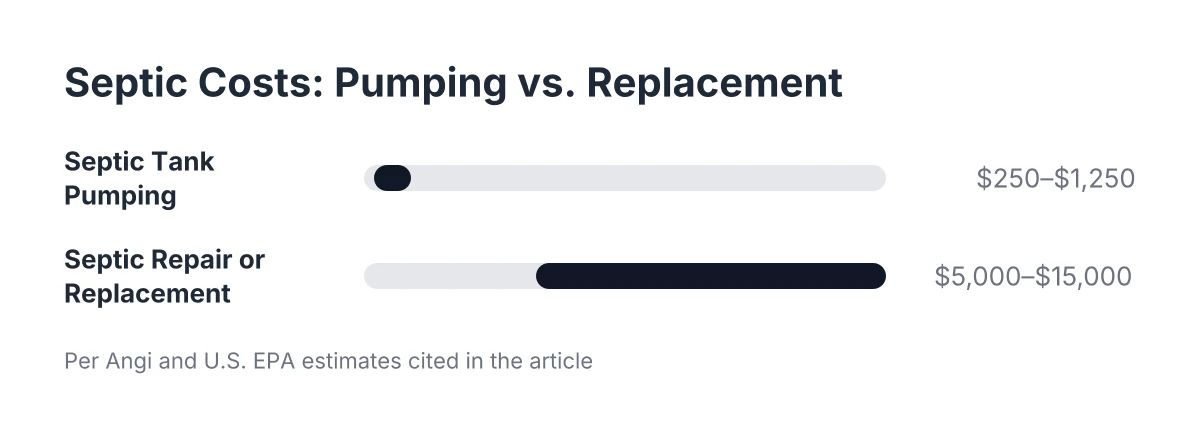
    Cost range comparison: septic tank pumping $250–$1,250 average $427 versus repairs or replacement $5,000–$15,000.
    Routine septic pumping averages $427 and typically costs $250–$1,250, while major repairs or replacement range from $5,000–$15,000 according to EPA data.

    You just bought land in Hesperia, or you are about to close on it, and nobody can tell you a single thing about the septic system. No records, no maps, no visible lid. Then a toilet gurgles, or a wet spot shows up in the yard, and the first quote you hear involves thousands of dollars in repairs. Before you accept that number, you need to understand the difference between septic tank pumping vs repair decision situations and problems a simple pump-out can fix. The gap between those two bills is enormous, and knowing which one you actually face is the single most useful thing you can learn before you spend a dime.

    This guide walks through what pumping costs, what repairs cost, how to tell which one your system needs, and how to read a quote so you know whether it is fair. It is written for the High Desert, where a lot of properties changed hands with zero paperwork on the septic system, and where a buyer with no records has to figure things out from scratch.

    Why the Pumping vs. Repair Decision Matters So Much

    Here is the core problem. A backed-up septic system looks the same on the surface whether the fix costs a few hundred dollars or five figures. Slow drains, gurgling toilets, sewage odors, and soggy ground can all come from a tank that is simply full. They can also come from a crushed pipe, a failed drain field, or a broken pump. You cannot tell which from inside the house.

    That uncertainty is where bad quotes live. A homeowner who does not know the difference has no way to push back when someone says the whole system needs work. According to the U.S. Environmental Protection Agency, septic tank repair or replacement typically costs between $5,000 and $15,000. Routine pumping, by contrast, averages $427 according to Angi data, with a typical range of $250 to $1,250 depending on tank size and location.

    Read those two numbers again. The difference between "your tank is full" and "your system has failed" can be more than ten thousand dollars. As a result, the smartest first move on almost any septic problem is to confirm whether pumping alone resolves it before anyone starts talking about excavation or replacement.

    What Septic Tank Pumping Actually Costs in 2026

    Septic tank pumping in 2026 generally runs from about $250 to over $1,250, with a national average around $427 according to Angi. The price moves based on tank size, how hard the tank is to reach, how full it is, and whether the visit is scheduled or an emergency. In the Hesperia area, access and lid depth are the two factors that swing the price most often.

    Pumping means a truck arrives, the crew opens the tank lid, and they remove the liquid and solid waste inside. On a straightforward job, the whole visit takes an hour or two. That is the entire service. There is no digging up the yard beyond exposing the lid, and no replacing parts.

    Several things push a pumping bill toward the higher end of the range:

    • A buried lid with no riser. If the crew has to locate the tank and dig down to the lid, that adds labor time. This is common on older High Desert properties.
    • A larger tank. More gallons pumped means more time on site and more disposal volume.
    • Heavy solids buildup. A tank that has gone many years without service takes longer to clean out, and some operators price septic tank cleaning as a separate, deeper service than a standard pump-out.
    • Emergency timing. A backup on a Saturday night costs more than a scheduled weekday visit. Emergency septic pumping carries a premium at almost every company.
    • Long hose runs. If the truck cannot get close to the tank, extra hose length adds setup time and sometimes a fee.

    For a land buyer with no records, the buried-lid factor is the one to plan for. If nobody knows where the tank is, a septic tank locating service finds it and marks it before any pumping happens. Some companies fold locating into the pumping visit; others line-item it. Either way, ask for it on the quote so you are not surprised.

    What Septic Repairs Cost, and Why the Range Is So Wide

    Septic repair costs range from a few hundred dollars for a small fix to the $5,000 to $15,000 the EPA cites for major repair or replacement. The range is wide because "repair" covers everything from swapping a baffle to digging up and rebuilding an entire drain field. The component that failed determines the bill.

    Here is a rough map of where repair money goes, from smallest to largest. These are illustrative ranges, not quotes, and your property's soil, layout, and county requirements will move the numbers.

    1. Baffles and lids. The baffles inside the tank direct flow and keep solids out of the drain field. Replacing a failed baffle or a cracked lid is usually one of the cheaper repairs, often in the hundreds.
    2. Broken or root-clogged pipes. The line between the house and the tank, or between the tank and the drain field, can crack, sag, or fill with roots. Cost depends on how deep it sits and how much digging the fix requires.
    3. Pump and float switch failures. Some septic system types use an effluent pump to move wastewater uphill or into a mound. Septic tank pump replacement cost typically lands in the four figures once you count the part, labor, and electrical checks. The EPA recommends inspecting systems with pumps, float switches, or other mechanical parts once a year, precisely because these components fail.
    4. Tank damage. A cracked or collapsing tank often cannot be patched. Replacement means excavation, a new tank, permits, and inspection.
    5. Drain field failure. This is the big one. When the soil absorption area clogs or the field pipes fail, the fix can mean building a new field, which drives total septic system cost toward the top of the EPA's range and sometimes past it.

    Notice what all five have in common: none of them are fixed by pumping. However, and this matters, several of them are frequently misdiagnosed when the real issue is just a full tank. That is why the order of operations matters so much.

    Septic Tank Pumping vs Repair Decision: How to Tell Which One You Need

    The honest answer is that pumping the tank is usually the first diagnostic step, not just a service. Once the tank is empty, a crew can see the baffles, the inlet and outlet, the liquid levels, and how the system behaves. Most septic tank pumping repair calls get sorted into "pump and monitor" or "actual repair" at exactly this moment.

    Here are the patterns that point toward each outcome.

    Signs pumping alone will likely fix it

    A full tank produces symptoms gradually. Drains slow down over weeks, not overnight. If your system has not been pumped in years, or you have no idea when it was last serviced, a full tank is the most likely explanation for a backup. After pumping, everything drains normally and stays that way. That is the good outcome, and it is the common one on neglected but healthy systems.

    For example, picture a common Hesperia scenario. A buyer closes on a two-acre property with a manufactured home. There are no septic records, no riser, and no lid in sight. Six weeks in, the shower starts backing up. A locate finds the tank about eighteen inches down; the crew digs to the lid and pumps it. The tank was simply full, likely for the first time in a decade. Total cost lands in the hundreds. No repair needed, and the buyer now knows exactly where the tank is for next time.

    Signs you are looking at a real repair

    Some symptoms point past the tank. Watch for these:

    • The system backs up again within days or weeks of a fresh pump-out.
    • Sewage or standing water appears over the drain field, not just near the tank.
    • The tank refills with groundwater soon after pumping, which suggests a crack or a saturated field pushing water backward.
    • The crew finds broken baffles, a collapsed inlet, or roots inside the tank during pumping.
    • An alarm sounds on a system with a pump, or the pump runs constantly or not at all.

    In addition, water usage can fake a failure. The EPA notes that a single leaky or running toilet can send as much as 200 gallons of extra water per day into a septic system. That volume can overwhelm a working drain field and mimic a failed one. Before approving a major repair, fix any running toilets and dripping fixtures, then see whether the symptoms ease.

    One honest limitation: a pumped-out tank inspection tells you a lot, but it cannot see underground pipes or the full condition of a drain field. If symptoms persist after pumping and the obvious causes are ruled out, you need a professional to dig deeper, sometimes literally, before anyone can give you a reliable repair number.

    Reading a Quote: What Fair Septic Tank Pumping Repair Pricing Looks Like

    A fair septic quote itemizes the work so you can see what each piece costs. For a pumping visit, that means the pump-out itself, any locating or lid excavation, disposal, and any emergency premium listed separately. For repairs, it means parts, labor, excavation, and permits broken out, plus a written explanation of what failed and how the crew confirmed it.

    Compare that to the quote that should worry you: a single large number, a diagnosis delivered without opening the tank, or a repair recommendation before anyone has pumped and looked inside. A company that skips the look-inside step is guessing, and you are paying for the guess.

    Questions worth asking before you approve anything:

    • Did you pump the tank and inspect the baffles, inlet, and outlet before recommending this repair?
    • What exactly failed, and can you show me?
    • Is locating or digging to the lid included, or billed separately?
    • If this is an emergency call, what portion of the price is the after-hours premium?
    • Will I get a written report I can keep with the property records?

    That last question matters double for a buyer. A written inspection report becomes the first document in a property file that previously had nothing in it. If you are still in escrow, that report can also support a price negotiation or a repair credit; a documented drain field problem is a very different conversation with a seller than a vague worry.

    Buying Property With No Septic Records: Do This Before Closing

    If you are buying High Desert property and the seller cannot or will not confirm the septic condition, get the tank located and inspected before you close. A septic system inspection with the tank pumped open is the only way to know what you are buying. Guessing from the age of the house is not a plan.

    The process is straightforward. A locate-and-mark service finds the tank, which on older Hesperia lots often has no riser and sits under a foot or more of soil. The crew exposes the lid, pumps the tank, and inspects what they can see: tank condition, baffles, liquid levels, and signs of drain field trouble. You get a written report you can use for the purchase decision, a lender requirement, or a permit application.

    Some buyers hesitate because a locate-and-inspect job costs money on a property they might walk away from. Look at it the other way. Spending several hundred dollars to avoid inheriting a five-figure drain field failure is one of the best-leveraged inspections in the whole transaction. Total septic tank cost over your years of ownership depends heavily on the condition of the system on day one, and this is your only chance to know that condition before the risk becomes yours. The EPA recommends the average household have its septic system inspected at least once every three years; a purchase with zero records is the clearest possible time to start that clock.

    While you are at it, ask the inspector to sketch a simple septic system diagram showing the tank, lid, and drain field locations relative to the house. It takes minutes, and it means you will never pay for a locate again. It also matters if you plan a remodel or addition, since you cannot build over the tank or field.

    What This Means for Commercial Grease Traps and Holding Tanks

    The pump-first logic applies to commercial accounts too. A restaurant grease trap that backs up is almost always overdue for pumping, not broken. An RV park holding tank that smells is usually full, not failed. Scheduled grease trap pumping and holding tank service on a recurring monthly or quarterly cycle keeps a small business ahead of both health code deadlines and emergency-rate invoices.

    Therefore the math for a single-location restaurant or independently owned RV park is the same as for a homeowner, just on a faster clock. Grease and heavy use fill a trap or tank quickly. A recurring schedule with a local crew turns an unpredictable emergency expense into a known line item, and it produces the service records that health inspectors ask for.

    The Bottom Line: Pump First, Repair Only When the Evidence Says So

    The cost gap between pumping and repair is the whole story. Pumping averages $427 according to Angi. Repair or replacement runs $5,000 to $15,000 according to the U.S. Environmental Protection Agency. Given that gap, the only sensible order of operations is: locate the tank if you do not know where it is, pump it, inspect what the empty tank reveals, and approve repairs only when someone can show you what failed.

    For the land buyer holding keys to a property with no septic records, that order of operations is also your buying checklist. Locate, pump, inspect, document. Do it before closing if you can, and immediately after if you cannot. Either way, you will know exactly what you own, what it needs, and what a fair price for that work looks like, before anyone hands you a five-figure number you have no way to check.

    If you need your septic tank serviced, Hesperia Septic can help.
    Related Reading

  • Septic Tank Pumping Prices in Hesperia, CA: What Cleaning and Inspection Actually Involve

    septic tank pumping prices

    If you're standing in your Hesperia, CA yard looking at a wet spot that smells like sewage, or your toilets stopped flushing an hour ago, you want two things right now: someone who can fix it, and a straight answer on what it costs. This guide walks through what actually happens during professional septic tank pumping, cleaning, and inspection, how septic tank pumping prices are set, and what regular upkeep looks like so you never end up in this spot again. Understanding septic tank maintenance is the foundation of avoiding costly repairs. No sales pitch, just the process explained the way a local septic crew would explain it over the phone.

    Why the Process Matters More Than the Price Quote

    Most people searching for septic tank pumping near me have never watched the job get done. That makes it hard to tell a fair quote from a padded one, and it makes it easy for a bad operator to skip steps you're paying for.

    Here's the short version. A proper visit for septic tank pumping in Hesperia, CA removes everything from the tank: the liquid, the floating grease layer on top, and the settled sludge on the bottom. A rushed job pulls out the liquid and leaves the sludge behind. Your tank looks empty for a week, then the problem comes back, and you're paying twice.

    Therefore, knowing the steps below is worth more than any price list. When you can ask "are you removing the sludge layer or just pumping the liquid," you sound like someone who can't be shortchanged. That alone changes how the job goes.

    What Happens During a Professional Septic Tank Pumping Visit

    A professional septic tank pumping visit follows a clear sequence: locate the tank, open the access lid, measure the sludge and scum layers, pump out all contents with a vacuum truck, break up and remove the settled solids, and check the tank's basic condition before closing it back up. The whole visit typically takes one to a few hours depending on tank access and condition.

    Here's each step in more detail, so you know what to expect when the truck pulls up to your Hesperia property.

    Step 1: Locating the Tank

    First, the crew has to find your tank. On newer Hesperia homes this is easy; the lid is at grade or under a few inches of soil, and county records or as-built drawings show where it sits. On older High Desert properties, the tank can be buried under decades of dirt, a patio, or landscaping nobody remembers installing.

    A septic crew that offers septic tank locating will probe the yard, follow the sewer line out from the house, or use records to narrow it down. If you've owned the home a while, sketch the tank location once it's found and keep that sketch. It saves time and money on every future visit.

    Step 2: Opening and Measuring

    Next, the crew uncovers the access lid and opens the tank. Before pumping anything, a good operator looks at what's inside. The tank holds three layers: a scum layer of grease and floating solids on top, liquid in the middle, and sludge on the bottom.

    The thickness of the sludge and scum layers tells the real story. Thick layers mean the tank was overdue; thin layers mean you're on a good schedule. This measurement is also your best evidence for how often your specific household needs pumping, which beats any generic rule of thumb.

    Step 3: Pumping and Cleaning the Full Tank

    Then the vacuum hose goes in. The truck pulls out the liquid first, but the job isn't done there. The crew uses the hose, and sometimes a tool to break up compacted sludge, to remove the solids from the bottom and the grease cap from the top.

    This is the difference between septic tank pumping and septic tank cleaning done right. Everything comes out. If someone quotes you a strangely low number and finishes in twenty minutes on a full tank, ask what they left behind.

    Step 4: The Inspection Before the Lid Goes Back On

    Finally, with the tank empty, the operator gets the only clear look anyone will have at your system for years. A basic inspection during pumping checks:

    • The inlet baffle, which keeps incoming waste from shooting across the tank
    • The outlet baffle or filter, which keeps solids from escaping into the drain field
    • Cracks, root intrusion, or signs the tank is deteriorating
    • Water flowing back into the tank from the drain field, which can signal a saturated or failing field
    • The condition of lids and risers

    For example, backflow from the outlet pipe is one of the earliest visible signs of drain field trouble. Catching it during a routine pump-out gives you options. Discovering it during a sewage backup on a Saturday night does not.

    How Septic Tank Pumping Prices Are Actually Set

    Septic tank pumping prices depend on a handful of concrete factors: the size of your tank, how full it is, how hard the tank is to find and access, whether it's a routine visit or an emergency call, and local disposal fees for hauling the waste. According to Angi data, septic tank pumping averages $427 nationally, with a typical range of $250 to $1,250 or more depending on tank size and location.

    Let's break down what moves the number up or down in the High Desert:

    • Tank size. Bigger tanks hold more waste, take longer to pump, and fill more of the truck. Larger homes usually have larger tanks.
    • Tank condition. A tank that hasn't been pumped in ten years has thick, compacted sludge that takes longer to remove than a tank on a regular schedule.
    • Access. A lid at grade level costs less to service than a tank buried two feet down under landscaping. If the crew has to dig, expect that reflected in the price. Risers, which extend the lid to ground level, pay for themselves over a few visits.
    • Locating work. If nobody knows where the tank is, septic tank locating adds time before pumping even starts.
    • Timing. Emergency septic pumping at night or on a weekend generally costs more than a scheduled weekday visit. That's true across the industry, and it's the single best financial argument for staying on a maintenance schedule.

    However, be careful comparing quotes on price alone. A low quote that covers pumping liquid only, with sludge removal as a surprise add-on once the lid is open, often ends up costing more than an honest all-in number. Ask what the quote includes before the truck arrives.

    Septic Tank Pumping Prices vs. the Cost of Neglect

    Here's the comparison that matters more than any price list. The U.S. Environmental Protection Agency estimates that septic repair or replacement typically runs $5,000 to $15,000. Routine pumping, by contrast, sits in the hundreds. Skipping a few hundred dollars of maintenance to risk a five-figure septic system repair cost is a bad trade every time.

    Consider a scenario any Hesperia homeowner can picture. A family buys a home and never thinks about the septic tank because nothing seems wrong. Six years later, sludge has built up past the outlet, solids have been washing into the drain field the whole time, and the field soil is clogging. The first visible symptom is sewage backing up into the hall bathroom on a holiday weekend.

    At that point, the bill isn't one pump-out. It's an emergency call, plus a camera or inspection to diagnose the drain field, plus whatever repair the diagnosis shows. As a result, the cheapest septic service you will ever buy is the routine one you schedule before anything goes wrong.

    One honest caveat: pumping is maintenance, not a cure. If your drain field is already failing, pumping the tank buys you days or weeks, not a fix. A trustworthy operator will tell you that at the tank, and a drain field problem needs a professional diagnosis, not another pump-out.

    How Often Should You Pump and Inspect a Septic Tank?

    The U.S. Environmental Protection Agency recommends having the average household septic system inspected at least once every three years by a professional, and alternative systems with pumps, float switches, or other mechanical parts inspected once a year. Pumping frequency varies by household size, tank size, and water use, so let the sludge measurements from your last visit set your actual schedule.

    In addition, some households build sludge faster than average. Homes with garbage disposals send far more solids into the tank; the Massachusetts Department of Environmental Protection recommends annual pumping for households with disposals regardless of tank size. If you run a disposal daily, plan on a shorter interval than your neighbors.

    A simple septic maintenance schedule for a Hesperia home looks like this:

    1. Get the tank pumped and inspected now if you can't remember the last time it was done.
    2. Write down the date, the sludge and scum measurements, and anything the crew flagged.
    3. Set the next inspection based on those measurements, using the EPA's three-year interval as your outer limit.
    4. Keep the tank location sketch and service records with your house documents.

    That's the whole system. Four items, and it keeps most homeowners off the emergency-call list permanently.

    Daily Habits That Protect Your Tank and Drain Field

    Between pump-outs, what goes down your drains decides how fast the tank fills and how long the drain field lasts. The rules are simple, but they only work if everyone in the house follows them.

    Keep these out of a septic system:

    • Wipes of any kind, including ones labeled flushable
    • Grease, cooking oil, and fat washed down the kitchen sink
    • Paper towels, feminine products, and diapers
    • Paint, solvents, and harsh chemicals that kill the bacteria doing the work inside your tank
    • Coffee grounds and food scraps in volume

    Protect the drain field itself too. Never park or drive on it; vehicle weight compacts the soil and crushes pipes. Don't plant trees near it, since roots seek out the moisture in the lines. In addition, direct roof gutters and yard drainage away from the field, because a waterlogged field can't absorb wastewater from the house.

    Water use matters as well. Spreading laundry across the week instead of running five loads on Saturday gives the tank time to settle solids between surges. Fixing a running toilet stops hundreds of gallons a day from flooding the system for no reason.

    Warning Signs That Mean Call Someone Today

    The early signs of septic system failure are slow drains throughout the whole house, gurgling pipes, sewage odor indoors or in the yard, wet or unusually green patches over the tank or drain field, and a septic alarm sounding. Any one of these means the system needs attention; sewage backing up into tubs or floor drains means it needs attention today.

    Note the difference between one slow drain and every drain. One slow sink is usually a clog in that line, a plumber-type problem. Every fixture draining slowly at once points to the tank or the drain field, a septic problem. Many Hesperia homeowners learn this distinction the hard way after a plumber visit that couldn't fix the real issue.

    If sewage is already backing up, stop running water in the house. Every flush and every load of laundry adds to what's coming back at you. Then call a septic service, not a general plumber, and tell them what you're seeing: backup location, odors, wet spots, and whether an alarm is sounding. Those details help the crew show up ready.

    What to Ask Before You Book Septic Service in Hesperia, CA

    When you're comparing septic tank services prices from local operators, the questions you ask matter more than the number on the quote. A few minutes on the phone tells you a lot.

    Ask these before booking:

    • Does the quote cover pumping the full tank, including sludge and scum, or liquid only?
    • Is a basic inspection of baffles and tank condition included while the tank is open?
    • What do digging, locating, or extra-heavy sludge cost if they come up?
    • What are the disposal fees, and are they included?
    • For emergency calls, what's the after-hours difference, stated up front?

    A local, septic-focused crew should answer all of these plainly. Vague answers on what's included are how a $400 job becomes an $800 invoice. You're not being difficult by asking; you're being the kind of customer who gets straight treatment.

    Location matters too. A crew based in the High Desert knows Hesperia's soil, common tank setups, and local disposal requirements, and doesn't route your call through a national dispatch center that has never seen a drain field.

    The Bottom Line for Hesperia Homeowners

    Septic tank pumping prices are set by real, physical factors: tank size, sludge buildup, access, and timing. National data from Angi puts the average around $427, while the EPA pegs repair or replacement at $5,000 to $15,000. The gap between those two numbers is the entire argument for maintenance.

    A professional visit is more than emptying a tank. It's the sludge measurement that sets your real schedule, the baffle check that protects your drain field, and the early warning if something bigger is developing. Done on schedule, it's a routine expense in the hundreds. Skipped for years, it becomes an emergency in the thousands.

    So if you can't remember the last time your tank was pumped, that's your answer. Get it pumped and inspected, write down what the crew finds, and put the next date on the calendar. That one habit is what separates homeowners who never think about their septic system from homeowners searching for emergency septic pumping at 8pm on a Saturday.

    If you need your septic tank pumped, Hesperia Septic can help.

    Related Reading