Sewage is backing up into your tub, or the septic alarm just started screaming at 11 p.m., and the first two questions in your head are the right ones: how fast can someone get here, and what will this septic pump cost me? This guide answers both for Hesperia and the surrounding High Desert. It walks through what to do in the next ten minutes, what emergency pumping usually costs compared to a scheduled visit, and what drives the price up or down on your specific property. If you just bought land out here and have no records of where the tank even sits, there is a section for you too, because an unknown tank changes both the timeline and the bill.
First, Stop the Backup From Getting Worse
Before you think about cost, stop feeding the system. Every gallon that goes down a drain right now ends up in a tank that has no room left. That means the water has to go somewhere, and the lowest drain in the house is usually where it comes out.
Here is the short version of septic backup triage:
- Stop using water. No flushing, no laundry, no dishwasher, no showers. Turn off the washing machine mid-cycle if you have to.
- If your system has a pump and the alarm is going off, press the silence button if there is one, but do not unplug the pump or breaker unless sewage is actively surfacing.
- Keep people and pets away from any wet ground or pooling sewage in the yard. Raw sewage carries bacteria you do not want tracked into the house.
- Do not open the tank lid yourself. Septic gases are dangerous, and an open tank is a fall hazard.
- Call a local septic crew, not a general plumber first. A backup at the tank needs a pump truck; a plumber's snake cannot empty a full tank.
That last point matters for your wallet. People in a panic often call emergency plumbing services first, pay a service call fee, and then get told they need a septic company anyway. If sewage is coming up in multiple drains at once, or the yard over the tank is wet, the problem is almost always the tank or drain field, not a single clogged pipe. An emergency plumber is the right call when one fixture is blocked; a septic crew is the right call when the whole house backs up.
What Does Emergency Septic Pumping Cost in Hesperia?
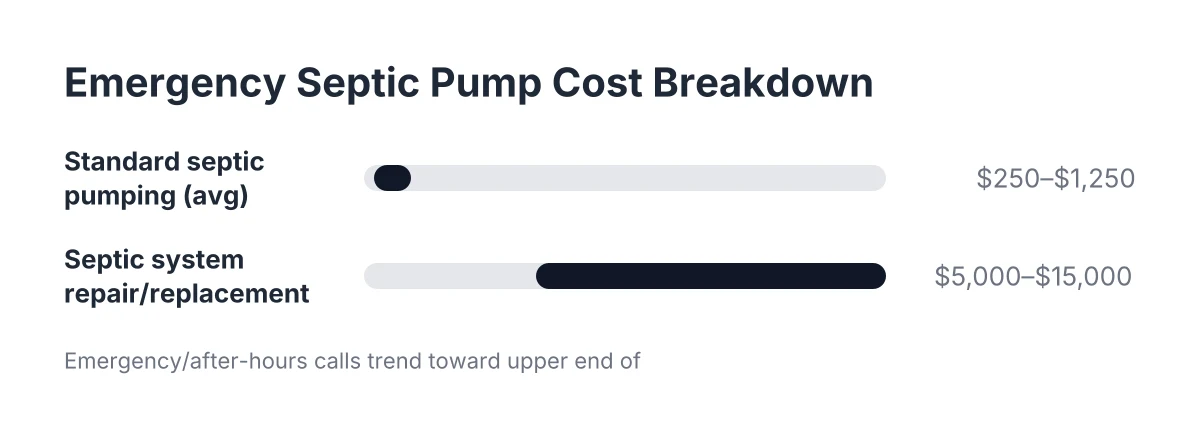
Emergency septic pumping in Hesperia generally costs more than a scheduled pump-out because you are paying for a truck and crew outside normal hours, often the same night. According to Angi data, the cost of septic tank pumping averages $427, ranging from $250 to $1,250 or more depending on tank size and location. After-hours or emergency work typically lands in the upper part of that range or above it.
There is no single fixed number for Hesperia, and any company that quotes you an exact price before seeing the property is guessing. However, the pattern is consistent. A straightforward daytime pump-out with an exposed lid sits near the lower end. A midnight call with a buried lid, a tank that has not been pumped in a decade, and sewage in the house pushes toward the higher end.
The honest way to think about emergency septic service pricing is as two parts: the base pumping job, plus whatever the emergency conditions add. Those add-ons usually include after-hours dispatch, digging to find and expose a buried lid, extra pumping time for a badly overfilled tank, and cleanup-related work like clearing the line between the house and the tank.
One more comparison worth holding onto while you decide how fast to act. The EPA estimates septic tank repair or replacement typically costs between $5,000 and $15,000, far more than routine pumping. A backup you address tonight with a pump truck can become a drain field failure if wastewater keeps pushing solids into the field for another week. Paying an emergency premium on pumping is cheap next to replacing a system.
What Drives Septic Pump Cost Up or Down
The cost of pumping a septic tank in an emergency comes down to five factors: tank size, how full and neglected the tank is, whether the lid is accessible, the time of day, and how far the truck has to travel. Each one moves the price in a predictable direction, so you can roughly place your own situation before anyone arrives.
Tank size and how full it is
Bigger tanks hold more waste, and more waste means more time on site and more volume hauled to a disposal facility. Some companies price partly by volume, which is why you will see references to septic pumping cost per gallon in national guides. A tank that has gone years without service also builds a thick sludge layer that takes longer to break up and pump out than the contents of a regularly maintained tank.
Access to the tank and lid
If your lid sits at grade under a riser, the crew parks, opens it, and pumps. If the lid is buried under a foot of High Desert dirt, someone has to find it and dig it out first, and that labor gets added to the bill. Long hose runs matter too. A tank 150 feet from the nearest spot a truck can park takes more setup than one next to the driveway.
Timing and urgency
Nights, weekends, and holidays cost more everywhere, and septic is no exception. As of 2026, after-hours dispatch fees remain the single most common line item that separates an emergency invoice from a scheduled one. If the situation allows, and sometimes it does, waiting until morning can trim the bill. Sewage actively entering the house does not allow it. A slow drain and a faint odor sometimes do.
Location within the High Desert
Hesperia proper is straightforward for a local crew. Remote parcels off dirt roads out toward the edges of the High Desert add drive time, and rough access can limit which trucks can reach the tank at all. This is one reason searching "septic pump cost near me" gives such scattered answers; the same job can price differently five miles apart.
Pumping Cost vs. Pump Replacement Cost: Two Different Bills
Septic pumping and septic pump replacement are two different jobs with two different price ranges, and people mix them up constantly when searching. Pumping means a truck removes the waste from your tank. Pump replacement means swapping out a mechanical effluent or sewage pump inside certain systems, which is a parts-and-labor repair, not a pump-out.
This distinction matters most if your septic alarm is going off. An alarm usually means the liquid level in a pump chamber is too high. That can happen for two reasons:
- The tank or chamber is simply full, and pumping solves it.
- The mechanical pump has failed, and the chamber filled up because nothing is moving water out.
If it turns out you need a new pump, the question shifts from pumping fees to how much a septic pump costs to replace, which depends on the pump type, chamber depth, and electrical work involved. A crew responding to an alarm call should be able to tell you on site which situation you have. Systems with pumps and float switches also need more frequent attention in general. The EPA recommends that alternative systems with electrical float switches, pumps, or mechanical components be inspected once a year, compared with at least once every three years for a standard gravity system.
The Hesperia Wrinkle: When Nobody Knows Where the Tank Is
Emergencies get more expensive when the tank location is a mystery, and in the High Desert that happens often. Plenty of properties around Hesperia changed hands with no septic records, no as-built diagram, and no visible lid or riser anywhere on the lot. California has one of the lowest shares of homes on septic among U.S. states, at about 10 percent according to the U.S. Environmental Protection Agency, so records and local knowledge are thinner here than in heavy-septic states.
Consider a realistic scenario. You closed on a two-acre Hesperia parcel in the fall, the seller shrugged when asked about the septic, and three months later the shower drain starts gurgling and backing up on a Saturday night. Nobody knows where the tank is. The crew now has to run a septic tank locating job before they can pump anything, tracing the sewer line from the house and probing to find the lid, then digging it out. That locate-and-dig work can add meaningful time and cost to the visit, sometimes a few hundred dollars on top of the pumping itself, depending on depth and ground conditions.
Therefore, if you are buying land with no records right now, the cheapest emergency is the one you prevent before closing. A septic locate and inspection before you sign gives you three things:
- The tank physically located and marked, so no future crew bills you to find it
- A written picture of the system's condition you can use in the purchase decision
- Leverage to negotiate if the inspection turns up a failing tank or drain field
Buyers sometimes worry that a locate-and-inspect job delays escrow. In practice, it is a single site visit, and it is far less disruptive to a sale than discovering a failed system after you own it. If the inspection does turn up a bad system, that is exactly the information you paid for; a $5,000 to $15,000 replacement is the seller's negotiation problem before closing and yours after.
What About Grease Traps, Holding Tanks, and RV Parks?
Commercial backups follow the same logic but with a compliance clock attached. A restaurant grease trap overflowing on a Friday night is not just a mess; it is a health code problem that can shut down service. RV parks and campgrounds with holding tanks face the same math when a tank fills faster than expected during a busy weekend.
For these accounts, the emergency-versus-scheduled cost gap is the whole argument for recurring service. A grease trap or holding tank pump-out on a monthly or quarterly schedule is a predictable line item. The same trap pumped as an after-hours emergency, with a dining room full of odor, costs more and risks revenue on top of it. Single-location operators around Hesperia are usually better served by a standing schedule with a local truck than by calling around every time the trap gets close to full.
How to Get a Real Number Before the Truck Rolls
You cannot pin down an exact emergency price from a search result, but you can get close with a two-minute phone call. When you call a local septic company, whether at 2 p.m. or 2 a.m., have answers ready for the questions that actually set the price.
- Where is the sewage showing up: inside the house, in the yard, or both?
- Do you know where the tank is, and is the lid exposed or buried?
- When was the tank last pumped, if you know at all?
- Does your system have a pump or an alarm panel, and is the alarm on now?
- Can a truck get within reasonable hose distance of the tank area?
A crew that answers the phone at night and walks you through those questions calmly is telling you something about how the job will go. In addition, ask them to separate the quote into the base pump-out and the emergency or access add-ons. That breakdown keeps the invoice from surprising you and lets you decide, for example, whether waiting until 7 a.m. saves enough to matter.
Searches for residential septic services near me will surface national lead sites alongside local crews. The difference shows up at midnight. A national call center books a ticket; a local Hesperia operation knows the soil, the buried-lid problem, and how to find a tank on a parcel with no records.
The Bottom Line on Emergency Septic Pump Cost
Emergency septic pump cost in Hesperia runs higher than a scheduled pump-out, with national data from Angi putting routine pumping at a $427 average and a $250 to $1,250 range, and after-hours conditions pushing jobs toward the top of that range or past it. The biggest levers are tank size, neglect, lid access, timing, and location, and the biggest wildcard on High Desert properties is a tank nobody can find.
Two moves protect your money. If sewage is backing up now, stop all water use and get a local pump truck dispatched; the emergency premium is small next to a drain field replacement. If you are buying property with no septic records, spend on a locate and inspection before closing so your first pump-out is a scheduled one, not a Saturday night dig. For anything beyond pumping, such as a failed pump, a collapsed lid, or a saturated drain field, get a professional evaluation before deciding on repairs, because the right fix depends on conditions no article can see from here.
If you need your septic tank serviced, Hesperia Septic can help.
Leave a Reply