If a health inspector has ever flagged your grease trap, you already know the real question is not whether to pump it. The question is how often, and how to prove you did. A grease trap maintenance schedule is the answer to both. Determining the right grease trap pumping frequency tells you when the trap gets pumped, who does it, and where the paperwork lives when an inspector asks for it. This guide walks through how to build that schedule, what actually drives cleaning frequency, and what to expect from a service crew here in Hesperia and the High Desert.
We wrote this for the person who owns the problem but is not always on-site. That might be a restaurant manager juggling a citation deadline, a landlord whose tenant just called about a smell in the kitchen, or a small business owner who inherited a grease trap with the lease and has no idea when it was last serviced.
Why a Grease Trap Maintenance Schedule Matters More Than the Trap Itself
A grease trap only works when it has room to work. The trap slows down kitchen wastewater so fats, oils, and grease float to the top and food solids sink to the bottom. Clean water in the middle flows out to the sewer or septic system. Once the grease layer and the solids layer get thick enough, the trap stops separating anything. Grease flows straight through to your drain line, your sewer lateral, or your septic tank.
That is not a small problem. According to the U.S. Environmental Protection Agency, grease from restaurants, homes, and industrial sources is the most common cause of reported sewer blockages, responsible for 47% of cases. In addition, Wastewater Digest reports that a single restaurant can release between 800 and 17,000 pounds of grease into the sewer system each year. Your trap is the only thing standing between that grease and a backup.
Therefore, the schedule matters more than the equipment. A well-sized trap that never gets pumped fails. A modest trap on a disciplined grease trap maintenance schedule keeps a kitchen running and an inspection file clean. Inspectors know this too, which is why they ask to see service records, not just the trap itself.
How Often Should You Pump a Grease Trap?
Most commercial kitchens need grease trap pumping somewhere between monthly and quarterly, and the most widely used trigger is the one-quarter rule: pump the trap once fats, oils, grease, and solids fill 25% of its total liquid depth. Past that point, the trap loses its ability to separate grease, and material starts passing through to your drain lines.
The 25% benchmark, often called the 1/4 rule, shows up in grease control programs across the country because it reflects how traps actually fail. It is a capacity rule, not a calendar rule. A busy burger kitchen can hit 25% in three weeks. A coffee shop that fries nothing might take three months to get there.
However, you still need a calendar to run a business. The practical approach is to convert the capacity rule into a schedule:
- Have the trap pumped and note the date.
- At the next service, ask the crew how full it was. A good grease trap cleaner will measure or estimate the grease and solids layers.
- If the trap was well past 25%, shorten the interval. If it was barely dirty, stretch it.
- Repeat until the interval lands where the trap hits about 25% right when the truck shows up.
After two or three service visits, you have a grease trap maintenance schedule built on your kitchen's real output instead of a guess. Write that interval down, put it on a recurring calendar, and hand the standing appointment to a service company so it happens without you chasing it.
What Changes the Pumping Interval
Several factors push the schedule shorter or longer:
- Menu. Fryers, flat-tops, and meat-heavy menus load a trap fast. Salads and espresso do not.
- Volume. A kitchen serving 300 covers a day fills a trap faster than one serving 40.
- Trap size. A small under-sink trap in a strip-mall kitchen may need monthly service. A large in-ground grease interceptor outside might go longer between pump-outs.
- Dishwashing habits. Scraping plates into the trash before rinsing keeps solids out of the trap and stretches the interval.
- Seasonality. Say a Hesperia restaurant near the freeway doubles its traffic in summer travel season. In that scenario, a quarterly winter schedule may need to tighten to every six weeks from June through August.
Grease Trap vs. Grease Interceptor
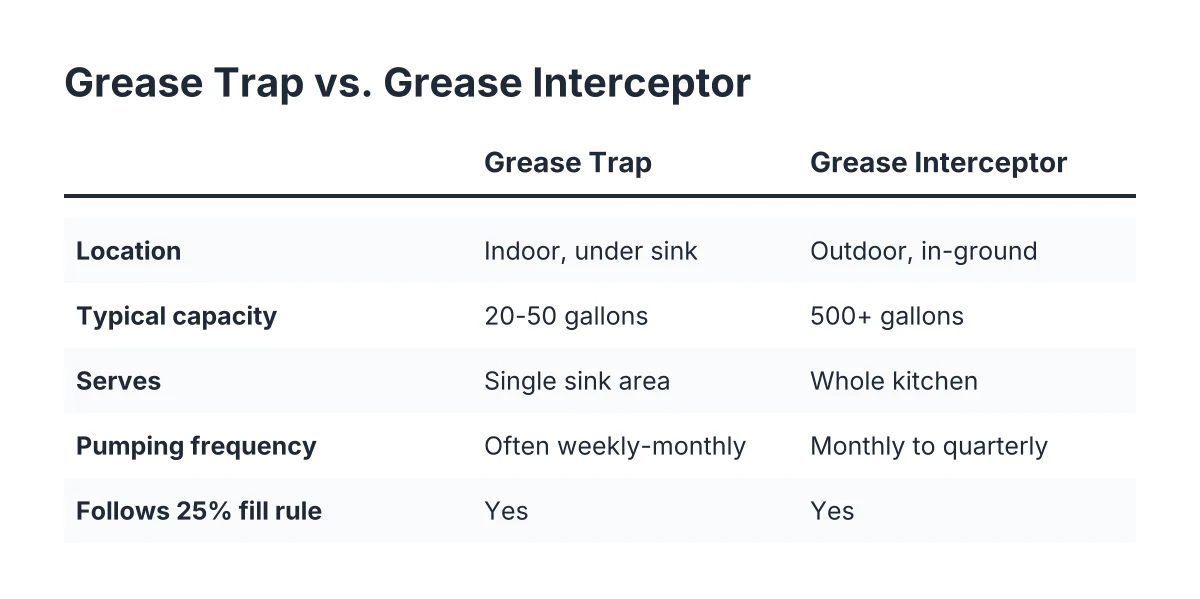
The terms get mixed up, and the difference affects your schedule. A grease trap is usually the smaller unit, often indoor, mounted under or near the sink, holding roughly 20 to 50 gallons. A grease interceptor is the larger in-ground tank outside the building, often 500 gallons or more, that serves the whole kitchen.
Small indoor traps fill fast and need frequent attention, sometimes weekly skimming by staff plus regular professional pumping. Outdoor interceptors hold more but still follow the same 25% logic; they just take longer to get there. A grease interceptor cleaning schedule tends to run monthly to quarterly for most food-service operations, while a small indoor trap may need service far more often. If you are not sure which one your building has, a service crew can tell you during the first visit.
Do Home Kitchens Need a Grease Trap Maintenance Schedule?
Most single-family homes do not have a grease trap at all, so most homeowners do not need a grease trap maintenance schedule; their kitchen grease goes into the septic tank, which makes regular septic tank pumping the residential equivalent. Homes that do have a trap, such as properties with commercial-style kitchens or certain rentals, should follow the same 25% rule as restaurants.
For everyone else on septic, the grease question becomes a septic question. Grease that goes down a home kitchen drain does not disappear. It cools, hardens, and joins the scum layer in the septic tank. Pour enough bacon fat and fryer oil down the sink over a few years and you shorten the life of the tank and, worse, the drain field.
The U.S. Environmental Protection Agency recommends that the average household have its septic system inspected at least once every three years by a professional. Households with garbage disposals generate more sludge; the Massachusetts Department of Environmental Protection recommends annual pumping for homes with disposals regardless of tank size. In addition, the EPA notes that alternative septic systems with pumps, float switches, or other mechanical parts should generally be inspected once a year.
So if you own a home in Hesperia and your kitchen drains run slow, the fix is usually not a grease trap. It is a septic inspection and, often, septic tank pumping. The grease discipline still applies, though: scrape pans into the trash, collect fryer oil in a container, and never treat the sink as a grease disposal.
Landlords and Property Owners: Managing a Schedule You Cannot Watch
Rental properties add a wrinkle. You own the trap or the septic system, but the tenant controls what goes down the drain. Suppose you own a small commercial building in Hesperia with a taqueria tenant. The lease says the tenant handles grease trap service, but the health inspector cites the property, and the backed-up drain line floods your building, not theirs.
For that reason, many owners keep grease trap service in their own hands rather than leaving it to tenants. A standing arrangement with one local crew means the trap gets pumped on schedule whether or not the tenant remembers, and the service records come to you. The same logic applies to residential rentals on septic: tenants report the smell, but you own the tank, the pumping decision, and the habitability obligation.
A few practices make remote management workable:
- Put the service interval in writing and share it with the tenant so they expect the truck.
- Ask the service company to invoice and report to you directly, not the tenant.
- Keep every manifest and receipt in one folder per property.
- Have the crew flag anything unusual, such as a trap that is suddenly filling faster, which can signal a tenant's habits have changed.
However, know the limits of a schedule. If drains are already backing up, sewage is surfacing, or an alarm is sounding, that is an emergency call, not a calendar item. Scheduled maintenance prevents most of those calls; it does not replace them once the problem exists.
What a Compliant Service Visit Looks Like
Grease trap pumping done right is more than sucking out the liquid on top. A proper full pump-out removes everything: the floating grease cap, the water in the middle, and the settled solids on the bottom. The crew should also scrape the walls and baffles, check that the baffles are intact and in place, and confirm the trap refills and flows correctly before leaving.
Watch out for partial service sometimes called skimming, where only the top grease layer is removed. It is cheaper per visit, but the solids stay behind and keep eating your trap's capacity. Most health departments and grease control programs expect full pump-outs, and inspectors can tell the difference when they open the lid.
Documentation is the other half of compliance. As of 2026, most jurisdictions with grease control programs expect food-service operators to keep service records available for inspection, commonly covering the past one to three years. Requirements vary by city and county, so confirm the specifics with your local health department or sewer authority. At minimum, your file for each visit should show:
- Date of service
- Volume pumped
- Name of the service company and the hauler
- Where the waste was taken for disposal
- Condition notes, such as baffle damage or unusually fast grease buildup
Ask any commercial grease trap cleaner you are evaluating whether they provide a manifest or service record you can hand an inspector. If the answer is vague, keep looking. The paperwork is the point. A pumped trap with no record protects your plumbing; a pumped trap with a record protects your permit.
Build a Simple Grease Trap Maintenance Checklist
You do not need special software. A one-page grease trap maintenance checklist per location covers it:
- Trap or interceptor location, size, and access notes
- Current service interval and next scheduled date
- Service company contact
- Log of each visit with date, volume, and manifest number
- Staff duties between services, such as scraping plates and wiping pans before washing
- A note on what triggered the last interval change, so the next manager understands the history
Post the between-service duties near the dish station. The single biggest thing kitchen staff control is how much grease and food waste reaches the trap in the first place. Dry-wiping pans and scraping plates into the trash can stretch a pumping interval meaningfully, which shows up directly in your grease trap service cost over a year.
What Grease Trap Service Costs, and How the Schedule Affects It
Exact pricing depends on trap size, access, and how full it is, so treat any number here as an illustrative estimate rather than a quote. As a rough frame, pumping a small indoor trap generally costs less per visit than pumping a large in-ground interceptor, and an overdue, packed trap costs more to service than one on a regular schedule. Emergency calls after a backup cost the most of all, because now you are paying for the pump-out plus the cleanup plus the lost business hours.
That is the quiet math behind a maintenance schedule. For example, suppose a kitchen skips two quarterly services to save money, then takes a backup on a Friday night. In that scenario, the emergency service, the mess, and the closed dining room can easily cost more than a year of scheduled visits combined. The schedule is not an expense on top of the problem; it is the cheaper version of the problem.
There is a real trade-off to weigh. Pumping more often than your trap needs wastes money on service you did not require. Pumping less often risks pass-through grease, line blockages, and inspection trouble. The 25% rule, checked and adjusted over your first few service visits, is how you find the interval that avoids both.
Finding Grease Trap Cleaning Near Hesperia
If you are searching for grease trap cleaning near me from a Hesperia kitchen, rental property, or commercial building, you have a few options to compare. National brokers dispatch whoever is available, which can mean a different crew and a different standard each visit. Multi-trade shops treat trap and tank work as a side job. A local septic and pumping crew treats it as the main job.
For an operator who cannot afford a failed inspection, the questions that matter are practical ones:
- Do you handle commercial grease traps and interceptors, not just residential septic tanks?
- Do you do full pump-outs, including solids, rather than skimming?
- Will you provide a manifest or service record for my compliance file?
- Can you set a recurring schedule and service the trap without me on-site?
- If a trap or a septic tank backs up between visits, can the same crew respond?
A crew based in Hesperia that pumps septic tanks, grease traps, and holding tanks across the High Desert can usually answer yes to all five. That last question matters more than owners expect. The company that already knows your trap, your access panel, and your service history is the one you want answering the phone when something goes wrong at 9 p.m. on a Saturday.
The Bottom Line
Start with the 25% rule, convert it into a calendar interval over your first few services, and put that interval on autopilot with one local crew. Keep every manifest in a folder per location. Adjust the schedule when the menu, the volume, or the season changes.
Do that, and the grease trap stops being a recurring fire drill. It becomes a line item that handles itself, an inspection question you can answer with paperwork instead of promises, and one less reason for a tenant or a manager to call you at a bad time.
If you need your septic tank serviced, Hesperia Septic can help.
Leave a Reply