If you own or are buying a property in Hesperia with a restaurant, a food-prep tenant, or a commercial kitchen of any kind, grease trap pumping for restaurants is a service you will need on a regular schedule, not just when something backs up. Grease traps fill fast, health and sewer authorities expect them to be maintained, and a neglected trap can shut down a kitchen or foul a septic system in a matter of weeks. Understanding your grease trap pumping schedule is essential to keeping your property in compliance and your kitchen operational. This guide walks through how a grease trap works, how often it needs pumping, what the rules generally require, and how to set up a service schedule that keeps your tenant cooking and your property out of trouble.
This matters double if you bought the property without records. Maybe the seller could not tell you when the trap was last pumped, or whether the building even has one. You are not alone in that. Plenty of small commercial and mixed-use properties in the High Desert change hands with no paperwork on the grease trap or the septic system behind it. The good news is that a local pumping crew can locate the trap, open it, tell you exactly what condition it is in, and put you on a schedule so you never have to guess again.
How a Grease Trap Works in a Restaurant
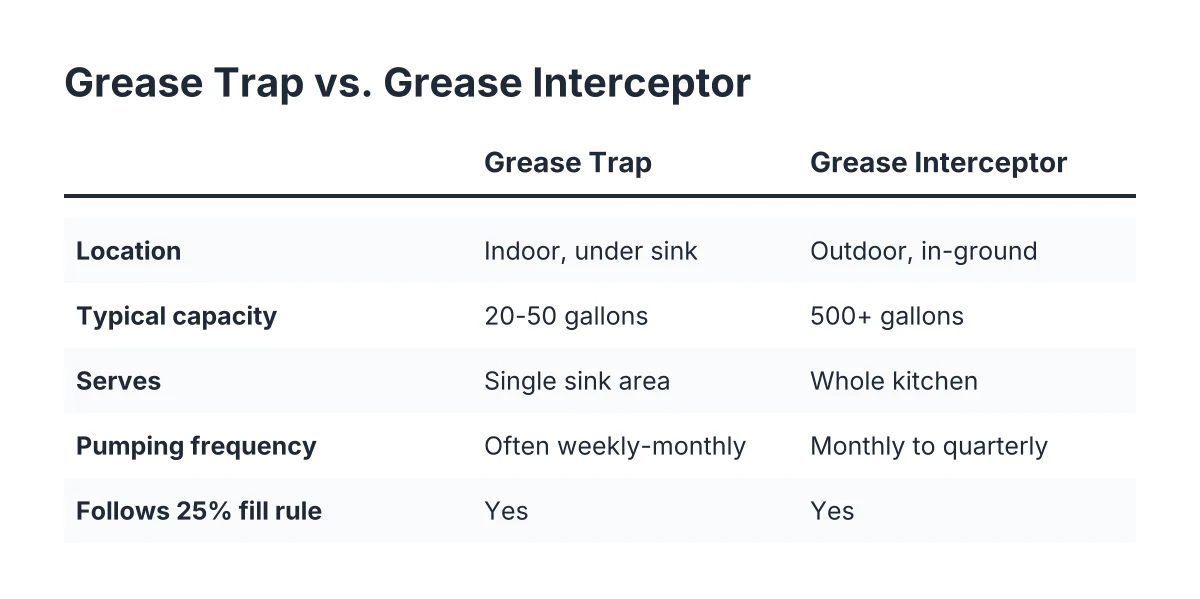
A grease trap is a box, either under the sink or buried outside, that catches fats, oils, and grease before they reach the sewer line or septic system. Kitchen wastewater flows in, slows down, and separates. Grease floats to the top, food solids sink to the bottom, and the water in the middle flows out toward the sewer or septic tank.
That separation is the whole job. Fats, oils, and grease, often shortened to FOG, cool and harden inside pipes. According to the U.S. Environmental Protection Agency, grease from restaurants, homes, and industrial sources is the most common cause of reported sewer blockages, responsible for 47% of cases. The trap exists to catch that grease while it is still warm and floating, before it can coat a pipe or clog a drain field.
However, a trap only works while it has room to separate. As the grease layer on top grows and the solids layer on the bottom rises, the space for water to slow down shrinks. Once the trap is too full, grease flows straight through and into whatever is downstream. On a Hesperia property, downstream often means a septic tank and drain field, and grease is one of the worst things you can send into either one.
If the building sits on septic, the stakes are higher than they would be on city sewer. Grease that escapes the trap disrupts the bacteria in the septic tank that break down solids. The tank clogs faster, needs pumping more often, and in a bad case the grease reaches the drain field, where it can cause damage that pumping alone cannot fix.
Recommended Frequency: How Often Your Grease Trap Needs Pumping and Scheduling
Most restaurant grease traps need pumping every one to three months, depending on the trap size and how much the kitchen cooks. A busy burger or taco kitchen can fill a small under-sink trap in a few weeks. A larger outdoor interceptor at a lower-volume operation might go a full quarter. The honest answer is that frequency depends on the specific trap and the specific kitchen, and the first pump-out tells you a lot.
The volume involved surprises most property owners. According to Wastewater Digest, a single restaurant can release between 800 and 17,000 pounds of grease into the sewer system each year. That range is wide because kitchens vary so much, which is exactly why a fixed calendar guess is not enough on its own.
A common industry benchmark is the one-quarter rule: pump the trap when the combined grease and solids fill about 25% of its capacity. Wait longer and the trap stops separating effectively. Many jurisdictions write a version of this rule directly into their requirements, alongside a maximum interval between pump-outs regardless of how full the trap looks.
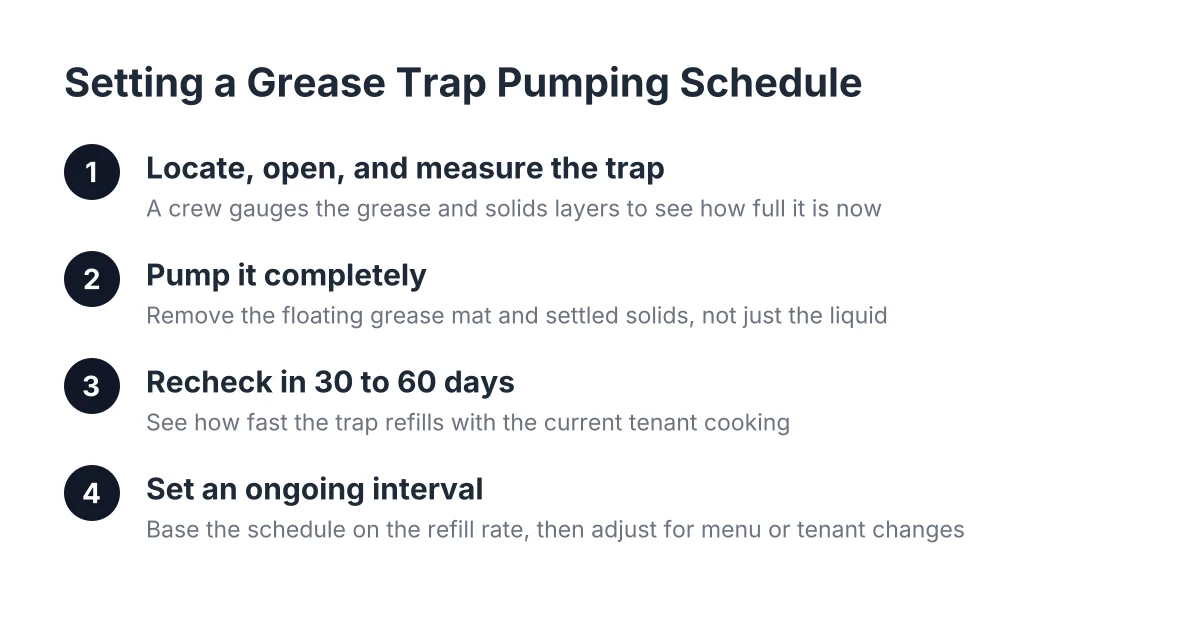
Here is how to land on the right schedule for a property you just took over:
- Have the trap located, opened, and measured. A crew can gauge the grease and solids layers and tell you how full it is right now.
- Pump it completely, including the floating grease mat and the settled solids, not just the liquid in the middle.
- Note the date, then have it checked again in 30 to 60 days to see how fast it refills with the current tenant cooking.
- Set the ongoing interval from that refill rate, then adjust if the menu, hours, or tenant changes.
For example, suppose you close on a small strip building in Hesperia with a taqueria tenant and zero maintenance records. An illustrative first visit might find the outdoor interceptor at 60 or 70% capacity, well past the point where it protects anything. In that scenario, a full pump-out, a follow-up check the next month, and a standing schedule every 60 days would be a reasonable plan, refined over the first two or three cycles.
Grease Trap Requirements for Restaurants: What the Rules Expect
Grease trap requirements for restaurants generally come from three directions: the local sewer or sanitation district, the county health department, and the fire or building code that governed the trap's installation. Most food-service operations are required to have a properly sized trap or interceptor, keep it maintained so it actually captures grease, and keep records proving they did.
The specifics vary by jurisdiction, and Hesperia-area properties can fall under different authorities depending on whether they connect to sewer or run on septic. Therefore, do not rely on a general article, this one included, for compliance details. Check with the local sewer district or county environmental health office for the exact rules that apply to your address, including any mandated pumping interval.
That said, a few expectations show up in most programs, and they are worth knowing as an owner even if your tenant handles day-to-day operations:
- The trap must be pumped before it loses effectiveness, often defined by the 25% capacity benchmark or a maximum time interval.
- Pumped grease must be hauled away by a permitted hauler and taken to an approved disposal site, not dumped or diluted on the property.
- The operator must keep pumping receipts or a maintenance log, and inspectors can ask to see them.
- Pouring hot water, degreasers, or enzymes into a trap to push grease through it is prohibited in most jurisdictions, because it just moves the problem into the public system.
In addition, the disposal side is a real part of the service. Grease and septic waste do not stay on site; they get hauled by truck to an approved treatment or disposal facility. According to the New Hampshire Department of Environmental Services, waste pumped from residential septic tanks is transported to a sewage treatment plant for disposal rather than processed on site, and commercial grease follows a similar hauled-away path under local rules. When you hire a pumper, you are paying for legal hauling and disposal, not just suction.
For a landlord, the practical question is who holds the compliance burden. Most commercial leases put grease trap maintenance on the tenant. However, if the tenant skips it and the trap overflows into your septic system, the damage lands on your property. Many small landlords in this position keep the pumping contract in their own name and bill it back, so they always have the receipts and control the schedule.
What Happens During a Grease Trap Pump-Out
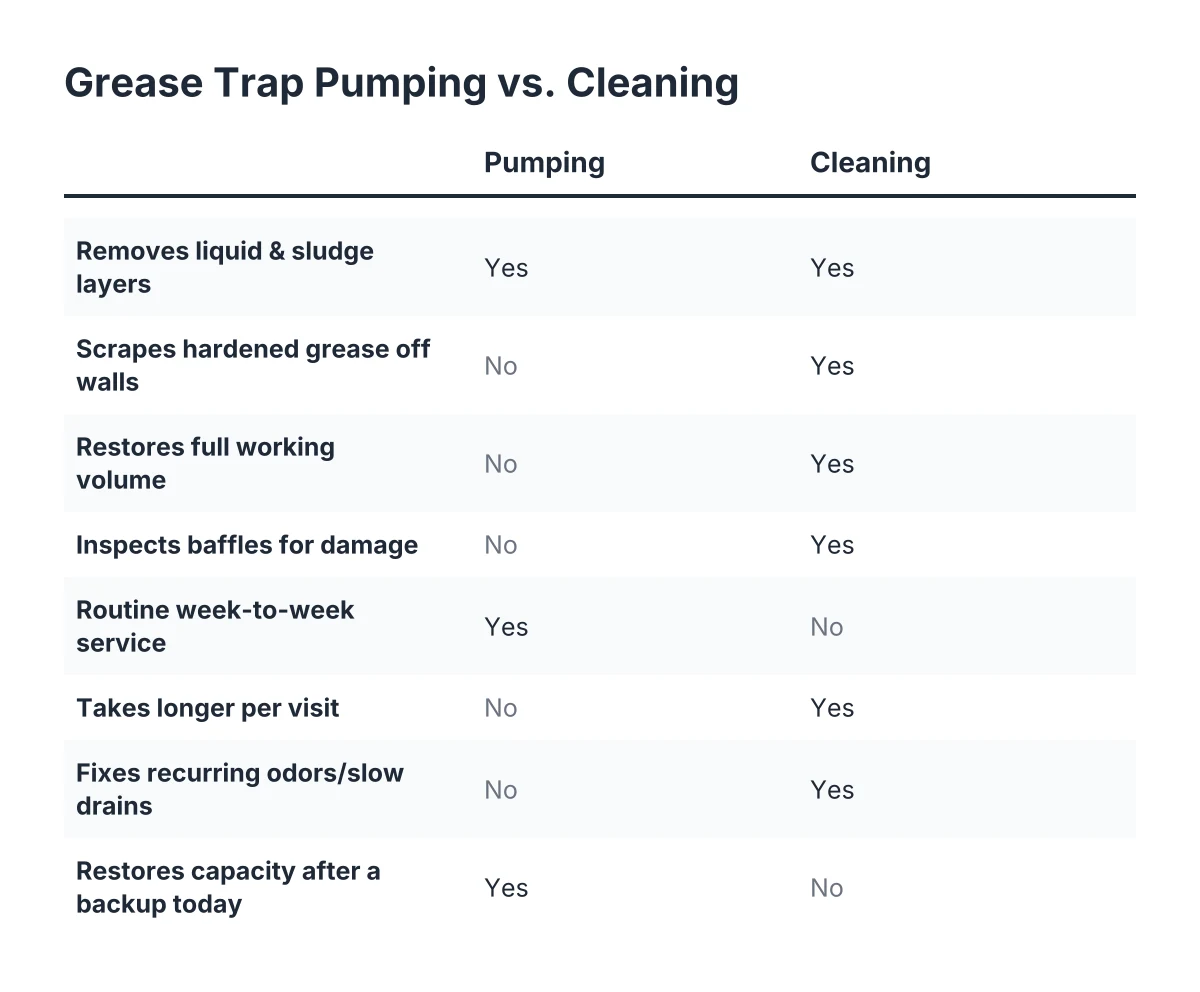
A proper grease trap service removes everything in the trap: the floating grease mat on top, the settled food solids on the bottom, and the water in between. Pumping only the liquid and leaving the hardened grease cap behind is a shortcut that leaves the trap nearly as compromised as before. When you review invoices, look for language confirming a full pump-out and, when needed, scraping of the trap walls and baffles.
A typical visit runs like this. The crew locates and opens the trap, which may mean lifting an indoor cover or pulling an outdoor lid. They measure or eyeball the grease and solids layers, then pump the full contents into the truck. Good crews scrape down the sides and check the inlet and outlet baffles, since a broken baffle lets grease slip straight through. Then they close it up and give you documentation of the service.
Most single-trap pump-outs take under an hour on site, though access problems can stretch that. An indoor trap in a cramped kitchen during lunch service is slower than an outdoor interceptor with a clear lid. Scheduling service before opening or after close keeps the disruption to your tenant near zero, which matters when your rent depends on that kitchen staying open.
Expect a few things to cost extra beyond a routine pump-out. Digging to find a buried lid with no riser, cutting through roots or hardscape, emergency after-hours response to an overflow, and repairs to damaged baffles or lids are usually billed separately. On cost, no single figure fits every trap; size, access, and disposal fees all move the number. As a point of reference from the septic side of the same trade, Angi reports septic tank pumping averages $427, ranging from $250 to $1,250 or more depending on tank size and location. Get a written quote for your specific trap rather than budgeting off a generic number.
Why This Lands on the Property Owner, Not Just the Tenant
Grease trap neglect is a property problem wearing a tenant costume. The tenant deals with slow drains and smells. You deal with what comes after: a fouled septic tank, a saturated drain field, a health department notice attached to your address, or a vacancy when the kitchen cannot operate. The trap is cheap to maintain and expensive to ignore.
The math is lopsided. Routine pumping a few times a year is a line item. Septic damage is a project. The U.S. Environmental Protection Agency estimates septic repair or replacement typically costs between $5,000 and $15,000, far more than routine pumping. On a High Desert commercial parcel where the building depends entirely on its septic system, letting grease reach the tank and drain field is one of the fastest ways to turn a performing property into a problem property.
There is also the records question, which land buyers with no paperwork know well. A file of dated pumping receipts does more than satisfy an inspector. It answers the exact question you could not get answered when you bought the place, so the next buyer, lender, or insurance adjuster never has to guess. If you plan to sell or refinance, a documented maintenance history on the grease trap and the septic tank pumping schedule behind it is a small, cheap credibility asset.
One honest limitation: pumping maintains a trap, it does not fix a bad one. If the trap is undersized for the kitchen, has broken baffles, or was never plumbed correctly, no schedule will fully protect the system. In that case you need an assessment and possibly a repair or replacement, and that is a conversation to have with a professional after they have actually opened the trap, not something to diagnose from an article.
Grease Trap Pumping for Restaurants on Septic Systems in Hesperia
Grease trap pumping for restaurants on septic-served properties needs to happen more often and more carefully than on sewer-connected buildings, because there is no city main to absorb the mistakes. Everything the trap misses goes into a tank and drain field on your own parcel, and the drain field is the expensive part.
Inside a septic tank, according to the U.S. Environmental Protection Agency, fats, oils, and grease float to form a scum layer on top, solids sink to form sludge on the bottom, and the middle liquid layer, called effluent, flows out to the drain field. A restaurant upstream loads that scum layer far faster than a house does. When the scum layer gets thick enough to reach the outlet, grease exits with the effluent and starts plugging the soil in the drain field. High Desert soils and a commercial kitchen are not a forgiving combination.
Consequently, on a septic-served food property, treat the grease trap and the septic tank as one system with two service points. The trap gets pumped on its short cycle, monthly or quarterly. The septic tank gets pumped on its longer cycle, and a crew that services both can check the tank's scum layer during trap visits and flag trouble early. Commercial buildings generally need more frequent tank pumping than homes anyway, since heavy restroom traffic and unknown waste from the public add load a family home never sees.
If you cannot find the septic tank or the trap at all, start with a locate. A crew that pumps in Hesperia regularly can trace the lines, find the lids, mark them, and install risers so the next service does not start with a shovel. For a buyer with no records, that single visit converts an unknown liability into a known, scheduled maintenance item.
Choosing a Grease Trap and Septic Pumping Crew in the High Desert
The right provider for a Hesperia commercial property is a crew that pumps grease traps and septic tanks as their core work, not a plumbing or multi-trade shop that treats pumping as a side job. Grease hauling requires the right truck, the right disposal arrangements, and familiarity with what local inspectors want to see on paper.
Before you sign up for a standing schedule in 2026, ask three questions:
- Do you pump the full trap, including the grease cap and settled solids, and do you check the baffles on every visit?
- Where does the grease go, and will I get documentation of legal hauling and disposal with each service?
- Can you service both the grease trap and the septic tank on this property, and flag septic problems you spot during trap visits?
A fair quote names the trap size or gives a per-gallon rate, spells out what is included, and lists likely extras such as locating a buried lid, after-hours response, or hard-to-access indoor traps. Be wary of a price that seems too low to cover disposal; skimmed-liquid-only pumping and questionable dumping are how those numbers get made, and both leave you exposed.
For a small landlord managing one to five septic-served properties in the Hesperia area, the practical endgame is simple: get every trap and tank located, get a baseline pump-out with a condition report, and put each property on a written schedule. If you have a food tenant and no idea when the grease trap was last touched, or no idea where it even is, a local Hesperia septic and grease trap crew can open it up, tell you plainly what you are dealing with, and set the schedule. Reach out, get an estimate for a first pump-out and inspection, and turn the biggest unknown on the property into a routine line item.
If you need your septic tank serviced, Hesperia Septic can help.
Prefer to talk it through? Call (760) 249-7872 — a quick call is usually the fastest way to get a straight answer for your situation.