Category: septic tank cost

  • Septic Tank Cost Terms Explained: A Plain-English Glossary

    septic tank cost glossary

    If you own a home in Hesperia with a septic system, or you are about to buy one, the quotes and inspection reports can read like a foreign language. This septic tank cost glossary breaks down the terms you will hear from pumping crews, inspectors, and real estate agents into plain English. Use it to read a quote line by line, ask better questions on the phone, and spot a problem before it turns into a backup in your yard. Every entry starts with a one-sentence definition you can understand on its own.

    • Septic Tank
    • Drain Field
    • Baffle
    • Scum and Sludge Layers
    • Riser
    • Effluent Filter
    • Cesspool
    • The 3 Types of Septic Systems
    • Conventional Gravity System
    • Aerobic Treatment Unit (ATU)
    • Septic Tank Pumping
    • What Affects Septic Tank Cost
    • Hydro Jetting
    • Emergency Pumping
    • Trip Fee
    • Dump Fee (Disposal Fee)
    • Septic Inspection
    • Grease Trap

    The Parts of Your System

    Septic Tank

    A septic tank is a buried, watertight container that catches everything that goes down your drains and separates it into layers: solids sink, grease floats, and liquid flows out the other end. It is the heart of the whole system and the part that gets pumped. Most quotes you see for septic tank pumping are priced around emptying this tank. If a buyer's inspection turns up a concrete tank of unknown age, this inspection checklist for concrete tanks walks through what to look for before you close.

    Drain Field

    A drain field is the network of buried pipes or trenches that spreads the liquid leaving your septic tank into the soil, where it filters naturally. It is also called a leach field. This is the expensive part of the system to replace, so protecting it is the main reason regular pumping matters. If a provider says your drain field is failing, ask them to show you the evidence, such as soggy ground, sewage odor, or water that will not drain from the tank.

    Baffle

    A baffle is a barrier inside the septic tank that keeps floating grease and scum from escaping into the drain field. Tanks have an inlet baffle where waste enters and an outlet baffle where liquid leaves. A broken or missing baffle lets solids reach the drain field, which shortens its life. Inspectors check baffles during pumping, and a quote that mentions baffle repair usually means the crew saw damage when the tank was open.

    Scum and Sludge Layers

    Scum and sludge are the two layers that build up inside a septic tank: scum is the floating layer of grease and light solids, and sludge is the heavy layer that settles on the bottom. The space between them is the liquid that flows out to the drain field. When those layers grow too thick, the tank needs pumping. A crew that measures these layers before quoting extra work is giving you real information, not a guess.

    Riser

    A riser is a pipe extension that brings your septic tank's access lid up to ground level so nobody has to dig every time the tank needs service. Without risers, the crew may have to excavate to reach the lids, and digging adds labor to the bill. Installing risers during a pumping visit often pays for itself over time. If your quote includes a line for digging, ask whether adding risers would make future visits cheaper.

    Effluent Filter

    An effluent filter is a screen on the tank's outlet that catches small solids before they can wash into the drain field. Not every tank has one, but where present it needs occasional cleaning, usually during pumping. A clogged filter can back sewage up into the house even when the tank itself is fine. If a provider mentions cleaning or replacing the filter, that is routine, not an upsell.

    Cesspool

    A cesspool is an older type of waste pit that collects sewage without a separate tank and drain field, letting liquid seep straight into the surrounding soil. Some older High Desert properties still have them. They fill faster and fail sooner than modern systems, which affects both service frequency and long-term cost. If you are weighing the two, this comparison of septic systems versus cesspools covers the differences that matter to a buyer.

    Types of Septic Systems

    The 3 Types of Septic Systems

    The three types of septic systems most homeowners encounter are conventional gravity systems, pressure distribution systems, and alternative or engineered systems. A conventional gravity system lets waste flow downhill from the tank to the drain field with no pump. A pressure distribution system uses a pump to push liquid evenly across the drain field, common where the ground is flat or the field sits uphill. Alternative systems, such as mound or aerobic treatment units, are engineered for difficult soil and cost more to install, service, and repair. Knowing which type you have changes what maintenance costs to expect, so ask your inspector to name it in writing.

    Conventional Gravity System

    A conventional gravity system is a septic setup where wastewater flows from the house to the tank to the drain field entirely by gravity, with no pumps or electronics. It is the simplest and usually the cheapest type to maintain because there are fewer parts that can fail. Most standard septic tank pumping quotes assume this kind of system. If yours has a pump chamber or control panel, mention it when you call so the quote matches the work.

    Aerobic Treatment Unit (ATU)

    An aerobic treatment unit is a septic system that adds air to the tank so oxygen-loving bacteria can break down waste faster and cleaner than a standard tank. ATUs have motors, air pumps, and sometimes alarms, which means more parts to service and more service visits. If a property listing mentions an ATU, budget for ongoing maintenance beyond simple pumping. Ask any provider whether they service ATUs before booking, since not every pumping crew handles them.

    Service, Pricing, and Paperwork

    Septic Tank Pumping

    Septic tank pumping is the process of using a vacuum truck to remove the built-up sludge, scum, and liquid from your septic tank. It is the single most common septic service and the baseline for most quotes you will collect. Pumping on a regular schedule protects the drain field, which is where the big money hides. When solids escape into the field, the fix jumps from a routine pumping bill to a major repair, so the overall septic tank cost picture depends more on the drain field than the tank itself.

    What Affects Septic Tank Cost

    Septic tank cost varies based on several factors including system type, tank size, soil conditions, and whether the tank needs locating or digging. On older Hesperia properties with no records, the crew may use probes, flushable transmitters, or old permit sketches to find the tank. Locating work takes real time before any pumping starts, which is why it appears as its own line on a quote. If you know where your lids are, say so when you call; it can shrink the job.

    Hydro Jetting

    Hydro jetting means clearing a clogged pipe with a high-pressure stream of water instead of a cable or snake. Crews sometimes recommend it for the line between the house and the tank when grease or roots have built up. It is a separate service from pumping, so expect it as its own line item if it appears on your quote. Ask what the crew found in the line that makes jetting necessary before you approve it.

    Emergency Pumping

    Emergency pumping is a septic tank pumping visit scheduled outside normal hours or on short notice because sewage is backing up or about to. It typically costs more than a planned visit because the crew is dropping other work to get to you. A slow drain today is cheaper to handle than a backup on a holiday weekend. If your tank is due, booking ahead is the easiest way to avoid paying the emergency rate.

    Trip Fee

    A trip fee is a charge some companies add just for driving a truck to your property, separate from the cost of the actual work. It is one of the most common surprise line items on a septic invoice. Always ask whether the quoted price includes travel, digging, and dump fees or whether those get added later. This pricing guide to hidden septic fees in Hesperia lists the add-on charges to ask about before the truck rolls.

    Dump Fee (Disposal Fee)

    A dump fee is the charge for legally disposing of the waste the truck pumps out of your tank, since crews must haul it to an approved treatment facility. Some companies fold this into the pumping price; others list it separately. Neither approach is wrong, but you want to know which one you are looking at before comparing quotes. Two quotes that look far apart can land in the same place once disposal is counted.

    Septic Inspection

    A septic inspection is an evaluation of the tank, baffles, liquid levels, and drain field to judge the system's condition, often ordered during a home sale. It is different from pumping, though the two are often done together because an empty tank is easier to inspect. For buyers, an inspection report is the best defense against inheriting a failing system with no paper trail. If a seller has no service records, this guide on choosing between pumping and repair with no records explains how to read what the tank itself tells you.

    Grease Trap

    A grease trap is a container that catches fats, oils, and grease from a kitchen's drains before they reach the septic system or sewer. They are standard in restaurants and some larger properties, and they need their own pumping schedule. Grease trap pumping is a separate service from septic tank pumping, with its own line on a quote. If your property has one, mention it when booking so the crew brings the right setup.

    Using These Terms

    You now have the working vocabulary to read a septic quote line by line and ask what each charge covers, from trip fees to baffle repairs. Keep this glossary handy when you compare service providers, and do not hesitate to ask a crew to explain any term they use; a good one will. For the full picture of what pumping and service run, see the complete guide to what a septic tank costs.

    If you need your septic tank serviced, Hesperia Septic can help.

    Related Reading

  • How Much Does Septic Tank Cost?

    septic system cost

    How much does a septic tank cost? The honest answer depends on what your system needs, because septic system cost swings on three things: whether you need pumping, a repair, or a full replacement; the size and condition of your tank; and how hard it is to reach on your property. Anyone who quotes you a firm number before knowing those three things is guessing. This guide walks through each factor in plain language so you can tell which side of the price line you sit on. By the end, you will know exactly what to have ready to get a real number for your Hesperia property.

    What Drives the Cost of Septic Tank Pumping

    Scope: pumping, repair, or replacement

    This is the biggest fork in the road. Routine septic tank pumping is the low end of the scale. A repair to a lid, baffle, or pipe sits in the middle. Replacing a tank, or installing a new tank and leach field, is the expensive end because it involves excavation, materials, permits, and inspection. Before you assume the worst, read when pumping solves the problem versus when a repair is needed. Many backups and slow drains trace back to a full tank, not a broken one.

    Tank size and how full it is

    A bigger tank holds more waste, and more waste means more time and more disposal volume when the truck arrives. If your tank has gone years without service, the solids layer at the bottom takes longer to break up and remove, which adds labor. You can usually tell which side you are on by your service history. Regular pumping on a schedule keeps each visit at the routine end. A tank that has been ignored until it backed up will cost more to handle.

    Access and dig conditions

    The crew has to find your tank, uncover the lids, and get the truck's hose to it. A tank with risers at grade level, a clear driveway, and a short hose run is the cheap version. A tank buried under two feet of soil, hidden under a deck, or sitting far from where the truck can park pushes the price up. If you do not know where your tank is, septic tank locating is a service on its own, and it comes before any pumping can happen.

    Condition of the tank and drain field

    An aging concrete tank with a cracked lid, a failed baffle, or a leach field that no longer absorbs water changes the job entirely. A pumping visit can reveal these problems, which is one reason an inspection matters before you buy or sell a property. Material choice matters too when replacement is on the table. Our guide to concrete septic tanks and how they compare to plastic and fiberglass covers what each material means for lifespan and price.

    System type

    A standard gravity septic system is the simplest and cheapest kind to install and maintain. An aerobic system, which uses a motor and air pump to treat waste more actively, costs more to install and more to keep running because it has mechanical parts that need service. If you are pricing a new install, the type of system your soil and county requirements allow will shape the number more than almost anything else. If you are comparing system styles from scratch, our breakdown of septic versus cesspool systems explains the tradeoffs.

    Timing and urgency

    An emergency call for a septic backup on a weekend costs more than a scheduled weekday pumping. Sewage in the house or standing in the yard forces the work to happen now, on the provider's overtime clock. If your system is merely due for service, scheduling ahead keeps you in the routine pricing tier and out of the emergency one.

    Cost Factor Table

    Factor Pushes the price down when… Pushes it up when…
    Scope of work The tank just needs routine pumping You need repairs, a new tank, or a full tank and leach field install
    Tank size and fill level The tank is average size and serviced on schedule The tank is large or has gone years between pumpings
    Access Lids are at grade and the truck parks close The tank is buried, hidden, or far from truck access
    Tank and field condition Tank and drain field are sound Baffles, lids, or the leach field need work
    System type It is a standard gravity system It is an aerobic system with pumps and motors
    Timing You schedule service ahead of trouble It is an emergency backup on a night or weekend

    How to Get an Accurate Septic Tank Estimate

    You do not need to be a septic expert to get a solid quote. You just need to hand the provider the right facts. Have these ready:

    • Tank location and access. Do you know where the lids are? Are they exposed or buried? How close can a truck get?
    • Service history. When was the tank last pumped? If you have no records, say so; that changes what the crew plans for.
    • Symptoms. Slow drains, gurgling, odors, wet spots in the yard, or a full backup all point to different scopes of work.
    • Property details. Number of bedrooms and bathrooms, and whether the home is your full-time residence or a rental.

    A good quote spells out what is included: pumping the tank, digging to reach lids, disposal of the waste, and a basic look at the tank's condition while it is open. It should also state what triggers extra charges. Estimates differ between providers because some quote a bare pumping price and add fees for digging, extra volume, or disposal later, while others fold everything into one number. That is why two quotes for the same job can look far apart on paper. Our guide to hidden fees septic companies charge in Hesperia shows the line items to ask about before anyone starts digging.

    The fastest way to a personalized number is the Septic Tank Pumping Cost Calculator. Answer a few questions about your tank and property and get an estimate built for your situation, not a generic figure.

    Ways to Keep the Cost Down

    Pump on a schedule, not after a backup. Routine pumping is the cheapest thing you will ever do for your septic system. Waiting until sewage backs up into the house converts a routine visit into an emergency call plus cleanup, and it can push solids into the drain field, where the expensive damage happens. Understanding the factors that drive septic tank cost helps you prioritize this preventative maintenance.

    Expose your own lids before the crew arrives. If you know where the tank is and you are able to dig, uncovering the lids yourself removes the digging labor from the bill. Ask first so you dig in the right spot.

    Get two or three itemized quotes. Not to grind the lowest bidder, but to see what each provider includes. A quote that lists digging, disposal, and inspection separately tells you more than a single vague number.

    Fix small problems while the tank is open. A cracked lid or a failing baffle costs less to handle during a pumping visit than as a separate trip later. Ask the crew what they see while the tank is exposed.

    Watch what goes down the drain. Grease, wipes, and heavy garbage disposal use fill a tank faster and stress the drain field. Slower fill means longer stretches between pumpings and a leach field that lasts.

    Cost Questions People Ask

    What does septic tank replacement cost?

    Replacement is the top of the price scale because it means excavation, a new tank, permits, and inspection, and often new plumbing connections. The final number depends on tank material, tank size, soil conditions, and how deep the crews have to dig. Before budgeting for replacement, get the tank inspected; some "failed" tanks just need pumping and a repair.

    What does it cost to install a septic tank and leach field?

    A full install is priced by the whole system, not just the tank. The leach field is often the larger share because it requires soil testing, trenching, and enough yard space to lay the lines. Lot size, soil drainage, and county permit requirements in the High Desert all move the number, so an on-site evaluation is the only way to get a real figure.

    How much does an aerobic septic system cost compared to a standard one?

    More, both upfront and over time. An aerobic system adds an air pump, a motor, and sometimes a spray or drip distribution setup, and those parts need ongoing service. Standard gravity systems have no moving parts, which is why they stay cheaper for the life of the system. Aerobic systems earn their keep on lots where soil or space rules out a conventional leach field.

    Why do septic quotes vary so much between companies?

    Because they are not always quoting the same job. One company's number may cover pumping only, while another includes digging to the lids, disposal fees, and a condition check. When you compare quotes, compare the line items, not just the totals. The lowest headline septic tank cost can end up the highest bill once the add-ons land.

    The Bottom Line

    Your price comes down to scope, tank size and access, and how urgent the job is, and no honest provider can name a number without those facts. Gather two or three itemized quotes, ask what each one includes, and use the Septic Tank Pumping Cost Calculator to get a number matched to your property. A scheduled pumping today is the cheapest version of this job you will ever see.

    If you need your septic tank serviced, Hesperia Septic can help.

    Related Reading

  • Buying Property With a Concrete Septic Tank in Hesperia: The Inspection Checklist

    concrete septic tank inspection

    If you're about to close on land or a home in Hesperia with no septic records, a concrete septic tank inspection is the one step that turns the biggest unknown on the property into a number you can negotiate. The tank in the ground is almost certainly concrete: most older High Desert properties were built with concrete tanks, and knowing what that means for failure points, repairs, and lifespan changes how you budget. This guide walks through what an inspector checks (lid, baffles, walls, seams), what each finding costs to fix, how long a concrete tank should last, and how to price the results before you commit money to a property where nobody can tell you what's buried out back.

    No hidden-fee talk, no manufactured upsells. Just the numbers and trade-offs, so when a quote lands in your inbox you can tell whether it's fair.

    Why Septic Tank Concrete Dominates the High Desert

    Concrete is the default septic tank material in Hesperia and most of the High Desert for a simple reason: it holds up. A concrete tank is heavy, so it doesn't float or shift when groundwater or soil conditions change. It handles the weight of soil above it, and in many cases it can survive a vehicle accidentally driving over the area, which plastic tanks often cannot.

    For a land buyer with no records, this matters in a practical way. If the home on your new property was built decades ago, the odds are high that the tank is concrete. That tells you something about what to inspect, what parts wear out first, and roughly what a replacement would cost if the inspection turns up bad news.

    Concrete tanks are typically precast, meaning they were poured at a factory and delivered by truck. Some older rural tanks were poured in place on site. Poured-in-place tanks can be fine, but they can also be undersized, unbaffled, or built to no particular standard, which is one more reason a professional inspection matters on a property with no paperwork.

    What the Inspection Findings Cost to Fix

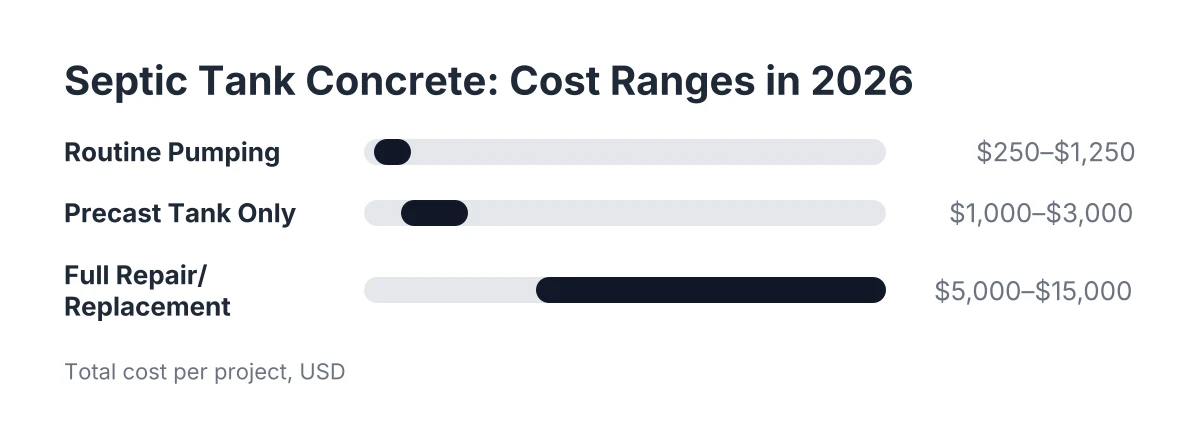
    Worst case first, so the rest of the numbers have context. A precast concrete septic tank itself typically runs somewhere in the range of $1,000 to $3,000 for the tank alone, depending on size and the supplier. However, the tank is the smaller part of the bill. Excavation, delivery, setting the tank with a crane truck, connecting the plumbing, permits, and backfill make up most of a full installation, which is why total project costs land far above the sticker price of the tank.

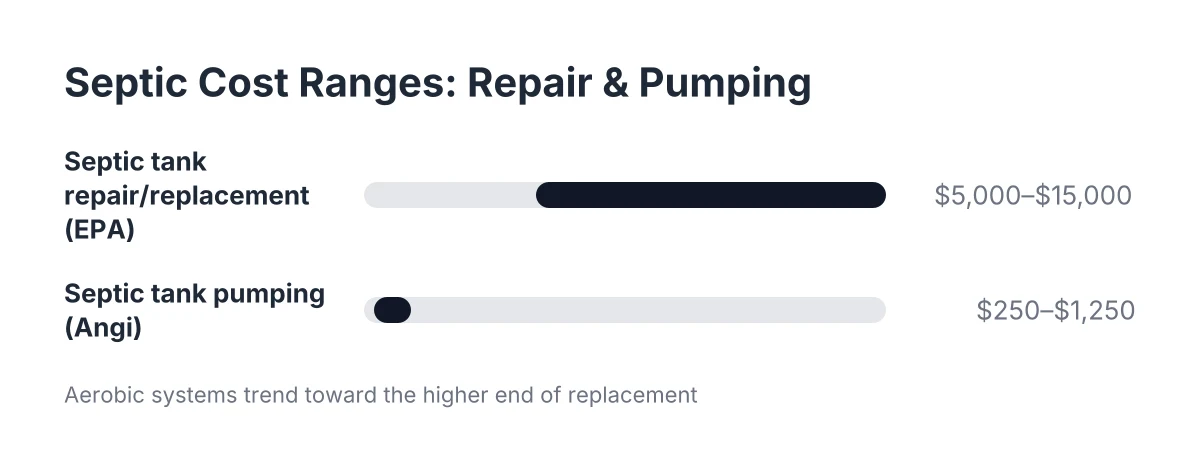
    According to the U.S. Environmental Protection Agency, septic tank repair or replacement typically costs between $5,000 and $15,000. That range covers most residential situations, and it's a useful sanity check when you're comparing quotes for the cost of septic tank replacement. If a bid comes in far outside that window, ask what's driving it. Sometimes there's a real reason, like deep burial, hard soil, or a failed drain field that also needs work. Sometimes there isn't.

    Here's how the pieces of a concrete tank project typically break down:

    • The tank itself: the precast concrete unit, priced by capacity
    • Excavation and site work: digging the hole, managing soil, and backfilling after the set
    • Delivery and placement: a boom truck or crane sets the tank, and access to your lot affects this cost
    • Plumbing connections: tying the house line and the drain field line into the tank
    • Permits and inspections: San Bernardino County requires permits for septic work, and fees vary
    • Risers and lids: a concrete septic tank riser and cover bring the access point to grade so future pumping doesn't require digging

    Compare that full-replacement picture to routine service. According to Angi, septic tank pumping averages $427, with a range of $250 to $1,250 or more depending on tank size and location. That gap between a few hundred dollars for pumping and five figures for replacement is the strongest argument for maintaining a concrete tank instead of letting it fail.

    One note on comparing quotes: septic tank cost varies with tank size, burial depth, and how easy the lid is to reach. A quote that seems high may reflect a deep tank with no riser, and a quote that seems low may not include digging to find the lid at all. Ask each company to itemize so you're comparing the same work.

    How Long Does a Concrete Septic Tank Last?

    A well-built concrete septic tank commonly lasts 40 years or more, and some last well past that with regular pumping and no structural damage. Lifespan depends on the quality of the original concrete, the soil conditions, and whether the tank was maintained or left to accumulate solids for decades. Plastic and fiberglass tanks generally have shorter expected lifespans and are more vulnerable to physical damage.

    That longevity is the core of the concrete value argument. A tank that costs more to install but lasts twice as long usually wins on total cost of ownership. However, longevity is not a guarantee. Concrete has specific failure points, and on a property with no records, those failure points are exactly what an inspection should look at.

    Where a Concrete Septic Tank Inspection Looks First

    Concrete rarely fails all at once. It degrades in predictable places:

    1. The lid and cover. The concrete septic tank lid takes the most abuse. Lids crack from age, vehicle traffic, or careless digging. A cracked concrete cover is a safety hazard, especially on land where kids or livestock roam. Lid replacement is one of the cheaper concrete repairs, often a few hundred dollars installed, and it's worth doing immediately if the lid is compromised.
    2. The baffles. Baffles direct flow inside the tank and keep solids from washing into the drain field. In older concrete tanks, baffles were often concrete themselves, and sewage gases eat away at concrete above the waterline over decades. A deteriorated baffle lets solids escape and can quietly kill a drain field, which is the expensive part of the system.
    3. The tank walls above the waterline. The same corrosive gases that destroy baffles can pit and weaken the concrete crown of the tank. An inspector checks this when the tank is pumped and empty.
    4. Seams and connections. Cracks at the inlet, outlet, or the seam between tank sections can let groundwater in or sewage out. Either one is a problem worth knowing about before closing on a property.

    Septic Tank Concrete vs. Plastic and Fiberglass

    Concrete, plastic, and fiberglass all show up in residential septic systems, and each has a real trade-off profile. Concrete costs more upfront and lasts longer. Plastic costs less and installs faster, but it can crack under weight, and an empty plastic tank can float upward in wet soil if it isn't anchored. Fiberglass sits between the two on price and resists corrosion well, but it shares plastic's vulnerability to shifting and damage during installation.

    For example, here's how the materials compare on the factors that matter most:

    • Upfront cost: plastic is usually cheapest, fiberglass is mid-range, and concrete costs the most for the tank itself
    • Installation: plastic and fiberglass tanks are light enough to place without a crane; concrete needs heavy equipment, which adds cost
    • Durability: concrete handles soil weight and surface traffic best; plastic is most vulnerable to crushing and deformation
    • Lifespan: concrete typically outlasts both alternatives when maintained
    • Repairability: cracked concrete can often be patched or fitted with new baffles; a badly cracked plastic tank usually means replacement

    In Hesperia's soil and climate, concrete remains the common choice for full-size residential tanks. That said, material is only one part of the picture. Septic system types range from standard gravity systems, which most Hesperia homes have, to alternative designs with pumps and mechanical parts. An aerobic septic system cost runs meaningfully higher than a conventional gravity system, both to install and to maintain, because it uses powered components that need attention. The EPA advises that alternative systems with electrical float switches, pumps, or mechanical components should generally be inspected once a year, versus at least once every three years for a standard system.

    If you're replacing a failed system rather than just a tank, the county's requirements and your soil conditions may dictate the system type more than your preference does. That's a conversation to have with a septic professional and the county before you assume a like-for-like swap.

    Concrete Septic Tank Inspection: The Buyer's Sequence

    If you're buying land or a home in Hesperia with no septic records, treat the septic system as an unknown expense until someone physically opens the tank. The seller may not know where the tank is. The previous owner may never have pumped it. None of that shows up in a standard home inspection, which typically doesn't open or evaluate the septic tank at all.

    Here is the practical sequence that protects you:

    1. Get the tank located. A septic tank locating service finds the tank and marks it, even when there's no visible lid or riser on the lot. On older properties, the concrete lid is often buried under a foot or more of soil.
    2. Have the tank pumped and inspected together. A concrete septic tank inspection can't be done on a full tank. Pumping it empty lets someone check the baffles, the concrete walls, the lid, and the liquid levels that hint at drain field health.
    3. Ask for a written report. For a purchase decision, you want documentation: tank material, approximate condition, lid and baffle status, and any signs of drain field failure. Lenders and escrow officers can work with a written report; they can't work with a verbal "seems fine."
    4. Price the findings before you close. If the report shows a cracked concrete septic tank cover, that's a modest fix you can negotiate. If it shows a collapsing tank or a saturated drain field, you're looking at the EPA's $5,000 to $15,000 replacement range, and that belongs in your purchase negotiation, not in your first year of ownership as a surprise.

    Consider a realistic Hesperia scenario. A buyer closes on a 1970s home on an acre lot. No septic records exist, no lid is visible, and the seller shrugs. A locate finds the tank 18 inches down under the side yard. Pumping and inspection reveal a concrete tank in decent shape, but the concrete outlet baffle has dissolved and solids have been flowing toward the drain field for years. The fix is a new outlet tee, a few hundred dollars, caught before it destroyed a drain field worth thousands. That is the entire case for inspecting before you buy.

    The trade-off is real: a locate-and-inspect job costs money on a property you might walk away from, and it can add a few days to escrow. Weigh that against the alternative, which is absorbing a five-figure replacement with no negotiating leverage after closing.

    Getting the Most Life Out of a Concrete Tank

    Once you own the property, the goal shifts from evaluating the tank to protecting it. Concrete rewards maintenance more than any other tank material, because most concrete failures build slowly and get caught during routine pumping.

    First, establish a pumping baseline. If nobody knows when the tank was last pumped, have it pumped now and note the date. The EPA recommends professional inspection at least once every three years for the average household, and pumping visits are the natural time to do it. More than one in five U.S. households rely on septic or small cluster systems, according to the EPA, so this is ordinary homeownership on septic, not an exotic burden.

    Next, add a riser if the tank doesn't have one. A concrete septic tank riser, or a plastic riser bolted to the concrete tank, brings the access lid up to ground level. Every future pumping visit gets cheaper and faster because nobody has to dig to find the lid. On a property where you just paid to locate the tank, a riser means you never pay for that again.

    In addition, protect the ground above the tank. Don't park vehicles, place sheds, or pour patios over the tank or drain field. Concrete is the toughest tank material, but repeated vehicle loads crack lids and stress tank crowns. Mark the tank location on a simple property sketch, and keep it with your house documents so the next owner isn't in your position.

    Finally, know your warning signs. Slow drains across the whole house, sewage odor in the yard, or wet ground over the drain field mean the system needs attention now, not at the next scheduled pumping. Catching a backup early is the difference between an emergency pumping visit and a sewage cleanup inside the house.

    When to Repair Concrete and When to Replace It

    Repair a concrete tank when the structure is sound and the failure is a component: a cracked lid, a deteriorated baffle, or a bad inlet connection. These fixes typically cost hundreds, not thousands, and they restore decades of remaining service life. Replace the tank when the concrete itself has failed, meaning collapsed sections, major cracks below the waterline, or a crown so deteriorated it can't safely support a lid.

    A pumped-out, visual inspection is the only honest way to make that call. Anyone quoting a full replacement without opening and emptying the tank is guessing, and you shouldn't pay five figures on a guess. Likewise, a badly failed tank patched to limp along is a liability, especially if you plan to sell or build on the property later. Structural assessments and county permit questions are where a professional's judgment matters most; this guide can frame the decision, but it can't look inside your tank.

    For most Hesperia property owners, the math favors concrete's long game. Pump on schedule, inspect when you pump, fix small concrete failures while they're small, and a concrete tank installed decades ago keeps working for decades more. For the land buyer starting with zero records, one locate, one pumping, and one written concrete septic tank inspection report turn the biggest unknown on the property into a line item you can actually plan around.

    If you're buying in Hesperia and need the tank found, pumped, and inspected before you close, Hesperia Septic can help.

    Related Reading

  • Hidden Fees Septic Tank Companies Charge in Hesperia, CA: A Pricing Guide

    Process flow showing six questions property owners should ask septic tank companies to uncover hidden fees before service.
    Six critical questions to ask a septic company when requesting a quote for pumping service in Hesperia, CA.

    You called a septic company, they quoted one number on the phone, and the invoice came back higher. If you own rental property in Hesperia, CA, or you just bought land with a septic system nobody left records for, you have probably run into hidden septic fees already. This guide breaks down the hidden septic fees septic tank companies commonly add to a bill, which ones are legitimate charges for real work, and which ones are padding. By the end, you should be able to look at any septic quote and know exactly what you are paying for and why.

    The short version: most surprise charges come from work the phone quote never covered, like digging to reach a buried lid, pumping more gallons than expected, or hauling extra waste. A good local crew tells you about these possibilities before the truck shows up. A bad one waits until the tank is open and you have no leverage.

    Why Septic Quotes in Hesperia Rarely Match the Final Bill

    A phone quote for septic tank pumping is an estimate based on what the company can see, which at that point is nothing. They have not seen your tank, your lot, or your lids. In the High Desert, where lots are bigger, tanks are older, and records are thin, the gap between quote and invoice can be wide.

    Here is the core problem. The base price for septic tank pumping usually covers a standard tank with an accessible lid and a normal amount of waste. Everything outside that description costs extra. That is not automatically dishonest; digging through two feet of compacted desert soil is real labor. The dishonest part is when a company knows those extras are likely and quotes low anyway to win the call.

    For context on the baseline, according to Angi, septic tank pumping averages $427 nationally, with a range from $250 to $1,250 or more depending on tank size and location. If a quote comes in far below that range, ask what it excludes. The answer usually explains the whole business model.

    The Most Common Hidden Septic Fees Septic Tank Customers Report

    The add-on charges below show up on septic invoices across the country, and Hesperia is no exception. Some are fair when the work is real. Others exist to inflate a lowball quote. Knowing the difference is how you protect yourself.

    Digging and Lid Access Charges

    Many older Hesperia properties have septic tanks buried with no riser, which means the crew has to find the lid and dig down to it before any pumping starts. Companies charge for this by depth, by time, or by flat fee. It is legitimate work, but it should be disclosed as a possibility when you book, not revealed after the shovel comes out.

    If you do not know where your tank is, say so on the phone. Ask what septic tank locating costs and what digging runs per foot of depth or per hour. A straight answer up front is a good sign. A vague "we'll see when we get there" is not.

    Extra Gallon and Overage Fees

    Base pumping prices assume a certain tank size. However, if your tank turns out to be larger, or it is overfull because of a backup, the truck hauls more gallons and the price goes up. The fair version of this fee is disclosed as a per-gallon or per-size rate before the job. The unfair version is a surprise line item with no rate explained.

    This one hits land buyers hard. With no records, you may not know if the property has a 1,000-gallon concrete septic tank or something larger serving a house that was expanded over the years. Ask the company how they price by size and what happens if the tank is bigger than expected.

    Solids, Sludge, and "Heavy Waste" Surcharges

    A tank that has not been pumped in years builds up a thick sludge layer that takes longer to break up and remove. Some companies charge extra for this under names like heavy solids fee, back-flushing fee, or extra cleaning charge. Again, the work can be real. Breaking up compacted sludge takes time and water.

    The red flag is when this fee appears on every invoice regardless of tank condition. If a company cannot show you the tank and explain why the charge applies, push back. Any crew doing honest septic tank cleaning should be able to point into the open tank and show you what they are talking about.

    Disposal and Environmental Fees

    Waste from your tank has to be hauled to an approved disposal site, and that costs the company money. Some operators build disposal into their base price; others break it out as a separate line. Neither approach is wrong, but a disposal fee that was never mentioned on the phone is a classic hidden fees septic tank move. Ask directly: does your quote include disposal, or is that separate?

    Trip Charges and Fuel Surcharges

    Hesperia properties can sit well off paved roads, and some companies add trip charges for distance or fuel. A local Hesperia crew should rarely need this for jobs inside the immediate High Desert area. If you are quoted a trip charge for an address ten minutes from town, ask why.

    Emergency and After-Hours Markups

    Emergency septic pumping costs more than scheduled service, and that is reasonable. A crew coming out on a Sunday night for a septic backup is doing harder work on worse terms. What matters is that the emergency rate is stated when you call, not discovered on the invoice. If you own rentals, get the after-hours rate structure in writing before you ever need it. Tenant backups do not wait for business hours.

    What a Fair Septic Quote in Hesperia, CA Should Include

    A trustworthy quote names its assumptions and its exceptions. When you call for septic tank pumping in Hesperia, CA, the company should be able to walk through all of the following before scheduling:

    • The base price and what tank size it assumes
    • Whether locating the tank is included, and what it costs if not
    • Digging or lid access charges, stated per foot, per hour, or flat
    • The per-gallon or per-size rate if the tank is bigger than assumed
    • Whether waste disposal is included in the base price
    • Any surcharge for heavy solids, and what condition triggers it
    • Emergency or after-hours rates, if that applies to your situation
    • Whether a written report or invoice with findings is included

    If a company answers all eight without dodging, you are probably dealing with a straight operator. If they get cagey on two or more, keep calling around. Comparing quotes only works when every quote covers the same list.

    Buying Land With No Septic Records? Here Is What the Locate and Inspect Actually Costs You

    For a buyer with no septic records, a locate-and-inspect job typically runs a few hundred dollars and covers finding the tank, uncovering the lid, pumping it so the inspector can see the walls and baffles, and producing a written condition report. Compared to what you are risking on the purchase, it is one of the cheapest pieces of due diligence in the deal.

    Consider a realistic Hesperia scenario. You are in escrow on a two-acre lot with an older house, the seller cannot tell you where the tank is, and there is no riser visible anywhere on the property. A septic tank locating service traces the line from the house, marks the tank, and digs to the lid. The crew pumps the tank, and the inspection reveals whether the concrete septic tank is sound or cracked, whether the baffles are intact, and whether the drain field is taking water.

    Now weigh the two outcomes. If the system is healthy, you close with confidence and a document you can show your lender. If it is failing, you just learned something worth thousands in negotiating power. The EPA estimates septic repair or replacement typically costs between $5,000 and $15,000, and a full new system with a leach field can run higher depending on soil conditions and septic tank design. The cost to install a septic tank and leach field on High Desert soil is not a number you want to discover after closing.

    One honest limitation: a standard inspection cannot see everything. Buried pipe condition and long-term drain field performance sometimes only reveal themselves under real household use. A written report tells you the system's condition on inspection day, which is far better than nothing, but it is not a lifetime warranty. If the report flags anything marginal, bring in the county or a septic professional before you waive contingencies.

    How Landlords in Hesperia Can Lock In Pricing Before There Is a Problem

    Landlords with septic-served rentals in Hesperia should get a written rate sheet from a septic company before any tenant calls about slow drains. Knowing the base pumping price, the access charges, and the emergency markup in advance turns a 10 p.m. backup call from a financial unknown into a known cost you already budgeted.

    The math favors planning. According to the U.S. Environmental Protection Agency, the average household should have its septic system inspected at least once every three years by a professional, and systems with pumps or float switches should be inspected once a year. Putting your rentals on a schedule means you choose the timing, you avoid emergency rates, and your tenants never see a backup in the first place.

    In addition, watch your water bills between visits. The EPA notes a single leaky or running toilet can push as much as 200 gallons of extra water per day into a septic system. That kind of load overwhelms a tank and drain field fast, and it turns a routine pumping schedule into an emergency call. A spiking water bill at a rental is a septic warning sign, not just a plumbing annoyance.

    Finally, ask for itemized invoices on every job. If you own three or four septic properties, those invoices become your maintenance record, your tax documentation, and your evidence when a tenant dispute comes up. A company that resists itemizing is telling you something about how it prices.

    Questions That Expose Hidden Fees Septic Tank Companies Hope You Skip

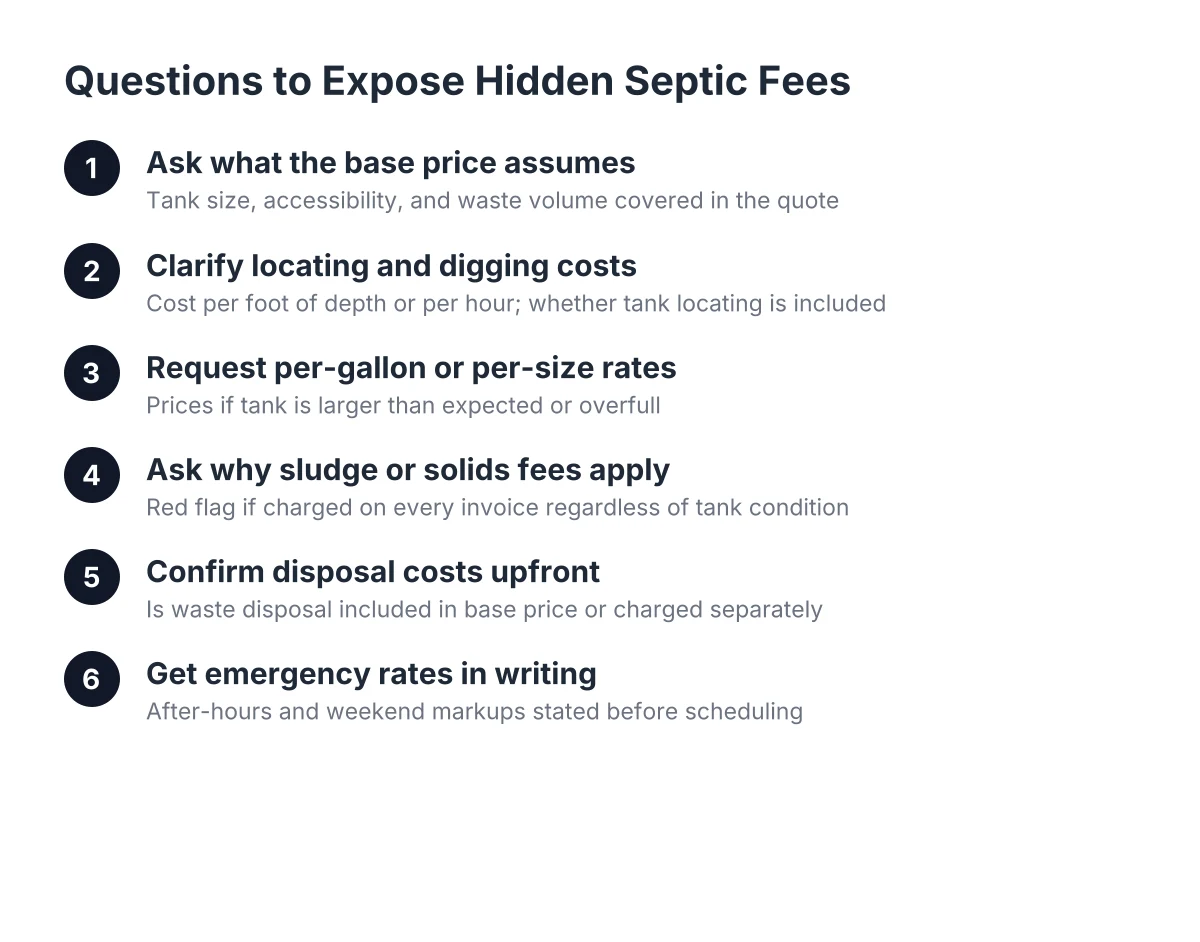
    Five direct questions on the phone will surface most hidden septic fees operators rely on: what does the base price assume, what costs extra, what are the rates for those extras, is disposal included, and will the invoice itemize everything. Any company that hedges on those five is quoting to win the call, not to tell you the truth.

    Work through them in order:

    1. What tank size and access does your base price assume?
    2. What situations trigger extra charges, and what does each one cost?
    3. Is waste disposal included, or billed separately?
    4. If you find a problem mid-job, do you stop and get my approval before doing paid extra work?
    5. Will my invoice itemize every charge with a description?

    Question four matters most. The worst version of a hidden fee is work performed without authorization, then billed. A good crew opens the tank, shows you or photographs what they found, quotes the additional work, and waits for a yes. That single practice separates the companies worth keeping on speed dial from the ones worth avoiding.

    Comparing Septic Quotes the Right Way in 2026

    Comparing septic quotes means comparing total expected cost, not base price. As of 2026, the honest way to evaluate two quotes is to ask both companies the same eight-item list from earlier in this guide, write down every rate, and estimate the realistic total for your specific property, including likely digging and any size overage.

    For example, Company A quotes $300 base but charges separately for digging, disposal, and heavy solids. Company B quotes $475 with digging to a stated depth and disposal included. On a Hesperia property with a buried lid and a tank that has not been pumped in eight years, Company B is probably cheaper. The base price told you nothing; the assumptions told you everything.

    This is also where septic tank cost research pays off beyond a single job. Once you understand what drives the price, which is tank size, access, waste volume, disposal, and timing, you can spot a padded invoice from any company, on any property, for the rest of the time you own septic-served real estate.

    The Bottom Line for Hesperia Property Owners

    Hidden septic fees are not a reason to fear septic service; they are a reason to ask better questions. Nearly every surprise charge traces back to an assumption the phone quote made and nobody discussed. Digging, tank size, waste volume, disposal, and after-hours timing account for most of the gap between the number you heard and the number you paid.

    Therefore, control the conversation before the truck rolls. Tell the company what you know about your tank, admit what you do not know, and get every rate that could apply. Whether you are a land buyer trying to locate a tank before escrow closes or a landlord budgeting maintenance across a few rentals, the property owners who pay fair prices in Hesperia are the ones who made the company name its assumptions first.

    If you need your septic tank serviced, Hesperia Septic can help.

    Related Reading

  • Septic Tank Pumping vs. Repair Costs: When Pumping Solves the Problem

    Cost range comparison: septic tank pumping $250–$1,250 average $427 versus repairs or replacement $5,000–$15,000.
    Routine septic pumping averages $427 and typically costs $250–$1,250, while major repairs or replacement range from $5,000–$15,000 according to EPA data.

    You just bought land in Hesperia, or you are about to close on it, and nobody can tell you a single thing about the septic system. No records, no maps, no visible lid. Then a toilet gurgles, or a wet spot shows up in the yard, and the first quote you hear involves thousands of dollars in repairs. Before you accept that number, you need to understand the difference between septic tank pumping vs repair decision situations and problems a simple pump-out can fix. The gap between those two bills is enormous, and knowing which one you actually face is the single most useful thing you can learn before you spend a dime.

    This guide walks through what pumping costs, what repairs cost, how to tell which one your system needs, and how to read a quote so you know whether it is fair. It is written for the High Desert, where a lot of properties changed hands with zero paperwork on the septic system, and where a buyer with no records has to figure things out from scratch.

    Why the Pumping vs. Repair Decision Matters So Much

    Here is the core problem. A backed-up septic system looks the same on the surface whether the fix costs a few hundred dollars or five figures. Slow drains, gurgling toilets, sewage odors, and soggy ground can all come from a tank that is simply full. They can also come from a crushed pipe, a failed drain field, or a broken pump. You cannot tell which from inside the house.

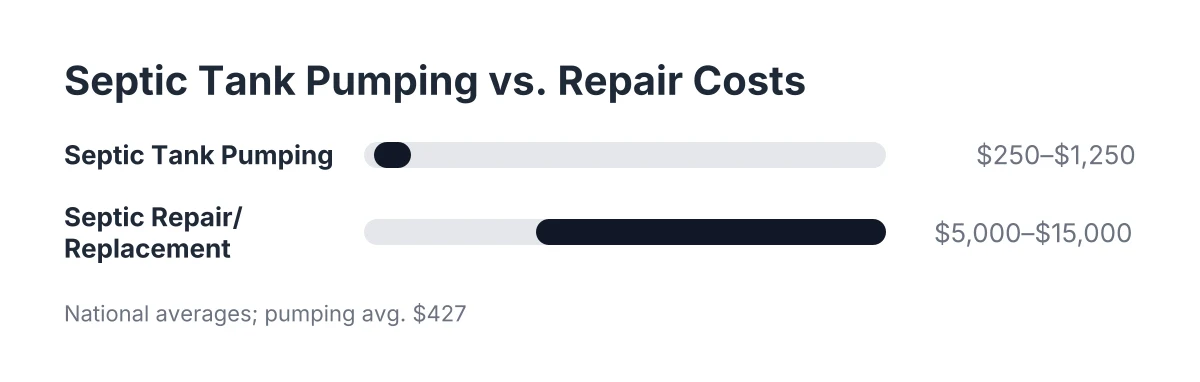
    That uncertainty is where bad quotes live. A homeowner who does not know the difference has no way to push back when someone says the whole system needs work. According to the U.S. Environmental Protection Agency, septic tank repair or replacement typically costs between $5,000 and $15,000. Routine pumping, by contrast, averages $427 according to Angi data, with a typical range of $250 to $1,250 depending on tank size and location.

    Read those two numbers again. The difference between "your tank is full" and "your system has failed" can be more than ten thousand dollars. As a result, the smartest first move on almost any septic problem is to confirm whether pumping alone resolves it before anyone starts talking about excavation or replacement.

    What Septic Tank Pumping Actually Costs in 2026

    Septic tank pumping in 2026 generally runs from about $250 to over $1,250, with a national average around $427 according to Angi. The price moves based on tank size, how hard the tank is to reach, how full it is, and whether the visit is scheduled or an emergency. In the Hesperia area, access and lid depth are the two factors that swing the price most often.

    Pumping means a truck arrives, the crew opens the tank lid, and they remove the liquid and solid waste inside. On a straightforward job, the whole visit takes an hour or two. That is the entire service. There is no digging up the yard beyond exposing the lid, and no replacing parts.

    Several things push a pumping bill toward the higher end of the range:

    • A buried lid with no riser. If the crew has to locate the tank and dig down to the lid, that adds labor time. This is common on older High Desert properties.
    • A larger tank. More gallons pumped means more time on site and more disposal volume.
    • Heavy solids buildup. A tank that has gone many years without service takes longer to clean out, and some operators price septic tank cleaning as a separate, deeper service than a standard pump-out.
    • Emergency timing. A backup on a Saturday night costs more than a scheduled weekday visit. Emergency septic pumping carries a premium at almost every company.
    • Long hose runs. If the truck cannot get close to the tank, extra hose length adds setup time and sometimes a fee.

    For a land buyer with no records, the buried-lid factor is the one to plan for. If nobody knows where the tank is, a septic tank locating service finds it and marks it before any pumping happens. Some companies fold locating into the pumping visit; others line-item it. Either way, ask for it on the quote so you are not surprised.

    What Septic Repairs Cost, and Why the Range Is So Wide

    Septic repair costs range from a few hundred dollars for a small fix to the $5,000 to $15,000 the EPA cites for major repair or replacement. The range is wide because "repair" covers everything from swapping a baffle to digging up and rebuilding an entire drain field. The component that failed determines the bill.

    Here is a rough map of where repair money goes, from smallest to largest. These are illustrative ranges, not quotes, and your property's soil, layout, and county requirements will move the numbers.

    1. Baffles and lids. The baffles inside the tank direct flow and keep solids out of the drain field. Replacing a failed baffle or a cracked lid is usually one of the cheaper repairs, often in the hundreds.
    2. Broken or root-clogged pipes. The line between the house and the tank, or between the tank and the drain field, can crack, sag, or fill with roots. Cost depends on how deep it sits and how much digging the fix requires.
    3. Pump and float switch failures. Some septic system types use an effluent pump to move wastewater uphill or into a mound. Septic tank pump replacement cost typically lands in the four figures once you count the part, labor, and electrical checks. The EPA recommends inspecting systems with pumps, float switches, or other mechanical parts once a year, precisely because these components fail.
    4. Tank damage. A cracked or collapsing tank often cannot be patched. Replacement means excavation, a new tank, permits, and inspection.
    5. Drain field failure. This is the big one. When the soil absorption area clogs or the field pipes fail, the fix can mean building a new field, which drives total septic system cost toward the top of the EPA's range and sometimes past it.

    Notice what all five have in common: none of them are fixed by pumping. However, and this matters, several of them are frequently misdiagnosed when the real issue is just a full tank. That is why the order of operations matters so much.

    Septic Tank Pumping vs Repair Decision: How to Tell Which One You Need

    The honest answer is that pumping the tank is usually the first diagnostic step, not just a service. Once the tank is empty, a crew can see the baffles, the inlet and outlet, the liquid levels, and how the system behaves. Most septic tank pumping repair calls get sorted into "pump and monitor" or "actual repair" at exactly this moment.

    Here are the patterns that point toward each outcome.

    Signs pumping alone will likely fix it

    A full tank produces symptoms gradually. Drains slow down over weeks, not overnight. If your system has not been pumped in years, or you have no idea when it was last serviced, a full tank is the most likely explanation for a backup. After pumping, everything drains normally and stays that way. That is the good outcome, and it is the common one on neglected but healthy systems.

    For example, picture a common Hesperia scenario. A buyer closes on a two-acre property with a manufactured home. There are no septic records, no riser, and no lid in sight. Six weeks in, the shower starts backing up. A locate finds the tank about eighteen inches down; the crew digs to the lid and pumps it. The tank was simply full, likely for the first time in a decade. Total cost lands in the hundreds. No repair needed, and the buyer now knows exactly where the tank is for next time.

    Signs you are looking at a real repair

    Some symptoms point past the tank. Watch for these:

    • The system backs up again within days or weeks of a fresh pump-out.
    • Sewage or standing water appears over the drain field, not just near the tank.
    • The tank refills with groundwater soon after pumping, which suggests a crack or a saturated field pushing water backward.
    • The crew finds broken baffles, a collapsed inlet, or roots inside the tank during pumping.
    • An alarm sounds on a system with a pump, or the pump runs constantly or not at all.

    In addition, water usage can fake a failure. The EPA notes that a single leaky or running toilet can send as much as 200 gallons of extra water per day into a septic system. That volume can overwhelm a working drain field and mimic a failed one. Before approving a major repair, fix any running toilets and dripping fixtures, then see whether the symptoms ease.

    One honest limitation: a pumped-out tank inspection tells you a lot, but it cannot see underground pipes or the full condition of a drain field. If symptoms persist after pumping and the obvious causes are ruled out, you need a professional to dig deeper, sometimes literally, before anyone can give you a reliable repair number.

    Reading a Quote: What Fair Septic Tank Pumping Repair Pricing Looks Like

    A fair septic quote itemizes the work so you can see what each piece costs. For a pumping visit, that means the pump-out itself, any locating or lid excavation, disposal, and any emergency premium listed separately. For repairs, it means parts, labor, excavation, and permits broken out, plus a written explanation of what failed and how the crew confirmed it.

    Compare that to the quote that should worry you: a single large number, a diagnosis delivered without opening the tank, or a repair recommendation before anyone has pumped and looked inside. A company that skips the look-inside step is guessing, and you are paying for the guess.

    Questions worth asking before you approve anything:

    • Did you pump the tank and inspect the baffles, inlet, and outlet before recommending this repair?
    • What exactly failed, and can you show me?
    • Is locating or digging to the lid included, or billed separately?
    • If this is an emergency call, what portion of the price is the after-hours premium?
    • Will I get a written report I can keep with the property records?

    That last question matters double for a buyer. A written inspection report becomes the first document in a property file that previously had nothing in it. If you are still in escrow, that report can also support a price negotiation or a repair credit; a documented drain field problem is a very different conversation with a seller than a vague worry.

    Buying Property With No Septic Records: Do This Before Closing

    If you are buying High Desert property and the seller cannot or will not confirm the septic condition, get the tank located and inspected before you close. A septic system inspection with the tank pumped open is the only way to know what you are buying. Guessing from the age of the house is not a plan.

    The process is straightforward. A locate-and-mark service finds the tank, which on older Hesperia lots often has no riser and sits under a foot or more of soil. The crew exposes the lid, pumps the tank, and inspects what they can see: tank condition, baffles, liquid levels, and signs of drain field trouble. You get a written report you can use for the purchase decision, a lender requirement, or a permit application.

    Some buyers hesitate because a locate-and-inspect job costs money on a property they might walk away from. Look at it the other way. Spending several hundred dollars to avoid inheriting a five-figure drain field failure is one of the best-leveraged inspections in the whole transaction. Total septic tank cost over your years of ownership depends heavily on the condition of the system on day one, and this is your only chance to know that condition before the risk becomes yours. The EPA recommends the average household have its septic system inspected at least once every three years; a purchase with zero records is the clearest possible time to start that clock.

    While you are at it, ask the inspector to sketch a simple septic system diagram showing the tank, lid, and drain field locations relative to the house. It takes minutes, and it means you will never pay for a locate again. It also matters if you plan a remodel or addition, since you cannot build over the tank or field.

    What This Means for Commercial Grease Traps and Holding Tanks

    The pump-first logic applies to commercial accounts too. A restaurant grease trap that backs up is almost always overdue for pumping, not broken. An RV park holding tank that smells is usually full, not failed. Scheduled grease trap pumping and holding tank service on a recurring monthly or quarterly cycle keeps a small business ahead of both health code deadlines and emergency-rate invoices.

    Therefore the math for a single-location restaurant or independently owned RV park is the same as for a homeowner, just on a faster clock. Grease and heavy use fill a trap or tank quickly. A recurring schedule with a local crew turns an unpredictable emergency expense into a known line item, and it produces the service records that health inspectors ask for.

    The Bottom Line: Pump First, Repair Only When the Evidence Says So

    The cost gap between pumping and repair is the whole story. Pumping averages $427 according to Angi. Repair or replacement runs $5,000 to $15,000 according to the U.S. Environmental Protection Agency. Given that gap, the only sensible order of operations is: locate the tank if you do not know where it is, pump it, inspect what the empty tank reveals, and approve repairs only when someone can show you what failed.

    For the land buyer holding keys to a property with no septic records, that order of operations is also your buying checklist. Locate, pump, inspect, document. Do it before closing if you can, and immediately after if you cannot. Either way, you will know exactly what you own, what it needs, and what a fair price for that work looks like, before anyone hands you a five-figure number you have no way to check.

    If you need your septic tank serviced, Hesperia Septic can help.

    Related Reading

  • Septic vs. Cesspool: Which Is Right for You?

    septic vs cesspool

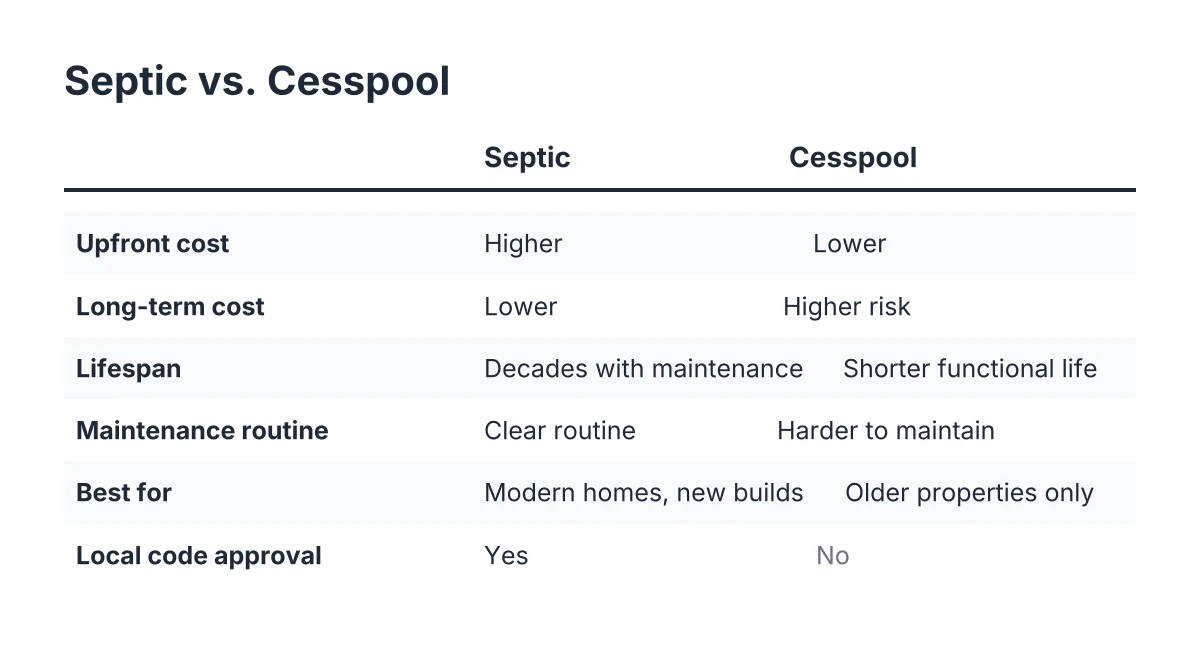
    Septic systems and cesspools are both ways to handle wastewater when a home isn't hooked up to city sewer, but they work very differently and aren't interchangeable choices anymore. When you're weighing septic vs cesspool, here's the short answer: a septic system is the modern standard almost everywhere today and works well for most properties, while a cesspool is an older, simpler pit that many areas no longer allow you to install new. If you're building, replacing a failed system, or dealing with a home that already has one of these, it helps to understand the difference before you spend money on pumping, repairs, or a full replacement. Homeowners in Hesperia and the High Desert usually deal with septic tanks, since that's what most local properties are built around. Understanding septic tank cost helps you make informed decisions about these systems. But it helps to know how a cesspool compares if you're buying an older property or trying to figure out what's actually in your yard.

    Comparison Table

    Criterion Septic Cesspool
    Upfront cost Higher upfront, more parts to install (tank, drain field, piping) Lower upfront, simpler pit-style structure
    Long-term cost Lower long-term cost with regular septic tank pumping and care Higher long-term risk, more prone to costly failures over time
    Lifespan Typically decades with proper maintenance Generally shorter functional life, especially in dense soil
    Maintenance Routine septic tank pumping and inspection keeps it working Harder to maintain, no true separation of solids and liquid
    Best for Most modern homes and properties needing a permitted system Older properties already using one, rarely approved for new builds

    Septic vs Cesspool: Strengths and Trade-offs

    A septic system is an underground tank paired with a drain field. Wastewater flows into the tank, solids settle out, and the remaining liquid moves out to the drain field, where the soil filters it naturally. This two-stage setup is why septic systems hold up well over time when crews pump and inspect them on a normal schedule. It's also why septic is the standard choice for new construction and replacements in most areas, including here in the High Desert.

    The trade-off is that septic systems cost more to install because there's more to build: the tank itself, the drain field, and the piping that connects everything. They also need some attention. Skipping septic tank pumping for too long lets solids build up past what the tank can hold, which can cause a septic backup into the house or damage to the drain field that's expensive to fix. The good news is that this kind of trouble is largely preventable. Regular septic tank pumping, septic tank cleaning, and septic system inspections catch problems while they're still small and cheap to handle, instead of after they've turned into a septic backup or overflow.

    Where septic really shines is long-term reliability. A well-maintained system can handle years of daily use without trouble. It's also the system most local code requires now, so if you're replacing anything or buying a property that needs work, septic is likely your only permitted option.

    Cesspool: How It Compares to Septic vs Cesspool

    A cesspool is a simpler setup: a pit or chamber in the ground that both holds waste and lets liquid seep out through its walls or bottom into the surrounding soil. There's no separate tank and drain field doing distinct jobs. It's all happening in one place. Because a cesspool has less built into it, it usually costs less to install and has fewer moving parts to think about.

    That simplicity is also its biggest weakness. Without a tank to hold solids back, more waste ends up seeping directly into the surrounding ground. This means cesspools tend to clog, smell, and fail faster than septic systems, especially in soil that doesn't drain well. Many areas, including much of California, have restricted or banned new cesspool installations because of the risk they pose to groundwater and nearby wells. If you already have one on an older property, it can usually keep working for a while with pumping and care, but you're working with a system that most local rules won't let you rebuild or expand once it fails.

    For most homeowners today, a cesspool isn't a system you'd choose to install new. It shows up mostly on older properties where owners installed it decades ago, before current rules existed.

    Septic vs Cesspool: The Deciding Factors

    Cost Drivers

    Septic costs more upfront but saves you money over the long haul, while a cesspool is cheaper to install but risks bigger costs down the road. The extra cost of a septic system comes from building both a tank and a drain field, plus the piping that ties them together. A cesspool skips that separate drain field, which keeps initial costs down. But when it fails or needs replacing, you're often looking at a full system change since most areas no longer approve new cesspools for install.

    Lifespan

    Septic systems generally outlast cesspools by a wide margin when owners keep up with maintenance. A tank that gets regular septic tank pumping and an occasional inspection can serve a home for a long time, since crews remove the solids before they cause trouble. A cesspool doesn't have that same solids-management step, so it tends to clog and lose function sooner, especially with heavier household use or less permeable soil.

    Installation and Local Rules

    This factor settles the question for most people before cost or lifespan even come into play. If you're installing new or replacing a failed system, septic is likely your only real option, since most areas have moved away from approving new cesspools. A cesspool only stays relevant if your property already has one from years back and it's still working.

    Maintenance

    Both systems need some upkeep, but septic gives you a clear maintenance routine to follow. Septic tank pumping, tank cleaning, and periodic inspection are straightforward tasks that keep a septic system working the way it's supposed to. A cesspool is harder to maintain well because it has no separate tank holding solids apart from the rest of the system, so pumping it doesn't fix the underlying design limitation the way it does with septic.

    Situational Fit

    Your best fit usually comes down to what's already on the property and what your local rules allow. A newer home or a system that needs replacing almost always points to septic. An older property with an existing cesspool that's still working might not need immediate action, but it's worth having it inspected so you know what you're actually dealing with before it turns into an emergency septic backup or overflow.

    Which Should You Choose?

    Choose Septic if:

    • You're building new or replacing a failed system
    • You want a setup with a clear, manageable maintenance routine
    • You're buying a home and want a system that meets current local requirements
    • You'd rather pay more upfront for lower long-term risk

    Choose Cesspool if:

    • Your property already has a working cesspool and you're not doing new construction
    • You understand it may need closer monitoring and won't be eligible for replacement in kind
    • You're planning to have it inspected soon to see how much life it has left

    Common Questions

    Can I replace a cesspool with a new cesspool?

    In most areas today, no. Rules around wastewater systems have tightened over the years, and most jurisdictions no longer approve cesspools for new installation because of the risk they pose to groundwater. If your cesspool fails, you'll likely be looking at a septic system as the replacement.

    How do I know if I have a septic tank or a cesspool?

    If your home is older, it's worth confirming this before you assume anything, since some properties still have a cesspool without the owner realizing it. A septic system inspection can identify what you actually have, locate the tank, and tell you its condition. Septic tank locating is a useful first step if you're not sure what's buried in your yard.

    Which one needs pumping more often?

    Both need waste removed periodically, but septic systems are built around a clear pumping and cleaning routine that keeps the tank working properly. When you're comparing septic vs cesspool for an existing property, keep in mind that a cesspool without a separate tank can be harder to service well. Pumping it doesn't fix the underlying design the way it does with a septic tank.

    What happens if I ignore maintenance on either system?

    Skipping maintenance on a septic tank or cesspool can lead to a septic backup or overflow that's messy and expensive to deal with. Warning signs include slow drains, gurgling pipes, standing water in the yard, or odors near the tank or pit. Catching problems early with routine septic tank pumping and inspection is far less disruptive than dealing with a full backup after the fact.

    If you need your septic tank serviced, Hesperia Septic can help.

    Related guide: septic tank cost — Complete Guide

    Related Reading