If someone just told you that your septic system is beyond saving, slow down before you sign anything. A full septic system replacement is one of the biggest checks a property owner in Hesperia will ever write for something buried underground. The EPA estimates septic tank repair or replacement typically costs between $5,000 and $15,000, far more than routine pumping, according to U.S. Environmental Protection Agency. Understanding the septic replacement timeline—what it involves, how long it takes, and when it is truly necessary—is critical before you commit to this major expense. That gap between a $400 pump-out and a five-figure dig is exactly why you should understand what replacement actually involves, how long it takes, and when it is truly necessary before you commit.
This guide walks through the full timeline, from the first backed-up drain to the final inspection sign-off. Along the way, it covers the honest question most searchers are really asking: do I need a new septic system, or is someone trying to sell me one I don't need?
First, Confirm You Actually Need a Full Septic System Replacement
Most septic problems do not require replacement. A tank that has not been pumped in years, a clogged inlet baffle, a crushed pipe between the house and the tank, or roots in a distribution line can all cause the same symptoms as a failed system: slow drains, gurgling, sewage smells, or wet spots in the yard. Each of those has a fix that costs a fraction of a new system.
Here is a useful way to think about it. A conventional septic system has two main components, the septic tank and the drain field, according to U.S. Environmental Protection Agency. Problems in the tank or the pipes are usually repairable. Problems in the drain field itself, where the soil can no longer absorb wastewater, are the ones that push you toward septic system replacement.
Signs that point toward drain field failure rather than a simple clog include:
- Sewage backing up again shortly after the tank was pumped
- Standing water or persistently soggy ground over the drain field, even in dry High Desert weather
- Strong sewage odor outdoors that returns after pumping
- The tank refilling with groundwater or effluent flowing back from the field during pumping
- A history of repeated pump-outs at shorter and shorter intervals
That last one matters. If you pumped the tank 18 months ago and you are backed up again with normal water use, the wastewater has nowhere to go. That usually means the soil absorption area is saturated or clogged. Septic drain field failure is the most common reason a system genuinely needs to be replaced rather than repaired.
One honest caution: you cannot confirm drain field failure from the surface. Before you accept a replacement quote, have the tank pumped and inspected. Pumping empties the tank so a crew can see the baffles, check the tank walls, and watch whether liquid flows back in from the field. That single visit often settles the repair-versus-replace question, and it is a step worth insisting on no matter who does the eventual work.
Why the Pump-and-Inspect Step Protects You
Suppose a landlord in Hesperia gets a call from tenants about a sewage smell and slow drains. A contractor drives by, looks at a wet spot in the yard, and quotes a full replacement in the five figures. In that scenario, a pump-out and inspection might reveal a root-blocked outlet pipe instead, a repair measured in hundreds, not thousands.
That hypothetical plays out often enough that the pump-first rule should be non-negotiable. Routine septic tank pumping and inspection is also how you avoid this decision entirely. The average household should have its septic system inspected at least once every three years by a professional, according to U.S. Environmental Protection Agency. For an active family of four, pumping every two to three years is generally advisable because of higher solids and water use, according to Penn State Extension. Systems that get that attention rarely fail without warning.
Septic Replacement Timeline: How Long Does It Really Take?
A full septic system replacement typically takes one to four months from the first inspection to final sign-off, even though the excavation and installation work itself often takes only a few days to a week. Soil testing, system design, county permitting, tank delivery, and inspection scheduling consume most of the calendar. Plan for the paperwork, not just the digging.
That surprises most property owners. The hole in the yard is the fast part. The sequence around it is where the weeks go, and understanding that sequence helps you plan around a rental property, a business, or a home sale deadline.
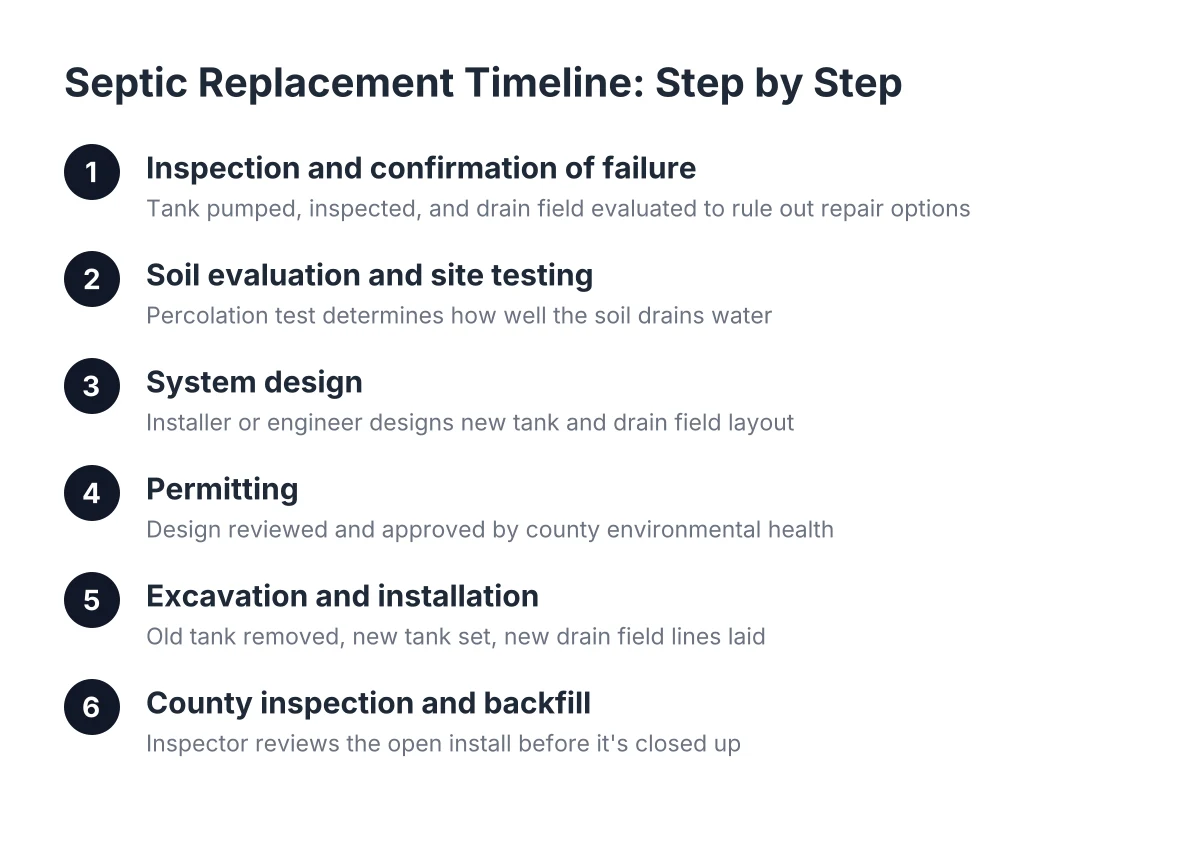
Here is the typical order of events:
- Inspection and confirmation of failure. The tank is pumped and inspected, and the drain field is evaluated. This is where repair options get ruled out.
- Soil evaluation and site testing. A percolation test must be performed before installing a septic system to determine how well the soil drains water, according to University of Nebraska-Lincoln Extension. In the High Desert, soil conditions vary from lot to lot, so this step shapes the whole design.
- System design. Based on the soil results, household size, and available space, an installer or engineer designs the new tank and drain field layout.
- Permitting. The design goes to the county for review and approval. In this area, that means working through San Bernardino County's environmental health requirements for onsite wastewater systems.
- Excavation and installation. The old tank is pumped out and abandoned or removed, the new tank is set, and the new drain field lines are laid.
- County inspection and backfill. An inspector reviews the open installation before it can be covered. Backfill and grading finish the job.
Each handoff in that list is a potential wait. Permit review times depend on county workload. Tank delivery depends on the manufacturer's schedule. The final inspection depends on when an inspector can come out. None of those are within the installer's control, which is why an honest contractor gives you a window rather than a promised date.
What Can Stretch the Replacement Timeline
Several things commonly add weeks to a replacement project. Knowing them upfront keeps the delays from feeling like something went wrong.
Permit review is the most common. Septic system permits in San Bernardino County go through an environmental health review, and complex sites or incomplete applications take longer. In addition, failed or borderline percolation results can force a redesign, sometimes requiring an engineered or alternative system that needs extra review.
Supply and scheduling issues matter too. Tank delivery timing and government inspection scheduling sit outside the installer's hands, and either one can pause the job mid-stream. During periods of broader supply disruption, wait times for installations have stretched to several months in some markets, with quotes rising during the wait. Weather is less of a factor in Hesperia than in wetter regions, but wind and ground conditions can still shift a dig by a day or two.
Finally, surprises underground add time. Undocumented old tanks, unmarked utility lines, or a previous drain field in an unexpected location can all force design changes on the fly. This is one reason septic tank locating before excavation is worth the small extra step, especially on older properties with no records.
What the Full Septic System Replacement Process Looks Like on Site
Once permits are in hand, the on-site work moves fast. A typical crew starts by pumping the old tank completely, since septic waste pumped from residential tanks is transported by truck to a sewage treatment plant for disposal rather than being processed on-site, according to New Hampshire Department of Environmental Services. For a commercial property owner keeping compliance records, that off-site disposal is documented, which matters if a health inspector ever asks where the waste went.
Next comes excavation. The old tank is either crushed and filled in place or removed, depending on the design and county requirements. The crew digs for the new tank and trenches for the new drain field lines. After separation in the tank, wastewater will flow through perforated lateral pipes into the absorption field, then filter through gravel or stone and finally through sand and soil layers, according to U.S. Environmental Protection Agency. Those trenches, their depth, and their spacing all come from the approved design, not guesswork.
Setting the tank is precise work. The fill material around the point where the pipe penetrates the tank gets compacted thoroughly to prevent settling or damage at that connection, according to Onsite Installer. A tank that shifts after backfill can break its inlet or outlet connection, which is an expensive problem to discover a year later.
Then the job pauses for inspection. The county inspector needs to see the open installation, verify it matches the permitted design, and approve it before anything gets buried. Only after that sign-off does the crew backfill, grade, and clean up. From first shovel to final grading, the on-site portion of a full septic system replacement usually runs a few days to a week for a standard residential system, longer for engineered or alternative designs.
Repair, Replace, or Keep Pumping: Weighing the Options
Do septic systems need to be replaced eventually? Yes, but the timeline varies enormously. A well-built conventional system that gets pumped on schedule can serve a property for decades. A neglected one can fail in half that time. Septic system lifespan is less about the calendar and more about how the system has been treated.
Because you are at the consideration stage, here is a balanced way to weigh your three realistic paths:
- Keep pumping and maintaining. Right choice if the tank and field are structurally sound and problems trace back to overdue pumping or minor clogs. According to Angi, septic tank pumping averages $427, ranging from $250 to $1,250 or more depending on tank size and location. That is the cheapest path by far when the system supports it.
- Targeted repair. Right choice when one component failed: a cracked baffle, a broken line, a failed distribution box, or a damaged riser. Repairs cost more than pumping but far less than replacement, and they buy years when the drain field is still healthy.
- Full replacement. Right choice when the drain field has failed, the tank is structurally compromised, or the county requires it. Health departments generally require full replacement of a failed absorption system rather than accepting additive products or restoration treatments as a permanent fix. Additives that promise to revive a dead field mostly delay the inevitable while the problem worsens.
There is one more trigger worth flagging for property owners planning construction. Home additions or remodels can force a septic relocation or replacement if the new footprint overlaps the existing tank or drain field. Therefore, if you are planning to build on a septic property in 2026, get the system located and evaluated before you finalize the plans, not after the foundation is staked.
A trade-off worth naming: replacement is expensive and disruptive, but repeatedly repairing a system at the end of its life can cost more over five years than replacing it once. If you are pumping every year just to keep drains flowing, you are renting time from a failing field. At some point the math flips, and an honest evaluation should show you where that point sits for your property.
Planning Around Replacement as a Landlord or Business Operator
Non-residential owners face a version of this problem that homeowners do not: the system fails while someone else is using the property. Say a rental property owner who lives out of the area gets a tenant complaint about slow drains and an odor near the leach lines. That owner needs a diagnosis, documentation, and a plan they can manage remotely, without flying in to stand over a hole.
For that situation, a few practical moves make the process manageable:
- Get the tank pumped and inspected first, and ask for written findings you can keep with the property file
- Request documentation of waste disposal for compliance and habitability records
- Ask for the realistic permit-to-completion window before committing, so you can plan tenant communication or temporary arrangements
- Set a recurring pumping and inspection schedule afterward, so the next event is a calendar item rather than an emergency call
The same logic applies to a small commercial property on septic, or a cabin with a holding tank that only gets seasonal use. One local crew that handles the pumping, the inspection records, and the backup response means the system stops being a recurring fire drill. More than one in five U.S. households depend on individual septic systems or small community cluster systems to treat their wastewater, according to U.S. Environmental Protection Agency, and out here in the High Desert the share of septic properties runs high. Managing one well from a distance is a solved problem when the maintenance routine exists.
Note that if your replacement involves an alternative system with pumps, float switches, or mechanical components, the maintenance obligation changes. Those systems should generally be inspected once a year, according to U.S. Environmental Protection Agency, and full service can include pump replacement and filter cleaning, not just pump-outs. Factor that ongoing cost into the repair-versus-replace decision, not just the installation price.
What to Do Before You Sign a Replacement Contract
Before committing to a full septic system replacement, work through a short checklist. Each item protects you from paying for a system you did not need, or from a timeline surprise mid-project.
First, confirm the diagnosis independently. A pump-out and inspection by a septic crew is the ground truth. If the tank drains and the field accepts water, replacement is premature. Second, verify the installer is properly licensed for installation work; installing a system requires certification and licensing beyond a pumping operation, including knowledge of soil types, percolation rates, system design, and local regulations, according to New Hampshire Department of Environmental Services. Pumping and installing are different trades, and a good pumping crew will tell you plainly which side of that line a job falls on.
Third, get the permit plan in writing. Ask who files with San Bernardino County, what the design includes, and what happens if the percolation test forces a redesign. Fourth, ask for the realistic timeline window, including the parts outside anyone's control: permit review, tank delivery, and inspection scheduling. A contractor who promises an exact completion date on day one is guessing.
Finally, plan the aftercare before the backfill. A new system fails the same way an old one does if it never gets pumped. Put the first inspection on the calendar the day the county signs off. The cheapest septic system you will ever own is the one you maintain, and the whole point of surviving a replacement once is never repeating it.
If you need your septic tank serviced, Hesperia Septic can help.
Leave a Reply