Tag: sludge and scum levels

  • Aerobic Septic System Inspection in Hesperia, CA: Why Maintenance Is Different

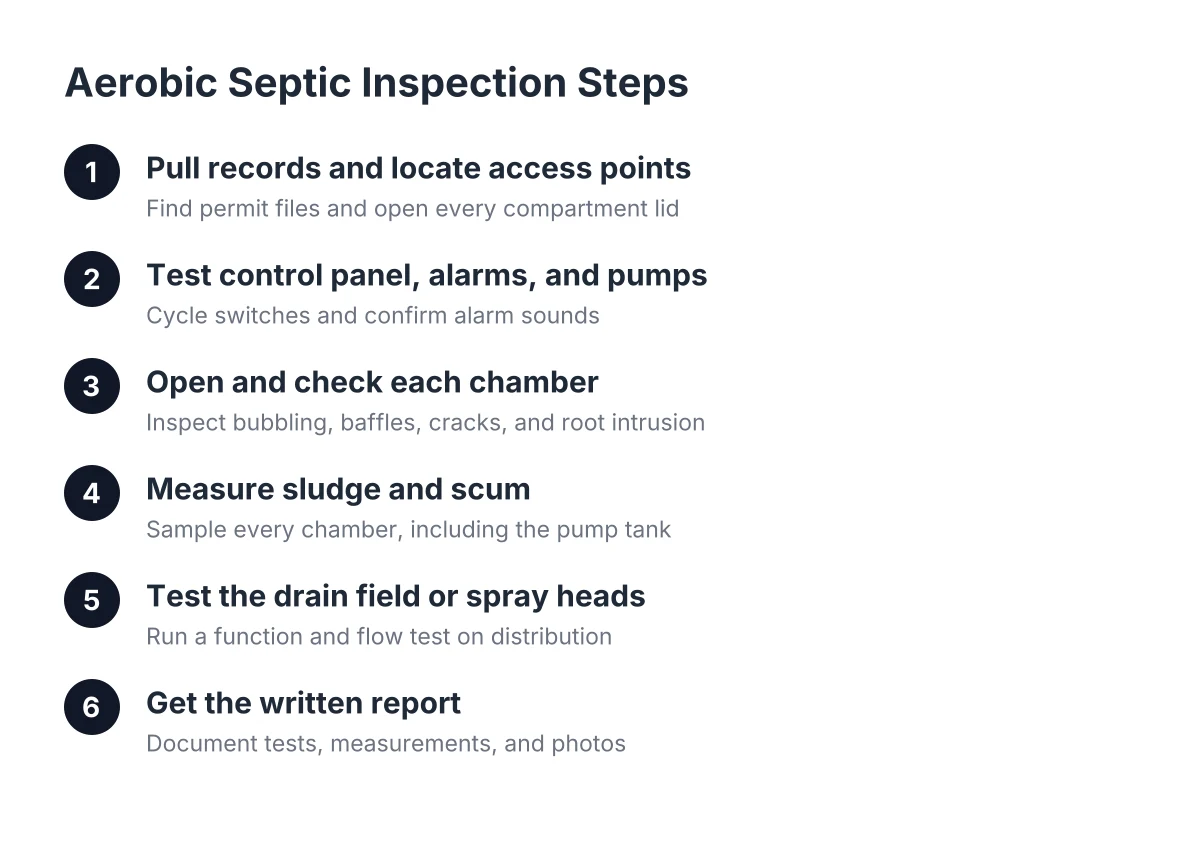
    Diagram of aerobic septic inspection steps from records to written report
    The six steps a thorough aerobic septic inspection follows, from records to the written report.

    If your Hesperia property has an aerobic septic system, an aerobic septic system inspection works differently than the check a conventional gravity tank gets. Understanding the aerobic septic inspection steps will help you recognize what thorough work looks like. Aerobic systems have pumps, air compressors, alarms, and multiple chambers, and every one of those parts needs to be opened, tested, and documented. That documentation matters, too. Buyers, sellers, and lenders often want a written report on system condition before a sale or refinance closes, and a proper inspection produces exactly that: a documented record from a crew that knows High Desert soil and the quirks these systems develop here.

    This guide walks through the inspection step by step, so you know what a thorough job looks like, what it should include, and where a corner-cutting provider will skip work you are paying for.

    Why Aerobic Systems Need a Different Inspection

    A conventional septic system has two main components, a tank and a drain field, according to the U.S. Environmental Protection Agency. The tank settles solids, and the drain field disperses the clarified liquid into the soil. There are no moving parts.

    An aerobic system adds machinery. It typically has a trash tank, an aeration chamber where air gets pumped into the wastewater, a clarifier, and a pump tank, plus a control panel with alarms. More parts mean more things that can fail quietly. That is why the EPA recommends alternative systems with pumps, float switches, or mechanical components be inspected once a year, while the average household system needs a professional inspection at least once every three years.

    The purpose of a routine aerobic inspection is threefold: catch problems before they start, identify problems that already exist, and extend the working life of the system. With repair or replacement typically running $5,000 to $15,000 according to the U.S. Environmental Protection Agency, a yearly inspection is cheap insurance.

    Here is what a complete aerobic septic inspection covers, in the order a careful crew works.

    Step 1: Pull the Records and Locate Every Access Point

    Start with paperwork. If you bought the house recently and have no records, tell the inspector up front. San Bernardino County permit files sometimes show the original system layout, and a crew that offers septic tank locating can find buried lids without tearing up half the yard.

    An aerobic system has several compartments, and a thorough inspection opens every one of them: the trash tank, the aeration unit, the clarifier, and the pump tank. If a provider only pops one lid and calls it done, that is not an inspection. It is a glance.

    Step 2: Test the Control Panel, Alarms, and Pumps

    Before anything gets opened, the technician tests the electrical side. That means cycling every switch on the control panel and pressing the pump test button to confirm the pump kicks on and the alarm actually sounds.

    This step matters because the alarm is your only early warning. If the aerator dies and the alarm is also dead, the system can run septic for weeks before you smell anything. By then the damage to the treatment process is done.

    Step 3: Open and Check Each Chamber

    Next, the crew opens each compartment and looks at what is happening inside. In a healthy aerobic system, the aeration chamber should show visible bubbling from the air supply. On the other side of the dividing wall, the clarifier should look still and calm. Bubbling where it should be still, or stillness where it should bubble, points to a failed diffuser, a bad compressor, or a breach in the dividing wall.

    The inspector also checks the physical condition of each tank: cracks, root intrusion, and the baffles at the inlet and outlet. According to University of Nebraska-Lincoln Extension, those baffles force solids to settle instead of floating out toward the drain field, so a broken baffle is a direct threat to the rest of the system. Photos of the tank interior should go in your report.

    Aerobic Septic System Inspection Steps: Measuring Sludge and Scum

    This is the step most often skipped. Every chamber gets sampled and measured for scum and sludge levels, including the pump tank. Homeowners assume the pump tank stays clean because it only holds treated water. In practice, sludge builds up there too, and a sludge-choked pump tank will burn out the pump.

    If solids are high, the fix is septic tank pumping. Some homeowners schedule pumping and the inspection together, which saves a second trip. For context, Angi reports septic tank pumping averages $427, with a range of $250 to $1,250 or more depending on tank size and location.

    Step 5: Test the Drain Field or Spray Heads

    Treatment does not end at the tank. The inspector runs a function and flow test to confirm the drain field or spray distribution is accepting water the way it should. Hesperia's sandy, fast-draining High Desert soil is generally forgiving, but compacted areas, driveway traffic over lateral lines, and years of solids carryover can still choke a field.

    Warning signs the inspector watches for include:

    • Wet or spongy ground over the drain field in a climate this dry
    • Sewage odor near the tank or field
    • Slow drains or gurgling inside the house
    • Standing water or unusually green grass in one strip of the yard

    Any of these on your own property means call a professional now, not at your next scheduled visit. A backup rarely fixes itself.

    Step 6: Get the Written Report

    The inspection ends with documentation, and this is where the report earns its keep. A useful septic system inspection report lists what was opened, measured sludge and scum levels per chamber, pump and alarm test results, photos of tank interiors, and the condition of baffles and the drain field. It flags anything that needs repair now versus items to watch. Following these aerobic septic inspection steps produces documentation that protects both buyer and seller.

    If you are selling, refinancing, or buying, that written record is what escrow officers and lenders actually want to see. For example, suppose a Hesperia homeowner lists a house with an aerobic system and no service records since 2019. In that scenario, a documented 2026 inspection with photos and measurements can keep a nervous buyer at the table, while a verbal "it looked fine" does nothing.

    What This Costs and How Long It Takes

    Aerobic septic system inspection cost varies with tank access, number of chambers, and whether pumping happens the same day. Providers price it differently, so ask for the number up front and ask what it includes. A standalone inspection usually takes a couple of hours on site; add pumping and you should plan for longer. Digging to find unmarked lids adds time, which is another reason septic tank locating up front pays off.

    Be honest about the trade-off: an aerobic system will always cost more to maintain than a conventional gravity system. Keeping a conventional system healthy through routine pumping is the cheapest path, because it helps you avoid ever needing the upgrade. If you already have an aerobic system, yearly inspections are the price of keeping it alive.

    How to Choose an Inspector in Hesperia, CA

    Homeowners in Hesperia, CA worried about upsells should ask three questions before booking:

    1. Will you open and measure every chamber, including the pump tank, or only the main lid?
    2. Does the report include photos, measurements, and pump and alarm test results in writing?
    3. If you find a problem, will you show it to me on site before quoting a repair?

    A fair quote spells out what is included and what costs extra, such as digging for buried lids or same-day pumping. A provider who answers those three questions directly is one you can put on a recurring schedule and stop thinking about, which is the whole point.

    Also know the limits of any inspection. An inspector can assess condition and function, but permits, new installations, and county sign-offs involve the local health department, and repairs to failed components are a separate job. When an inspection turns up a failed aerator or a saturated field, get a licensed professional involved before spending anything.

    Ready to Put Your System on a Schedule

    If your aerobic system has gone more than a year without a documented inspection, or you have no idea when the tank was last pumped, now is the time to fix that. A local Hesperia crew can locate your tank, open every chamber, test the pumps and alarms, and hand you a written report you can file, show a lender, or hand to a buyer. Reach out to schedule an inspection or get an estimate, and get your septic system off your worry list.

    If you need your septic tank serviced, Hesperia Septic can help.


    Prefer to talk it through? Call (760) 249-7872 — a quick call is usually the fastest way to get a straight answer for your situation.
    Related Reading

  • Annual Septic Maintenance Plan: Prevent Costly Repairs Before They Start

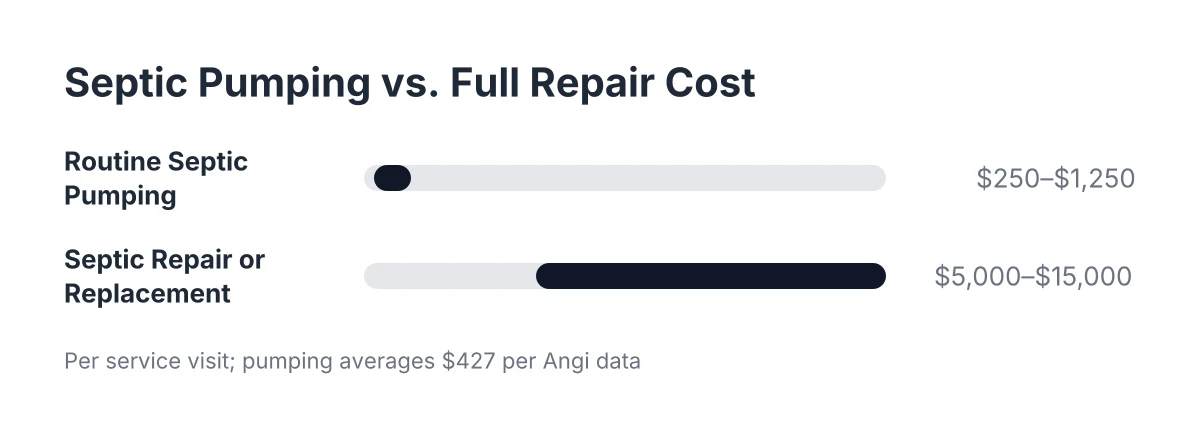
    Cost range chart comparing septic pumping to septic repair or replacement costs
    Routine pumping costs far less than the septic repairs it helps prevent, as noted in this maintenance guide.

    Most people who call about a septic emergency in Hesperia have one thing in common. They did not know their system was in trouble until sewage backed up into a shower or the yard started to smell. An annual septic maintenance plan is the simplest way to stay off that list. It is not complicated, it is not expensive compared to a repair, and it works because septic problems build slowly and quietly. This guide walks through what a maintenance plan actually covers, what you should be doing between service visits, and why the math favors prevention every single time.

    Why Septic Problems Never Announce Themselves Early

    A septic system does its work underground and out of sight. That is the whole problem. By the time you see a symptom, the failure has usually been developing for months or years.

    Here is how it goes wrong. Every conventional septic system has two main components, according to the U.S. Environmental Protection Agency: the septic tank itself and the drain field. The tank holds wastewater long enough for solids to settle to the bottom and grease to float to the top. Only the clarified liquid in the middle should flow out to the drain field, where the soil absorbs and filters it.

    When the tank fills with too much sludge, that separation stops working. Solids start slipping past the outlet and into the drain field, where they clog the soil. The drain field cannot be pumped out or rinsed clean. Once it fails, you are looking at excavation and replacement, and the EPA estimates septic repair or replacement typically costs between $5,000 and $15,000. Routine pumping, by comparison, averages $427 according to Angi data, with a range of roughly $250 to $1,250 depending on tank size and location.

    That gap is the entire argument for a maintenance plan. You are trading a modest, predictable service cost for protection against a repair bill that can hit five figures.

    What an Annual Septic Maintenance Plan Actually Includes

    An annual septic maintenance plan is a scheduled arrangement where a septic professional checks your system on a set calendar instead of waiting for you to notice trouble. The core pieces are a periodic inspection, sludge and scum level measurement, and pumping when the tank actually needs it. The plan replaces guesswork with a record.

    Here is what a typical visit under a yearly septic maintenance program covers:

    • Locating and opening the tank lid, or confirming access if a riser is installed
    • Measuring the sludge layer on the bottom and the scum layer on top
    • Checking the inlet and outlet baffles for damage or blockage
    • Looking at the tank walls for cracks, corrosion, or root intrusion
    • Walking the drain field area for soggy spots, odors, or unusually green grass
    • Recording findings so you have a written history of the system

    The baffles deserve a word here because most homeowners have never heard of them. According to University of Nebraska-Lincoln Extension, septic tanks use a baffle at both the inlet and outlet, a downward-facing tee that stops solids from floating out and forces them to settle. If a baffle breaks or rots away, solids flow straight to the drain field. An inspection catches that. Nothing else does, because a broken baffle causes no symptom inside the house until the drain field is already taking damage.

    Not every visit ends in pumping. That is a feature, not a flaw. The point of a maintenance schedule is to pump when measurements say the tank needs it, and to skip it when the levels are fine. Either way, you know where you stand.

    How Often Should a Septic System Be Serviced?

    A septic system should be inspected by a professional at least once every three years, according to the U.S. Environmental Protection Agency, and pumped based on measured sludge levels rather than a guess. Alternative systems with pumps, float switches, or other mechanical parts should be inspected once a year per EPA guidance. Household size and habits move those numbers.

    For pumping frequency, household load matters more than the calendar. According to Penn State Extension, an active family of four should generally pump every two to three years because of the higher volume of solids and liquid a busy household produces. A retired couple in the same house might stretch that interval; a family of six with teenagers will shorten it.

    Garbage disposals change the math dramatically. Homes with disposals generate far more sludge, and the Massachusetts Department of Environmental Protection recommends annual pumping for those households regardless of tank size. If you run a disposal daily on a septic system, your tank is filling much faster than your neighbor's.

    This is exactly why a fixed septic tank maintenance schedule beats waiting for symptoms. Slow drains, gurgling pipes, and yard odors are not early warnings. They are late-stage signs that solids have already moved where they should not be. A scheduled visit measures the sludge before it crosses that line.

    The Everyday Habits That Decide Your System's Lifespan

    The service visits are half the plan. The other half is what your household sends down the drain the rest of the year. A septic tank is a biological system; bacteria break down waste, and anything that kills those bacteria or clogs the tank works against you.

    What Not to Flush With a Septic System

    Keep this list short and absolute. If it did not come out of a human body and it is not septic-safe toilet paper, it does not go in the toilet:

    • Wipes of any kind, even ones labeled "flushable"
    • Feminine hygiene products, dental floss, and cotton swabs
    • Paper towels and facial tissues
    • Cat litter
    • Medications, which harm the bacteria the tank depends on
    • Cigarette butts

    Kitchen and Laundry Rules

    Grease and cooking oil are the biggest kitchen offenders. They float, build up the scum layer, and can slip into the drain field where they coat the soil. Pour grease into a can, let it harden, and trash it.

    Spread laundry loads across the week instead of running five loads on Saturday. Flooding the tank with hundreds of gallons in one afternoon pushes water through before solids can settle. In addition, go easy on harsh drain cleaners and heavy bleach use; both kill the bacteria doing the work.

    Protect the Drain Field

    The drain field needs three things: no traffic, no roots, and no extra water. Never drive or park on it, even with a light vehicle. Keep trees and deep-rooted shrubs well away, since roots hunt for the moisture in those lines. Route roof gutters and landscape drainage away from the field so the soil is not saturated before your wastewater even arrives.

    One more thing worth saying plainly: skip the additive products. Regular pumping and periodic professional inspection prevent septic problems; a jug of bacteria promising to let you skip pumping does not. There is no additive that removes sludge from a tank. Only a pump truck does that.

    When You Have No Records at All

    Plenty of High Desert properties change hands with zero septic paperwork. No pumping receipts, no permit drawings, sometimes not even a visible lid. If you just bought land or a home in Hesperia and the seller could not tell you where the tank is, you are not starting a maintenance plan; you are starting from scratch.

    Suppose you close on a two-acre property off a dirt road outside Hesperia. The listing said "septic," the seller inherited the place and never lived there, and there is no riser or lid anywhere in sight. In that scenario, the first step is a septic tank locating service. A crew traces the sewer line from the house, finds the tank, and digs to expose the lid. From there, an inspection tells you the tank's condition, whether the baffles are intact, and how full it is.

    That first locate-and-inspect visit becomes year zero of your maintenance record. Everything after it is documented: tank location marked, condition noted, pumping dates logged. If you ever sell, remodel, or pull a county permit, that paper trail answers the questions you could not answer when you bought the place. For buyers still in escrow, a written inspection report is also leverage; it either confirms the system is sound or gives you a repair number to negotiate with before closing.

    What an Annual Septic Maintenance Plan Costs Compared to a Failure

    The honest way to judge any maintenance plan is to put the numbers side by side. Pumping averages $427 according to Angi, and inspections are a fraction of that. Failure sits at the other end. The EPA puts typical repair or replacement between $5,000 and $15,000, and that figure does not include landscaping repair or the days your household spends without working drains.

    Consider a hypothetical Hesperia homeowner who skips septic tank maintenance for eight years to save money. Say the tank needed pumping at year three and again at year six, so the "savings" total somewhere around $850 in skipped service. By year eight, solids have been washing into the drain field for years. The drains slow, then back up on a holiday weekend, and an emergency pump-out buys a few weeks. The diagnosis that follows is a saturated drain field, and the estimate lands in the EPA's repair range. In that scenario, avoiding two routine visits cost ten times what they would have.

    Emergency calls also come with pressure that routine visits do not. When sewage is backing up into your tub, you are making a same-day decision under stress, often at a premium. A homeowner on a maintenance schedule makes the same decisions calmly, months ahead of any crisis.

    There is one trade-off worth stating. If you are on a tight budget and your system is new, healthy, and lightly used, some plan visits will find nothing wrong. You are paying for confirmation. That is still cheaper than the alternative, but it is fair to know that prevention sometimes means paying to hear good news.

    Signs Your System Is Already Past the Maintenance Stage

    A maintenance plan prevents problems; it does not reverse ones already underway. Watch for these signs of septic system failure, and treat them as a reason to call a professional now rather than start a plan later:

    1. Drains running slow throughout the whole house, not just one fixture
    2. Gurgling sounds from toilets or drains after you run water
    3. Sewage odor inside the house or in the yard near the tank or drain field
    4. Wet, spongy ground or standing water over the drain field
    5. Grass over the drain field that is greener and taller than the rest of the yard
    6. Sewage backing up into tubs, showers, or floor drains

    Any one of these means the system needs attention, and backing sewage means it needs attention today. However, a single slow drain is usually a plumbing clog, not a septic failure; do not panic over one sluggish sink. The pattern to worry about is the whole house acting up at once, because everything in the house meets at the septic tank.

    Diagnosing why a system is failing takes a professional. A backed-up tank, a broken baffle, a crushed line, and a saturated drain field all produce similar symptoms above ground, and the fixes range from a routine pump-out to major excavation. This is not a guess-and-check project for a homeowner.

    Building Your Plan: A Simple Starting Point for 2026

    You do not need anything elaborate to start. Here is a realistic first-year sequence for a Hesperia homeowner, or a new owner with no records, putting an annual septic maintenance plan in place in 2026:

    1. Locate the tank if you do not already know where it is, and mark it. Consider a riser so future visits do not require digging.
    2. Get a baseline inspection with measured sludge and scum levels, and keep the written report.
    3. Pump if the measurements call for it, and log the date.
    4. Fix household habits: no wipes, no grease down the drain, spread out laundry, protect the drain field.
    5. Set the next inspection date based on your household size and system type, then put it on the calendar like a dental cleaning.

    From year two onward, the plan mostly runs itself. A scheduled visit, a quick measurement, a pump-out every few years when the levels call for it. Your file grows, your system stays documented, and the odds of ever making a panicked weekend call drop toward zero.

    The homeowners who end up on the emergency list are not careless people. They simply owned a system that never gave them a reason to think about it until the day it failed. A maintenance plan gives you that reason on your schedule, at routine prices, with time to decide. That is the whole pitch, and the numbers back it up.

    If you need your septic tank serviced, Hesperia Septic can help.

    Prefer to talk it through? Call (760) 249-7872 — a quick call is usually the fastest way to get a straight answer for your situation.

    Related Reading

  • What Happens During Septic Tank Inspection and Cleaning in Hesperia, CA

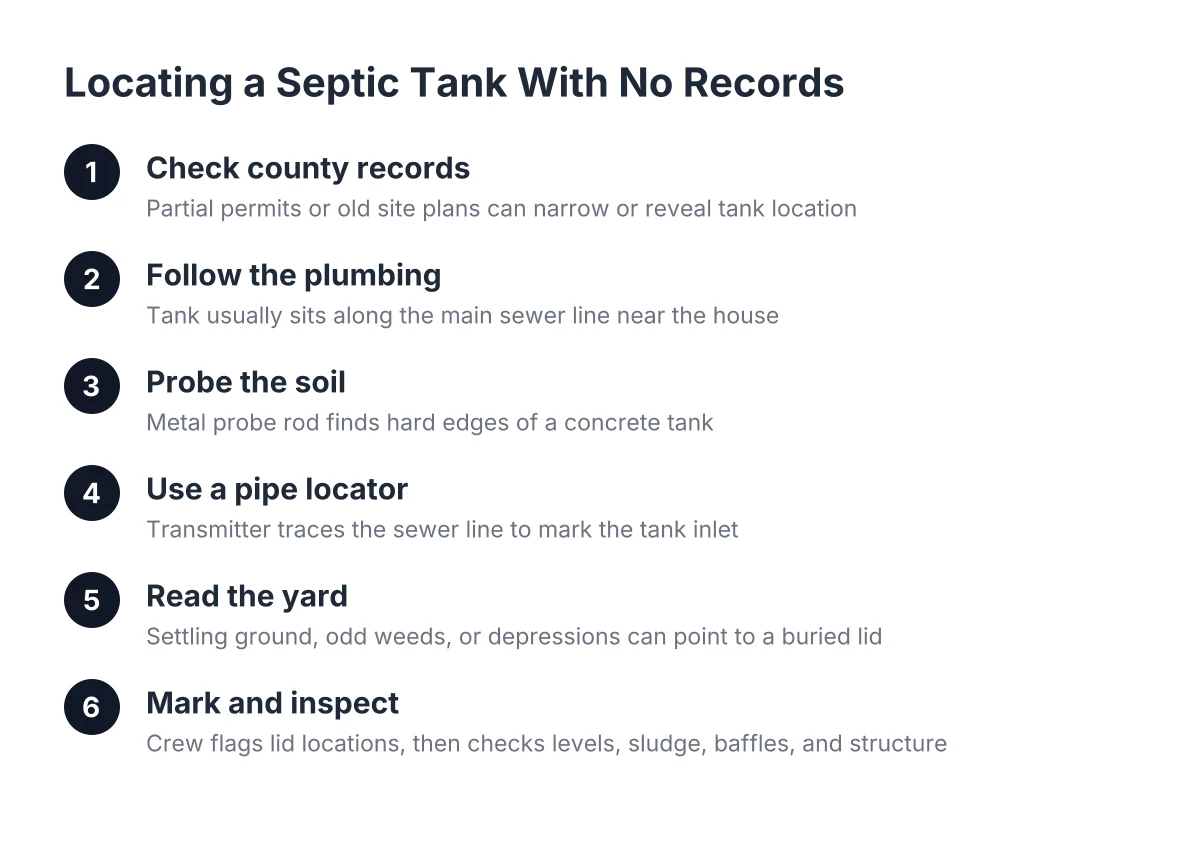
    Steps showing how a crew performs a septic tank locate inspection with no records
    How a crew locates and inspects a buried septic tank on a Hesperia property with no records, as described in this guide.

    If you just bought land in Hesperia, or you own a rental on septic and the seller left you nothing, you need to know exactly what happens during septic tank locate inspection and cleaning before you spend money or sign anything. There are no records. There may be no visible lid. Maybe a tenant is calling about slow drains, or an alarm you have never heard before is buzzing at 9 p.m. This guide walks through the entire process, step by step, from locating a buried tank on an unfamiliar lot to what the crew actually does once the lid comes off. The goal is simple: when the truck shows up, you know what to expect, what to ask, and what the paperwork should say when it is over.

    Why Buyers and Small Landlords End Up Here With No Records

    More than one in five U.S. households depend on individual septic systems or small community cluster systems to treat their wastewater, according to the U.S. Environmental Protection Agency. In the High Desert, that share is much higher. Most homes and rentals in Hesperia sit on septic, not sewer.

    However, records are another story. County permit files for older properties are often incomplete or missing. Previous owners may never have pumped the tank, or they pumped it and kept no receipts. Sellers sometimes will not confirm anything about septic condition, and they are not always required to.

    That leaves you, the buyer or landlord, holding the risk. A tank that has not been pumped in a decade, a cracked lid buried under two feet of sand, or a failing drain field can turn a good deal into a bad one. The EPA estimates septic repair or replacement typically costs between $5,000 and $15,000, far more than routine pumping. Knowing what you are dealing with before closing, or before a tenant moves in, is the whole point of a septic tank locate inspection.

    Step One: How a Crew Locates and Inspects a Septic Tank With No Map

    Finding a buried septic tank on a lot with no records is a solvable problem, and it happens more often than you would think in Hesperia. A local crew combines a few methods, usually in this order:

    • Check county records first. Even a partial permit or an old site plan narrows the search area. Sometimes it shows the tank location outright.
    • Follow the plumbing. The main sewer line leaves the house through the foundation or crawl space. The tank almost always sits along that line, typically within a short run of the house.
    • Probe the soil. A thin metal probe rod pushed into the ground finds the hard edges of a concrete tank. In High Desert sand, this works well.
    • Use a pipe locator. A small transmitter sent down the cleanout traces the sewer line electronically. The crew follows the signal above ground and marks where it ends, which is the tank inlet.
    • Read the yard. A patch of ground that settles differently, greener weeds in a dry lot, or an old depression can all point to a buried lid.

    Once the tank is found, the crew marks the corners and the lid locations. For a land buyer, ask them to mark it with paint or flags and note the location in writing. That marked location alone has value for any future remodel, addition, or permit application, since the county will want to know where the system sits relative to any new construction.

    One honest caveat: on large rural parcels with no structure connected, or where the line was abandoned, locating can take longer and may not succeed on the first visit. A crew should tell you that upfront rather than guess.

    What Happens During a Septic Tank Inspection

    A septic tank inspection is a physical check of the tank, its components, and the ground around it, done with the lid open. The crew measures sludge and scum levels, checks the baffles at the inlet and outlet, looks for cracks or root intrusion, and observes how liquid flows into the tank. You should get the findings in writing.

    Here is the sequence in practice:

    1. Expose the lids. If there is no riser at grade, the crew digs down to the access lids. In Hesperia soil this is usually shovel work, not machinery.
    2. Check the liquid level before pumping. This matters. A level above the outlet pipe suggests the drain field is not absorbing water. A level far below normal can point to a leaking tank. This one reading tells an inspector a lot.
    3. Measure sludge and scum. The solid layer on the bottom and the grease layer on top get measured against the tank depth. Heavy buildup means the tank is overdue for pumping.
    4. Inspect the baffles and tees. These direct flow inside the tank. A rusted or broken outlet baffle lets solids escape into the drain field, which is how drain fields die early.
    5. Run water from the house. Flushing toilets and running fixtures confirms the line flows freely into the tank and shows whether anything backs up.
    6. Look at the tank structure. Cracked concrete, a sagging lid, or exposed rebar all go in the report. This is also where a crew flags collapse risk. Older concrete tanks can deteriorate to the point where a lid or wall gives way, and a collapsing tank is a genuine safety hazard for anyone walking above it.

    For a purchase decision, ask for a written report that covers tank condition, measured levels, baffle condition, and any drain field concerns observed. Lenders and county offices in 2026 increasingly want documentation, not a verbal thumbs up. As a reference point for maintenance planning, the U.S. Environmental Protection Agency recommends a professional septic tank locate inspection at least once every three years for a typical household, and once a year for systems with pumps, float switches, or other mechanical parts.

    What Happens During Septic Tank Pumping and Cleaning

    Septic tank pumping removes the accumulated sludge, scum, and liquid from the tank through a vacuum hose connected to a pump truck. Cleaning goes a step further; the crew breaks up the compacted sludge layer, often by backflushing liquid into the tank, so the vacuum can pull out solids that a quick pump would leave behind.

    The distinction matters for a buyer with no records. A tank that has sat for ten years has a hardened sludge blanket on the bottom. Sucking off the liquid and leaving that blanket behind is not a real service. A proper cleaning stirs and removes it, and the crew can then see the tank floor and walls, which makes the inspection more reliable.

    During the visit, expect the following:

    • The truck parks as close to the tank as access allows, and the crew runs hose to the open lid.
    • Pumping typically takes under an hour for a standard residential tank once the lid is exposed, though buried lids and long hose runs add time.
    • The crew notes what comes out. Lots of grease points to kitchen habits or a rental where tenants pour fat down the drain. Wipes and non-flushables point to the same conversation you may need to have with tenants.
    • After pumping, the empty tank gets a visual check that is impossible when it is full. Cracks below the liquid line, root intrusion, and floor condition are all visible now.

    On price, national data gives a rough anchor. According to Angi, septic tank pumping averages $427, ranging from $250 to $1,250 or more depending on tank size and location. If you are searching "septic services near me prices" for a Hesperia property, treat those figures as a national ballpark, not a quote; access, digging, and tank condition move the number.

    A Realistic Scenario: The Rental With a Mystery Tank

    Consider a common Hesperia situation. You own a three-bedroom rental off Ranchero Road, bought two years ago with no septic disclosure. The tenant texts on a Friday: the shower is draining slow and there is a gurgle in the kitchen sink. You have no idea where the tank is, when it was last pumped, or whether the problem is the tank or the drain field.

    A septic tank locate inspection visit answers all three questions in one trip. The crew traces the line, finds the tank fifteen feet off the back porch, and digs to the lids. The liquid level is at the top of the outlet, and the sludge measurement shows the tank is past due. They pump and clean it, the drains recover, and the written report notes a sound tank with a worn outlet baffle to watch.

    As a landlord, you now have three things you did not have Friday morning: a marked tank location for the property file, a service record that starts the maintenance clock, and a documented baseline you can hand to a property manager or the next buyer. The tenant has working drains by the weekend, which is what keeps a lease intact.

    When It Cannot Wait: Backups, Alarms, and Overflows

    Sometimes the inspection and the emergency are the same visit. Sewage backing up into a tub, a septic alarm sounding at night, or wet ground pooling over the tank means the system is telling you it is full or failing right now. This is where emergency septic service differs from a scheduled job: the crew triages first, pumps to relieve the immediate pressure, and then inspects to find out why it happened.

    If you are in that situation tonight, take these steps before the truck arrives:

    1. Stop using water. No flushing, no laundry, no dishwasher. Every gallon in makes the backup worse.
    2. Keep people and pets away from any surfacing sewage. It is a health hazard, and saturated ground over an old tank can be unstable.
    3. Do not open the tank yourself. Septic gases are dangerous in enclosed spaces, and an unsupported dig around an old concrete tank risks a lid failure. On the related question people search, a septic tank does not explode under normal conditions, but the gases inside are hazardous and occasionally flammable, which is one more reason lid work belongs to a crew with the right equipment.
    4. Note what you saw first. Which drain backed up, what the alarm panel says, and where water is pooling. This shortens diagnosis when the crew arrives.

    Many people in a backup start by searching "emergency plumbing near me" or "24 hour plumber near me." A plumber can clear a clog inside the house, but if the tank is full or the drain field is saturated, snaking the line only buys hours. A pump truck is what relieves a full tank, so if the property is on septic, a septic crew is usually the right first call.

    What Happens During Septic Tank Reporting, and What to Do With It

    The paperwork after a septic tank locate inspection is where the visit pays off for a buyer or landlord. What happens during septic tank reporting is straightforward: the crew documents the tank location, measured levels, component condition, what was pumped, and any repairs recommended, and you keep that record with the property file.

    Use the report differently depending on your situation:

    • Buying before closing: Attach the report to your due diligence file. A documented bad system is a negotiating point, not a dead deal; repair estimates in the $5,000 to $15,000 range the EPA cites give you real numbers to bring to the seller.
    • Planning a remodel or addition: The marked tank and line location tells your contractor and the county where you can and cannot build. Setbacks from the tank and drain field affect where an ADU or addition can go.
    • Managing a rental: Start a simple log. Date of pumping, condition notes, and tenant instructions about what not to flush. When you sell the property, that log answers the exact questions you could not get answered when you bought it.

    One trade-off to be honest about: a locate and inspection costs money on a property you might not keep, and it can add a few days to escrow if lids have to be dug up. Weigh that against buying blind. On a system where replacement runs five figures, the inspection is the cheapest information in the whole transaction. And if the report turns up structural damage, a failed drain field, or signs of a partial collapse, get a second professional opinion before authorizing major repair work; that is a decision worth two sets of eyes.

    The Bottom Line for Hesperia Properties Without Records

    A missing septic record is a fixable problem, not a mystery you have to live with. A local Hesperia crew can locate the tank, open it, measure what is inside, pump and clean it properly, and hand you a written report, usually in a single visit. For a buyer, that report turns an unknown into a line item. For a small landlord, it turns a tenant complaint into a documented, closed ticket.

    The pattern that costs High Desert property owners real money is the opposite one: skip the locate, skip the inspection, and find out about the system when sewage is already in the hallway. At that point you are paying for an emergency pump, possible cleanup inside the unit, and the same inspection you deferred. Getting eyes inside the tank early, and knowing exactly what happens during septic tank service before you need it urgently, is how you stay on the cheap side of that line.

    If you need your septic tank serviced, Hesperia Septic can help.

    Related Reading