Tag: sewage odor

  • 7 Signs Your Septic Tank Needs Pumping: Backups, Odors, and Slow Drains

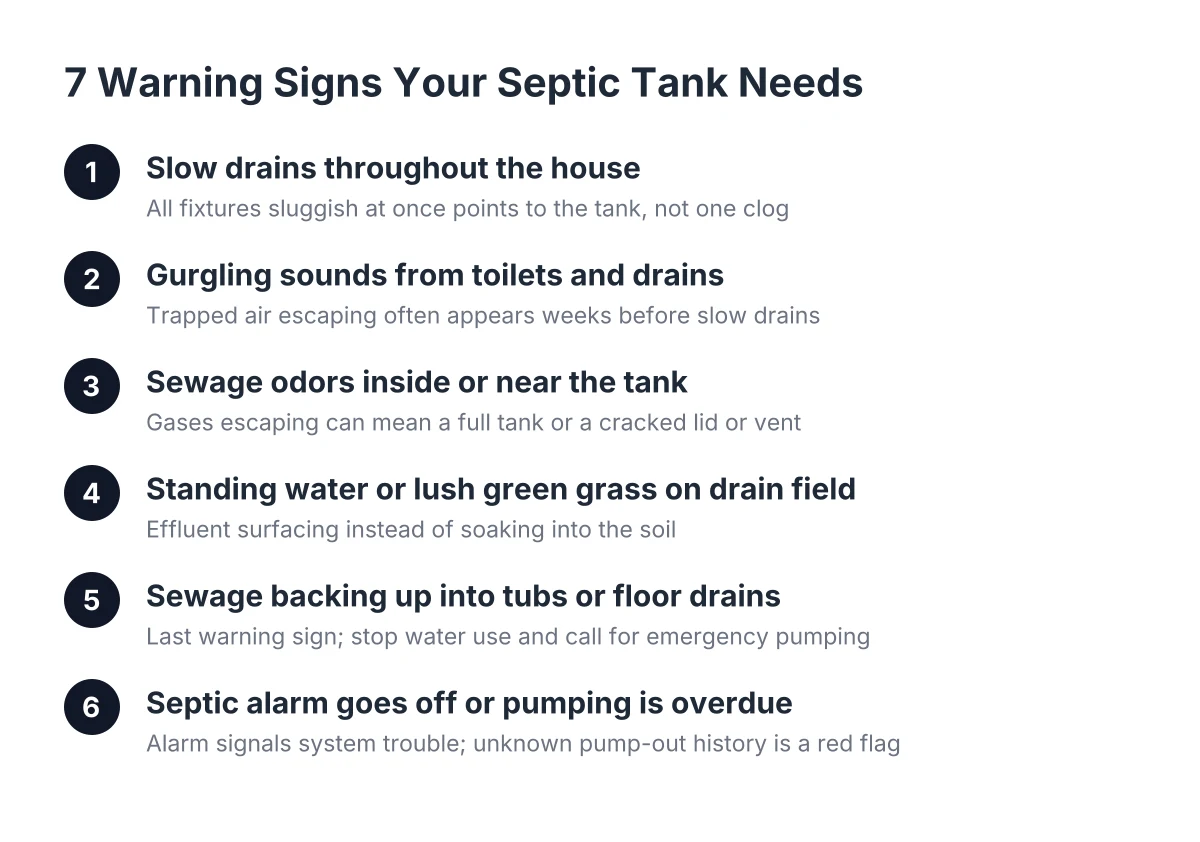
    Sequence of septic backup warning signs from slow drains to sewage backup
    The warning signs tend to appear in this order, from slow drains to a full backup.

    Most septic problems announce themselves before sewage ever reaches your tub. The signs your septic tank needs pumping usually show up in a predictable order: drains slow down, odors creep in, the yard gets wet, and then a backup hits at the worst possible time. Recognizing septic backup warning signs early is the difference between a routine septic tank pumping visit and a weekend emergency with a tenant calling you at 8pm. If you own a home or a rental in Hesperia, catching these signals early helps you act before a costly emergency develops.

    This list walks through the seven warning signs in the rough order they tend to appear, plus what each one usually means. Some point to a full tank that just needs pumping. Others point to a clog or a drain field problem that pumping alone will not fix. Knowing the difference helps you evaluate what you are actually paying for when a truck shows up.

    1. Slow Drains Throughout the House, Not Just One Fixture

    One slow sink is usually a plumbing clog. Every drain in the house running slow at the same time is one of the earliest signs your septic tank is getting full. When sludge builds up in the tank, wastewater has nowhere to go, so it backs pressure into every line connected to the system.

    Here is the quick test: if the master bathroom tub, the kitchen sink, and a toilet on the other side of the house are all sluggish, the problem is downstream of all of them. That points to the tank or the line leading to it. A landlord hearing "all the drains are slow" from a tenant should treat that differently than "the bathroom sink is slow," because the first one gets worse on its own.

    Therefore, do not spend money on drain cleaner or a plumber snaking one fixture if the whole house is affected. A regular plumber will often tell you they do not handle septic anyway. Whole-house slowness calls for a septic inspection or pumping visit first.

    2. Gurgling Sounds From Toilets and Drains

    Gurgling is trapped air escaping through your plumbing because wastewater cannot flow freely into the tank. You will hear it when a toilet finishes flushing, or from a tub drain while the washing machine empties. It sounds minor, but it is the system telling you the pipes are fighting for space.

    In addition, gurgling often shows up a week or two before slow drains become obvious. Tenants tend to ignore it, so if you own rental property, it is worth asking specifically about strange drain noises during any maintenance visit. Catching the problem at the gurgling stage usually means a straightforward pump-out instead of a backup cleanup. These early warning signs of septic backup prevent much costlier repairs.

    3. Sewage Odors Inside the House or Near the Tank

    A healthy septic system should not smell. Sewage odor near drains, around the tank lid, or drifting across the yard means gases are escaping where they should not, and often means the tank is full enough that the scum layer is pushing waste toward the outlet. Odor inside the house is the more urgent version; it usually means wastewater is sitting in the lines.

    For example, a common Hesperia scenario looks like this: a homeowner notices a faint sewage smell in the hall bathroom for a few days, assumes it is a dry trap, and pours water down the drain. The smell comes back. A week later the toilet will not flush and water is rising in the tub. The odor was the warning; the backup was the bill.

    However, odor alone does not always mean a full tank. A cracked lid, a damaged vent, or a leaking tank can also cause smells. If pumping does not resolve a persistent odor, ask the crew to inspect the tank and lids while it is open.

    4. Standing Water or Lush Green Grass Over the Drain Field

    Wet, soggy ground over the tank or drain field when it has not rained is one of the clearer signs your septic tank is either overfull or failing to drain. In the High Desert, this one stands out. Hesperia yards are dry most of the year, so a soft, muddy patch or a stripe of bright green grass in an otherwise brown yard is hard to miss.

    That green stripe happens because wastewater is surfacing and fertilizing the grass above the drain field. It looks healthy, but it means effluent is not soaking into the soil the way it should. Sometimes pumping the tank buys time. Other times the drain field itself is saturated or failing, which is a bigger conversation.

    This is the point where an honest assessment matters. According to the U.S. Environmental Protection Agency, septic repair or replacement typically costs between $5,000 and $15,000, far more than routine pumping. A crew that opens the tank and checks liquid levels can usually tell you whether you are looking at a pump-out or a drain field problem, and you should expect them to explain which one and why.

    5. Sewage Backing Up Into Tubs, Showers, or Floor Drains

    Sewage backing up into the house is the last warning, not the first. Wastewater follows gravity, so it surfaces at the lowest drains first: a ground-floor tub, a shower, or a floor drain in a laundry room. When you spot septic backup warning signs like gray or black water rising in a tub when the toilet flushes, stop running water immediately. Every gallon you use has nowhere to go but back inside.

    At this stage you need emergency septic pumping, not a drain snake. Pumping the tank relieves the pressure and stops the backup in most cases where a full tank is the cause. If the tank is not full and sewage is still backing up, the blockage is likely in the line between the house and the tank, or the drain field is refusing water. A crew that pumps tanks daily can tell the difference at the site.

    While you wait for a truck, three things help:

    • Stop all water use, including laundry, dishwashers, and showers, and ask tenants to do the same.
    • Keep people and pets away from any sewage on floors or in the yard; raw sewage carries bacteria.
    • Note where the water came up first, because that detail helps the crew find the problem faster.

    6. The Septic Alarm Is Going Off

    If your system has a pump or an alarm and it is sounding, the tank has reached a high water level and needs attention soon. Systems with float switches and pumps are designed to warn you before sewage surfaces. The alarm going off does not always mean an immediate overflow, but it does mean the normal draining process has stopped working.

    First, check whether anything obvious tripped it, such as a power outage affecting the pump. If power is fine and the alarm stays on, silence the buzzer if there is a switch, cut back water use, and get the tank checked. The U.S. Environmental Protection Agency recommends that alternative systems with float switches, pumps, or mechanical components be inspected once a year, precisely because these parts fail quietly until the alarm sounds.

    7. It Has Been Years Since the Tank Was Pumped, or You Do Not Know

    No visible symptoms does not mean an empty tank. Sludge builds up silently, and by the time you see the signs your septic tank is backing up, the cheap window has closed. If you bought a Hesperia home or rental and have no pumping records, assume the clock started before you did.

    The U.S. Environmental Protection Agency recommends a professional inspection at least once every three years for the average household. Households with garbage disposals build sludge faster; the Massachusetts Department of Environmental Protection recommends annual pumping for homes with disposals regardless of tank size. For a landlord, an inspection at tenant turnover is a cheap way to reset that clock and get documentation for your files.

    Cost is the other reason to act before symptoms appear. According to Angi data, septic tank pumping averages $427, ranging from $250 to $1,250 or more depending on tank size and location. Compare that to an after-hours backup at a rental: pumping, cleanup inside the unit, an unhappy tenant, and possibly a vacancy while you remediate. The math favors the scheduled visit every time.

    Do These Signs Mean Pumping or Full Septic Tank Cleaning?

    Pumping removes the liquid and floating waste from the tank; full cleaning also removes the compacted sludge layer from the bottom and lets the crew see the tank's interior. If your only symptom is that time has passed, routine pumping usually covers it. If you have had backups, odors, or years of neglect, ask about full septic tank cleaning so the hardened sludge does not stay behind and shorten the interval until your next problem.

    The signs on this list do not always separate the two on their own. As a result, the honest answer often comes only once the lid is open and the crew can see the sludge and scum layers. A good crew will show you what they find and explain whether the tank, the line, or the drain field is the issue, rather than defaulting to the most expensive fix. If someone recommends a full system replacement based on symptoms alone, without opening and evaluating the tank, get a second opinion.

    When to Call a Professional in Hesperia

    Any sign on this list is worth a phone call; two or more at once is worth a same-day call. Slow drains plus gurgling means the tank is likely near capacity. Odor plus a wet spot in the yard means wastewater is already escaping. Sewage in a tub or an alarm sounding means stop using water and get a truck out.

    One limitation worth stating plainly: no article can diagnose your system from a distance. Soil conditions, tank size, household habits, and system age all change the picture, and some problems, like a collapsed line or a failed drain field, require an on-site inspection to confirm. What you can do as of 2026 is know these seven signs, keep pumping records for every property you own, and call before the last warning becomes a backup in the hallway.

    If you need your septic tank serviced, Hesperia Septic can help.
    Related Reading

  • 8 Signs Your Septic Tank Needs Pumping Now, Not Next Year

    septic tank warning signs

    If you own a home on septic in Hesperia and you can't remember the last time the tank was pumped, you're not alone. Most calls we take start the same way: something in the house changed, and the homeowner wants a straight answer, not a sales pitch. This guide covers the septic tank warning signs you should never ignore, ranked roughly from "schedule it soon" to "stop running water and call today." Knowing the difference can save you real money; according to the U.S. Environmental Protection Agency, septic repair or replacement typically costs $5,000 to $15,000, while a routine pump-out is a few hundred dollars.

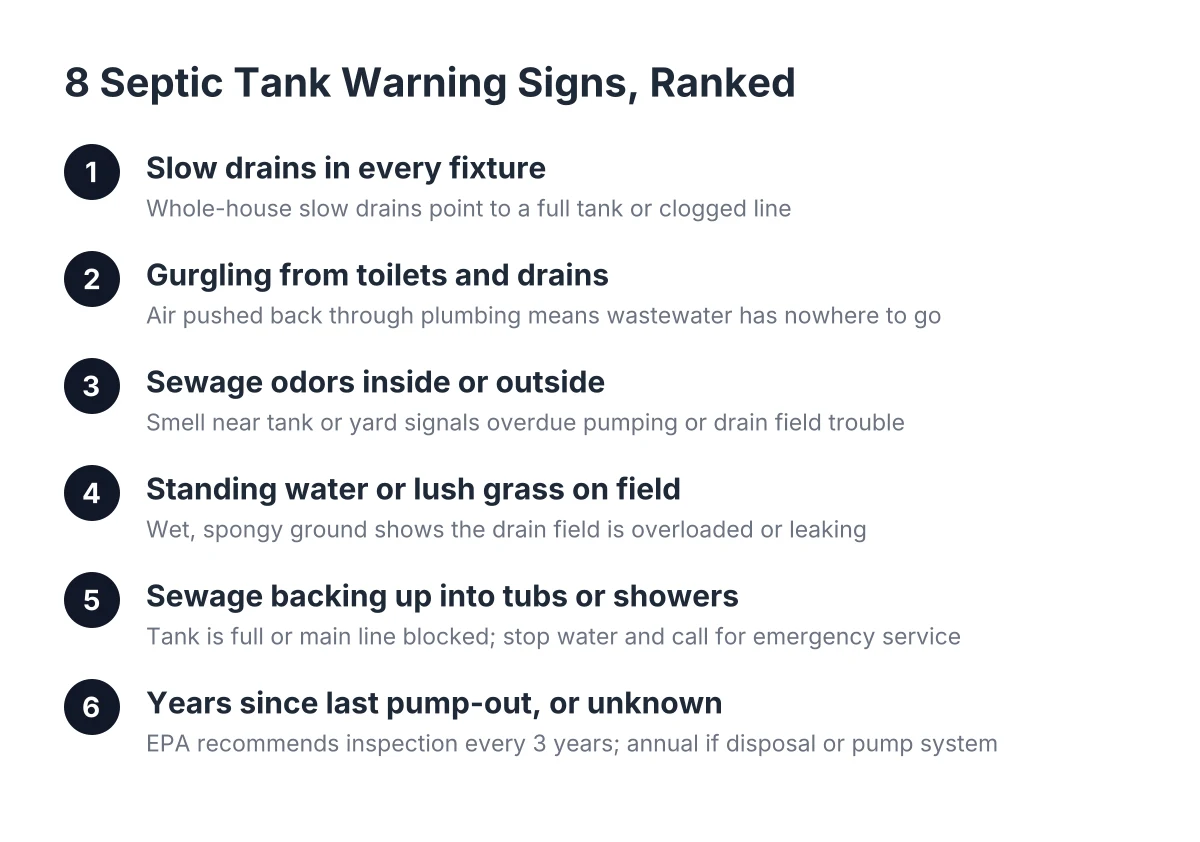
    Here are the eight warning signs, in order.

    1. Slow Drains in Every Fixture, Not Just One

    One slow sink is usually a clogged pipe. Slow drains across the whole house, especially in the lowest fixtures like a ground-floor shower or toilet, point to a full septic tank or a clogged line between the house and the tank.

    Watch what happens when you run the washing machine. If the toilet gurgles or the shower drain backs up while the washer empties, the system can't take water as fast as your house sends it. That pattern is one of the most reliable early warning signs when a septic tank is getting full.

    2. Gurgling Sounds From Toilets and Drains

    Gurgling means air is being pushed back through your plumbing because wastewater has nowhere to go. It often shows up before any visible backup, which makes it a useful early warning.

    For example, a homeowner near Main Street and Escondido Avenue might notice the hall bathroom toilet bubbling every time someone showers. Nothing has overflowed yet, so it's easy to ignore. That gurgle is the system telling you the tank is near capacity or the outlet is clogging. Booking a pump-out at this stage usually means a routine visit instead of an emergency one.

    3. Sewage Odors in the House or Yard

    A healthy septic system should not smell. If you catch a rotten-egg or sewage odor near drains inside, or around the tank lid and drain field outside, gases and wastewater are escaping where they shouldn't.

    Odor near the tank often means it's overdue for pumping. Odor spread across the yard, especially with damp ground, can mean the drain field is struggling. In Hesperia's dry climate, a persistent sewage smell outside stands out; our soil doesn't stay wet on its own, so a smelly, soggy patch deserves attention fast.

    4. Standing Water or Lush Grass Over the Drain Field

    Wet, spongy ground over the tank or drain field is one of the clearest septic tank warning signs that something is leaking or overloaded. When the tank fills past its working level, wastewater pushes out to the drain field faster than the soil can absorb it, and it surfaces.

    In the High Desert, this sign is hard to miss. A bright green strip of weeds or grass in an otherwise brown yard, with no irrigation to explain it, usually sits right over the drain field. That greenery is being fed by effluent. Pumping the tank relieves the pressure, but if the drain field is already saturated, an inspection should come with it.

    5. Sewage Backing Up Into Tubs, Showers, or Floor Drains

    This is the sign that skips the warning stage. When dark water or sewage comes up through the lowest drains in the house, the tank is full or the main line is blocked, and every flush makes it worse.

    If this is happening now, do three things:

    • Stop running water. No flushing, no laundry, no dishwasher.
    • Keep people and pets away from any backup inside or pooling outside.
    • Call for emergency septic pumping rather than waiting to see if it drains on its own.

    A backup rarely fixes itself. Pumping the tank is usually the first step, and it also lets a crew see whether the problem is the tank, the inlet line, or the drain field.

    6. It's Been Years Since the Last Pump-Out, or You Don't Know

    You don't need a visible symptom to be overdue. Solids build up in the tank whether or not anything smells. Once the sludge layer gets deep enough, solids flow into the drain field, and that's how a cheap maintenance task turns into a five-figure repair.

    The EPA recommends a professional inspection at least once every three years for the average household, and once a year for alternative systems with pumps or float switches. In addition, households with garbage disposals produce far more sludge; the Massachusetts Department of Environmental Protection recommends annual pumping for those homes regardless of tank size.

    If you just bought a house in Hesperia and the seller couldn't tell you when the tank was last serviced, treat that as a sign in itself. A pump-out with an inspection gives you a clean baseline and a record to plan from.

    7. The Septic Alarm Is Going Off

    Not every system has one, but if yours does, take it seriously. Systems with pumps or float switches use an alarm to signal high water in the tank, a failed pump, or a power issue. It's the one part of a septic system designed to warn you before sewage reaches your floor.

    However, an alarm doesn't tell you which problem you have. Silencing it and hoping is how a high-water warning becomes a backup by the weekend. A pump-out plus an inspection of the floats and pump usually sorts out whether you had a one-time overload or a component that needs repair.

    8. Nitrate or Bacteria Problems in a Nearby Well

    This one matters for rural Hesperia properties on well water. A failing or leaking septic system can send bacteria and nitrates into the groundwater your well draws from. If a water test comes back with elevated nitrates or coliform bacteria, the septic system is a prime suspect.

    This is also the sign where you should bring in a professional rather than troubleshoot alone. Pumping may be part of the fix, but tracing contamination to a leaking tank or failed drain field takes an inspection, and sometimes county involvement. No article can diagnose that from your kitchen table.

    How to Tell a Full Tank From a Failing System

    A full tank needs pumping. A failing system needs pumping plus diagnosis, and the signs overlap, which is why homeowners get nervous about upsells. Here's a practical way to sort them.

    Signs that usually mean the tank is full and pumping alone will fix it:

    • Slow drains and gurgling that started gradually
    • Odor near the tank lid, not spread across the yard
    • No service history for three or more years

    Signs your septic tank warning signs may indicate failing, where pumping is step one but not the whole answer:

    • Standing water or sewage surfacing over the drain field
    • Backups that return within weeks of a pump-out
    • Contamination showing up in well water tests

    The honest trade-off: pumping a failing system buys time, but it doesn't repair a crushed line or a saturated drain field. A crew that pumps your tank should be able to tell you what they see at the inlet, outlet, and baffles, and whether liquid flows back from the drain field into the tank. Flowback during pumping is a strong indicator the field is the problem, not the tank.

    If several of the "failing" signs sound familiar, two resources will help you decide the next move. Our guide to 7 signs your septic system needs replacement, not just another pumping walks through when a tank is genuinely at the end of its life. And a professional septic system inspection in Hesperia gives you a measured answer — sludge depth, baffle condition, and drain field health — instead of a guess.

    What Acting Early Actually Saves You

    The gap between routine service and emergency repair is the whole argument for acting on early signs. According to Angi data, septic tank pumping averages $427, with a typical range of $250 to $1,250 depending on tank size and location. Compare that to the EPA's estimate of $5,000 to $15,000 for repair or replacement, and the math settles itself.

    There's a practical difference too. A scheduled pump-out happens on your calendar, in daylight, with the lids located ahead of time. An emergency call happens with sewage in your shower, often after hours, sometimes with a tank nobody can find because it was buried decades ago. If you don't know where your tank is, septic tank locating is worth doing before you ever need it urgently.

    What to Expect When You Call a Local Crew in 2026

    Knowing what a normal visit looks like makes it easier to compare quotes and spot padding. A straightforward septic tank pump-out in the Hesperia area generally includes:

    1. Locating and uncovering the tank access lids
    2. Pumping out liquids, sludge, and scum, not just the liquid layer
    3. A visual check of the tank, baffles, and inlet and outlet as it empties
    4. Telling you what they found, in plain language, before recommending anything else

    Ask any company you call whether the quote covers digging to reach the lids, and whether they pump the full tank or skim it. Those two questions expose most of the pricing surprises homeowners run into. A local, septic-focused crew should answer both without hesitation.

    The Bottom Line for Hesperia Homeowners

    Slow drains, gurgling, and odors are your cheap warnings; backups, surfacing sewage, and alarms are the expensive ones. If you've noticed any of the early septic tank warning signs or backing up or filling, scheduling a pump-out now is the difference between a routine service call and a weekend you'll be telling neighbors about for years. And if you've hit the later signs, stop running water and get a crew out; the tank isn't going to un-fill itself.

    If you need your septic tank serviced, Hesperia Septic can help.

    Related Reading