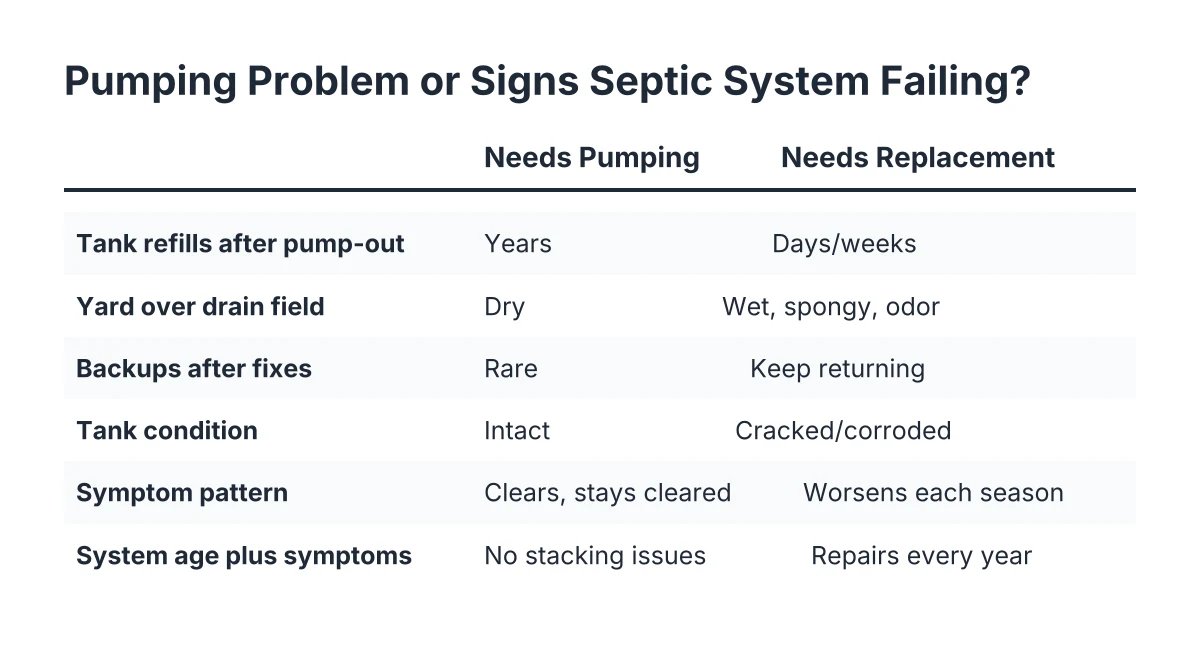
Nobody wants to hear that a tank pump-out will not fix the problem. However, some of the signs septic system failing are pumping problems, and some point to a system that has reached the end of its life. The difference matters, because pumping a tank runs a few hundred dollars while replacing a system runs thousands. This article lays out seven signs that separate the two, so you can push back on an unnecessary upsell or face a real replacement with your eyes open.
Here in Hesperia and the High Desert, this question comes up constantly. More than one in five U.S. households depend on individual septic systems or small community cluster systems to treat their wastewater, according to the U.S. Environmental Protection Agency, and out here that share is higher. If you just bought land with no septic records, or you have maintained your system for years and something changed, the list below is for you.
First, the honest baseline: most septic problems do not require replacement
Most of what people call "septic failure" is actually a full tank, a clogged line, or a broken component. Septic tank pumping, a line clearing, or a baffle repair fixes the majority of calls a local crew runs. The U.S. Environmental Protection Agency estimates septic tank repair or replacement typically costs between $5,000 and $15,000, far more than routine pumping, so anyone telling you to replace should be able to show you evidence, not just say the word "failing."
That is the standard to hold every recommendation against. A trustworthy crew will pump the tank, look at what happens next, and explain what they see in plain terms. If the tank fills back up from the drain field within hours or days of pumping, that is a system problem. If it takes years to fill again, pumping did its job.
With that baseline set, here are the seven signs that point past pumping toward septic system replacement.
1. The tank fills back up right after pumping
This is the clearest sign on the list. A healthy tank sends liquid out to the drain field and fills gradually over years. If your tank is full again within days or weeks of a pump-out, the drain field is not accepting water, and the wastewater has nowhere to go.
At that point, pumping is a bandage, not a fix. You can keep paying for pump-outs to buy time, but the underlying problem is septic drain field failure, and no amount of pumping repairs soil that will not drain. This is the moment to get a real inspection instead of scheduling another truck.
2. Sewage surfaces in the yard over the drain field
Wet, spongy ground, standing gray water, or a sewage smell over the drain field means effluent is rising instead of soaking down. In the High Desert this stands out fast; a green, lush stripe of grass in an otherwise dry Hesperia yard is a classic tell. The soil under the field has likely clogged with a black, tar-like layer called biomat.
Occasionally, surfacing sewage traces back to a crushed pipe or a distribution box problem, which is a repair, not a replacement. However, if the whole field is soggy rather than one spot, the field itself has failed, and a new field or new system is usually the answer.
How to know if signs septic system failing or truly a clog
A clog shows up suddenly and usually affects the house first; drains slow down or back up all at once, often after heavy use. Failure develops gradually and shows up in the yard, with wet ground, odors, and a tank that stays full. A clog clears and stays cleared; a failing field gets worse every season no matter what you snake or pump.
One practical test: have the tank pumped and the lines checked. If everything drains fine afterward and stays that way, you had a clog or a full tank. If symptoms return within weeks, you are looking at the system itself.
3. Backups keep returning after every fix
One backup after ten years is a maintenance event. Backups every few months, after you have already pumped the tank and cleared the lines, indicate signs septic system failing. Repeated septic backup means wastewater keeps hitting a wall somewhere, and pumping only resets the clock.
For a homeowner who has kept up on maintenance for years, this pattern change is the signal to watch. Your system behaved for a decade, and now it does not. Something downstream of the tank, usually the field, has stopped doing its job.
4. The tank itself is cracked, collapsed, or corroded
Sometimes the field is fine and the tank is the problem. Older concrete tanks can crack or lose their baffles; steel tanks rust through; lids and risers crumble. During a pump-out, the technician can see the inside of the tank, and that view tells the story.
A cracked tank leaks wastewater into the surrounding soil before treatment, and it can also let groundwater in, which overloads the field. Depending on the damage, this may mean replacing only the tank rather than the entire system, which is a meaningfully smaller job. Either way, patching a failing tank rarely holds.
5. The system is past its expected lifespan and the problems are stacking up
Septic system lifespan varies with soil, water use, and maintenance, but no system lasts forever. Drain fields in particular have a finite working life because the soil slowly clogs even with perfect care. Age alone is not a reason to replace; age plus recurring symptoms is.
Think of it like a roof. You do not replace a 30-year-old roof that is not leaking, but you also stop paying for patches when leaks show up in three places at once. If an aging system needs a repair every year, replacement usually becomes the cheaper path over a five-year window.
6. You bought property with no records and the inspection tells a bad story
This scenario plays out across the High Desert every year. A buyer picks up five acres outside Hesperia, there is no visible lid or riser, the seller has no paperwork, and nobody can say when the tank was last pumped. The first step is a septic tank locating service to find and mark the tank, followed by an inspection with the tank open.
What the inspection finds decides everything. Here is what typically separates a livable system from a replacement on a no-records property:
- Solids near the outlet or a missing baffle: usually fixable with pumping and a repair.
- A tank that is structurally sound but overfull: pump it and monitor.
- Effluent standing at or above the outlet with a saturated field: the field has failed.
- An undersized or homemade tank that never met code: plan on replacement.
- Evidence of past surfacing, like stained soil or old repair trenches: budget for a new system.
Therefore, if you are in escrow, get the locate and inspection done before you close, and get the findings in writing. A few hundred dollars for an inspection is cheap insurance against inheriting a five-figure problem. If the report is bad, you can renegotiate, ask for a credit, or walk.
7. Well water tests or neighbors flag contamination
A failing system does not just inconvenience you; it releases untreated wastewater into the soil. If a well water test shows bacteria or nitrates, or a neighbor reports odors and wet ground near your property line, take it seriously. Contamination signs mean the system is failing at its actual job, treating wastewater, even if your drains still work fine indoors.
This is also where the county gets involved. In San Bernardino County, a failed system generally cannot be rebuilt informally; septic system permits go through the county's environmental health process, which reviews soil conditions and system design before approving a replacement. As of 2026, expect the permitting step to add time to the project, so start the paperwork early rather than after the yard floods.
Signs your septic system just needs pumping, not replacement
Signs your septic system needs to be pumped, rather than replaced, include slow drains throughout the house, gurgling pipes, mild odors near the tank lid, and a backup after years of no service. These symptoms come from a full tank, and a routine septic tank pumping visit resolves them. According to Angi data, the cost of septic tank pumping averages $427, ranging from $250 to $1,250 or more depending on tank size and location, which is a fraction of any replacement.
In addition, the U.S. Environmental Protection Agency recommends the average household have its septic system inspected at least once every three years by a professional. Alternative systems with pumps or float switches should be inspected once a year, per the same EPA guidance. For a homeowner who plans ahead, that schedule catches most problems while they are still pumping problems, not replacement problems.
Watch for these pump-it signals rather than panic signals:
- Every drain in the house is slow, not just one fixture
- Gurgling from toilets or drains after you run water
- It has been years since the last pump-out, or you have no record of one
- A single backup event with no yard symptoms afterward
What replacement actually involves if you do need it
The septic tank replacement process starts with a site evaluation and soil testing, then county permitting, then excavation and installation of the new tank and drain field. If you have heard the question "what are the 3 types of septic systems," it comes up here: conventional gravity systems, pressure-distribution systems, and alternative or engineered systems for difficult soils. The soil on your lot, not your preference, largely decides which type the county will approve.
Timeline-wise, permitting and design usually take longer than the dig itself. During the work, you may need to limit water use or arrange temporary accommodations for a short stretch. It is a disruptive project, which is exactly why it should never be sold to you casually.
One honest limitation: no article can diagnose your system from a distance. Soil conditions, tank construction, and field layout vary lot to lot across Hesperia, and a real answer requires opening the tank and looking. Use this list to ask sharper questions, not to skip the inspection.
The bottom line for Hesperia property owners
Learning to recognize signs septic system failing comes down to one pattern: symptoms that return after pumping point to the system, and symptoms that stay gone point to maintenance. One backup, one slow drain, or one odor near the lid is a service call. A soggy field, a tank that refills in days, and repairs stacking up year after year are the signs your septic system has run out of road.
Either way, insist on evidence before you spend replacement money. A crew that opens the tank, shows you what it sees, and explains the difference between a pumping problem and a field problem is the crew worth listening to.
If you need your septic tank serviced, Hesperia Septic can help.