You just bought land in Hesperia, or you are about to close on it, and nobody can tell you a single thing about the septic system. No records, no maps, no visible lid. Then a toilet gurgles, or a wet spot shows up in the yard, and the first quote you hear involves thousands of dollars in repairs. Before you accept that number, you need to understand the difference between septic tank pumping vs repair decision situations and problems a simple pump-out can fix. The gap between those two bills is enormous, and knowing which one you actually face is the single most useful thing you can learn before you spend a dime.
This guide walks through what pumping costs, what repairs cost, how to tell which one your system needs, and how to read a quote so you know whether it is fair. It is written for the High Desert, where a lot of properties changed hands with zero paperwork on the septic system, and where a buyer with no records has to figure things out from scratch.
Why the Pumping vs. Repair Decision Matters So Much
Here is the core problem. A backed-up septic system looks the same on the surface whether the fix costs a few hundred dollars or five figures. Slow drains, gurgling toilets, sewage odors, and soggy ground can all come from a tank that is simply full. They can also come from a crushed pipe, a failed drain field, or a broken pump. You cannot tell which from inside the house.
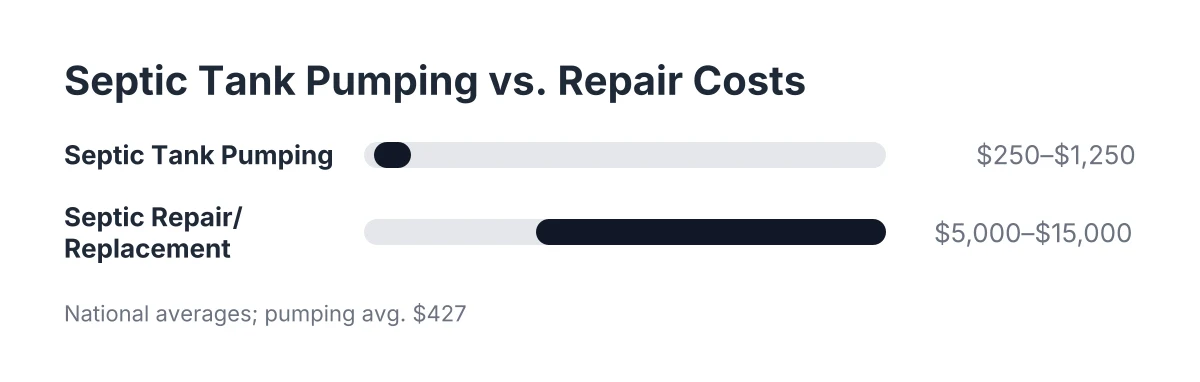
That uncertainty is where bad quotes live. A homeowner who does not know the difference has no way to push back when someone says the whole system needs work. According to the U.S. Environmental Protection Agency, septic tank repair or replacement typically costs between $5,000 and $15,000. Routine pumping, by contrast, averages $427 according to Angi data, with a typical range of $250 to $1,250 depending on tank size and location.
Read those two numbers again. The difference between "your tank is full" and "your system has failed" can be more than ten thousand dollars. As a result, the smartest first move on almost any septic problem is to confirm whether pumping alone resolves it before anyone starts talking about excavation or replacement.
What Septic Tank Pumping Actually Costs in 2026
Septic tank pumping in 2026 generally runs from about $250 to over $1,250, with a national average around $427 according to Angi. The price moves based on tank size, how hard the tank is to reach, how full it is, and whether the visit is scheduled or an emergency. In the Hesperia area, access and lid depth are the two factors that swing the price most often.
Pumping means a truck arrives, the crew opens the tank lid, and they remove the liquid and solid waste inside. On a straightforward job, the whole visit takes an hour or two. That is the entire service. There is no digging up the yard beyond exposing the lid, and no replacing parts.
Several things push a pumping bill toward the higher end of the range:
- A buried lid with no riser. If the crew has to locate the tank and dig down to the lid, that adds labor time. This is common on older High Desert properties.
- A larger tank. More gallons pumped means more time on site and more disposal volume.
- Heavy solids buildup. A tank that has gone many years without service takes longer to clean out, and some operators price septic tank cleaning as a separate, deeper service than a standard pump-out.
- Emergency timing. A backup on a Saturday night costs more than a scheduled weekday visit. Emergency septic pumping carries a premium at almost every company.
- Long hose runs. If the truck cannot get close to the tank, extra hose length adds setup time and sometimes a fee.
For a land buyer with no records, the buried-lid factor is the one to plan for. If nobody knows where the tank is, a septic tank locating service finds it and marks it before any pumping happens. Some companies fold locating into the pumping visit; others line-item it. Either way, ask for it on the quote so you are not surprised.
What Septic Repairs Cost, and Why the Range Is So Wide
Septic repair costs range from a few hundred dollars for a small fix to the $5,000 to $15,000 the EPA cites for major repair or replacement. The range is wide because "repair" covers everything from swapping a baffle to digging up and rebuilding an entire drain field. The component that failed determines the bill.
Here is a rough map of where repair money goes, from smallest to largest. These are illustrative ranges, not quotes, and your property's soil, layout, and county requirements will move the numbers.
- Baffles and lids. The baffles inside the tank direct flow and keep solids out of the drain field. Replacing a failed baffle or a cracked lid is usually one of the cheaper repairs, often in the hundreds.
- Broken or root-clogged pipes. The line between the house and the tank, or between the tank and the drain field, can crack, sag, or fill with roots. Cost depends on how deep it sits and how much digging the fix requires.
- Pump and float switch failures. Some septic system types use an effluent pump to move wastewater uphill or into a mound. Septic tank pump replacement cost typically lands in the four figures once you count the part, labor, and electrical checks. The EPA recommends inspecting systems with pumps, float switches, or other mechanical parts once a year, precisely because these components fail.
- Tank damage. A cracked or collapsing tank often cannot be patched. Replacement means excavation, a new tank, permits, and inspection.
- Drain field failure. This is the big one. When the soil absorption area clogs or the field pipes fail, the fix can mean building a new field, which drives total septic system cost toward the top of the EPA's range and sometimes past it.
Notice what all five have in common: none of them are fixed by pumping. However, and this matters, several of them are frequently misdiagnosed when the real issue is just a full tank. That is why the order of operations matters so much.
Septic Tank Pumping vs Repair Decision: How to Tell Which One You Need
The honest answer is that pumping the tank is usually the first diagnostic step, not just a service. Once the tank is empty, a crew can see the baffles, the inlet and outlet, the liquid levels, and how the system behaves. Most septic tank pumping repair calls get sorted into "pump and monitor" or "actual repair" at exactly this moment.
Here are the patterns that point toward each outcome.
Signs pumping alone will likely fix it
A full tank produces symptoms gradually. Drains slow down over weeks, not overnight. If your system has not been pumped in years, or you have no idea when it was last serviced, a full tank is the most likely explanation for a backup. After pumping, everything drains normally and stays that way. That is the good outcome, and it is the common one on neglected but healthy systems.
For example, picture a common Hesperia scenario. A buyer closes on a two-acre property with a manufactured home. There are no septic records, no riser, and no lid in sight. Six weeks in, the shower starts backing up. A locate finds the tank about eighteen inches down; the crew digs to the lid and pumps it. The tank was simply full, likely for the first time in a decade. Total cost lands in the hundreds. No repair needed, and the buyer now knows exactly where the tank is for next time.
Signs you are looking at a real repair
Some symptoms point past the tank. Watch for these:
- The system backs up again within days or weeks of a fresh pump-out.
- Sewage or standing water appears over the drain field, not just near the tank.
- The tank refills with groundwater soon after pumping, which suggests a crack or a saturated field pushing water backward.
- The crew finds broken baffles, a collapsed inlet, or roots inside the tank during pumping.
- An alarm sounds on a system with a pump, or the pump runs constantly or not at all.
In addition, water usage can fake a failure. The EPA notes that a single leaky or running toilet can send as much as 200 gallons of extra water per day into a septic system. That volume can overwhelm a working drain field and mimic a failed one. Before approving a major repair, fix any running toilets and dripping fixtures, then see whether the symptoms ease.
One honest limitation: a pumped-out tank inspection tells you a lot, but it cannot see underground pipes or the full condition of a drain field. If symptoms persist after pumping and the obvious causes are ruled out, you need a professional to dig deeper, sometimes literally, before anyone can give you a reliable repair number.
Reading a Quote: What Fair Septic Tank Pumping Repair Pricing Looks Like
A fair septic quote itemizes the work so you can see what each piece costs. For a pumping visit, that means the pump-out itself, any locating or lid excavation, disposal, and any emergency premium listed separately. For repairs, it means parts, labor, excavation, and permits broken out, plus a written explanation of what failed and how the crew confirmed it.
Compare that to the quote that should worry you: a single large number, a diagnosis delivered without opening the tank, or a repair recommendation before anyone has pumped and looked inside. A company that skips the look-inside step is guessing, and you are paying for the guess.
Questions worth asking before you approve anything:
- Did you pump the tank and inspect the baffles, inlet, and outlet before recommending this repair?
- What exactly failed, and can you show me?
- Is locating or digging to the lid included, or billed separately?
- If this is an emergency call, what portion of the price is the after-hours premium?
- Will I get a written report I can keep with the property records?
That last question matters double for a buyer. A written inspection report becomes the first document in a property file that previously had nothing in it. If you are still in escrow, that report can also support a price negotiation or a repair credit; a documented drain field problem is a very different conversation with a seller than a vague worry.
Buying Property With No Septic Records: Do This Before Closing
If you are buying High Desert property and the seller cannot or will not confirm the septic condition, get the tank located and inspected before you close. A septic system inspection with the tank pumped open is the only way to know what you are buying. Guessing from the age of the house is not a plan.
The process is straightforward. A locate-and-mark service finds the tank, which on older Hesperia lots often has no riser and sits under a foot or more of soil. The crew exposes the lid, pumps the tank, and inspects what they can see: tank condition, baffles, liquid levels, and signs of drain field trouble. You get a written report you can use for the purchase decision, a lender requirement, or a permit application.
Some buyers hesitate because a locate-and-inspect job costs money on a property they might walk away from. Look at it the other way. Spending several hundred dollars to avoid inheriting a five-figure drain field failure is one of the best-leveraged inspections in the whole transaction. Total septic tank cost over your years of ownership depends heavily on the condition of the system on day one, and this is your only chance to know that condition before the risk becomes yours. The EPA recommends the average household have its septic system inspected at least once every three years; a purchase with zero records is the clearest possible time to start that clock.
While you are at it, ask the inspector to sketch a simple septic system diagram showing the tank, lid, and drain field locations relative to the house. It takes minutes, and it means you will never pay for a locate again. It also matters if you plan a remodel or addition, since you cannot build over the tank or field.
What This Means for Commercial Grease Traps and Holding Tanks
The pump-first logic applies to commercial accounts too. A restaurant grease trap that backs up is almost always overdue for pumping, not broken. An RV park holding tank that smells is usually full, not failed. Scheduled grease trap pumping and holding tank service on a recurring monthly or quarterly cycle keeps a small business ahead of both health code deadlines and emergency-rate invoices.
Therefore the math for a single-location restaurant or independently owned RV park is the same as for a homeowner, just on a faster clock. Grease and heavy use fill a trap or tank quickly. A recurring schedule with a local crew turns an unpredictable emergency expense into a known line item, and it produces the service records that health inspectors ask for.
The Bottom Line: Pump First, Repair Only When the Evidence Says So
The cost gap between pumping and repair is the whole story. Pumping averages $427 according to Angi. Repair or replacement runs $5,000 to $15,000 according to the U.S. Environmental Protection Agency. Given that gap, the only sensible order of operations is: locate the tank if you do not know where it is, pump it, inspect what the empty tank reveals, and approve repairs only when someone can show you what failed.
For the land buyer holding keys to a property with no septic records, that order of operations is also your buying checklist. Locate, pump, inspect, document. Do it before closing if you can, and immediately after if you cannot. Either way, you will know exactly what you own, what it needs, and what a fair price for that work looks like, before anyone hands you a five-figure number you have no way to check.
If you need your septic tank serviced, Hesperia Septic can help.