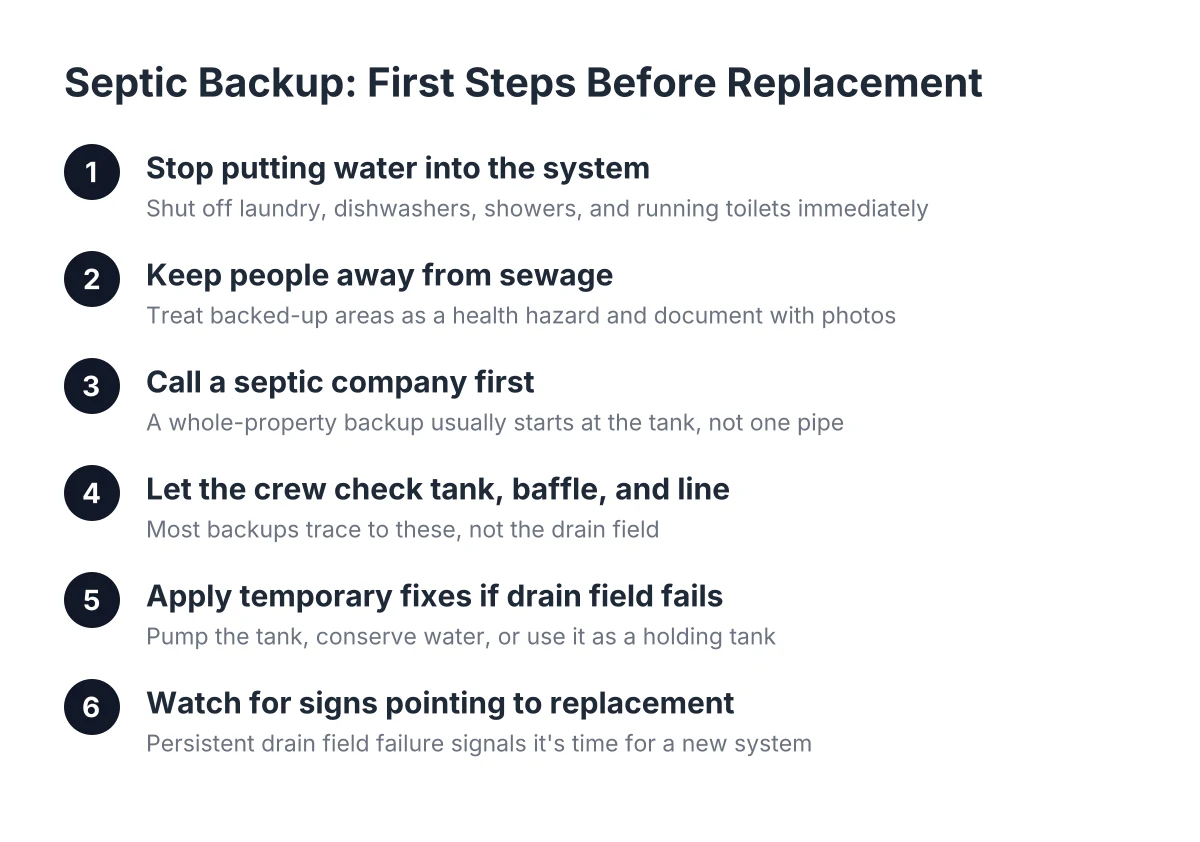
Sewage is coming up in the tub, a tenant is texting photos of a wet spot in the yard, or the health inspector just flagged your property. You need emergency septic backup solutions right now, but here is the part most articles skip: a backup does not automatically mean your septic system is dead. A septic backup temporary fix is often all that stands between a minor expense and full system replacement. Many backed-up systems in Hesperia get back to normal with a pump-out and a minor fix. Some need full replacement. The honest answer is that you often cannot know which one you have until the tank is opened and inspected, and anyone who quotes you a new system over the phone before looking is guessing.
This guide walks through what to do in the first hours of a backup, the temporary measures that buy you time, and the specific signs that tell you replacement is truly on the table. It is written for property owners who are not always on-site, including landlords and small business operators in the High Desert, as well as homeowners dealing with their first septic emergency.
Step 1: Stop Putting Water Into the System
The single most useful thing you can do in the first ten minutes costs nothing. Stop all water use. Every gallon that goes down a drain has to go somewhere, and right now that somewhere is your floor or your yard.
Shut off laundry, dishwashers, and showers. If the property is a rental, call or text the tenants and tell them to hold off on water use until a crew arrives. According to the U.S. Environmental Protection Agency, a single leaky or running toilet can push as much as 200 gallons of extra water per day into a septic system. If a toilet is running, close its supply valve at the wall.
For a restaurant or commercial property, this is harder; you may need to limit operations for a few hours. However, continuing to run water into a backed-up tank turns a messy afternoon into contaminated flooring and a much bigger bill.
Step 2: Keep People Away From Sewage, Inside and Out
Raw sewage carries bacteria and should be treated as a health hazard, not just a mess. Keep kids, pets, and tenants away from any backed-up fixture or wet area in the yard. Do not try to mop up standing sewage with household towels you plan to keep.
In addition, if you are a landlord managing this remotely, document the situation. Ask the tenant for photos with timestamps. That record helps you with habitability questions later, and it gives the septic crew useful information before they roll a truck.
Step 3: Call a Septic Company First, Not a Plumber
This step saves people real money. When the whole house backs up, or multiple drains slow down at once, the problem is almost always at the tank or beyond it, not in one pipe. A septic service company can open the tank, check the levels, and tell you where the blockage actually is.
A plumber makes sense when one fixture is clogged and everything else drains fine. For a whole-property backup on a septic system, calling a plumber first often means paying for a service call that ends with "you need your tank pumped." Start with the septic crew; if they confirm the tank is fine and the clog is in your house plumbing, then bring in a plumber.
In Hesperia and the surrounding High Desert, that call usually means emergency septic pumping plus an inspection while the tank is open. If nobody knows where the tank is, which is common on rental properties and land bought without records, septic tank locating is part of the same visit.
Step 4: Understand What the Crew Checks Before Anyone Says "Replace"
A backup has a short list of likely causes, and a good crew works through them in order. Here is the diagnostic sequence that should happen before the word replacement enters the conversation:
- Tank level. Is the tank simply full? Most emergency backup calls trace back to a tank that went years past its service interval, letting sludge and scum build up until wastewater had nowhere to go. A pump-out fixes this.
- Inlet baffle. According to the Washington State Department of Health, a clogged inlet baffle is a common cause of septic backups and should be one of the first things checked. This is a minor repair, not a system failure.
- The line between house and tank. Roots, grease, or a sag in the pipe can block flow. Again, fixable without touching the drain field.
- The drain field itself. If the tank is at a normal level after pumping but water will not leave it, or the ground over the field is soggy and smells, the drain field is the suspect. This is where replacement conversations legitimately begin.
A conventional system has two main components, the septic tank and the drain field, according to the U.S. Environmental Protection Agency. Problems in the first three items above live in or before the tank and rarely require replacement. Only the fourth points toward major work.
Step 5: Quick Temporary Fixes for Backups When the Drain Field Fails
Suppose the crew confirms the bad news: the drain field is saturated and not absorbing water the way it should. Even then, you do not have to sign for a new system that afternoon. There are legitimate short-term measures that keep a property usable while you plan, permit, and budget.
- Pump the tank and conserve hard. Pumping empties the tank and resets the clock. With strict water conservation, shorter showers, spaced-out laundry, fixed leaks, a household can often run for a stretch on a freshly pumped tank even with a weak drain field.
- Use the tank as a temporary holding tank. When a drain field has failed and replacement is not immediate, scheduling periodic pump-outs and treating the tank as a holding tank is a recognized stopgap. It costs money each visit, but it keeps the property habitable while permits and contractors line up.
- Rest the field. Soil sometimes recovers partially if you cut the load on it. Combined with pumping, reduced flow gives a marginal field its best chance.
- Consider bacterial or enzyme treatments cautiously. These are sometimes tried on a flagged drain field before committing to replacement. Results vary, and health departments do not accept them as a permanent fix for a failed absorption system. Treat them as a maybe, not a plan.
These emergency septic backup solutions are bridges, not destinations. If the field has truly failed, the endpoint is replacement, and the local health department will require a real fix rather than additives. The value of the bridge is time: time to get a San Bernardino County permit, a soil evaluation, and a fair price instead of a panic decision.
Step 6: Know the Signs That Point Past Temporary Fixes to Replacement
Replacement becomes the honest recommendation when backups repeat after proper pumping and the drain field cannot be revived. Watch for this pattern: the tank gets pumped, everything works for a few weeks or months, then the same slow drains and gurgling return. That cycle usually means wastewater is not leaving the tank because the soil absorption area has failed. A septic backup temporary fix only works if the underlying cause is temporary; when the drain field is exhausted, no amount of pumping or conservation will bring it back.
Other signals include standing water or lush green strips over the drain field in an otherwise dry High Desert yard, sewage odor outdoors that returns after pumping, and a tank that refills with groundwater shortly after being emptied. Septic systems also tend to fail suddenly rather than announce themselves gradually, which is why the first backup often feels like it came from nowhere.
Cost context matters here. The EPA estimates septic repair or replacement typically runs between $5,000 and $15,000, far more than routine pumping. That gap is exactly why you should insist on the diagnostic steps above before agreeing to major work, and it is also why repeated emergency pump-outs stop making financial sense once a field is confirmed dead. At some point the holding-tank strategy costs more per year than financing the fix. When the numbers reach that crossover, septic system replacement is the cheaper path, not the expensive one.
One honest limitation: no article can tell you from a distance whether your specific field is recoverable. Soil conditions, system age, and how the property is used all matter, and in 2026 San Bernardino County permitting and soil testing requirements shape what a replacement even looks like on your lot. Get an on-site inspection before committing either way.
Step 7: Set Up the System So the Next Emergency Does Not Happen
Once the immediate crisis is handled, put the system on a schedule instead of waiting for the next backup. According to the U.S. Environmental Protection Agency, the average household should have its septic system inspected at least every three years, and Penn State Extension notes that an active family of four generally benefits from pumping every two to three years.
For non-residential operators, the same logic applies with different intervals. A restaurant grease trap on an inspector's radar, an RV holding tank before a season of trips, or a rental property you manage from another city all run better on a standing service arrangement than on emergency calls. Say you own a Hesperia rental and the tenants report slow drains every eighteen months; in that scenario, a scheduled pumping and inspection rhythm costs less than the pattern of after-hours emergencies, tenant complaints, and cleanup it replaces.
More than one in five U.S. households depend on septic or small cluster systems, according to the U.S. Environmental Protection Agency, and the ones that avoid emergencies are mostly the ones on a schedule. The best of all emergency septic backup solutions is the maintenance plan that keeps you from needing one.
The Bottom Line for Hesperia Property Owners
A backup is a symptom, not a diagnosis. Stop the water, keep people clear, and get a septic crew to open the tank before anyone talks replacement. Most backups resolve with pumping or a minor fix like a cleared inlet baffle. When the drain field has genuinely failed, temporary measures like a septic backup temporary fix, conservation, scheduled pump-outs, and resting the field buy you the time to replace it on your terms instead of in a panic. That is the difference between an expensive weekend and an expensive mistake.
If you need your septic tank serviced, Hesperia Septic can help.
Prefer to talk it through? Call (760) 249-7872 — a quick call is usually the fastest way to get a straight answer for your situation.