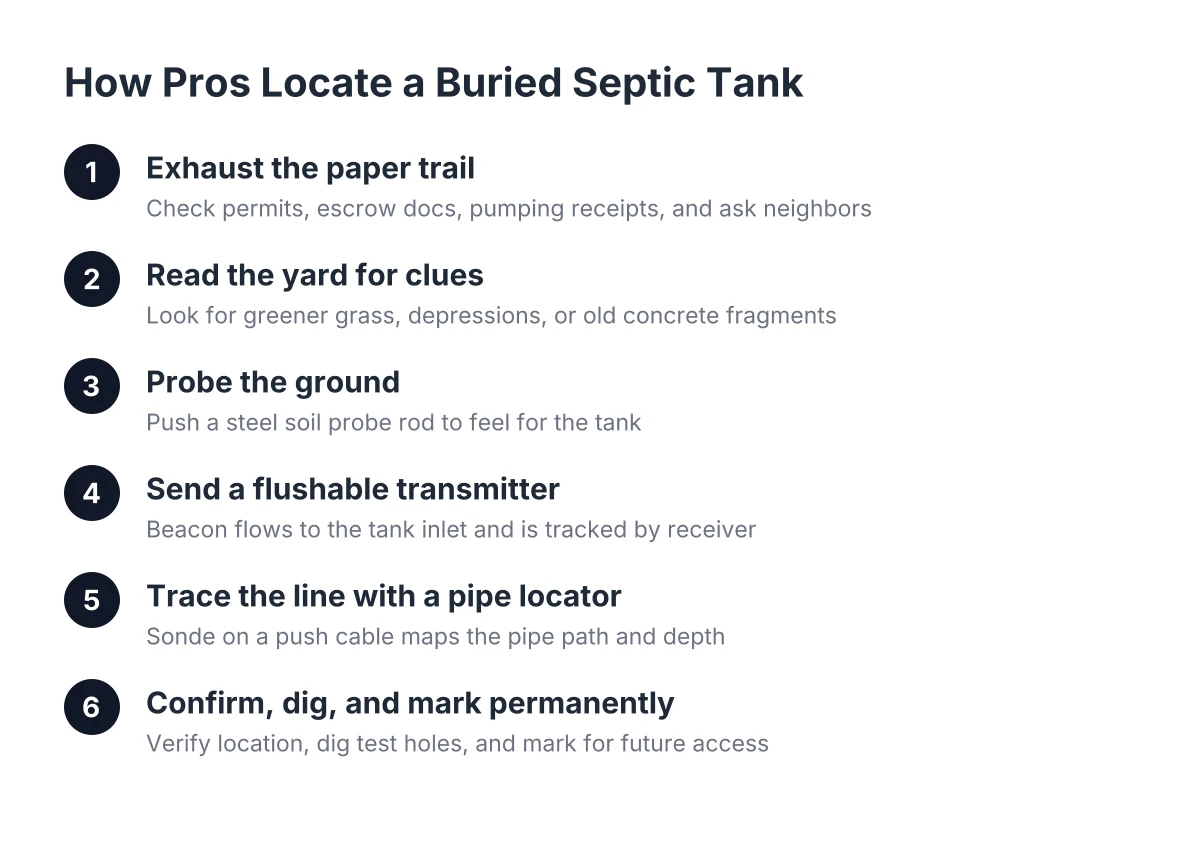
If you own a Hesperia property with no septic records, the fastest path to a found tank is knowing what septic tank locating equipment the pros actually use and how each tool works. Older High Desert homes often changed hands three or four times before anyone thought to save a site map. The county may have nothing on file. That leaves you with a buried concrete tank somewhere in the yard and no lid in sight. This guide walks through the equipment step by step, in the order a professional crew typically uses it, so you know what to expect and how to help the process go faster.
Step 1: Exhaust the Paper Trail Before Anyone Powers Up a Locator
First, check every record source you can reach. Equipment is the answer when paperwork fails, but paperwork is free and sometimes fast.
Look for these before scheduling a locate:
- The property's original permit or "as-built" drawing from San Bernardino County Environmental Health
- Home inspection or escrow documents from when you bought the house
- Receipts from any past septic tank pumping visit; pumpers often note lid location
- A previous owner or longtime neighbor who remembers where the truck parked
Suppose you bought a 1978 ranch house off Ranchero Road five years ago and the seller handed you nothing. In that scenario, a county records request might turn up a rough sketch, or it might turn up empty. Either way, gather what exists. Even a partial drawing that shows which side of the house the tank sits on cuts locating time in half.
If the paper trail dies, move to the physical clues, then the equipment.
Step 2: Read the Yard the Way a Locator Tech Does
Next, walk the property and note the signs a professional looks for before unloading a single tool. This step costs nothing and often narrows the search to a 200-square-foot patch.
Watch for:
- The point where the main sewer line exits the house, usually visible in the crawl space or at a cleanout
- A patch of grass or weeds that grows greener or faster than the rest, common even in dry High Desert yards
- A shallow depression or slight mound where soil settled over the tank after backfill
- Old concrete fragments, riser rings, or a suspicious square of different-colored dirt
The tank almost always sits along a straight line from where the sewer pipe leaves the house, typically 5 to 25 feet out. Mark that line with stakes or flags. Every tool in the next steps works faster when the search area is already narrow.
Step 3: Probe the Ground With a Soil Probe Rod
A soil probe is the simplest piece of septic tank locating equipment and often the first one out of the truck. It is a steel rod, usually four to five feet long, with a T-handle and sometimes a slightly bulged tip.
The technician pushes the probe into the soil every couple of feet along the suspected line. Dirt gives way with steady resistance. A septic tank made of concrete stops the rod cold with a hard, flat clunk you can feel in your hands. Fiberglass and plastic tanks give a duller thud, so an experienced hand matters.
However, Hesperia's soil creates a wrinkle here. Our decomposed granite and caliche layers can be hard enough to stop a probe on their own, which produces false positives. A pro learns to tell the difference between a caliche shelf and a tank lid by the sound and the way the rod skips. This is one reason a locate that looks simple on YouTube goes faster with someone who probes High Desert dirt every week.
One caution: probing blind near a steel tank or an old cesspool can be risky, since corroded lids can collapse. If your home predates the 1970s and you have no idea what is down there, let a professional do the probing.
Step 4: Send a Flushable Transmitter Down the Line
When probing alone does not settle it, the crew moves to electronic septic tank locating equipment, and the workhorse is the flushable transmitter. This is a small waterproof beacon, about the size of a large pill capsule, that broadcasts a radio signal at a set frequency.
Here is how a typical crew uses it:
- The technician flushes the transmitter down a toilet or drops it in through a cleanout.
- Water carries it along the sewer line toward the tank.
- Above ground, a handheld receiver picks up the signal and shows signal strength.
- The tech walks the yard, following the strongest reading until the transmitter stops moving.
- Where it stops is the tank inlet, and the crew marks that spot with paint or a flag.
The transmitter usually parks itself at the tank's inlet baffle because the flow slows down there. From the inlet, the tech can estimate where the lid and the outlet sit based on typical tank layouts, then confirm with the probe from Step 3. As a result, digging is limited to one or two small test holes instead of trenching up half the yard.
Step 5: Trace the Sewer Line With a Pipe Locator and Sonde
Some properties fight back. Maybe the sewer line takes an unexpected turn around an old addition, or the transmitter hangs up on a root intrusion before reaching the tank. For those jobs, crews use a sonde on a push cable, paired with a pipe locator wand.
A sonde works like the flushable transmitter, except it rides on the end of a semi-rigid cable the technician pushes through the line by hand. The receiver above ground tracks the sonde foot by foot, so the tech can paint the entire path of the pipe across the yard, including every bend. When the cable hits the tank baffle, the final signal marks the tank wall.
In addition, this method tells you the depth of the line at each point, which matters before a remodel or a fence post project. If you are locating the tank because you plan to pour a slab, add a garage, or run irrigation, ask the crew to mark the full pipe run, not just the lid. It is the same visit and saves you a second locate later.
Step 6: Confirm the Tank Location, Dig, and Mark It Permanently
Finally, the crew confirms and exposes. Electronic tools narrow the target to a small circle; the shovel does the rest. The technician hand-digs a test hole at the marked spot, usually 12 to 36 inches down in this area, until steel or septic tank concrete appears.
Once the lid is exposed, this is the moment to get the most from the visit:
- Photograph the open hole with the house in the frame for reference
- Measure from two fixed points, such as a house corner and a fence post, and write the distances down
- Ask about adding a riser, which brings the lid access to grade so no one ever digs for it again
- Have the tank pumped and inspected while it is open, since the hardest part of the job is already done
The EPA recommends the average household have its septic system inspected at least once every three years, and more than one in five U.S. households rely on septic or small cluster systems. A found and marked tank is what makes that schedule realistic. Nobody keeps up with maintenance on a tank they cannot find.
Why Professional Equipment Beats a Metal Detector for Tank Locating
A common question from homeowners: can a metal detector from the garage find the tank? Usually not. Most tanks in the Hesperia area are concrete, and concrete gives a metal detector nothing to hit unless the lid has steel rebar or handles near the surface. Detectors also chirp on every buried nail, pipe scrap, and bottle cap in a yard that has seen fifty years of projects.
By contrast, a professional septic tank locating service pairs the transmitter, the receiver, and local digging experience into one visit. The equipment finds the tank; the experience keeps the crew from probing through an inlet pipe or digging into an abandoned cesspool. On a property with no records, that combination is the difference between two marked flags in the yard and a weekend of random holes.
There is a limit worth naming. Locating tells you where the tank is, not what condition it is in. A tank with a cracked lid, a failed baffle, or a saturated drain field needs an inspection to catch, and repair or replacement runs far beyond routine service; the EPA estimates $5,000 to $15,000 for repair or replacement, compared with routine pumping that Angi data puts at a $427 average. Finding the tank is Step 1 of staying on the cheap side of that math.
Keep the Location From Getting Lost Again
You did the locate once. Make sure the next owner, or future you, never has to repeat it. Sketch a simple site map with your two measured distances, store the photos with your house documents, and note the date of the pumping that followed. Then put the next service on the calendar so the tank gets attention on a schedule instead of during an emergency, which is exactly the outcome a maintenance-minded homeowner is after.
If you need your septic tank serviced, Hesperia Septic can help.