If you own a commercial building in Hesperia that runs on a septic system, a commercial property septic inspection is not optional paperwork. Buyers want one before they sign. Lenders often want one before they fund. And San Bernardino County wants documented proof that the system serving your building actually works. The problem is that most business owners have never seen how one of these inspections runs, so they walk into a sale, refinance, or permit review blind. Understanding the commercial septic inspection process is essential to navigating that uncertainty.
This guide walks through the process step by step, the way it actually happens on High Desert properties. Follow it and you will know what the inspector is looking for, what the report needs to say, and where deals usually stall.
Step 1: Confirm You Actually Need an Inspection
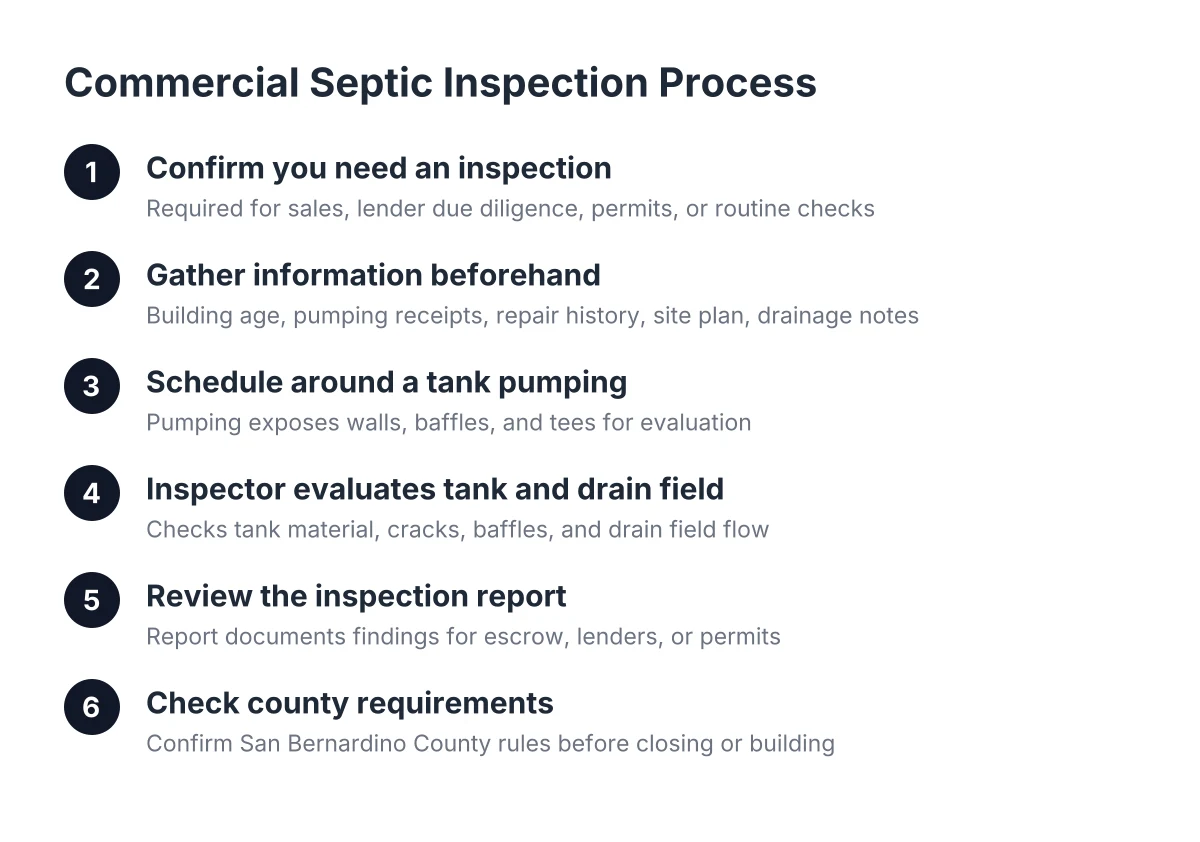
A commercial property septic inspection is typically needed in four situations: you are selling the property, a buyer or lender is doing due diligence, you are pulling a permit for a change of use or expansion, or you want a routine health check on a system that handles daily business wastewater.
Hesperia sits outside centralized sewer coverage in many areas, so plenty of commercial parcels here run on septic. Homes and buildings connected to city sewer do not need this; septic tanks serve areas without centralized sewer service, according to the Environmental Finance Center Network. If you are not sure which one you have, that is the first thing to confirm. A septic tank locating service can find and map a system when the records are missing, which is common on older High Desert commercial lots.
In addition, timing matters. The U.S. Environmental Protection Agency recommends a professional inspection at least once every three years for average systems, and once a year for alternative systems with pumps, float switches, or other mechanical parts. Commercial systems often carry heavier loads than a house, so treating those intervals as a ceiling rather than a target is the safer read.
Step 2: Gathering Information Before Your Commercial Septic Inspection Process
Before anyone opens a lid, gather what you know. An inspector will ask for the same preliminary information every time, and having it ready shortens the visit and strengthens the report.
Collect these items:
- The age of the building and, if known, the year the septic system went in
- Any past pumping receipts or service records
- Repair history, including drain field work or tank lid replacements
- A site plan or any drawing showing where the tank and drain field sit
- Notes on the property's slope and drainage, since a low spot that collects runoff behaves differently than a dry hilltop pad
Suppose you bought a small retail strip on the west side of Hesperia five years ago and the previous owner left nothing behind. In that scenario, expect the inspection to take longer and cost more, because locating the tank and confirming the layout becomes part of the job. That is normal, not a red flag, but you should budget for it.
Step 3: Schedule the Inspection Around a Tank Pumping
Here is the part that surprises most commercial owners: a thorough inspection includes pumping the tank. An inspector cannot check the tank's walls, baffles, and tees through three feet of sludge. Pumping first exposes the structure so the inspector can evaluate it, and photos of the empty tank interior become part of the documentation. The commercial septic inspection process requires this coordination to produce a credible report.
Therefore, book septic tank pumping and the inspection as one coordinated visit rather than two separate appointments. This also matters for the report itself. A "looks fine from the top" inspection done without pumping is the kind of thin report that escrow officers and lenders bounce back.
One honest trade-off: pumping adds cost to the visit. For a rough sense of scale, Angi reports that septic tank pumping averages $427, with a range from $250 to $1,250 or more depending on tank size and location. Commercial tanks often sit at the larger end. Treat those figures as ballpark context, not a quote.
Step 4: What the Inspector Evaluates During the Commercial Septic Inspection Process
During the commercial septic inspection process, the inspector evaluates both halves of the system. A conventional septic system has two main components, the septic tank and the drain field, according to the U.S. Environmental Protection Agency. Each gets its own set of checks.
At the tank
Expect the inspector to confirm the tank material, usually concrete on older High Desert installs, and look for cracks, deteriorated baffles, and clogged inlet or outlet tees. Photos of the empty tank interior document structural integrity. The inspector also notes whether the tank shows signs of ever having run full or backed up, since staining and residue lines tell that story.
At the drain field
Next comes a function and flow test. Water runs into the system while the inspector watches how the drain field accepts it. Slow acceptance, surfacing wastewater, or wet ground over the leach lines all point to a field problem, which is a bigger conversation than a tank issue. High Desert soil cuts both ways here; sandy ground often drains well, but compacted caliche layers and years of grease or heavy commercial use can choke a field that looks fine from the surface.
For example, a restaurant with an undersized or neglected grease trap can push fats into the septic side and quietly damage the drain field for years. If your building includes food service, the grease trap gets looked at too, and grease trap pumping records help your case.
Step 5: Understand What Goes Into the Inspection Report
A septic inspection report documents the property address, the date of service, the work performed, the tank material and condition, whether the tank has ever run full, the state of the tees and baffles, and whether any maintenance or problems turned up. Photos of the tank interior back up the written findings.
This is the document your escrow officer, lender, or buyer actually reads. A report built to that standard travels well through a transaction because it answers the questions those parties ask in order: Is the system functional today? Has it failed before? What is its remaining condition?
However, understand what the report is not. It is a snapshot of system condition on the day of the inspection, not a warranty on future performance. A drain field can pass a flow test in March and struggle under a doubled tenant load in August. No honest inspector will promise otherwise, and any report that reads like a guarantee should make you cautious rather than comfortable.
Step 6: Check County Requirements Before You Close or Build
Requirements for septic systems vary by locality, so verify what San Bernardino County expects for your specific situation rather than assuming rules carry over from somewhere else. This matters most in three cases.
First, new installations and replacements involve the county directly. A percolation test must be dug and performed before installing a septic system to confirm the soil drains properly, according to University of Nebraska-Lincoln Extension, and a local health department inspection typically follows as part of the installation process, per the Caroline County Health Department. County inspectors generally check leach line depth and length before allowing backfill, and a final county inspection signs the system off before use.
Second, failures trigger reporting. If a system has failed, county regulations generally require permits and health department notification before repair attempts, including any restoration products. Skipping that step can complicate a later sale badly.
Third, transactions and permits may require current documentation. Many service providers file a standardized report with the county for every tank pumped and use a similar format for real estate transactions, which is exactly why a properly documented commercial property septic inspection carries weight with lenders and escrow. As of 2026, confirm current county requirements before you schedule, since local rules change.
Step 7: Act on the Findings Before They Become an Emergency
Finally, do something with the results. A clean report goes in your property file and resets your maintenance clock. A report flagging a cracked baffle or a sluggish drain field is a to-do list, and the cheapest time to handle it is now, while it is a scheduled repair instead of a sewage backup during business hours.
You have probably heard someone say never buy a house with a septic tank. That advice is wrong, and the same logic applies to commercial property. Septic is not a defect; it is infrastructure that needs documented upkeep. More than one in five U.S. households already depend on septic or small cluster systems, according to the U.S. Environmental Protection Agency, and in California about 10 percent of homes run on them. What actually gets owners in trouble is not the tank, it is the missing records and the skipped septic system inspection that let a small problem grow into a failed field.
The Hesperia owners who never face a Saturday-morning backup are the ones who treat inspection like they treat a roof check: scheduled, documented, and handled by a local crew that knows how High Desert soil and older tanks behave. Get the inspection, keep the report, and your next sale, refinance, or permit review starts from proof instead of guesswork.
If you need your septic tank serviced, Hesperia Septic can help.
Prefer to talk it through? Call (760) 249-7872 — a quick call is usually the fastest way to get a straight answer for your situation.