If your septic system is failing and a pump-out no longer fixes the problem, the next decision is what kind of tank goes in the ground. Most property owners comparing concrete plastic septic tanks want two answers: which one lasts longer, and which one costs less over time. This comparison walks through both, with an honest look at when you actually need a new tank versus when pumping or a smaller repair solves it. That matters whether you own a rental in Hesperia, run a restaurant with a grease trap, or manage an RV park with holding tanks out here in the High Desert.
First: Do You Actually Need a New Tank?
A new septic tank is only necessary when the tank itself has failed, meaning it is cracked, collapsed, corroded through, or leaking sewage into the soil. Backups, slow drains, and odors are usually caused by a full tank, a clogged line, or a drain field problem, none of which require replacing the tank.
This is worth stating up front because tank replacement is expensive. According to U.S. Environmental Protection Agency estimates, septic repair or replacement typically runs $5,000 to $15,000. Routine septic tank pumping, by contrast, averages $427 according to Angi data, with a typical range of $250 to $1,250 depending on tank size and location. Nobody should pay for a new tank when a pump truck and an hour of work would have fixed it.
Signs that point to pumping or minor repair, not replacement:
- Drains slowed down gradually and the tank has not been pumped in years
- Sewage odor near the tank lid but no soggy ground over the drain field
- One backup event after heavy water use, such as holiday guests or a full RV park weekend
- A broken baffle, riser, or lid, which can be replaced on its own
Signs that point toward tank or system replacement:
- The tank has visible cracks, or a pumping crew reports groundwater leaking in
- Sewage surfaces over the tank or drain field even shortly after pumping
- The tank is decades old concrete with corroded walls above the waterline
- A plastic tank has deformed, shifted, or floated out of position
An inspection settles the question. A crew that pumps the tank can look at the walls, baffles, and inlet and outlet once it is empty, which is the only reliable way to judge the tank's condition. If you are buying land in Hesperia with no septic records, that inspection is the first move, not a replacement quote.
How Concrete Plastic Septic Tanks Differ Underground
Concrete and plastic septic tanks do the same job in different ways. A concrete tank is a heavy precast box, usually several tons, that stays put through soil movement, traffic loads, and decades of use. A plastic tank, sometimes called a poly tank, is a molded lightweight vessel that resists corrosion but depends on correct backfill and anchoring to hold its shape.
That difference in weight drives almost everything else in this comparison: durability, installation cost, failure modes, and how each one handles High Desert soil conditions. Here is how they stack up criterion by criterion.
Durability: How Long Each Tank Lasts
A well-made concrete septic tank commonly lasts 40 years or more, and many exceed that. Plastic tanks are often rated for around 30 years, though their real lifespan depends heavily on installation quality. Overall septic system lifespan is usually limited by the drain field, not the tank, for either material.
Concrete's main enemy is the wastewater itself. Hydrogen sulfide gas above the waterline slowly eats at the concrete, and older or poorly mixed tanks can corrode, spall, and eventually crack. When a pumping crew tells you they can see rebar or daylight through the wall, that concrete tank is done.
Plastic fails differently. The material does not corrode, but the tank can deform under soil pressure, crack if the backfill was rocky or compacted badly, or float upward when groundwater or a saturated drain field pushes on an empty tank. Floating is less common in Hesperia's dry conditions than in wet climates, but a monsoon-soaked trench during installation can still cause trouble.
For heavy use, concrete has the edge. A restaurant grease trap or a commercial holding tank that gets pumped on a monthly or quarterly schedule takes a lot of loading and unloading. Concrete handles the repeated empty-and-fill cycle and the weight of service traffic above it better than most poly tanks do.
Cost: What Each Option Runs in 2026
Plastic tanks usually cost less to buy and install; concrete tanks usually cost less to own over decades. Septic tank cost breaks into three pieces: the tank itself, the excavation and delivery, and the long-term maintenance and repair picture.
On the purchase side, a plastic tank is cheaper at the counter and far cheaper to move. One person can shift a small poly tank by hand, so delivery does not require a crane truck. Concrete tanks need heavy equipment to set, which adds to the installed price and requires clear access for the truck.
However, the installed cost gap narrows fast. Plastic tanks need careful bedding, specific backfill material, and sometimes concrete anchors or deadman straps to prevent floating. Cutting corners on that work is the number one cause of early plastic tank failure, and doing it right costs money. Concrete goes in a plain excavated hole and sits there by its own weight.
Over a 30 to 40 year horizon, a concrete tank that never deforms or floats often ends up the cheaper choice, because you buy it once. A plastic tank installed correctly can match that, but a plastic tank installed poorly becomes a second septic system replacement bill a decade later. Either way, the full project falls inside that EPA range of $5,000 to $15,000 for most standard systems, with drain field work driving the high end.
Installation and Site Access in the High Desert
Site access often decides the concrete versus plastic question before durability or price does. A concrete tank requires a boom or crane truck to get within reach of the hole. On a tight commercial lot, a fenced rental yard, or an RV park with narrow interior roads, that access may not exist.
Plastic wins on difficult sites. Crews can carry a poly tank past a building, down a slope, or through a gate that no crane truck will ever fit through. For a cabin property or a back-lot holding tank, that flexibility can be the deciding factor.
Hesperia's soil cuts both ways. Sandy, well-draining desert soil is forgiving for plastic tanks because groundwater pressure is rarely constant. On the other hand, caliche layers and rocky spots make proper backfill harder, and rocky backfill against a plastic tank wall is a slow-motion crack. Concrete shrugs off rough backfill.
Permitting is the same either way. In San Bernardino County, septic work runs through county environmental health, and a new or replacement system needs a permit, a site evaluation, and often a percolation test before anything goes in the ground. Whether the design is a conventional septic system or an aerobic septic system for a tough lot, the tank material does not change the paperwork; the county cares about capacity, setbacks, and soil.
Which Tank Fits Commercial and Rental Properties?
For grease traps, holding tanks, and rental septic systems, concrete is usually the safer default because it tolerates heavy pumping schedules, vehicle traffic, and tenant neglect. Plastic makes sense for these properties mainly when access rules out a crane truck or when the tank sits far from anything heavy.
Consider a realistic Hesperia example. A restaurant owner gets flagged by the health inspector because the grease trap is overdue for pumping, then learns during the pump-out that the old tank is cracked. The replacement decision happens fast and under compliance pressure. A concrete interceptor near the kitchen, where delivery trucks cross the lot, is the standard call because a plastic tank under traffic load is a liability.
A landlord with a single rental on septic faces a different math. Tenants will not report slow drains early, so the tank needs to survive irregular maintenance. Concrete's tolerance for abuse, plus risers that bring the lid to grade so a pumping crew can service it without the landlord on site, keeps the property out of habitability disputes.
RV parks and campgrounds split the difference. Dump station tanks and holding tanks that see constant pump-outs favor concrete for the loading cycles. Remote holding tanks at individual sites, where no truck drives overhead, are a reasonable place for plastic.
One trade-off applies to everyone: no article can evaluate your specific soil, groundwater, or access. Before committing to either material, have the site evaluated by a septic professional and confirm requirements with San Bernardino County environmental health, because a tank that is right for the lot next door can be wrong for yours.
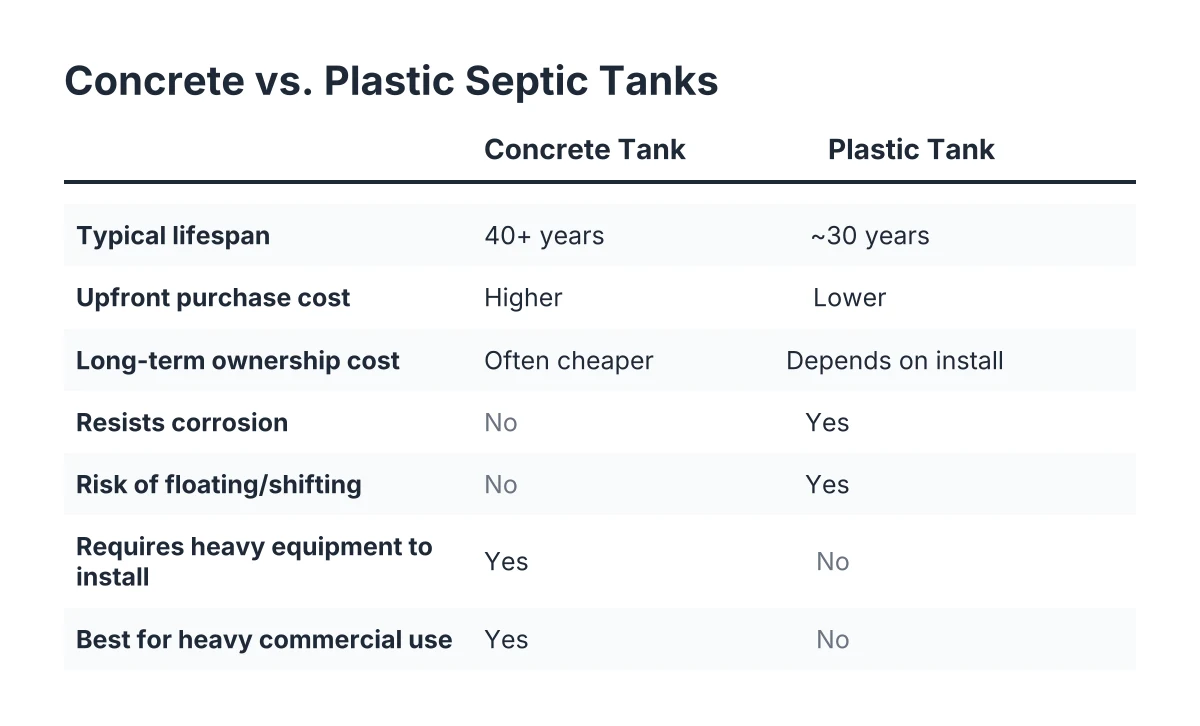
Quick Side-by-Side on Concrete Plastic Septic Tanks
Here is the short version of how concrete plastic septic tanks compare on the factors that matter most:
- Lifespan: Concrete often 40+ years; plastic around 30 years when installed correctly
- Upfront cost: Plastic lower to buy and deliver; concrete higher due to weight and crane placement
- Long-term cost: Concrete usually cheaper per decade; plastic depends on installation quality
- Failure mode: Concrete corrodes and cracks slowly; plastic deforms, cracks from bad backfill, or floats
- Site access: Plastic fits tight lots and hand-carry sites; concrete needs truck access
- Traffic and heavy use: Concrete handles vehicle loads and frequent pump-outs; plastic should stay away from both
- Buoyancy: Concrete stays put empty; plastic needs anchoring in wet or saturated ground
- Repairability: Concrete baffles and lids can often be repaired; a compromised plastic tank usually gets replaced
How to Choose
Start with whether you need a new tank at all. Get the tank pumped and inspected first; if the walls, baffles, and inlet are sound, maintenance is the answer, not replacement. The EPA recommends a professional inspection at least once every three years for average households, and once a year for systems with pumps or mechanical parts, which catches most problems before they become excavation projects.
If the tank truly has failed, let three questions decide the material. First, can a crane truck reach the hole? If not, plastic may be your only practical option. Second, will anything heavy ever cross the tank, including delivery trucks, RVs, or equipment? If yes, lean concrete. Third, how long do you plan to own the property? A long hold favors concrete's lifespan; a shorter hold may not justify the higher installed cost.
For most Hesperia commercial accounts, rentals, and long-term owners, concrete earns its price. For tight-access sites and lighter-duty holding tanks, a properly bedded and anchored plastic tank does the job. Either choice only works as long as it gets pumped on schedule, so pick the tank, then pick a local crew that will keep it on a service calendar without you having to babysit it.
If you need your septic tank serviced, Hesperia Septic can help.