Tag: inlet baffle

  • Emergency Septic Backup Solutions: Temporary Fixes Before Replacement in Hesperia

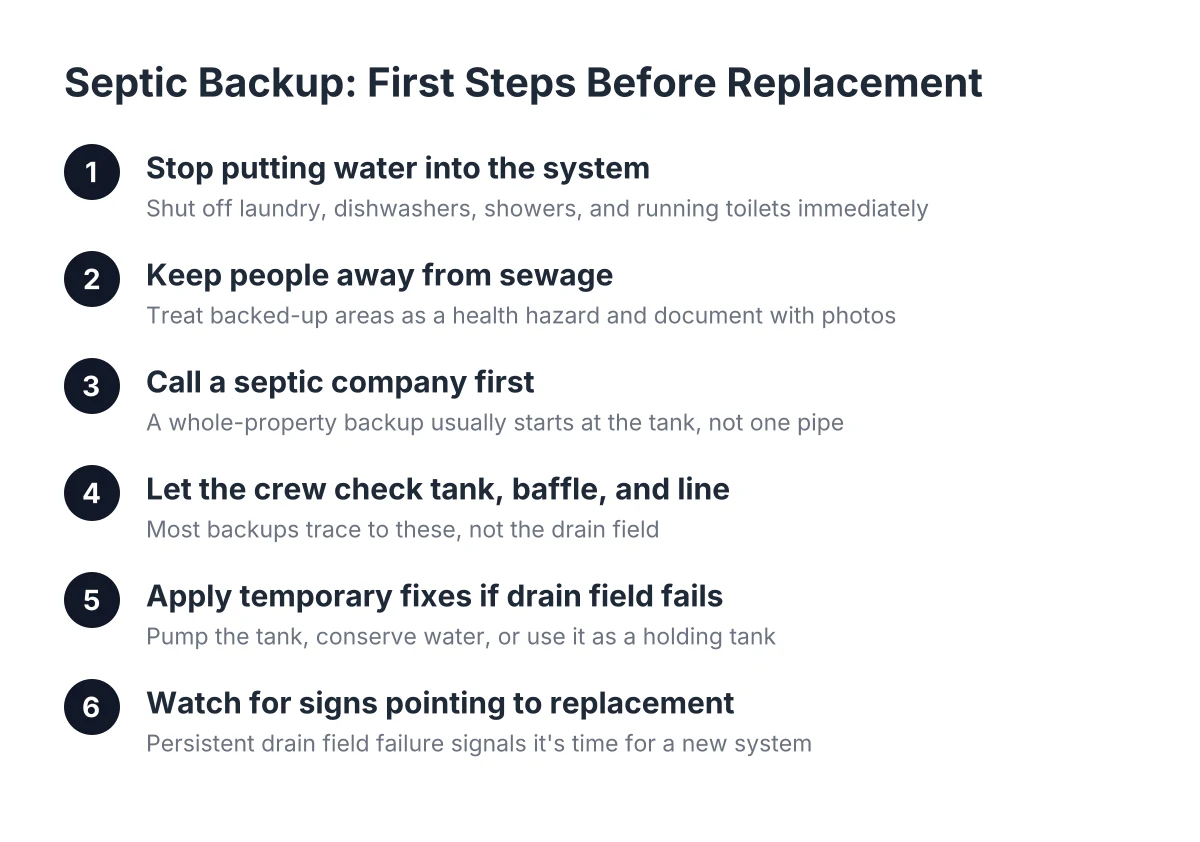
    Steps for handling a septic backup temporary fix before replacement in Hesperia
    The recommended sequence for handling a septic backup before assuming full replacement is needed.

    Sewage is coming up in the tub, a tenant is texting photos of a wet spot in the yard, or the health inspector just flagged your property. You need emergency septic backup solutions right now, but here is the part most articles skip: a backup does not automatically mean your septic system is dead. A septic backup temporary fix is often all that stands between a minor expense and full system replacement. Many backed-up systems in Hesperia get back to normal with a pump-out and a minor fix. Some need full replacement. The honest answer is that you often cannot know which one you have until the tank is opened and inspected, and anyone who quotes you a new system over the phone before looking is guessing.

    This guide walks through what to do in the first hours of a backup, the temporary measures that buy you time, and the specific signs that tell you replacement is truly on the table. It is written for property owners who are not always on-site, including landlords and small business operators in the High Desert, as well as homeowners dealing with their first septic emergency.

    Step 1: Stop Putting Water Into the System

    The single most useful thing you can do in the first ten minutes costs nothing. Stop all water use. Every gallon that goes down a drain has to go somewhere, and right now that somewhere is your floor or your yard.

    Shut off laundry, dishwashers, and showers. If the property is a rental, call or text the tenants and tell them to hold off on water use until a crew arrives. According to the U.S. Environmental Protection Agency, a single leaky or running toilet can push as much as 200 gallons of extra water per day into a septic system. If a toilet is running, close its supply valve at the wall.

    For a restaurant or commercial property, this is harder; you may need to limit operations for a few hours. However, continuing to run water into a backed-up tank turns a messy afternoon into contaminated flooring and a much bigger bill.

    Step 2: Keep People Away From Sewage, Inside and Out

    Raw sewage carries bacteria and should be treated as a health hazard, not just a mess. Keep kids, pets, and tenants away from any backed-up fixture or wet area in the yard. Do not try to mop up standing sewage with household towels you plan to keep.

    In addition, if you are a landlord managing this remotely, document the situation. Ask the tenant for photos with timestamps. That record helps you with habitability questions later, and it gives the septic crew useful information before they roll a truck.

    Step 3: Call a Septic Company First, Not a Plumber

    This step saves people real money. When the whole house backs up, or multiple drains slow down at once, the problem is almost always at the tank or beyond it, not in one pipe. A septic service company can open the tank, check the levels, and tell you where the blockage actually is.

    A plumber makes sense when one fixture is clogged and everything else drains fine. For a whole-property backup on a septic system, calling a plumber first often means paying for a service call that ends with "you need your tank pumped." Start with the septic crew; if they confirm the tank is fine and the clog is in your house plumbing, then bring in a plumber.

    In Hesperia and the surrounding High Desert, that call usually means emergency septic pumping plus an inspection while the tank is open. If nobody knows where the tank is, which is common on rental properties and land bought without records, septic tank locating is part of the same visit.

    Step 4: Understand What the Crew Checks Before Anyone Says "Replace"

    A backup has a short list of likely causes, and a good crew works through them in order. Here is the diagnostic sequence that should happen before the word replacement enters the conversation:

    1. Tank level. Is the tank simply full? Most emergency backup calls trace back to a tank that went years past its service interval, letting sludge and scum build up until wastewater had nowhere to go. A pump-out fixes this.
    2. Inlet baffle. According to the Washington State Department of Health, a clogged inlet baffle is a common cause of septic backups and should be one of the first things checked. This is a minor repair, not a system failure.
    3. The line between house and tank. Roots, grease, or a sag in the pipe can block flow. Again, fixable without touching the drain field.
    4. The drain field itself. If the tank is at a normal level after pumping but water will not leave it, or the ground over the field is soggy and smells, the drain field is the suspect. This is where replacement conversations legitimately begin.

    A conventional system has two main components, the septic tank and the drain field, according to the U.S. Environmental Protection Agency. Problems in the first three items above live in or before the tank and rarely require replacement. Only the fourth points toward major work.

    Step 5: Quick Temporary Fixes for Backups When the Drain Field Fails

    Suppose the crew confirms the bad news: the drain field is saturated and not absorbing water the way it should. Even then, you do not have to sign for a new system that afternoon. There are legitimate short-term measures that keep a property usable while you plan, permit, and budget.

    • Pump the tank and conserve hard. Pumping empties the tank and resets the clock. With strict water conservation, shorter showers, spaced-out laundry, fixed leaks, a household can often run for a stretch on a freshly pumped tank even with a weak drain field.
    • Use the tank as a temporary holding tank. When a drain field has failed and replacement is not immediate, scheduling periodic pump-outs and treating the tank as a holding tank is a recognized stopgap. It costs money each visit, but it keeps the property habitable while permits and contractors line up.
    • Rest the field. Soil sometimes recovers partially if you cut the load on it. Combined with pumping, reduced flow gives a marginal field its best chance.
    • Consider bacterial or enzyme treatments cautiously. These are sometimes tried on a flagged drain field before committing to replacement. Results vary, and health departments do not accept them as a permanent fix for a failed absorption system. Treat them as a maybe, not a plan.

    These emergency septic backup solutions are bridges, not destinations. If the field has truly failed, the endpoint is replacement, and the local health department will require a real fix rather than additives. The value of the bridge is time: time to get a San Bernardino County permit, a soil evaluation, and a fair price instead of a panic decision.

    Step 6: Know the Signs That Point Past Temporary Fixes to Replacement

    Replacement becomes the honest recommendation when backups repeat after proper pumping and the drain field cannot be revived. Watch for this pattern: the tank gets pumped, everything works for a few weeks or months, then the same slow drains and gurgling return. That cycle usually means wastewater is not leaving the tank because the soil absorption area has failed. A septic backup temporary fix only works if the underlying cause is temporary; when the drain field is exhausted, no amount of pumping or conservation will bring it back.

    Other signals include standing water or lush green strips over the drain field in an otherwise dry High Desert yard, sewage odor outdoors that returns after pumping, and a tank that refills with groundwater shortly after being emptied. Septic systems also tend to fail suddenly rather than announce themselves gradually, which is why the first backup often feels like it came from nowhere.

    Cost context matters here. The EPA estimates septic repair or replacement typically runs between $5,000 and $15,000, far more than routine pumping. That gap is exactly why you should insist on the diagnostic steps above before agreeing to major work, and it is also why repeated emergency pump-outs stop making financial sense once a field is confirmed dead. At some point the holding-tank strategy costs more per year than financing the fix. When the numbers reach that crossover, septic system replacement is the cheaper path, not the expensive one.

    One honest limitation: no article can tell you from a distance whether your specific field is recoverable. Soil conditions, system age, and how the property is used all matter, and in 2026 San Bernardino County permitting and soil testing requirements shape what a replacement even looks like on your lot. Get an on-site inspection before committing either way.

    Step 7: Set Up the System So the Next Emergency Does Not Happen

    Once the immediate crisis is handled, put the system on a schedule instead of waiting for the next backup. According to the U.S. Environmental Protection Agency, the average household should have its septic system inspected at least every three years, and Penn State Extension notes that an active family of four generally benefits from pumping every two to three years.

    For non-residential operators, the same logic applies with different intervals. A restaurant grease trap on an inspector's radar, an RV holding tank before a season of trips, or a rental property you manage from another city all run better on a standing service arrangement than on emergency calls. Say you own a Hesperia rental and the tenants report slow drains every eighteen months; in that scenario, a scheduled pumping and inspection rhythm costs less than the pattern of after-hours emergencies, tenant complaints, and cleanup it replaces.

    More than one in five U.S. households depend on septic or small cluster systems, according to the U.S. Environmental Protection Agency, and the ones that avoid emergencies are mostly the ones on a schedule. The best of all emergency septic backup solutions is the maintenance plan that keeps you from needing one.

    The Bottom Line for Hesperia Property Owners

    A backup is a symptom, not a diagnosis. Stop the water, keep people clear, and get a septic crew to open the tank before anyone talks replacement. Most backups resolve with pumping or a minor fix like a cleared inlet baffle. When the drain field has genuinely failed, temporary measures like a septic backup temporary fix, conservation, scheduled pump-outs, and resting the field buy you the time to replace it on your terms instead of in a panic. That is the difference between an expensive weekend and an expensive mistake.

    If you need your septic tank serviced, Hesperia Septic can help.


    Prefer to talk it through? Call (760) 249-7872 — a quick call is usually the fastest way to get a straight answer for your situation.
    Related Reading

  • How to Prevent Septic Clogs and Backups: Maintenance Steps That Actually Work

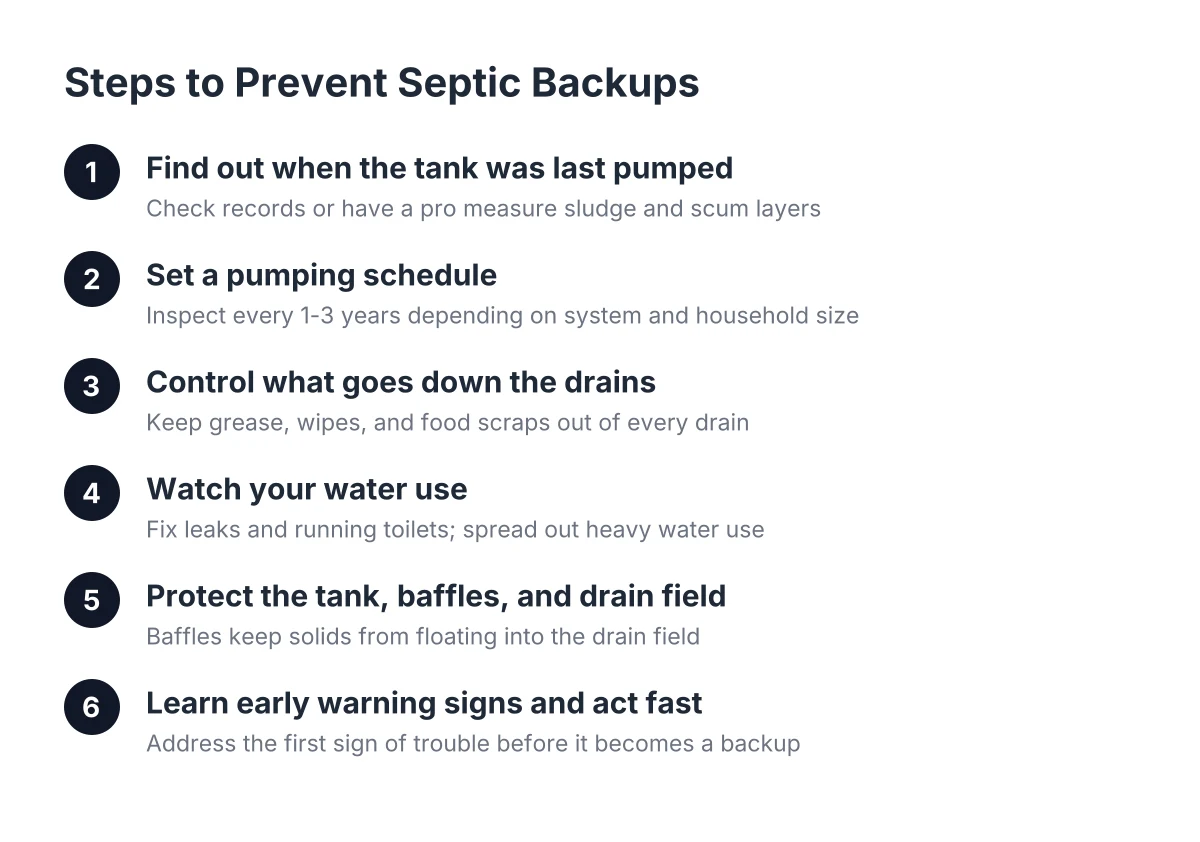
    Numbered steps showing how to prevent septic backups and tank clogs
    Following these maintenance steps in order helps prevent septic backups before they start.

    Most septic backups do not come out of nowhere. They build for months, usually because solids filled the tank or something went down a drain that should not have. The good news is that you can prevent septic backups with a short list of habits and a pumping schedule you set once and stop thinking about. This guide walks through the steps in order, with the common mistakes that cause problems for homeowners and small landlords in Hesperia and the High Desert.

    This matters more than most people realize. According to the U.S. Environmental Protection Agency, more than one in five U.S. households depend on individual septic systems or small community cluster systems to treat their wastewater. The same agency estimates septic repair or replacement typically costs $5,000 to $15,000, far more than routine pumping. Prevention is the cheap option.

    Step 1: Find Out When the Tank Was Last Pumped

    Start here, because everything else depends on it. The main way septic systems fail is slow and predictable: solids build up in the tank over years, then overflow into the drain field lines and clog them. Once drain field lines are clogged with solids, they usually cannot be cleaned out; they have to be replaced. Pumping on schedule is what stops that chain of events before it starts.

    If you just bought a house in Hesperia, check your closing documents for a septic inspection report or a pumping receipt. Ask the seller's agent if nothing turns up. For a rental property, check your own maintenance records and ask long-term tenants whether a pump truck has been out.

    However, if you cannot confirm a date, assume the tank is due. A septic service can open the lid, measure the sludge and scum layers, and tell you how full it actually is. That reading is more useful than any guess based on calendar years.

    Step 2: Strategies to Prevent Septic Backups

    A written schedule is the single best way to prevent septic backups. The U.S. Environmental Protection Agency recommends a professional inspection at least once every three years for the average household, and once a year for alternative systems with pumps, float switches, or other mechanical parts. For an active family of four, Penn State Extension notes that pumping every two to three years is generally advisable because of higher solids and liquid production.

    Your actual interval depends on tank size and how many people use the system. A retired couple can often go longer between pumpings than a four-person family or a fully occupied rental. The practical move:

    • Get the tank pumped and measured once to establish a baseline.
    • Ask the crew how fast solids are building, and set your interval from that.
    • Put the next service date on your calendar, or ask the septic company to track it.
    • Keep every receipt and inspection note in one folder per property.

    For landlords, that paper trail does double duty. It answers tenant complaints, supports a pre-lease turnover inspection, and shows a buyer the system was maintained if you ever sell.

    Step 3: Control What Goes Down the Drains

    Most septic problems trace back to what gets flushed or poured, with grease at the top of the list. Grease cools, hardens, and coats the inlet pipe and baffle. Wipes, even ones labeled flushable, do not break down the way toilet paper does. Over time these items form the clogs that turn into backups.

    Keep these out of every drain on a septic system:

    • Cooking grease, fats, and oils
    • Wipes of any kind, paper towels, and feminine products
    • Coffee grounds, eggshells, and heavy food scraps
    • Cat litter, cigarette butts, and dental floss
    • Paint, solvents, and large amounts of bleach or drain cleaner

    In addition, skip the additive products that promise to keep your tank healthy. A septic tank is a biological system that runs itself when it is not overloaded. Regular pumping does more for it than any bottle of enzymes, and harsh chemicals can kill the bacteria the tank depends on.

    For rental properties, this step is about tenants, not you. A one-page "what not to flush" sheet in the lease packet and a magnet on the fridge cost almost nothing. Say a landlord owns a three-bedroom rental near Main Street in Hesperia; a tenant who pours fryer grease down the kitchen sink every week can clog the inlet line in a year, and the landlord eats the service call. In that scenario, ten minutes of tenant education at move-in would have prevented the whole problem.

    Step 4: Watch Your Water Use, Including the Leaks You Can't Hear

    Every gallon that goes down a drain has to pass through the tank and soak into the drain field. Flood the system and solids get stirred up and pushed toward the outlet before they can settle. Crews call this hydraulic overloading, and it is one of the fastest ways to send solids into a drain field.

    A single leaky or running toilet can add as much as 200 gallons of extra water per day to a septic system, according to the U.S. Environmental Protection Agency. That is a huge, silent load. Fixing a running toilet is one of the cheapest septic repairs you will ever make.

    Beyond leaks, spread out heavy water use:

    • Run laundry across the week instead of five loads on Saturday.
    • Fix dripping faucets and running toilets as soon as you notice them.
    • Direct roof gutters and yard drainage away from the tank and drain field.
    • Do not let irrigation soak the drain field area.

    Step 5: Protect the Tank, Baffles, and Drain Field

    The parts of your system you cannot see need protection too. Inside the tank, a baffle at both the inlet and the outlet keeps solids from floating straight through; the University of Nebraska-Lincoln Extension describes these as downward-facing tees that force solids to settle to the bottom. A clogged inlet baffle is a common cause of septic backups, and according to the Washington State Department of Health it should be one of the first things checked when a line into the tank blocks up.

    Therefore, ask the crew to check both baffles every time the tank is pumped. A cracked or missing baffle is a cheap fix at pump-out time and an expensive one after solids reach the drain field.

    Above ground, keep weight and roots away:

    • Never drive or park vehicles over the tank or drain field.
    • Keep trees and deep-rooted shrubs away from the lines; roots find pipe joints.
    • Know where your tank and field are. If you do not, a septic tank locating service can map them so nobody builds a shed or pours a slab on top.

    Step 6: Learn the Early Warning Signs and Act on the First One

    Catching a problem early is the difference between a pump-out and a drain field replacement. Watch for these septic system warning signs:

    1. Slow drains throughout the house, not just one fixture
    2. Gurgling sounds from toilets or drains after you run water
    3. Sewage odor in the yard, especially near the tank or drain field
    4. A wet spot or unusually green, spongy grass over the drain field
    5. Sewage backing up into the lowest drains in the house

    One slow sink is usually a plumbing clog. Every drain slowing at once points to the tank or the line feeding it. Repeated backups at the same spot, like a clog that keeps forming at the same bend in the inlet pipe, signal a chronic blockage, not bad luck. That pattern is where basic septic system troubleshooting ends and a professional diagnosis begins.

    For septic symptoms, call a septic service first, not a plumber. A septic crew can open the tank, check the baffles and liquid level, and tell you whether the problem is the tank, the inlet line, or the drain field. If the tank checks out, then the issue is in your household plumbing and a plumber is the right call. Be realistic about the limits of prevention too; if the drain field itself is failing, no amount of pumping will fix it, and you will need a professional evaluation of repair or replacement options.

    The Payoff: A System You Don't Have to Worry About

    Preventing septic backups comes down to four habits: pump on a schedule, keep grease and wipes out of the drains, control water use, and act on the first warning sign instead of the third. None of it is complicated. For a Hesperia homeowner or a small landlord with a few septic-served rentals, an afternoon spent setting up a pumping schedule in 2026 is what keeps you from ever meeting the emergency side of this business.

    If you need your septic tank serviced, Hesperia Septic can help.


    Prefer to talk it through? Call (760) 249-7872 — a quick call is usually the fastest way to get a straight answer for your situation.

    Related Reading

  • Septic Tank Inlet and Outlet Baffles: What They Do and When They Fail

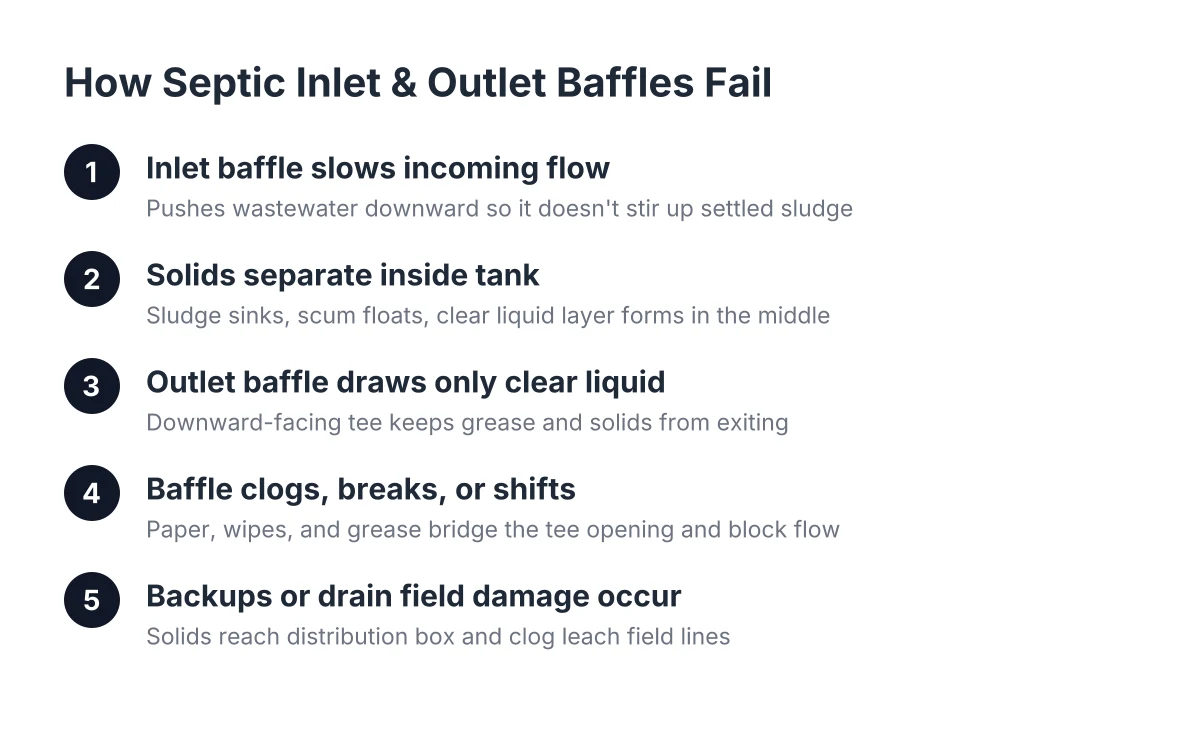
    Diagram of septic tank baffle failure showing how inlet and outlet baffles work and fail
    The inlet and outlet baffles enforce a strict sequence that keeps solids out of the drain field, as explained in this guide.

    If you run a restaurant, manage a rental with a septic system, or operate an RV park in the High Desert, the septic tank inlet and outlet are two parts you never see but depend on every day. They are the doorways of the tank. Wastewater comes in through the inlet, settles inside the tank, and clarified liquid leaves through the outlet toward the drain field. When either one clogs, breaks, or shifts out of position, you get the calls nobody wants: a tenant reporting sewage smell, a floor drain backing up during the lunch rush, or a health inspector asking questions you cannot answer. This guide explains what causes septic tank baffle failure, how inlets and outlets fail, what a proper inspection looks like, and what you can do to keep them working so your property stays off the emergency list.

    Why the Inlet and Outlet Matter More Than the Tank Itself

    A septic tank is a simple box. The engineering that makes it work lives at the two openings. According to US EPA, a typical residential septic system has two main components: a tank that clarifies wastewater and a drain field, also called a soil absorption area, that disperses the clarified liquid into the ground. The same basic layout applies to most small commercial systems in Hesperia.

    Inside the tank, waste separates into three layers. Solids sink to the bottom and form sludge. Grease and lighter material float to the top and form scum. In the middle sits a layer of clearer liquid. The whole system depends on only that middle liquid layer leaving the tank. If sludge or scum escapes, it clogs pipes and drain field lines that were never designed to handle solids.

    The inlet and outlet baffles are what enforce that rule. According to University of Nebraska-Lincoln Extension, septic tanks use a baffle at both the inlet and outlet, built as a downward-facing tee with a pipe section, that stops solids from floating to the top of the opening and forces them to settle to the bottom. Without working baffles, the tank is just a box that passes problems downstream.

    For a non-residential operator, that downstream problem is the expensive one. The U.S. Environmental Protection Agency estimates septic repair or replacement typically costs between $5,000 and $15,000, far more than routine pumping. Most of those failures start at the drain field, and most drain field failures trace back to solids that should have stayed in the tank.

    What the Septic Tank Inlet Baffle Does

    The inlet baffle is where wastewater from the building enters the tank. Its job is to slow that incoming flow and push it downward, so the rush of water does not stir up the sludge that has already settled. Think of it as a splash guard. Without it, every toilet flush and every sink of dishwater churns the tank contents and sends solids swirling toward the outlet.

    Knowing where your inlet is matters for maintenance too. On a rental property you just took over, or a commercial site with no records, the inlet side of the tank is the side closest to the building. The outlet side faces the drain field. If you do not know where the tank is at all, a septic tank locating service can find it and mark the lids before a problem forces the issue.

    The inlet baffle is also the first suspect when a line backs up. According to Washington State Department of Health, a clogged inlet baffle is a common cause of septic backups and should be one of the first things checked when troubleshooting a blocked line into the tank. Paper, wipes, and grease can bridge across the tee opening and block flow into the tank entirely. When that happens, wastewater has nowhere to go but back up the line toward your lowest drain.

    For a commercial kitchen, this failure mode is familiar. Grease that gets past an overloaded grease trap cools and hardens inside the inlet tee. The blockage builds slowly, so drains get sluggish for weeks before the day everything stops. That slow decline is your warning window, and it is the reason grease trap pumping on a schedule matters as much as septic tank pumping itself.

    Causes of Septic Tank Baffle Failure

    The outlet baffle guards the exit, and many pumpers consider it the most important component in the tank. Its downward-facing tee draws liquid from the clear middle layer, below the floating scum and above the settled sludge. That design keeps grease and solids from riding out of the tank into the outlet pipe, the distribution box, and the drain field lines.

    The elevations matter here. According to University of Nebraska-Lincoln Extension, a properly designed septic outlet pipe must sit lower than the inlet pipe, since solids float on top of the liquid in the tank and only the liquid should exit toward the drain field. That small height difference in the septic tank inlet outlet arrangement keeps flow moving in one direction and keeps the scum layer trapped inside the tank where it belongs.

    Downstream of the outlet, the stakes go up. According to Penn State Extension, a distribution box is a critical component that evenly distributes wastewater from the septic tank into multiple leach field lines. If the outlet baffle fails and scum reaches that box, it can clog one or more lines and overload the rest. According to U.S. Environmental Protection Agency, after separation in the tank, wastewater moves through perforated lateral pipes into the drain field, then filters through gravel or stone and finally through sand and soil. None of those layers can pass grease. Once they clog, there is no pumping them clean.

    This is why a missing or broken outlet baffle is not a cosmetic finding on an inspection report. It means every gallon leaving the tank carries a chance of solids, and every day it stays broken shortens the life of the most expensive part of your system.

    How Inlet and Outlet Baffles Fail

    Baffles fail in a handful of predictable ways, and each one leaves signs a trained eye can catch during routine service.

    • Corrosion and breakage. Older concrete baffles erode from the gases inside the tank. Pieces crack off and fall into the sludge, leaving the opening unguarded. Plastic tees last longer but can crack or snap off at the pipe connection.
    • Displacement. A baffle can turn out of position or get knocked loose during a rough pumping job or by settling soil. A tee that has rotated sideways no longer draws from the right depth, so it stops doing its job even though it is still physically there.
    • Clogging. Wipes, paper, and grease build up inside the tee until flow stops. On the inlet side this backs sewage toward the building. On the outlet side it can push the tank level up and flood the inlet.
    • Connection damage. The point where the pipe passes through the tank wall is a weak spot. According to Onsite Installer, fill material around the pipe penetration should be compacted thoroughly after the tank is set to prevent settling or damage at that connection. Poor compaction years ago shows up today as a sagged or sheared pipe at the tank wall.

    Suppose you own a small RV park outside Hesperia with a holding tank and an older septic tank serving the office and restrooms. Say the outlet baffle cracked off two seasons ago and nobody looked inside the tank during the last pump-out. When a septic tank baffle failure goes undetected, grease and scum drift into the drain field lines for weeks or months. In that scenario, the first visible symptom might be a wet, sour-smelling patch of ground near the hookup sites during your busiest weekend, and by then the fix is a drain field repair, not a baffle swap.

    Signs Your Septic Tank Inlet or Outlet Has a Problem

    You cannot see the baffles without opening the tank, but the system tells you when something at the inlet or outlet is wrong. Watch for these signs at any property you manage:

    1. Slow drains across the whole building. One slow sink is a plumbing problem. Every drain slowing at once points to the tank, often a clogging inlet baffle or a rising tank level.
    2. Gurgling in floor drains or toilets. Air trapped behind a partial blockage makes noise as water fights past it. In a commercial kitchen, gurgling floor drains after the dish pit runs are an early warning.
    3. Sewage odor near the tank or inside the building. A blocked inlet can push gases back up the line. Tenants usually report the smell before they report slow drains, so take those calls seriously.
    4. Wet or unusually green ground over the drain field. This suggests solids have already passed the outlet and the field is struggling. It is the latest and most expensive warning sign.
    5. Sewage backing up at the lowest fixture. This is the emergency stage. At this point you need septic backup and overflow response, not a maintenance visit.

    Therefore, the goal for any operator is to act on signs one through three. Those are baffle-stage problems with baffle-stage costs. Signs four and five mean the failure has moved downstream, where repairs run into five figures instead of hundreds.

    What a Proper Septic Tank Inlet and Outlet Inspection Looks Like

    A proper inspection of the septic tank inlet and outlet checks that both baffles are present, intact, correctly positioned, and clear of buildup. The crew opens the tank, and after pumping they use a mirror and flashlight to look at each tee from above. They confirm the tees have not turned, cracked, or corroded, and that the outlet sits lower than the inlet as designed.

    This check should be part of every pump-out, not a separate service you have to request. Pumping that only removes solids and closes the lids misses the entire point of opening the tank. The few minutes it takes to inspect both baffles is what turns a pump-out into actual septic tank maintenance, because it catches a $200 tee replacement before it becomes a drain field failure.

    On a multi-compartment tank, common on commercial sites, the crew should also check the baffle between compartments. That internal baffle keeps solids in the first chamber, and it can break or shift just like the tees at either end. A tank with a failed middle baffle sends solids to the outlet side even when the outlet tee itself is fine.

    Timing matters as much as thoroughness. The U.S. Environmental Protection Agency recommends that the average household have its septic system inspected at least once every three years by a professional, and once a year for systems with pumps, float switches, or other mechanical parts. For commercial accounts with heavy grease loads or high water use, the practical schedule is tied to your pumping schedule, since the baffle check happens whenever the tank is open. Homes and small businesses running garbage disposals load the tank faster; the Massachusetts Department of Environmental Protection recommends annual pumping for households with disposals regardless of tank size.

    One honest caveat: baffle repair and replacement is not a do-it-yourself job. Entering or reaching into a septic tank exposes you to gases that can kill within minutes, and repositioning a tee correctly requires knowing the design elevations for your tank. Look with a flashlight from outside the opening if you must, but leave hands-in-the-tank work to a crew with the right equipment.

    Keeping the Inlet and Outlet Working Between Pump-Outs

    Baffles fail faster when the tank works harder. As a non-residential operator, you control most of what enters the system, which means you control most of what stresses the septic tank inlet and outlet over time.

    For restaurants and commercial kitchens, the grease trap is the front line. A trap pumped on schedule keeps grease out of the septic inlet tee, where it hardens and clogs. Post a simple rule for staff: scrape plates into the trash, never the sink, and keep fryer oil out of every drain. For 2026 health inspections, keeping your grease trap pumping receipts in one folder also gives you a clean paper trail when an inspector asks.

    For rental properties, the risk is what tenants flush. Wipes, even ones labeled flushable, are the most common thing pulled out of clogged inlet baffles. Put the do-not-flush list in the lease and on a card inside the bathroom cabinet: no wipes, no grease, no paper towels, no feminine products, no cat litter. A one-page notice costs nothing and saves you the midnight backup call.

    For RV parks and properties with holding tanks, schedule pump-outs ahead of your busy season rather than after the first complaint. A holding tank pumped before the weekend rush never gets the chance to overflow, and a regular route with one local crew means you are not searching for RV holding tank pumping while guests are checking in.

    In addition, keep records for every property you manage. Note the tank location, lid positions, which side is the inlet, the date of each pump-out, and what the crew found at the baffles. When you sell the property, change managers, or face an inspection, that log is the difference between a five-minute answer and a day of digging.

    The Bottom Line for Hesperia Property Owners

    The inlet and outlet baffles are cheap parts protecting expensive ones. According to Angi, septic tank pumping averages $427, ranging from $250 to $1,250 or more depending on tank size and location. Compare that, plus a modest baffle replacement when needed, against the EPA's $5,000 to $15,000 estimate for repair or replacement, and the math settles itself.

    Make the baffle check a standing requirement, not an extra. Every time your tank is open for pumping, the crew should confirm both tees are present, positioned correctly, and clear. Ask for that check by name, ask what they found, and get it in writing. A local Hesperia crew that pumps the tank, inspects the septic tank inlet and outlet on every visit, and keeps you on a schedule is how a grease trap, rental septic system, or holding tank stops being a fire drill and becomes a line item you barely think about.

    If you need your septic tank serviced, Hesperia Septic can help.

    Prefer to talk it through? Call (760) 249-7872 — a quick call is usually the fastest way to get a straight answer for your situation.

    Related Reading

  • Septic System Backup Repair Costs in Hesperia: What to Expect and How to Avoid Them

    septic backup repair cost

    When sewage is backing up into your tub or pooling in the yard, the first question after "who do I call" is "what is this going to cost me." This guide walks you through septic backup repair cost and what you will likely pay in 2026, how to tell a fair quote from a padded one, and what to do right now to keep the damage and the bill from growing. The short version: most backups in Hesperia end with a pump-out, not a five-figure repair. Here is how to handle it in order.

    Step 1: Stop Adding Water to the System

    Before you call anyone, cut the water going down your drains. Every flush, shower, and load of laundry pushes more wastewater into a tank that has nowhere to put it. That is what forces sewage back up through the lowest drain in the house.

    Turn off the washing machine and dishwasher. Ask everyone in the house to stop flushing. If a toilet is running, shut its supply valve at the wall; according to the U.S. Environmental Protection Agency, a single leaky or running toilet can add as much as 200 gallons of extra water per day into a septic system. That alone can turn a slow backup into standing sewage overnight.

    This step costs nothing and it directly protects your floors, your drain field, and your final bill.

    Step 2: Figure Out If It Is the Septic System or the House Plumbing

    Next, do a quick check so you call the right professional. A septic backup and a plumbing clog can look identical from inside the house, but they get fixed by different people at different prices.

    Signs it is the septic system:

    • Sewage or gray water coming up in the lowest drains, usually a tub, shower, or floor drain
    • A wet, soggy, or smelly patch of yard over the tank or drain field
    • A septic alarm going off, if your system has one
    • Every drain in the house is slow or backing up, not just one

    Signs it is house plumbing: one fixture is clogged while everything else drains fine. In that case a plumber is the right call. For anything that looks septic, call a septic service first. They can diagnose the tank, the baffles, and the drain field, which a general plumber usually cannot. Many Hesperia homeowners lose a day and a service fee calling a plumber who then says they do not really do septic.

    Step 3: Call for Emergency Septic Pumping and Ask These Questions

    Once it looks like a septic backup, call a local septic crew and ask for emergency septic pumping. Before you commit, ask three questions on the phone:

    1. What is the base price for the pump-out, and what could add to it?
    2. Is there a separate after-hours or emergency fee, and how much?
    3. Do you charge extra for digging to find or uncover the tank lid?

    A straight answer to all three is the mark of an honest operator. According to Angi, septic tank pumping averages $427 nationwide, ranging from $250 to $1,250 or more depending on tank size and location. Emergency or after-hours service usually adds to that. A smaller 500 gallon septic tank generally costs less to pump than a larger one because the truck hauls away less waste.

    For example, suppose a homeowner in Hesperia has sewage coming up in the hall bathroom on a Saturday evening. A typical crew pumps the tank, checks the inlet baffle, and has the drains flowing again that day. In that scenario, the total lands in the hundreds, not the thousands, even with an after-hours charge. That is the most common outcome of a backup call.

    Step 4: Understanding the Cost of Septic Backup Repair by Tier

    Septic system backup repair costs fall into three tiers, and knowing which tier you are in is how you judge any quote. Most backups sit in the first tier: the tank is full because it went too long between pump-outs, and pumping alone fixes it. That is the hundreds range described above, and it is the outcome to hope for.

    The second tier is a component repair. A common example is a clogged or broken inlet baffle; according to the Washington State Department of Health, a clogged inlet baffle is a common cause of septic backups and one of the first things to check on a blocked line. Baffle work, a broken line between the house and tank, or a damaged lid usually costs more than a pump-out but far less than major work. As an illustrative estimate, think low hundreds to a couple thousand depending on digging and parts.

    The third tier is the one everyone fears: drain field failure or full system replacement. The EPA estimates septic tank repair or replacement typically costs between $5,000 and $15,000, far more than routine pumping. However, a backup alone does not mean you are in this tier. If the drains work fine after pumping and stay that way, the drain field is probably doing its job.

    Step 5: Verify the Diagnosis Before Agreeing to Major Work

    If a technician says you need drain field work or a new system, slow down and verify before signing anything. This is where the fear of a padded septic tank cost either comes true or gets put to rest.

    Ask the crew to show you what they found. A conventional system has two main parts, the tank and the drain field, according to the U.S. Environmental Protection Agency, and a real problem in either one is visible or testable. A failed drain field shows itself: water flows back into the tank from the outlet, the field stays soggy, or drains back up again within days of a fresh pump-out.

    Reasonable checks before approving big-ticket work:

    • Was the tank pumped first, and did the problem return afterward?
    • Did they inspect the inlet and outlet baffles and the line from the house?
    • Can they show you standing water or backflow at the outlet side?
    • Did you get an itemized written estimate separating labor, materials, and equipment?

    A quote that jumps straight to replacement without pumping and inspecting first deserves a second opinion. That said, if a system has failed, delaying real repair only spreads sewage and raises the eventual cost, so verification should take days, not months. Soil conditions, tank access, and county permitting all affect Hesperia repair pricing, so a firm number requires someone on site.

    Step 6: Prevent the Next Backup With Scheduled Pumping

    After the crisis passes, the cheapest repair is the one you never need. Nearly all emergency backup calls trace back to a tank that went years past its service interval, letting sludge and scum build until solids pushed into the lines or the drain field.

    The prevention plan is short:

    • Get on a pumping schedule. Penn State Extension notes that for an active family of four, pumping every two to three years is generally advisable.
    • Have the system inspected. The U.S. Environmental Protection Agency recommends a professional inspection at least once every three years.
    • Fix running toilets and dripping fixtures fast; extra water is the quiet killer of drain fields.
    • Keep grease, wipes, and food solids out of the drains. This goes double for commercial kitchens, where a grease trap on a regular pump-out schedule prevents both backups and health code trouble.
    • Skip additive products sold as a substitute for pumping. If additives fail to clear a buildup, the endgame can be replacing the system entirely.

    Do the math on this trade. A pump-out every few years costs hundreds. A replacement runs $5,000 to $15,000 by EPA estimates, and you carry that whole bill yourself; there is no city sewer department to absorb it. More than one in five U.S. households depend on septic or small cluster systems, according to the U.S. Environmental Protection Agency, and the ones that avoid emergencies are the ones on a schedule.

    Step 7: Keep Records So Future Service Costs Less

    Finally, write down what happened. Note the date of the pump-out, where the tank and lids are, what the crew found, and what they recommended. If the crew had to locate the tank this time, mark the spot or sketch it; skipping the locating step next time saves money on every future visit.

    These records also matter if you ever sell. Buyers and inspectors ask for septic service history, and a documented, regularly pumped system is worth more than a mystery in the yard. For an RV park or restaurant owner, the same log doubles as your compliance record for holding tank or grease trap service.

    A backup at 8pm feels like a disaster, and standing sewage is nothing to shrug off. But most Hesperia backups end with a same-day pump-out in the hundreds of dollars, a checked baffle, and a homeowner who now knows exactly what their system needs. Follow the steps in order, ask for itemized pricing, and the scary quote almost never materializes.

    If you need your septic tank serviced, Hesperia Septic can help.


    Prefer to talk it through? Call (760) 249-7872 — a quick call is usually the fastest way to get a straight answer for your situation.

    Related Reading