If you run a restaurant, manage a rental, or operate an RV park around Hesperia, septic tank pumping is one of those jobs you want on a calendar, not on a crisis list. The goal of this guide is simple: give you straight answers on timing, cost ranges, and what a visit involves, so you can set a schedule once and stop babysitting the problem. No upsell pressure, no vague "it depends" with nothing behind it. Just how a local crew that pumps tanks for a living thinks about scheduling in the High Desert.
This matters more when you are not on-site every day. A homeowner notices a slow drain in their own shower. A landlord hears about it three days later from a tenant, and a restaurant owner hears about it from a health inspector. Additionally, a schedule fixes that gap.
Why a Pumping Schedule Beats Waiting for Symptoms
The hard truth about septic systems is that visible symptoms show up after the damage has started. By the time drains slow, odors rise, or sewage surfaces near the tank, solids have usually been pushing past the outlet baffle toward the drain field for a while. Scheduled pumping removes those solids before they travel.
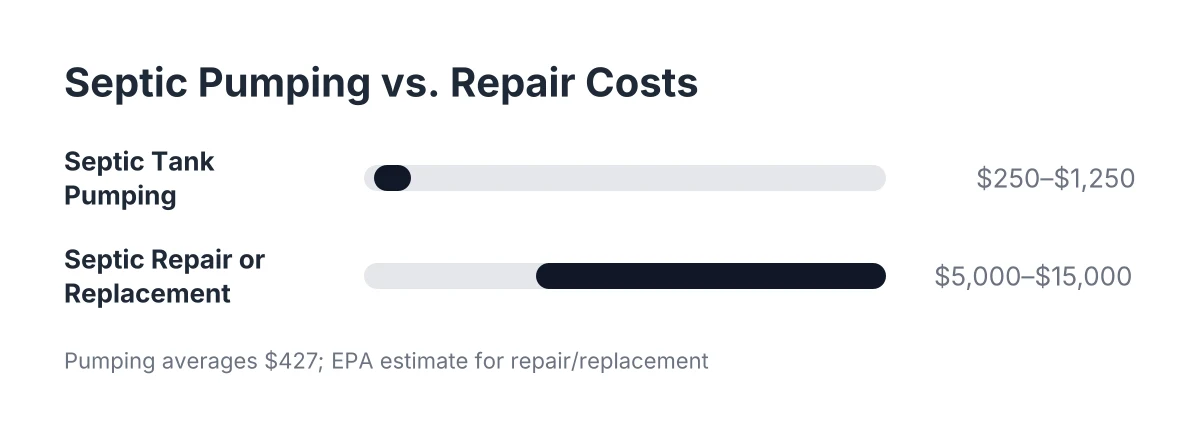
The math backs this up. According to Angi data, septic tank pumping averages $427, with a range of $250 to $1,250 or more depending on tank size and location. Compare that to the U.S. Environmental Protection Agency's estimate of $5,000 to $15,000 for septic repair or replacement. A pump-out every few years is cheap insurance against a five-figure bill.
There is a flip side, and an honest company will tell you about it. Pumping too often wastes money. A tank serving a lightly used rental or a seasonal cabin does not fill with solids at the same rate as a busy household or a working kitchen. The right schedule sits between those two mistakes, and it depends on tank size, usage, and what goes down the drains.
Think of it the way you think of oil changes on a work truck. You do not wait for the engine to knock. You also do not change the oil every two weeks. Furthermore, you pick an interval that matches how hard the vehicle works, then you stick to it.
How Often Septic Tank Pumping Should Happen
For a typical household, pumping the septic tank every two to three years is generally advisable for an active family of four, according to Penn State Extension, because more people means more solids and more water. The EPA also recommends a professional inspection at least once every three years for the average household. For many properties, pairing the pump-out with the inspection on the same visit is the practical move.
Usage changes the interval, though, and non-residential properties rarely match the "average household" profile. Here is how the main variables shift the schedule:
- Occupancy. A four-bedroom rental with six tenants fills a tank far faster than the same house with a retired couple. More people, shorter interval.
- Garbage disposals. Homes with disposals generate far more sludge. The Massachusetts Department of Environmental Protection recommends annual pumping for households with disposals, regardless of tank size. If your rental has one, plan accordingly or remove it.
- Tank size. A smaller tank reaches its solids limit sooner. If you do not know the size, the crew can usually tell you at the first pump-out, and that number anchors every future scheduling decision.
- System type. Alternative systems with pumps, float switches, or other mechanical parts should be inspected once a year, per the EPA, which naturally sets a tighter service rhythm.
- Business use. Grease traps and holding tanks run on much shorter cycles than residential tanks, often monthly or quarterly. More on that below.
One more thing worth checking: some localities require pump-outs at set intervals regardless of tank condition. Rules vary, so confirm what applies to your specific property with San Bernardino County rather than relying on general guidance alone. A good local service will know the common requirements and remind you when records matter.
A Simple Starting Schedule You Can Adjust
If you are taking over a property and have no service history, a reasonable approach is to schedule a pump-out and inspection now, then set the next interval based on what the crew finds. If the tank was heavily loaded, shorten the interval. Notably, if it was mostly liquid, you can likely stretch it. Two visits of real data beat any generic chart.
For grease traps, the health department and your trap's size drive the schedule more than anything else. Many restaurants land on monthly or quarterly service, but your inspector's expectations and how much fryer and dish volume you run should set the final number.
Seasonal Timing for Pumping in the High Desert
Hesperia's climate changes the scheduling conversation compared to wetter regions. We do not deal with frozen ground or spring flooding the way northern states do, which means pumping can happen year-round here. Still, the seasons give you natural windows worth using.
Spring and early summer are smart for RV parks, campgrounds, and seasonal properties. Suppose you run a small RV park off Highway 395 and your busy season starts around Memorial Day. Getting holding tanks and the main septic system pumped in April or early May means you enter peak season with full capacity, instead of discovering a near-full tank during a holiday weekend when every pumper in the High Desert is booked.
Summer brings heavy water use, which stresses a system that is already near capacity. High occupancy at rentals, more laundry, and more guests all push additional water through the tank. If a tank is loaded with solids going into summer, the extra flow is what pushes those solids into the drain field. Pumping before your heaviest use period, not after, is the pattern that protects the field.
Fall suits landlords who want systems serviced before holiday gatherings fill rental houses with guests. It is also the natural window to winterize RV holding tanks and get a final pump-out before cabins or trailers sit idle.
Winter in the High Desert is workable for pumping, and schedules are often more open. If your interval lands in January, there is no reason to wait. The one seasonal caution: after heavy rain, saturated soil around the tank and drain field can complicate a visit, so a dry week is easier for everyone.
The deeper point for a non-residential operator is this: schedule around your business calendar, not just the calendar year. Pump before your busy season, before inspections, and before vacancies turn over, so service never collides with revenue.
What a Septic Tank Pumping Visit Includes
A standard septic tank pumping visit covers locating and uncovering the tank access, pumping out the liquids and solids with a vacuum truck, checking the baffles and tank condition while it is empty, and hauling the waste for legal disposal. The visit typically runs under an hour once the lid is exposed, though access problems can extend it.
Here is the sequence in more detail, because knowing it helps you prep the site when you cannot be there yourself:
- Locating the tank. If you know where the lids are, mark them. If not, the crew can locate the tank, which is a common add-on for owners who just took over a property with no records.
- Exposing the access. Buried lids need to be dug up. Some companies include shallow digging; deep burial or hard ground can add labor. Installing risers after the first visit makes every future pump-out faster and cheaper.
- Pumping the tank. The truck removes scum, liquid, and sludge. A full pump-out takes everything, not just the liquid layer; removing the settled sludge is the entire point of the service.
- Checking the tank. With the tank empty, the crew can see the inlet and outlet baffles, which stop solids from floating out toward the drain field, according to University of Nebraska-Lincoln Extension. A cracked baffle found now is a small fix; found later, it can mean a damaged drain field.
- Hauling and disposal. The waste is trucked to a treatment facility for disposal, as the New Hampshire Department of Environmental Services describes; nothing is processed or dumped on-site. If you need disposal documentation for compliance records, ask for it when you book. That paperwork matters for restaurants and anyone answering to a health inspector.
What usually costs extra: locating a lost tank, deep digging, riser installation, repairs discovered during the visit, and emergency or after-hours response. A fair quote separates the pump-out price from these extras so you can compare apples to apples.
Service When You Are Not On-Site
Landlords and out-of-area owners should know that pumping does not require you to stand in the yard. If the crew has gate access, lid locations, and a contact number, the visit can happen while you run your actual business. Say a landlord in Victorville owns a rental in Hesperia and a tenant reports a sewage smell; in that scenario, the owner can authorize service by phone, the tenant provides access, and the owner gets the report and disposal record afterward. That is the arrangement to set up with your vendor before the first emergency, not during it.
Grease Traps, RV Holding Tanks, and Rental Septic Schedules
Non-residential accounts run on different clocks, and lumping them in with household advice causes problems. Each category deserves its own schedule.
Grease traps. Restaurant grease traps fill with fats, oils, and grease much faster than a septic tank fills with household solids. If an inspector has already flagged your trap, you need two things: a prompt pump-out and a documented recurring schedule you can show at the next inspection. Monthly or quarterly service is the common rhythm, tuned to your trap size and kitchen volume. The recurring schedule is what keeps the citation from repeating.
RV and holding tanks. Holding tanks have no drain field; everything that goes in stays until it is pumped. That makes the schedule purely a function of capacity and use. A park operator should track fill rates during peak season and book standing service rather than calling when tanks are already near the top, because peak season is exactly when same-day slots are scarce.
Rental properties. The scheduling risk with rentals is information lag. Tenants rarely report slow drains early, and turnover erases institutional memory about the last pump-out. Put the septic service date in your property records the same way you track water heater age, and schedule the next pump-out at move-out or on a fixed interval, whichever comes first.
For all three, the operational win is the same: one local septic tank pumping service that knows your properties, holds your service history, and shows up on a standing schedule without you driving it each time.
Warning Signs That Mean Pump Now, Not Next Quarter
A schedule prevents most emergencies, but systems still throw warnings. Call for service promptly if you or a tenant notices any of these:
- Drains running slow throughout the building, not just one fixture
- Gurgling sounds from drains or toilets
- Sewage odors inside, near the tank, or over the drain field
- Wet, soggy, or unusually green ground above the tank or field
- Sewage backing up into the lowest drains in the building
- A grease trap odor strong enough that customers notice it
An active backup or overflow is an emergency, and searching for 24 hour septic pumping is a reasonable response in that moment. Even then, the fix starts with pumping the tank to relieve pressure, followed by figuring out why it backed up. A backup in a recently pumped tank usually points to a clog, a baffle problem, or a struggling drain field, and diagnosing that is professional work, not a DIY job.
To be clear about limits: pumping solves a full tank, but it does not cure a failed drain field or a collapsed line. If problems return quickly after a pump-out, you need an inspection and possibly repair work, and an honest crew will tell you that instead of selling you another pump-out.
Choosing a Pumping Service for Recurring Work
When you search for septic tank pumping near me or a pump out service in Hesperia, you will find a mix of local crews, national call centers, and directory pages. For recurring commercial or rental work, the fit questions are different than for a one-time residential job. Ask these three things:
- Do you handle my kind of account? Confirm the company services grease traps, holding tanks, or rental properties, not just owner-occupied homes. A crew that already pumps restaurant traps understands inspection documentation; one that does not will learn on your dime.
- Can you provide disposal records? Waste must be hauled to a treatment facility, and you may need proof for health code or habitability compliance. A company that handles disposal properly can document it without hesitation.
- Will you put me on a schedule? The entire value for a busy operator is not having to remember. Ask whether they track service intervals and reach out when you are due, and whether service can happen with site access but without you present.
On price, expect quotes in line with general market ranges; Angi puts the national average for a residential pump-out at $427, with larger tanks, difficult access, and commercial work landing higher. A fair quote in 2026 names the base pump-out price, states what counts as extra, and does not change once the truck arrives. Be cautious of any quote that is far below the market range, since the difference often reappears as on-site add-ons.
Putting Your Schedule on Paper
Here is the whole system, condensed. Pump and inspect on a regular interval: every two to three years is the common residential baseline, annually with a garbage disposal, and monthly to quarterly for grease traps and busy holding tanks. Time the visit ahead of your heavy season, whether that is summer RV traffic, holiday rental occupancy, or a scheduled health inspection. Keep the service date, tank size, and disposal records in your property file.
Then let the schedule run. The property owners who never deal with septic emergencies are not lucky; they pump on a calendar and fix small findings while the tank is already open. If your Hesperia property, restaurant, or park is due, or you have no idea when it was last pumped, that uncertainty is itself the signal. Reach out to a local Hesperia septic crew, get the tank pumped and looked at, and set the next date before the truck leaves. One phone call now turns septic from a recurring fire drill into a line item you barely think about.
If you need your septic tank serviced, Hesperia Septic can help.
Prefer to talk it through? Call (760) 249-7872 — a quick call is usually the fastest way to get a straight answer for your situation.