If you own an RV, a remote cabin, or a small campground in the High Desert, the question of RV holding tank pumping frequency comes up sooner or later, usually right after a bad smell or a tank sensor that reads full. Understanding your RV holding tank schedule is essential to prevent backups and maintain your system. There is no single magic number that works for everyone. How often a holding tank needs a pump-out depends on the size of the tank, how many people use it, and how it gets used. This guide walks through how to figure out your own schedule, what happens when you wait too long, and why properties out past the pavement in Hesperia and the surrounding High Desert often need a mobile crew that comes to the tank instead of the other way around.
The people asking this question are usually not septic experts. Maybe you just bought a few acres with an old cabin on it and the seller left you nothing, no records, no maps, no idea where the tank even sits. Maybe you park an RV on your property most of the year and the nearest dump station is a long haul away. Either way, the question is the same: how often does this tank need to be emptied, and who is going to do it out here?
Why Holding Tanks Fill on Their Own Schedule, Not Yours
Here is the first thing to understand. A holding tank is not a septic system. A septic tank separates solids and sends liquid out to a drain field, so it only needs pumping every few years. Additionally, a holding tank stores everything. Nothing leaves until a truck pulls it out. That single difference changes the whole math on frequency.
With a septic system, the U.S. Environmental Protection Agency recommends a professional inspection at least once every three years, and pumping happens on a multi-year cycle for most homes. A holding tank does not get that kind of grace period. Every gallon that goes down the drain stays in the tank until someone pumps it. If the tank holds 300 gallons and your household or RV produces 30 gallons of wastewater a day, you have about ten days before it is full. That is not a maintenance schedule; that is a countdown.
This is why holding tank owners in the High Desert tend to fall into two camps. The first camp knows their fill rate and books pump-outs on a routine. The second camp finds out the tank is full when sewage backs up into the shower. Furthermore, the goal of this article is to move you from the second camp to the first.
How Often Does an RV Holding Tank Need Pumping?
An RV holding tank typically needs pumping every three to five days of full-time use for a black tank, and less often for occasional weekend use. The real answer depends on tank size, number of people, and water habits. A stationary RV used as a residence fills far faster than a rig used a few weekends a season.
Let's break down the main factors, because "it depends" is not useful on its own.
Tank size sets the ceiling
Most RV black tanks fall somewhere between 15 and 50 gallons, and gray tanks are often a similar size or larger. A cabin or park-model holding tank might be several hundred gallons. You cannot manage what you have not measured, so the first step is finding out what your tank actually holds. Check the manufacturer specs on an RV. For a buried cabin tank with no records, a pump-out crew can measure capacity during the first service by tracking how many gallons come out. Do not guess from a generic septic tank size chart; those charts describe residential septic tanks, and holding tanks vary widely.
Occupancy drives the fill rate
Two people using an RV bathroom part-time produce a fraction of what a family of four produces living in it full-time. The same logic that applies to septic applies here. For comparison, Penn State Extension notes that an active family of four should pump a full septic tank every two to three years because of higher solids and liquid production. A holding tank compresses that same usage math into days or weeks instead of years. More people, more flushes, more dishwater, faster fill.
Usage pattern matters as much as headcount
A weekend rig that sits empty Monday through Friday might go a month or more between pump-outs. A full-time setup on a Hesperia lot fills on a steady clock. Seasonal patterns matter too. Suppose a small High Desert campground runs near capacity from spring through fall and sits mostly empty in winter. In that scenario, the operator might need campground holding tank service weekly in season and monthly off season. One fixed schedule for the whole year would either waste money in January or flood a site in July.
Water habits stretch or shrink the interval
Short showers, fixing drips, and running full loads of dishes all slow the fill rate. Long showers and a leaky toilet valve can cut your interval in half without anyone noticing. If your tank seems to fill faster than the math says it should, check for a running toilet first. It is the most common silent tank-filler there is.
A Simple Way to Set Your Own RV Holding Tank Schedule
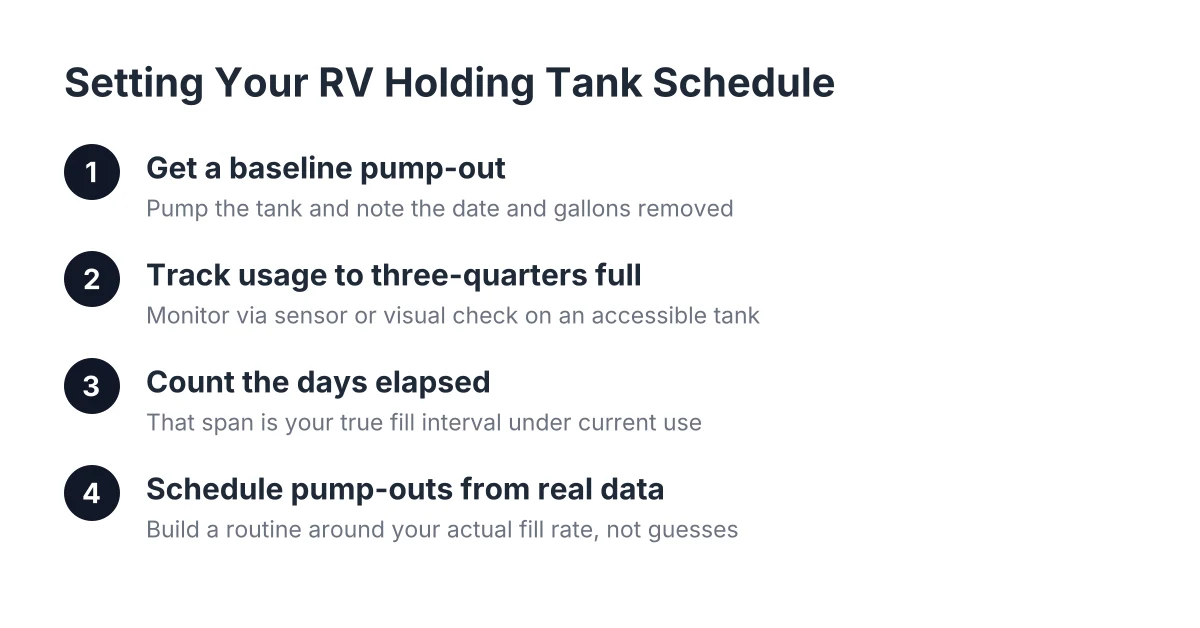
The most reliable approach is to establish a baseline with your first pump-out, then build the schedule around real numbers instead of guesses. This mirrors how experienced septic operators think about residential tanks: measure how fast waste accumulates once, then set the interval from data.
Here is a straightforward process:
- Get the tank pumped and note the date and the gallons removed.
- Track your usage until the tank reads about three-quarters full, either by sensor or by a visual check on an accessible tank.
- Count the days that took. That is your true fill interval under current use.
- Schedule your next pump-out at about 75 percent of that interval, so a heavy-use week does not push you past full.
- Recheck the math whenever occupancy changes, for example when family visits for a month or a seasonal renter moves in.
For example, say a couple living full-time in a fifth wheel on a lot near Hesperia finds their gray and black tanks combined take 12 days to reach three-quarters full. In that illustrative case, booking a mobile RV tank pump-out every 9 to 10 days keeps them clear of a backup with a small margin for company or laundry days. That kind of margin is the entire difference between routine service and an emergency call. Establishing your RV holding tank schedule this way gives you precise timing based on actual usage patterns.
One honest caveat: RV tank sensors are notoriously unreliable once waste coats the probes. If your sensor has read full for weeks or never leaves empty, do not build your schedule on it. Use elapsed days and gallons pumped instead, and consider having the tank cleaned, not just pumped, to restore accurate readings.
What Happens When You Stretch RV Holding Tank Pumping Too Far
Waiting too long between pump-outs causes problems that cost more than the service you skipped. The failure modes are predictable, and every one of them is worse than the smell that warned you.
- Backups into the living space. A full black tank has nowhere to send the next flush except back up the line. In an RV, that means the toilet. In a cabin, it can mean the lowest shower or floor drain.
- Solids hardening in the tank. When waste sits too long, especially in High Desert heat with low humidity, solids compact and dry into a layer that a standard pump-out struggles to remove. That is when a basic pump-out turns into a full holding tank cleaning job, which takes longer and costs more.
- Sensor failure. Caked waste on the probes is the number one reason tank monitors lie. Once they lie, you lose the early warning that would have prevented the next backup.
- Odors and vent problems. An overfull tank pushes gases back through the plumbing. If you smell sewage inside the rig or cabin, the tank is usually past due, not approaching due.
- Damage from overpressure. Portable RV black water tanks and older buried holding tanks were not built to sit at capacity for weeks. Fittings, seals, and valves take the strain first.
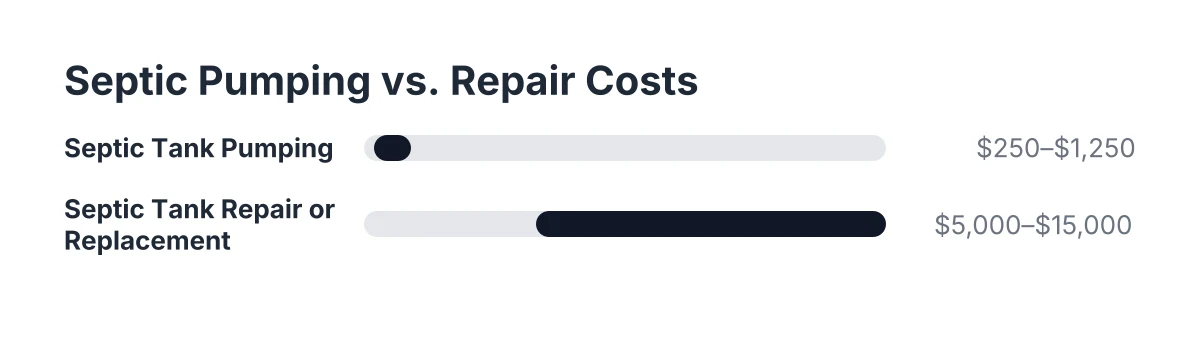
There is a useful comparison from the septic world here. The U.S. Environmental Protection Agency estimates septic repair or replacement typically runs $5,000 to $15,000, far more than routine pumping. Holding tanks are simpler systems, so the repair numbers are usually smaller, but the ratio holds. Routine service is cheap insurance against the expensive version of the same problem.
Why Dump Stations Do Not Solve This for Everyone
Plenty of RV owners handle their own tanks at a dump station, and if your rig moves regularly, that works fine. Searching for free RV dump stations near me before a trip is a reasonable habit for travelers. The trouble starts when the tank cannot come to the station.
Consider three situations common in the High Desert. First, the stationary RV: a rig parked long-term on private land, hooked to power and water, functioning as a home. Breaking camp every week to drive to a dump station is not realistic. Second, the remote cabin: a buried holding tank with no drain field, sometimes with no records of where the tank sits or what it holds. That tank is never going anywhere; the truck has to come to it. Third, the small campground or RV park without a dump station of its own, where guests fill on-site tanks that someone has to empty.
In all three cases, the answer is mobile service. A vacuum truck comes to the property, pumps the tank where it sits, and hauls the waste away legally. According to the New Hampshire Department of Environmental Services, waste pumped from tanks is trucked to a sewage treatment plant for disposal rather than handled on-site, and holding tanks specifically must be emptied by a licensed hauler. That legal disposal chain is the part a homeowner cannot do alone, no matter how handy they are.
This is also where a lot of remote High Desert properties get skipped. Long dirt driveways, no marked tank location, and no records make some crews decline the job. A local Hesperia crew that works these properties regularly knows the drill: locate the tank if nobody knows where it is, confirm what it holds, pump it, and leave the owner with a real baseline for scheduling the next visit.
Bought Land With a Mystery Tank? Start Here
If you just bought or are about to buy High Desert property and the seller handed over nothing, do not assume the wastewater system is a septic tank. Some rural cabins run on holding tanks precisely because the soil or lot never supported a drain field. The difference matters enormously for your budget, because a holding tank means recurring pump-outs forever, while a septic system means occasional septic tank pumping every few years.
Before you commit money, get three things:
- A locate. Have the tank physically found and marked. No visible lid or riser does not mean no tank; it usually means a buried lid under decades of sand.
- An identification. Confirm whether it is a septic tank with a drain field or a sealed holding tank. The presence or absence of an outlet line tells the story.
- An inspection with a pump-out. Pumping the tank lets a professional see the walls, baffles, and condition, and it gives you the baseline gallons figure for future scheduling.
A locate-and-inspect visit can feel like an unwelcome cost during escrow. Weigh it against the alternative: closing on a property, moving an RV onto it, and discovering the "septic system" is a 250-gallon holding tank that fills every two weeks. Knowing that before closing changes what you offer, or whether you offer at all. If the inspection turns up a failing or undersized system, you have negotiating leverage instead of a surprise.
Condition questions beyond a straightforward pump-out, such as a cracked tank, root intrusion, or a system that may need county permits to modify, are worth a professional evaluation rather than a guess. This is one place where saving a service fee up front can cost real money later.
Putting a Real RV Holding Tank Schedule Together for 2026
If you take one thing from this guide, make it this: RV holding tank pumping works best on a calendar, not a crisis. Treat it like an oil change. You would not wait for the engine to seize; do not wait for the toilet to back up.
Here is a practical way to think about intervals as you plan the year:
- Full-time RV living on a lot: expect black tank service every one to two weeks depending on tank size and household size, with gray water on a similar or faster clock if it shares the tank.
- Weekend and seasonal RV use: pump after each extended trip or when the tank reaches about three-quarters full, and never store a rig with waste sitting in the tank through a hot desert summer.
- Cabin holding tanks: set the interval from your measured fill rate after a baseline pump-out; a few hundred gallons of capacity with light weekend use may stretch to monthly or longer, while full-time occupancy shortens it fast.
- Campgrounds and small parks: build a seasonal schedule that scales with occupancy, and confirm your hauler can handle in-season frequency before the busy months start.
Costs vary with tank size, access, and how far the truck has to travel, so treat any number you see online as a rough guide. As a loose frame of reference, Angi reports that residential septic tank pumping averages $427, with a range from $250 to $1,250 or more depending on tank size and location. RV and small holding tank pump-outs are a different job than a full residential septic tank, so your quote will reflect the actual tank and site, not a national average.
The bottom line for High Desert owners is simple. Learn what your tank holds, measure how fast you fill it, and book service before the countdown runs out. A tank that gets pumped on schedule is a tank you never think about. A tank that gets ignored picks its own moment, and it always picks a bad one.
If you need your septic tank serviced, Hesperia Septic can help.
Prefer to talk it through? Call (760) 249-7872 — a quick call is usually the fastest way to get a straight answer for your situation.