Tag: grease trap pumping

  • 1000 Gallon Septic Tank Pumping Schedule: How Often and What It Costs

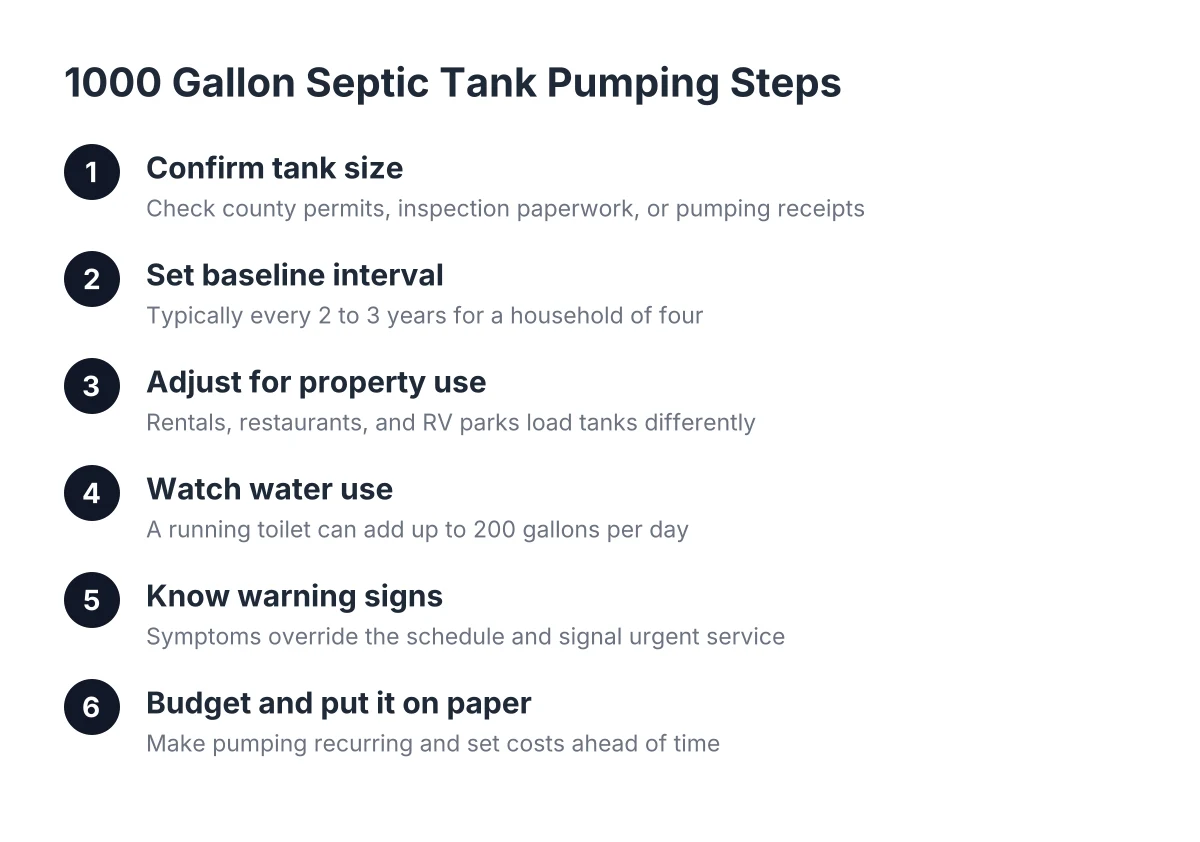
    Steps for setting a 1000 gallon septic tank pumping frequency schedule
    A step-by-step schedule for maintaining a 1000 gallon septic tank, as covered in this guide.

    A 1000 gallon septic tank is one of the most common sizes serving homes, small rental properties, and light commercial buildings in the High Desert. If you own one, or you just took over a property that has one, the question that matters most is simple: how often does it need pumping, and what happens if you wait too long? Understanding proper septic tank pumping frequency is essential to protecting your system and avoiding costly repairs. This guide walks through a step-by-step maintenance schedule so you can plan service, budget for it, and stop treating every tank problem as a surprise.

    This matters twice as much if you own the property but do not live there. A landlord in Hesperia, a restaurant manager with a grease trap, or an RV park operator with holding tanks cannot rely on noticing warning signs day to day. A schedule replaces noticing.

    Step 1: Confirm You Actually Have a 1000 Gallon Septic Tank

    Start by verifying the tank size, because pumping frequency depends on it. Pumping too rarely lets solids build up and push into the drain field. Pumping more often than the tank needs wastes money. You cannot set the right interval until you know what is in the ground.

    Check these sources in order:

    • County permit records. San Bernardino County keeps septic permits that often list tank size, material, and location on the lot.
    • The property's inspection or purchase paperwork. A septic inspection from the sale often records tank capacity.
    • A previous pumping receipt. Pumpers usually note gallons removed, which points to tank size.
    • A septic tank locating service. If nothing on paper exists, a crew can locate the tank, open it, and measure it.

    Tank material matters less than size for scheduling, but it is worth noting. A 1000 gallon septic tank in concrete is the common older install around Hesperia; plastic and polyethylene tanks show up on newer or replacement systems. Typical 1000 gallon septic tank dimensions run around 8 to 10 feet long, 5 feet wide, and 5 feet deep, though designs vary. Concrete lids are heavy and buried, so do not plan on opening one yourself.

    Step 2: Set Your Baseline Pumping Interval

    For a 1000 gallon tank serving a typical household, every two to three years is the standard working interval. According to Penn State Extension, an active family of four should generally pump every two to three years because of higher solids and liquid production. Fewer occupants can stretch that; more occupants, a garbage disposal, or heavy laundry use should shorten it.

    In addition, the U.S. Environmental Protection Agency recommends a professional inspection at least once every three years for the average household, and once a year for alternative systems with pumps, float switches, or other mechanical parts. A practical approach is to combine the two: schedule pumping and inspection together so the crew checks baffles, lids, and liquid levels while the tank is open.

    How Septic Tank Pumping Frequency Affects Tank Life

    Here is a simple starting matrix for a 1000 gallon tank. Treat it as a planning estimate, not a rule; actual need depends on water use and what goes down the drains.

    • 1 to 2 occupants: every 4 to 5 years
    • 3 to 4 occupants: every 2 to 3 years
    • 5 or more occupants, or heavy use: every 1 to 2 years

    Step 3: Adjust the Schedule for How the Property Is Used

    A house you live in, a rental you manage, and a commercial site all load a tank differently. Adjust the baseline accordingly.

    Rental properties. You do not control tenant habits. Suppose you own a three-bedroom rental in Hesperia on a 1000 gallon septic tank, and the tenants run a garbage disposal daily and do laundry for five people. That tank fills with solids faster than the same tank under a retired couple. For rentals, lean toward the shorter end of the interval and put the pump-out on a calendar instead of waiting for a tenant to call about a smell or slow drains. Getting the septic tank pumping frequency right protects your investment and avoids emergency calls.

    Restaurants and commercial kitchens. Grease traps are a separate schedule entirely. Fats, oils, and grease build up fast, and health inspectors check trap condition. Most operators end up on a monthly or quarterly grease trap pumping cycle depending on kitchen volume. If your building also has a septic tank, keep the two schedules separate; do not assume one pump-out covers both.

    RV parks, campgrounds, and holding tanks. Holding tanks store everything with no drain field, so they fill on a hard clock. Frequency depends entirely on occupancy, and a busy season can double the fill rate. Track it monthly during peak season until you know the pattern.

    Step 4: Watch Water Use Between Pump-Outs

    Water volume is the hidden variable in every septic schedule. A tank clarifies wastewater by letting solids settle before liquid flows to the drain field. Flood the tank with extra water and solids get pushed out before they settle, which clogs the drain field over time.

    The single biggest offender is a running toilet. According to the U.S. Environmental Protection Agency, one leaky or running toilet can add as much as 200 gallons of extra water per day into a septic system. On a 1000 gallon tank, that is a fifth of total capacity in extra flow every single day. For a landlord, this is a concrete reason to fix tenant-reported toilet issues fast; the toilet repair is cheap, and the drain field it protects is not.

    Between scheduled pump-outs, also keep grease, wipes, and harsh chemicals out of the drains. Additives sold as tank treatments do not replace pumping. The tank is a biological system, and regular pumping protects it better than anything poured down a drain.

    Step 5: Know the Warning Signs That Override the Schedule

    A schedule is the plan; symptoms are the exception that overrides it. If any of these show up before the next planned pump-out, move the service up.

    • Slow drains throughout the building, not just one fixture
    • A septic tank smell in the yard or near the tank lids
    • A wet spot or unusually green grass over the tank or drain field
    • Gurgling in drains or toilets after flushing
    • Sewage backing up at the lowest drain in the building

    However, be clear about what pumping can and cannot fix. Slow drains from a full tank clear up after a pump-out. Standing water over the drain field, or a tank that refills within days of pumping, points to drain field failure or a broken component. That is a repair conversation, not a pumping schedule problem. This is where septic system troubleshooting by someone who opens tanks every day earns its fee; the symptoms overlap, and guessing wrong gets expensive.

    Step 6: Budget for 1000 Gallon Septic Tank Pumping Costs

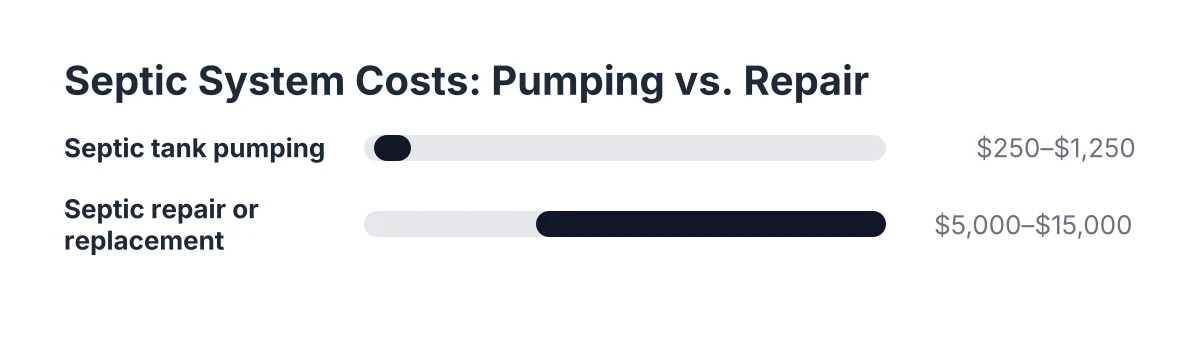
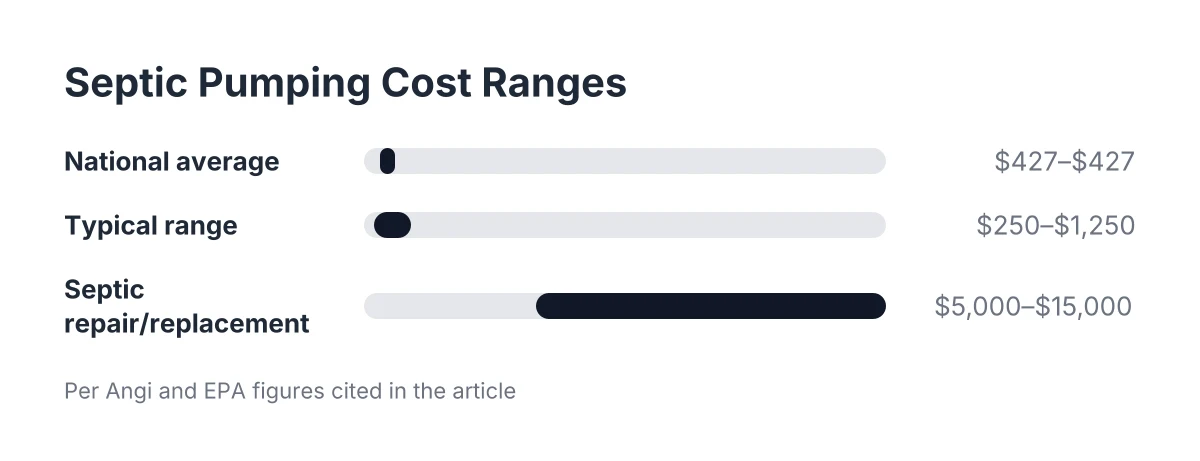
    Routine pumping is the cheap end of septic ownership. According to Angi data, septic tank pumping averages $427, with a typical range of $250 to $1,250 or more depending on tank size and location. As of 2026, a straightforward 1000 gallon pump-out with accessible lids usually lands in the lower part of that range; deep tanks, buried lids, or emergency timing push it up.

    Now compare that to the alternative. The EPA estimates septic repair or replacement typically costs $5,000 to $15,000, far more than routine pumping. Skipping two or three pump-outs to save several hundred dollars, then paying five figures for a drain field, is the worst trade in septic ownership. Regular pumping is the single most effective thing an owner can do to extend the life of the system.

    For grease trap and holding tank accounts, budget as a recurring line item rather than a one-off. A single-location restaurant or RV park generally plans for a few hundred dollars per pump-out on a monthly or quarterly cycle, depending on volume. Ask the pumper for documentation of each service; waste from these tanks is hauled by truck to a treatment facility for disposal, according to the New Hampshire Department of Environmental Services, and service records help with health code compliance.

    Step 7: Put the Schedule on Paper and Make It Recurring

    Finally, turn the interval into an actual system so it survives busy seasons and property handoffs. Visible symptoms only appear after a problem has already started, so a written schedule is the only reliable early warning you get.

    1. Record the tank size, material, and lid locations, with photos if possible.
    2. Note the date and findings of the last pump-out.
    3. Set the next pump-out date based on Steps 2 and 3, and put it on a calendar with a reminder.
    4. Ask your septic service whether they can schedule the next visit in advance, so it happens without you chasing it.
    5. Keep every receipt and inspection note in one folder; it protects you at sale time and during health inspections.

    For a non-residential operator, that last point is the whole game. One local crew handling the grease trap, the rental's tank, and the holding tanks on a recurring schedule means no fire drills, no babysitting, and a paper trail when an inspector asks.

    When to Bring in a Professional Instead of Waiting

    Some situations should skip the schedule discussion entirely. Sewage backing up into a building, standing wastewater in the yard, or a strong sewage odor indoors all call for emergency septic pumping and a professional look, not a calendar entry. Likewise, if you do not know where the tank is, do not dig blind; a locating service finds it without tearing up the yard or cracking a lid.

    A pumping crew can also tell you things a schedule cannot, such as whether baffles are intact, whether roots have entered the tank, and whether the sludge level suggests your interval is right. That feedback loop is how a generic two-to-three-year rule becomes a schedule tuned to your specific 1000 gallon septic tank and the way your property actually uses it.

    If you need your septic tank serviced, Hesperia Septic can help.


    Prefer to talk it through? Call (760) 249-7872 — a quick call is usually the fastest way to get a straight answer for your situation.
    Related Reading

  • Septic Inspection vs. Pumping: When to Schedule Each Service Separately

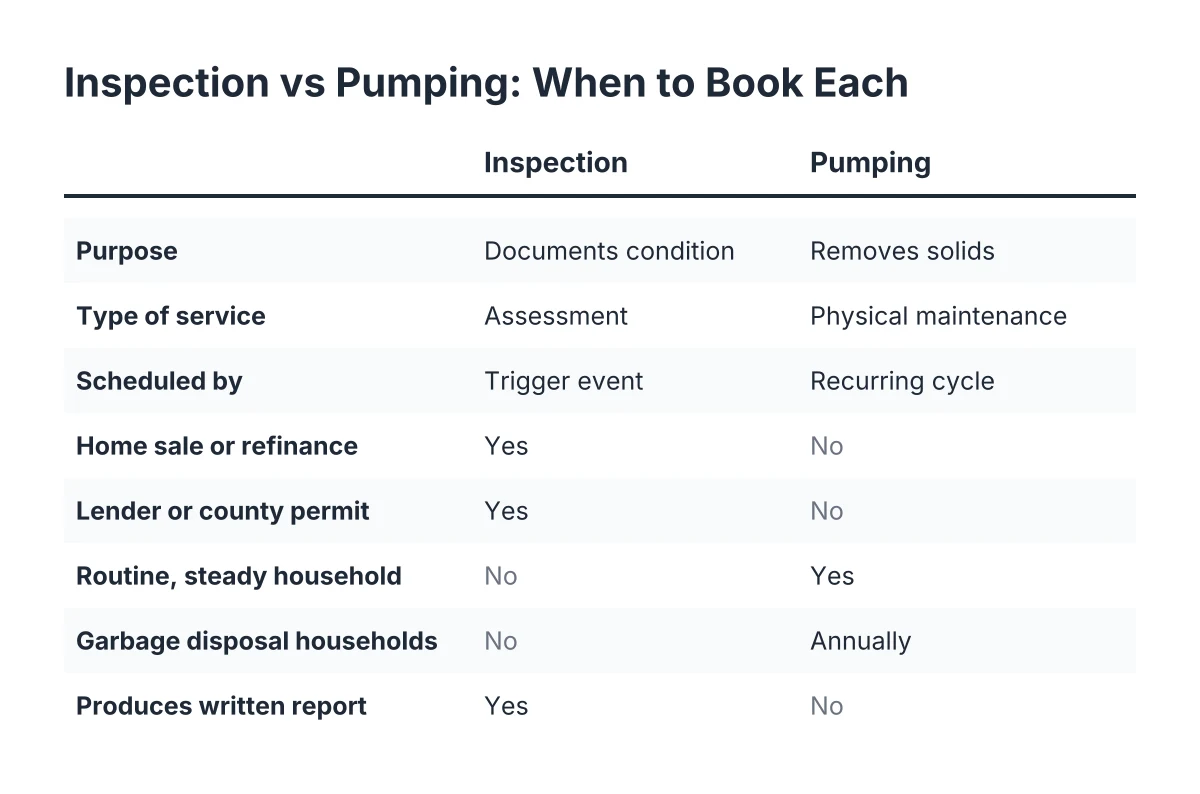
    Comparison checklist of septic inspection vs pumping schedule triggers and purposes
    Key differences between septic inspection and pumping, as outlined in this guide.

    If you own property in Hesperia, whether it is a home, a rental, or a small business on septic, you have probably wondered whether you need an inspection, a pumping, or both. Understanding the right inspection vs pumping schedule matters more than most owners realize. Schedule them wrong and you either pay twice for overlapping work or miss the one visit that would have caught a problem before it became a sewage backup. This guide breaks down what each service does, when to book them separately, when to combine them, and how the answer changes if you need documented reports for a home sale, a refinance, a lender, or a health inspector.

    The short version up front: pumping removes waste, and inspection documents condition. One keeps the system working. The other proves it works, in writing, to a buyer, an escrow officer, a lender, or a county reviewer. Owners in the High Desert often need both, but not always at the same time, and not on the same schedule.

    Inspection and Pumping Are Two Different Jobs

    A septic inspection and a septic tank pumping solve two different problems, even though the same crew often performs both. Pumping is physical maintenance; a truck removes the sludge and scum that build up in your tank over time. Inspection is an assessment; a technician evaluates the tank, the pipes, and the drain field, then documents what they find.

    According to the U.S. Environmental Protection Agency, a conventional septic system has two main components: the septic tank and the drain field. Pumping only touches the first one. All household drains feed a single pipe into the tank, where solids settle out and get removed by pumping, while the liquid flows out to perforated pipes in the drain field, according to US EPA. A pump truck cannot fix or even fully evaluate that second half of the system. That is inspection work.

    Here is the practical difference for a Hesperia property owner:

    • Pumping empties the tank of accumulated solids so wastewater keeps flowing and solids do not escape into the drain field.
    • Inspection checks tank condition, baffles, inlet and outlet pipes, liquid levels, and signs of drain field trouble, then produces a written report.
    • Pumping is routine maintenance you schedule on a recurring cycle.
    • Inspection is due diligence you schedule around a trigger: a sale, a refinance, a permit, a tenant complaint, or a suspected problem.

    Once you see them as separate jobs with separate purposes, the scheduling question gets easier to answer.

    When an Inspection Should Come First, Without Pumping

    Schedule a standalone septic system inspection when you need documented condition before a transaction or a decision, not when the tank is simply due for service. Buyers, sellers, lenders, and escrow officers all want the same thing: a written record of what is in the ground and whether it works. A pump-out receipt does not answer that question. An inspection report does.

    Common situations where inspection leads and pumping waits:

    1. Buying a home or land in the High Desert. If the seller has no service records, an inspection tells you what you are inheriting before you sign. High Desert soil drains differently across short distances, and a system that looks fine on paper can hide a drain field near the end of its life.
    2. Selling a home on septic. A pre-listing inspection lets you fix small issues on your own timeline instead of during escrow, when every repair becomes a negotiation.
    3. Refinancing or lender requirements. Some lenders want documentation that the septic system functions before they close. A dated, written inspection report satisfies that request in a way a verbal "it seems fine" never will.
    4. Permits and county requirements. Additions, remodels, or new construction near an existing system often require documentation of the system's location and condition. County requirements vary, so confirm what your specific project needs before assuming a general report will do.
    5. Taking over a rental property. Say a landlord buys a four-unit property outside Hesperia with no septic records at all. An inspection establishes a baseline: tank location, tank condition, and drain field health. That baseline becomes the starting point for a realistic maintenance plan, instead of guessing until a tenant calls about a smell.

    In each of these cases, the point of the visit is the report, not the pump-out. The inspector documents access points, measures sludge and scum layers, checks that the outlet sits lower than the inlet so only liquid leaves the tank, and notes any red flags in the yard above the drain field. For an escrow file or a lender, that document is the product.

    One caveat: if the inspector finds the tank so full that they cannot evaluate the baffles or outlet, pumping may become necessary mid-inspection anyway. Plan for that possibility in your budget when the system has no service history.

    When Pumping Should Come First, Without a Full Inspection

    Book septic tank pumping on its own when the tank is due for routine service and nothing about the system has changed. If your household size is steady, drains run normally, the yard smells fine, and you pumped on schedule last time, you likely do not need a formal inspection report attached to every pump-out.

    Pumping is the oil change of septic ownership. According to Penn State Extension, an active family of four generally benefits from pumping every two to three years because of higher solids and liquid production. Households with garbage disposals generate more sludge; the Massachusetts Department of Environmental Protection recommends annual pumping for those homes regardless of tank size. Your exact interval depends on tank size and how many people use the system, so a smaller household on a large tank can often stretch longer between visits.

    Standalone pumping also makes sense for:

    • Grease traps at restaurants and food businesses. Grease trap pumping runs on its own cycle, driven by kitchen volume and health code, not by the condition questions an inspection answers. If a health inspector flagged your trap, you need it pumped and documented, and you need a disposal record for your compliance file.
    • RV and holding tanks. A holding tank has no drain field to inspect. It fills, you pump it. Cabin owners and RV operators around Hesperia mostly need a reliable pump-out schedule, not a condition report.
    • Emergency backups. When sewage is backing into the house, pumping the tank relieves the immediate pressure. The diagnostic questions come after the crisis, not during it.

    A worthwhile habit: even during a routine pump-out, a good crew looks at what the empty tank reveals. Cracks, corrosion, root intrusion, and a saturated drain field all show themselves more clearly with the tank empty. That informal look is not a formal inspection report, but it often catches problems early.

    Building a Schedule: Inspection vs Pumping Frequency

    A workable septic system care plan pairs a recurring pumping cycle with periodic professional inspections, then adds one-off inspections whenever a transaction or a symptom demands documentation. The U.S. Environmental Protection Agency recommends the average household have its septic system inspected at least once every three years by a professional. Alternative systems with pumps, float switches, or mechanical parts should be inspected once a year, according to the U.S. Environmental Protection Agency.

    Here is a practical framework for 2026 planning:

    1. Set your pumping interval. Start from household size and tank size. A family of four on a standard tank lands in the two-to-three-year range per Penn State Extension. Adjust based on what the crew finds at each pump-out. Heavy sludge at two years means shorten the interval; a light tank means you can stretch it.
    2. Anchor inspections to the pumping visit when possible. Because an inspection-only visit often costs close to what pumping does, combining them on the same visit usually gives you more value per truck roll. The tank gets emptied and evaluated in one appointment, and you get gases released and a check for corrosion or root intrusion while the tank is open.
    3. Add standalone inspections for triggers. A sale, a refinance, a permit application, a new tenant complaint, or drains that slow across the whole house each justify an inspection outside the regular cycle.
    4. Check local requirements. Some jurisdictions require pump-outs or inspections at set intervals regardless of the system's actual condition. Verify what applies to your Hesperia property rather than relying only on general guidance.
    5. Keep every record. Pump-out receipts, disposal documentation, and inspection reports belong in one folder. For landlords and business operators, that folder is your habitability and health-code paper trail. For homeowners, it becomes the service history that makes your home easier to sell later.

    The reason to formalize this instead of waiting for symptoms is simple: symptoms arrive late. By the time drains slow or the yard smells, solids may already be pushing into the drain field. Scheduled visits catch buildup before it travels, which is why a maintenance calendar beats a nose test every time.

    What a Documented Inspection Report Should Contain

    An inspection report worth handing to a lender or escrow officer documents the system's components, their condition, and the inspector's findings in writing, with dates. If you are ordering a septic inspection for a home sale, ask up front what the report will include. A one-line "system OK" note will not survive scrutiny from a buyer's agent or an underwriter.

    A useful report typically covers:

    • Tank location and access. Where the tank sits, how it was accessed, and whether locating work was needed. Properties with no records sometimes require septic tank locating before anything else can happen.
    • Tank condition. Material, visible cracks or corrosion, baffle condition, and inlet and outlet pipe condition. According to University of Nebraska-Lincoln Extension, the outlet pipe must sit lower than the inlet, since solids float on the liquid and only liquid should exit toward the drain field. An inspector confirms that geometry still holds.
    • Sludge and scum measurements. How full the tank was, which feeds directly into your future pumping interval.
    • Liquid level observations. A level above the outlet suggests the drain field is not accepting water; a level below suggests a leak.
    • Drain field indicators. Soggy ground, surfacing effluent, unusually green strips of vegetation, or odors over the field.
    • Recommendations and date. What needs attention, what looks sound, and when the evaluation happened.

    Context matters to the findings, so expect a thorough inspector to ask questions before the visit: the age of the house, repair history, how often the tank was pumped in the past, and where the property sits, whether on a rise or in a low spot. Those answers shape what they look for once they open the lids.

    High Desert conditions add their own wrinkles. Soil that drains fast in one part of a parcel can drain slowly a hundred feet away, which is why a percolation test is required before installing any new system, according to University of Nebraska-Lincoln Extension, and why the local health department typically inspects as part of installation, per Caroline County Health Department. An inspector who knows how Hesperia-area soil behaves reads drain field symptoms differently than someone working from a generic checklist.

    What Skipping Either Service Ends Up Costing

    Skipping pumping lets solids overflow into the drain field, and skipping inspections lets hidden damage compound until it surfaces as a backup or a failed escrow. Both mistakes trade a modest, scheduled cost for a large, unscheduled one. The math is lopsided.

    According to Angi, septic tank pumping averages $427, with a typical range of $250 to $1,250 depending on tank size and location. Compare that to repair or replacement: the EPA estimates septic repair or replacement typically costs between $5,000 and $15,000. A decade of on-schedule pumping costs less than a single drain field failure.

    For a hypothetical example, suppose a Hesperia homeowner goes eight years without pumping because nothing seemed wrong. Solids fill the tank, then start flowing out with the liquid and clogging the drain field gravel. The first visible symptom is sewage backing into the shower on a Saturday. Emergency pumping relieves the backup, but the inspection that follows finds a saturated drain field that no amount of pumping will fix. In that scenario, a few skipped service visits turned into a five-figure replacement.

    The reverse mistake costs money too. Pumping a lightly used tank every year wastes service calls, and paying for a full documented inspection at every routine pump-out adds cost without adding information. The goal is not maximum service; it is matched service, with each visit doing a job you actually need done.

    There are also limits to what any schedule can promise. An inspection is a snapshot of condition on one date, not a warranty against future failure, and unusual situations, such as a suspected collapsed tank or a system with no locatable components, call for professional evaluation before anyone commits to a plan.

    Quick Decision Guide: Which Service Do You Book This Time?

    When you are staring at the phone deciding what to ask for, run through this list:

    • Selling, buying, or refinancing? Book an inspection. Expect pumping may be added if the tank is too full to evaluate.
    • Tank due on your regular cycle, no symptoms? Book pumping. Ask the crew to note anything unusual they see in the empty tank.
    • Hit your inspection year on the calendar? Combine inspection with pumping in one visit to get full value from the appointment.
    • Sewage backup, alarm sounding, or odors in the house? Book emergency pumping first. Schedule the diagnostic inspection once the immediate problem is relieved.
    • Health inspector flagged your grease trap? Book grease trap pumping and keep the disposal documentation for your compliance records.
    • New rental or land purchase with no records? Book locating plus inspection to establish a baseline, then set the recurring maintenance schedule from what the report shows.
    • RV or cabin holding tank? Book pumping on a usage-based cycle; no drain field means no field inspection needed.

    Treat the two services as tools with different jobs. Pumping keeps the system alive. Inspection tells you, and everyone who needs proof, exactly where the system stands. Owners in Hesperia who schedule each one deliberately, instead of lumping them together or skipping both, spend less over the life of the system and never find themselves explaining a surprise to an escrow officer or a health inspector.

    If you need your septic tank serviced, Hesperia Septic can help.

    Related Reading

  • Septic Backup Causes: Roots, Clogs, or a Full Tank? How to Tell What You’ve Got

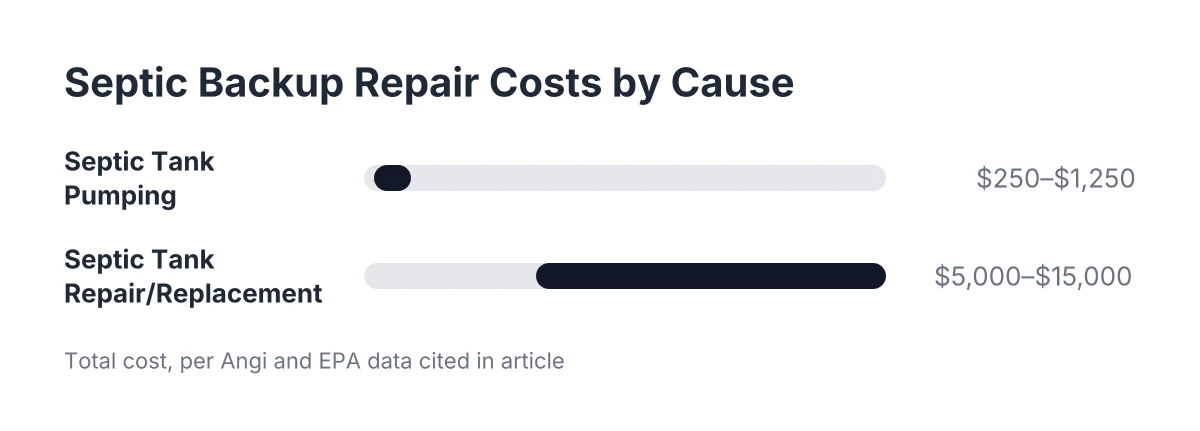
    Cost range chart comparing septic tank pumping versus repair costs to diagnose septic backup
    The cost of fixing a septic backup depends heavily on the cause, from a routine pump-out to a full repair.

    A backed-up septic system rarely announces the reason. Sewage rises in a shower drain, a toilet gurgles, or a tenant calls about a smell, and you have no idea whether you need a routine pump-out or a real repair. Sorting out septic backup causes takes some detective work, but the clues are usually there if you know where to look. To diagnose septic backup correctly, this guide walks through the three most common culprits—a full tank, a clog in the line, and tree root intrusion—and shows you how to read the symptoms so you can decide what to do before the situation gets worse.

    Here in Hesperia and the surrounding High Desert, septic systems do most of the wastewater work. According to the U.S. Environmental Protection Agency, more than one in five U.S. households depend on individual septic systems or small community cluster systems to treat their wastewater. Out here that share runs much higher, so knowing how to read your system is a practical skill, not a niche one.

    Why the Cause Matters Before You Call Anyone

    The cause of a septic backup decides both the fix and the cost. A full tank needs septic tank pumping, which is routine work. A clog in the line between the house and the tank might need a snake or jetting. Root intrusion or a failing drain field is a bigger conversation, sometimes involving excavation or replacement.

    Those price gaps are not small. According to Angi data, septic tank pumping averages $427, ranging from $250 to $1,250 or more depending on tank size and location. Meanwhile, the EPA estimates septic tank repair or replacement typically costs between $5,000 and $15,000. That is the difference between an afternoon appointment and a project you have to budget for.

    Therefore, spending ten minutes reading the symptoms before you pick up the phone pays off. You will describe the problem accurately, the crew will show up with the right equipment, and you will not pay for a pump-out that solves nothing because the real problem is roots in the outlet line.

    First, Rule Out the Simple Stuff: Is the Tank Just Full?

    A full septic tank is the most common reason a system backs up, and it is also the cheapest to fix. Solids build up in every tank over time. When the sludge layer gets deep enough, waste has nowhere to go, and it pushes back toward the house or out toward the drain field.

    Signs that point to a full tank rather than something worse:

    • Drains all over the house are slow, not just one fixture
    • Toilets gurgle or bubble after you flush
    • You cannot remember the last time the tank was pumped, or it has been more than a few years
    • Sewage odors show up near the tank lid or inside the house
    • The backup came on gradually over weeks, not overnight

    The pattern to notice is that a full tank affects the whole house. Every fixture drains into the same tank, so when the tank is the problem, everything slows down together. If only one sink or one toilet is misbehaving, the problem is more likely a localized clog in that fixture's line, which is a plumbing issue rather than a septic one.

    However, one hidden factor can fill a tank faster than you expect: excess water. According to the U.S. Environmental Protection Agency, a single leaky or running toilet can add as much as 200 gallons of extra water per day into a septic system. That extra flow stirs up solids and pushes them toward the outlet before the tank can settle them out. If your tank seems to fill quickly between pump-outs, check for running toilets and dripping fixtures before assuming the tank itself has failed.

    How to Diagnose Septic Backup Caused by Roots: Signs and Confirmation

    Root intrusion produces a different symptom pattern than a full tank. Roots grow into pipe joints, the tank inlet or outlet, and drain field lines, because that is where the moisture is. In the High Desert, where surface water is scarce, tree and shrub roots hunt for septic lines aggressively. A hairline gap in a pipe joint is an open invitation.

    Watch for these signs that roots, not a full tank, are behind the backup:

    1. Recurring backups after pumping. The tank gets pumped, everything works for a few weeks or months, then the same symptoms return. Roots blocking the inlet or outlet cause this cycle because pumping empties the tank but does not remove the obstruction.
    2. One line acts up while others work. Roots invade at a specific point. If the kitchen side of the house backs up but the bathrooms drain fine, a root mass in one branch line is a strong suspect.
    3. Unusually green or lush vegetation over the lines. In Hesperia's dry landscape, a green stripe over your sewer line or drain field stands out. Plants thriving there are often feeding on leaking wastewater.
    4. Gurgling that persists after pumping. Air trapped behind a partial root blockage keeps making noise even when the tank has plenty of capacity.
    5. A camera inspection shows it directly. This is the only way to know for certain. A septic system inspection with a camera can spot root hair, root masses, and the cracked joints they entered through.

    The honest answer is that you cannot confirm the cause of a septic backup from the surface alone. Symptoms narrow the odds, but a camera or a look inside the tank settles the question. If you have mature trees, especially thirsty species, within about 20 to 30 feet of your tank or lines, treat roots as a live possibility whenever backups recur.

    Why Roots Are a Bigger Problem Than a Clog

    A clog is debris; roots are a living, growing organism. Cut them back and they return through the same gap, usually thicker. Worse, the gap they entered through is itself damage. Roots widen cracks as they grow, and over time they can crush or separate pipe sections entirely.

    That is why root problems tend to escalate in cost the longer they wait. Early on, cutting the roots and repairing one joint may handle it. Left for years, the same intrusion can wreck a drain field, and drain field replacement sits at the top end of that $5,000 to $15,000 EPA repair estimate. Catching root intrusion during a routine septic system inspection is one of the strongest financial arguments for scheduled maintenance.

    Clogs and Blockages: The Middle Ground

    Between a full tank and root damage sits the ordinary clog. Grease, wipes, paper towels, feminine products, and food solids all cause blockages in the line between the house and the tank, or at the tank's inlet baffle. Clogs share some symptoms with root intrusion, which is why the two get confused.

    The main difference is history. A clog usually follows a specific event: a holiday weekend with a full house, a garbage disposal working overtime, or a tenant flushing things they should not. Root intrusion builds slowly and recurs. If your system worked fine for years and then backed up suddenly after heavy use, a clog is the likelier story.

    For non-residential properties, grease is the standout offender. A restaurant manager in Hesperia knows this pattern well: the health inspector flags the grease trap, drains in the kitchen slow down, and suddenly grease trap pumping becomes urgent instead of scheduled. Grease that escapes the trap hardens in downstream lines and behaves like a permanent clog. Putting grease trap pumping on a regular calendar, rather than waiting for an inspection citation, keeps that whole chain of problems from starting.

    Symptom-by-Symptom: What Each Warning Sign Usually Means

    Different symptoms point to different failures. Use this section as a quick translation table when you notice something off.

    Slow Drains Throughout the House

    Slow drains across every fixture usually mean the septic tank is full or the main line to the tank is restricted. When your whole house slows down at once, the shared component, the tank or main line, is the problem. Start with septic tank pumping and ask the crew to check the inlet and outlet baffles while the tank is open.

    If drains stay slow after a pump-out, the restriction is downstream or the drain field is not accepting water. That moves the conversation from routine service to diagnosis.

    Septic Tank Smell in the Yard

    A sewage smell in the yard points to wastewater reaching the surface, most often from a full tank, a failing drain field, or a leaking line. Odor near the tank lids alone can mean the tank is overdue for pumping. Odor spread across the drain field area, especially with damp ground, suggests the field is saturated or damaged.

    In desert soil, smells travel and surface moisture evaporates fast, so do not wait for standing water to take odor seriously. By the time you see pooling in Hesperia's climate, the underlying saturation is usually well established.

    Wet Spot Over the Septic Tank or Drain Field

    A wet spot over the septic tank or drain field means wastewater is escaping the system, and in the High Desert it is one of the clearest red flags you can get. Rain rarely explains soggy ground here. Effluent surfacing means the tank is overflowing, a line has broken, or the drain field can no longer absorb what the house sends it.

    Root damage is a frequent driver of this symptom. A root-cracked distribution line dumps water into one spot instead of spreading it across the field, and that spot turns wet and green. Treat any persistent wet area as urgent, keep kids and pets away from it, and get the system inspected before using more water than necessary.

    Sewage Backing Up Into the House

    Sewage in tubs, showers, or floor drains means the system has nowhere left to send wastewater, which makes it the most urgent symptom on this list. The lowest drains in the house back up first because gravity pushes overflow to them. Stop running water immediately; every flush and every load of laundry adds to what is already backing up.

    This is emergency territory regardless of cause. Emergency septic pumping can relieve the immediate pressure by emptying the tank, and what happens during that visit tells you a lot. If pumping restores normal flow, the tank was the problem. If water keeps backing up with an empty tank, the blockage or failure is elsewhere, and you have narrowed the diagnosis in one step.

    A Real-World Example: The Rental Property Callback

    Consider a scenario landlords with septic properties will recognize. You manage a rental in Hesperia, and tenants report a sewage smell and a slow shower. You schedule septic tank pumping, the crew empties the tank, and the tenants confirm everything works. Six weeks later, the same call comes in.

    At this point, the pattern itself is the diagnosis. A tank does not refill with solids in six weeks under normal use. Either something is loading the system abnormally, such as a running toilet adding water around the clock, or something structural is wrong, and with mature trees on many older High Desert lots, root intrusion at the tank outlet is a common finding. A camera inspection on the second visit costs far less than a third and fourth pump-out that solve nothing.

    For an owner who is not on-site, this is also the argument for working with one local crew that keeps records. When the same company pumped the tank last time, they can compare sludge levels, spot abnormal refill rates, and tell you whether you are dealing with maintenance or damage. That history is what turns a recurring fire drill into a managed system.

    How Professionals Diagnose Septic Backup and Sort Through Root Issues

    Professional diagnosis follows a process of elimination, and understanding it helps you evaluate what a crew tells you. Effective septic system troubleshooting starts at the tank because the tank reveals the most for the least effort. Here is the typical sequence:

    1. Locate and open the tank. On older properties, septic tank locating is sometimes step one, since buried lids and missing records are common.
    2. Check the levels. A tank overfull with liquid suggests the outlet or drain field is not taking water. A tank at normal level with a house that will not drain points to a blockage between house and tank.
    3. Inspect the baffles. Root hair at the inlet or outlet is visible evidence, and damaged baffles let solids escape into the drain field.
    4. Pump the tank and observe. Watching how the tank behaves during and after pumping, whether water flows back in from the drain field side, for example, narrows the cause further.
    5. Run a camera if needed. For recurring problems, a camera in the lines confirms roots, breaks, or bellies in the pipe that nothing else can prove.

    Ask any crew you hire which of these steps they performed and what they found. A good answer names specifics: sludge depth, baffle condition, where the water sat. A vague answer means you paid for a pump-out, not a diagnosis.

    One trade-off deserves honesty here. If the diagnosis lands on major root damage or drain field failure, pumping and root cutting are stopgaps, not cures, and you should get a repair assessment from a qualified professional before spending more on temporary fixes. Ongoing pump-outs on a failed field burn money without solving anything.

    Preventing the Next Backup

    Prevention looks different depending on which cause you are guarding against, so match the habit to the risk.

    • Against a full tank: put pumping on a schedule instead of waiting for symptoms. Your pumping history and household size determine the right interval, and a local crew that has seen your tank can recommend one based on actual sludge levels rather than a generic rule.
    • Against clogs: keep grease, wipes, and paper towels out of the drains. For commercial kitchens, keep grease trap pumping on a fixed calendar tied to your actual volume, not the inspection cycle.
    • Against roots: know where your lines run before planting anything, and keep water-hungry trees far from the tank and drain field. If mature trees already sit near the system, periodic camera inspections catch intrusion while it is still a joint repair instead of a field replacement.
    • Against water overload: fix running toilets and dripping fixtures promptly, and spread laundry loads across the week instead of running them back to back.

    For properties with pumps, float switches, or other mechanical components, the U.S. Environmental Protection Agency recommends inspection once a year. Standard gravity systems can go longer between inspections, but the principle holds: looking inside the tank on a schedule is how you find problems while they are still cheap.

    The Bottom Line: Read the Pattern, Then Act

    Septic backup causes — roots, clogs, and full tanks — account for most of the calls a septic crew in Hesperia takes, and each one leaves a different fingerprint. Whole-house slowdowns that build gradually point to a full tank. Sudden blockages after heavy use point to a clog. Recurring backups, lush green patches, and problems that survive a pump-out point to roots or drain field damage.

    Match your symptoms to those patterns before you call, and you will know whether you are scheduling routine septic tank pumping or asking for a diagnosis. Either way, acting on early warning signs is what separates a few hundred dollars of maintenance from a five-figure repair. The system tells you what is wrong; you just have to notice what it is saying.

    If you need your septic tank serviced, Hesperia Septic can help.

    Related Reading

  • Grease Trap Pumping at Home: Kitchen Habits That Cut Septic System Pumping Cost

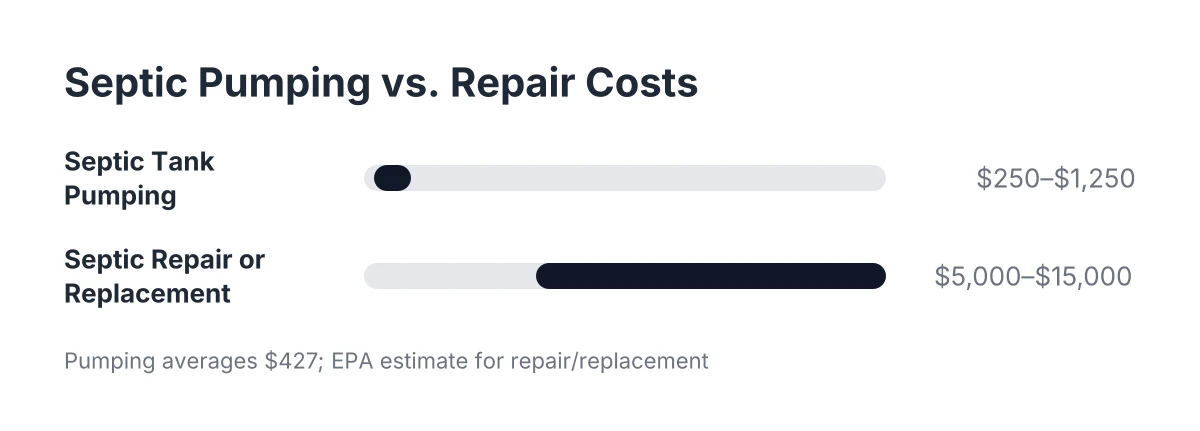
    Cost comparison chart: septic tank pumping ranges from $250–$1,250, while septic repair or replacement ranges from $5,000–$15,000.
    Routine pumping costs far less than emergency drain field repair, making kitchen grease habits a cost-effective lever for homeowners.

    If your kitchen drains through a grease trap or straight into a septic tank, the habits at your sink decide how often a pump truck shows up. Grease is the number one thing that shortens the time between pump-outs, and every extra visit adds to your septic system pumping cost over the life of the house. This guide answers the questions Hesperia homeowners and rental property owners ask most about grease, kitchen drains, and keeping a septic system out of emergency territory.

    The goal here is simple: practical upkeep that keeps you off the after-hours call list. A backed-up tub at 8pm is a bad way to learn where your grease has been going.

    What is a grease trap, and do homes in Hesperia have them?

    A grease trap is a small holding box on the kitchen drain line that catches fats, oils, and grease before they reach the septic tank or drain field. Most single-family homes in Hesperia do not have one; the septic tank itself does that job. However, some older properties, converted commercial buildings, and rental units with large kitchens do have a residential grease trap.

    If you own a rental property and you have never checked, look for a small access lid near the kitchen side of the building. A septic tank locating service can find both the tank and any trap if the property records are missing, which is common on older High Desert parcels.

    Either way, the maintenance logic is the same. Grease has to be caught, held, and pumped out before it moves downstream.

    Why does grease matter so much for a septic system?

    Grease matters because it never fully breaks down in a septic tank. Fats, oils, and grease float to the top and form a scum layer, and when that layer gets thick enough, grease escapes into the drain field and clogs the soil. A clogged drain field is the failure that turns a routine pumping bill into a major repair.

    The scale of the problem shows up clearly in commercial kitchens. According to Wastewater Digest, a single restaurant can release between 800 and 17,000 pounds of grease into the sewer system each year. A home kitchen produces far less, but a septic tank is also far smaller than a city sewer, so the grease you pour down the sink stays on your property.

    The cost gap is the reason to care. According to Angi data, septic tank pumping averages $427, ranging from $250 to $1,250 or more depending on tank size and location. The EPA estimates septic repair or replacement typically runs $5,000 to $15,000. Kitchen habits are the cheapest lever you have between those two numbers.

    How does grease affect septic system pumping cost over time?

    Grease raises your septic system pumping cost by filling the tank's scum layer faster, which shortens the interval between pump-outs. A household that pours bacon fat and fryer oil down the drain can need pumping years sooner than a neighbor with the same size tank and family. More visits per decade means more money spent on the same system.

    There is a second, bigger cost risk. Once grease pushes past the tank and into the drain field, no amount of pumping fixes the soil. At that point you are looking at drain field repair, and that is the $5,000 to $15,000 range the EPA describes, not a routine service call.

    For a small landlord with two or three septic-served rentals in Hesperia, this compounds. One tenant who treats the kitchen sink like a grease bin can quietly move a property from a predictable pumping schedule to an emergency septic pumping call during a lease turnover.

    What should never go down a kitchen drain on a septic system?

    Nothing greasy, fibrous, or chemical should go down a kitchen drain that feeds a septic tank. The tank depends on bacteria to break down waste, and grease smothers that process while solids fill the tank faster. Keep this list posted for family members or tenants:

    • Cooking oil, bacon grease, and pan drippings, even small amounts
    • Butter, shortening, mayonnaise, and salad dressing scraped from plates
    • Dairy-heavy liquids like gravy, cream sauces, and melted cheese
    • Coffee grounds and eggshells, which never break down
    • Fibrous scraps like celery, corn husks, and potato peels
    • Harsh drain cleaners and degreasers, which kill the bacteria the tank needs

    Instead, pour cooled grease into a can or jar, let it harden, and put it in the trash. Wipe greasy pans with a paper towel before washing. Scrape plates into the garbage, not the disposal.

    Garbage disposals deserve a special mention. Homes with disposals generate significantly more sludge, and the Massachusetts Department of Environmental Protection recommends annual pumping for such households regardless of tank size. If your rental has a disposal, budget for more frequent service or consider removing it at the next turnover.

    How often should a grease trap or septic tank be pumped?

    A residential grease trap needs pumping whenever grease and solids fill about a quarter of its depth, and a septic tank needs pumping on a schedule based on tank size, household size, and kitchen habits. There is no single interval that fits every Hesperia property. What matters is that someone checks the levels instead of waiting for a backup.

    A professional inspection is the honest way to set that schedule. The EPA recommends the average household have its septic system inspected at least once every three years. An inspection measures the scum and sludge layers, so you pump when the tank actually needs it, not on a guess.

    For landlords, tie the check to events you already manage: a pre-lease inspection at turnover, or a standing service visit for each property. Getting the schedule right is the core of septic tank maintenance, and it is what keeps pumping a planned line item instead of a surprise.

    What does grease trap pumping cost compared to septic system pumping cost?

    Grease trap pumping for a small residential trap generally costs less than a full septic tank pump-out because the trap holds far less volume. Septic system pumping cost is driven by tank size, how full the tank is, and how hard the lid is to access. A buried lid that needs locating and digging adds labor to any visit.

    If a crew is already on site pumping the tank, having the trap serviced in the same trip is usually cheaper than two separate visits. Ask for both when you schedule. When you search for septic tank service near me or septic maintenance near me, confirm the company handles grease trap pumping too; not every outfit does, and a plumbing generalist often will not.

    One trade-off worth naming: pumping more often than the tank needs wastes money, while stretching intervals to save on 2026 service costs risks the drain field. An inspection-based schedule beats both extremes.

    What are the warning signs that grease is winning?

    Slow kitchen drains, gurgling pipes, and a sewage smell near the sink or yard are the early signs that grease is building up in the trap, the tank, or the line between them. Wet, greasy patches over the drain field are a later and more serious sign. By the time sewage backs up into a tub, the problem has been building for months.

    Do not wait on these signs at a rental. Tenants often live with a slow drain for weeks before calling, so a "minor" complaint on the phone can mean a tank at capacity. A same-week pump and inspection is cheaper than a weekend backup response and a habitability complaint.

    If drains back up again shortly after a pumping, that points past the tank, possibly to a clogged line or a saturated drain field. That is the point to bring in a professional for a full septic system inspection rather than paying for repeat pump-outs that will not hold.

    Can I clean a residential grease trap myself?

    You can scoop a small under-sink grease trap yourself, but most homeowners and landlords should not. The work is unpleasant, the waste needs legal disposal, and a partial cleaning leaves hardened grease on the walls and baffles where clogs restart. A pump truck removes everything and can inspect the trap's condition at the same time.

    In-ground traps and septic tanks are not do-it-yourself territory at all. Tank gases are dangerous, and the waste must be hauled and disposed of properly. This is one place where searching septic repair near me and hiring a local septic crew is the safe and, over time, the cheaper move.

    The bottom line for Hesperia homeowners and landlords

    Grease control is the cheapest septic upkeep there is. A jar by the stove, a paper towel wipe before washing, and an inspection-based pumping schedule keep the scum layer thin and the drain field clean. Those habits stretch the years between pump-outs and keep your total septic system pumping cost as low as the system allows.

    Consider a real Hesperia scenario: a landlord with a three-bedroom rental pays for a routine pump-out in the $300 to $500 range at each long tenancy turnover and never hears from the tenant about drains. The same house with a fryer-happy tenant and no grease rules ends up with a Saturday backup, an emergency pumping call, and a drain field evaluation. Same tank, same soil, different kitchen habits.

    Set the schedule, post the do-not-flush list, and let a local crew measure the tank instead of guessing. That is how you stay off the emergency call list entirely.

    If you need your septic tank serviced, Hesperia Septic can help.

    Related Reading