Tag: flushable transmitter

  • Septic Tank Locating Terms Explained: A Plain-English Glossary

    septic tank locating glossary

    If you're trying to find a buried septic tank on your Hesperia property, the quotes and articles you read are full of terms nobody explains. This septic tank locating glossary breaks each one down in plain English so you can read an estimate line by line, ask sharper questions, and spot when a provider is talking about real work versus filler. Every definition stands on its own, so skim to the term you got stuck on and keep moving. Whether you just bought a home with no records or you need septic tank pumping and can't find the lid, these are the words you'll meet.

    • Flushable Transmitter
    • Pipe Locator (Receiver)
    • Soil Probe
    • Ground Penetrating Radar (GPR)
    • Cleanout
    • Septic Tank
    • Riser
    • Access Lid
    • Baffle
    • Drain Field (Leach Field)
    • Distribution Box (D-Box)
    • As-Built Drawing
    • Septic Permit Records
    • Probing and Exposing
    • Camera Inspection (Sewer Camera)
    • Locating Fee
    • Marking and Mapping

    Locating Equipment and Tools

    Flushable Transmitter

    A flushable transmitter is a small electronic device that gets flushed down a toilet and sends out a radio signal a technician can follow above ground. It rides the wastewater through your pipes and settles in the septic tank, and a handheld receiver traces its path across your yard. If a provider mentions one, it usually means your property has no records and no visible clues, so they need to follow the plumbing itself. It is one of the most reliable ways to find a tank under decades of landscaping. You can see how it compares to other tools in this guide to professional septic locating equipment.

    Pipe Locator (Receiver)

    A pipe locator is the handheld above-ground device that picks up the signal from a transmitter inside your pipes. The technician walks your yard with it, watching signal strength to map where the sewer line runs and where it ends at the tank. When a quote lists "electronic locating," this is usually the tool involved. It matters because electronic locating finds the tank without digging exploratory holes all over your lawn.

    Soil Probe

    A soil probe is a long metal rod a technician pushes into the ground to feel for the hard top of a buried tank or its lids. It is the simplest locating tool, and it works well once the search area is narrowed down. Probing confirms exactly where to dig before anyone puts a shovel in the ground. If a provider says they will "probe to confirm," that is a good sign they plan to dig one small hole instead of several.

    Ground Penetrating Radar (GPR)

    Ground penetrating radar is a machine that sends radio waves into the soil and reads the reflections to show buried objects like tanks, pipes, and lids. It looks like a push mower and builds a picture of what sits under your yard without breaking ground. GPR usually comes up on hard cases: concrete or paved-over yards, deep tanks, or properties where a flushed transmitter can't be used. Because it takes special equipment and training, a quote that includes GPR often signals a tougher, and typically pricier, search.

    Cleanout

    A cleanout is a capped pipe, usually near your house or in the yard, that gives direct access to your main sewer line. Locators love cleanouts because they can insert a transmitter or camera there instead of going through a toilet. If you can point a technician to your cleanout, you can shorten the job. Not every home has one that's easy to find, and some are buried too.

    Parts of the System They're Looking For

    Septic Tank

    A septic tank is a buried, watertight container, usually concrete, fiberglass, or plastic, that collects all the wastewater from your home. Solids settle to the bottom, and liquid flows out the other end to the drain field. Everything in a locating job aims at finding this tank and its access lids, because you can't pump or inspect what you can't reach. In the High Desert, tanks often sit under years of blown sand and landscaping, which is why locating is a service in the first place.

    Riser

    A riser is a vertical pipe that extends the tank's access opening up to ground level, capped with a lid you can see. If your tank has risers, future septic tank pumping visits skip the digging entirely. If it doesn't, expect the crew to dig down to the buried lids each time. Many homeowners add risers right after a locating job so they never have to pay to find the tank again.

    Access Lid

    An access lid is the removable cover on top of the septic tank that a crew opens to pump, clean, or inspect it. Many tanks have two or more lids, one over each compartment. Finding the tank is only half the job; the crew also needs to find and expose the lids. A quote that says "locate and expose lids" includes the digging, which is worth confirming before work starts.

    Baffle

    A baffle is a fitting inside the tank, at the inlet and outlet, that keeps floating solids from escaping into your pipes or drain field. Locators don't hunt for baffles, but inspectors check them once the tank is open. If a provider mentions a damaged baffle after opening your tank, that is a repair conversation, not a scare tactic. Broken baffles let solids clog the drain field, which is a far more expensive fix.

    Drain Field (Leach Field)

    A drain field is the network of buried, perforated pipes that spreads the liquid leaving your septic tank into the soil, where it filters naturally. You may also hear "leach field" or "leach lines," which mean the same thing. Locating jobs sometimes map the drain field too, since knowing where it sits keeps you from driving or building over it. Soggy grass or odors over this area often point to a septic backup building underground.

    Distribution Box (D-Box)

    A distribution box is a small buried box between the tank and the drain field that splits the outgoing water evenly among the leach lines. It is a common failure point, so inspectors often want to find it along with the tank. If a locating quote includes the D-box, the provider is mapping your whole system, not just the tank. That broader map costs more effort but saves guesswork later.

    The Process, Records, and Paperwork

    As-Built Drawing

    An as-built drawing is the diagram filed with the county when a septic system was installed, showing where the tank and drain field sit on the lot. It is the first thing worth checking before paying anyone to search, because a good as-built can turn a locating job into a five-minute walk. Many older Hesperia properties have no as-built on file, or the drawing no longer matches reality after remodels. When records are missing, professional locating serves as the practical fallback, and this article explains what locating does when your property has no records.

    Septic Permit Records

    Septic permit records are the county or health department files created when a system was permitted, installed, or repaired. They can include the as-built drawing, tank size, and installer notes. Ask your local records office before you book a search; even a partial record narrows where a crew has to look. No records at all is common on older rural properties, and it changes both the method and the cost of the job.

    Probing and Exposing

    Probing and exposing means confirming the tank's exact spot with a soil probe, then digging down by hand or machine to uncover the lids. Some quotes separate "locate" from "expose," and the digging can be its own line item. Depth matters here: a lid one foot down is a quick shovel job, while a lid three or four feet down takes real labor. Ask how deep they expect to dig and whether that digging is included in the price.

    Camera Inspection (Sewer Camera)

    A camera inspection means running a small waterproof camera through your sewer line to see the pipe's condition and, often, where it enters the tank. Paired with a locator, the camera head itself can be traced from above ground. Providers may suggest a camera when the line might be broken, root-clogged, or routed in an odd direction. It adds cost but answers two questions at once: where the tank is, and whether the pipe to it is sound.

    Locating Fee

    A locating fee is the charge for finding the tank, separate from the cost of pumping or repairs. Some companies fold it into a pumping visit; others bill it on its own, especially for hard searches involving GPR or long dig times. Ask up front whether the fee is credited toward septic tank pumping if you book both. For a fuller breakdown of what drives the price, see this septic tank locating cost guide.

    Marking and Mapping

    Marking and mapping means the technician flags the tank, lids, and lines with paint or stakes and gives you a simple sketch of where everything sits. This is the deliverable you should walk away with. Keep the sketch with your house papers; it saves the next crew, and your wallet, from repeating the search. If a provider doesn't offer any marking, ask for it before they leave.

    Key Terms in Septic Tank Locating and System Mapping

    Now a quote that says "electronically locate tank, probe and expose two lids, mark lines" reads as three concrete tasks instead of mystery jargon. You can ask what tool they'll use, how deep they expect the lids to be, and whether you'll get a sketch when they're done. That is usually the difference between a fair price and a confusing one.

    If you need your septic tank serviced, Hesperia Septic can help.

    Related guide: septic tank locating — Complete Guide
    Related Reading

  • How to Locate Your Septic Tank Without Records: DIY Methods That Work

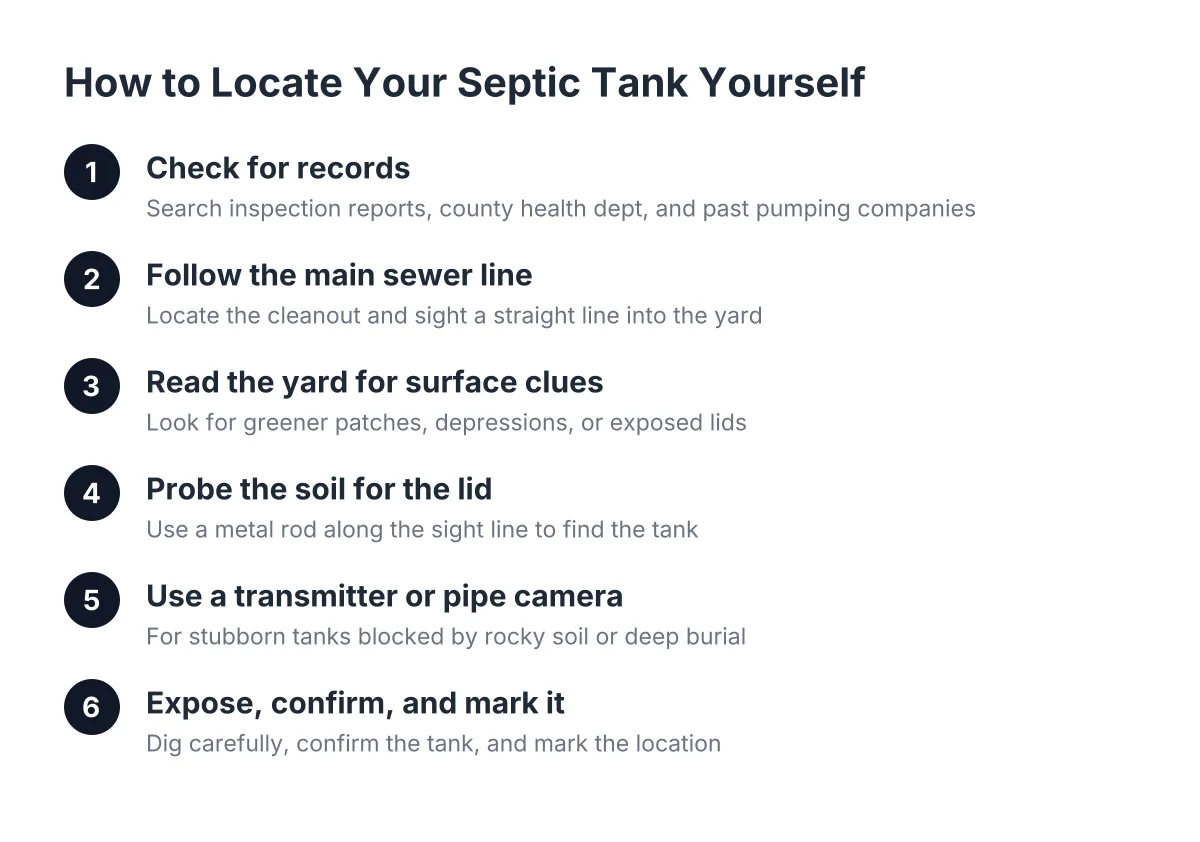
    Steps to locate septic tank yourself without records, from checking documents to marking it
    The six-step DIY process this guide walks through to find a septic tank without records.

    Plenty of High Desert homes changed hands with no septic paperwork at all. If you just bought a place in Hesperia, or you have owned yours for years and never needed to dig, you may have no idea where the tank sits. The good news is you can locate septic tank yourself with a few simple methods and tools, no records required. This guide walks through the process step by step, then covers when it makes sense to bring in a locating crew instead.

    Missing records are common on older High Desert properties. Some homes here were built decades before counties kept consistent septic permits on file. Others have records that show a tank exists but not where it was buried. Either way, you cannot schedule septic tank pumping, pass a pre-sale inspection, or plan a remodel until someone finds the lid.

    Step 1: Check for Records Before You Dig Anything

    Start with paperwork, even if you think none exists. A permit sketch or as-built diagram can save you hours of probing in the yard.

    Look in these places first:

    • Your home purchase documents, especially the inspection report and any seller disclosures
    • The San Bernardino County environmental health department, which may have a permit or as-built drawing on file
    • The company that pumped the tank last, if a neighbor or previous owner remembers the name
    • The original builder or a long-time neighbor with a similar floor plan

    Even a rough sketch helps. A diagram that shows the tank 15 feet off the back door narrows your search from the whole yard to a strip of dirt you can probe in an afternoon.

    However, do not be surprised if the county has nothing. Many Hesperia parcels predate consistent record keeping. If the paper trail is a dead end, move to the physical clues.

    Step 2: Follow the Main Sewer Line From the House

    Your main drain line points straight at the tank. Find where the sewer pipe exits the house and you have a direction to follow.

    First, locate the main cleanout. It is usually a capped pipe, 3 to 4 inches wide, sticking a few inches out of the ground near the foundation. In homes with a basement or crawl space, you can often see the main line itself and note which wall it exits through.

    Next, stand at that exit point and sight a straight line out into the yard. Septic installers almost always run the pipe straight to the tank to keep the fall consistent. Most tanks sit 10 to 25 feet from the house, though older installs vary.

    In addition, note the slope of your lot. Sewage moves by gravity, so the tank will be downhill from the house, never uphill. On a flat Hesperia lot that clue matters less, but on a sloped parcel it can rule out half the yard immediately.

    Step 3: Read the Yard for Surface Clues

    A buried tank often announces itself if you know what to look for. Walk the area along your sight line slowly and check for these signs:

    • A rectangular patch where grass or weeds grow greener or faster, fed by moisture below
    • A low spot or shallow depression where backfill settled over the tank
    • A bare or stressed patch of ground, since some tanks sit shallow enough to dry out the soil above them
    • Concrete lids, risers, or inspection pipes barely poking through the dirt
    • Areas snow melts first in winter, if you catch a rare High Desert snowfall

    For example, say a homeowner in Hesperia bought a 1978 ranch house with zero septic paperwork. In that scenario, a faint rectangular dip about 18 feet off the back bathroom wall, right along the line from the cleanout, would be the first place to probe. That combination of clues finds a lot of tanks.

    Desert landscaping makes this harder. Gravel yards and native scrub hide settling and green patches that a lawn would reveal. If the surface tells you nothing, you will need to probe.

    Step 4: Probe the Soil to Locate Your Septic Tank Lid

    A soil probe is the classic tool to locate a septic tank, and it is cheap. Any 4 to 5 foot metal rod with a handle works; hardware stores sell purpose-made probes for the price of a tank of gas.

    Work along your sight line from the cleanout, pushing the probe into the soil every couple of feet. Most tanks sit with their top 6 inches to 2 feet below grade. When the probe hits something flat and hard at a consistent depth, you have likely found the tank; concrete feels solid and unforgiving, while fiberglass or plastic gives a duller thud.

    Once you hit the tank, probe outward to trace its edges. Finding the corners tells you the tank's footprint and orientation, which helps you find the lid. On most tanks, the access lid sits over the inlet end, the outlet end, or the center. Probe for a slightly raised or distinct spot within the footprint.

    Two cautions here. Probe gently; older concrete lids can be brittle, and a hard jab can crack one. Also call 811 before any digging so buried gas, water, and electric lines get marked first. That call is free and it is the law before you excavate.

    Step 5: Use a Flushable Transmitter or Pipe Camera for Stubborn Tanks

    Sometimes probing fails. Caliche layers and rocky High Desert soil can stop a probe cold, and deep-set tanks sit below comfortable probing depth. When that happens, electronic locating tools take over.

    A flushable transmitter is a small radio beacon you flush down a toilet. It travels the sewer line and stops at the tank inlet, and a handheld receiver above ground pinpoints its position. Some homeowners rent these; septic crews carry them as standard equipment.

    Similarly, a pipe camera with a locating sonde can be fed through the cleanout. The camera shows the pipe's condition on the way, and the sonde lets the operator mark the line's path and the tank connection from the surface. This method has a bonus for anyone planning maintenance: you learn whether the line has root intrusion or bellies before they cause a septic backup.

    Therefore, if you have already spent a weekend probing with nothing to show for it, electronics are the logical next step. This is also where a professional septic tank locating service earns its fee, since the equipment, the experience reading desert soil, and the ability to expose and mark the lid come as one visit.

    Step 6: Expose, Confirm, and Mark the Location

    Finding the tank is only half the job. Now confirm it and record it so you never search again.

    Dig carefully by hand over the spot you identified until you expose the lid. Confirm it is the access lid, not just the tank top, since pumping requires an opening large enough for the hose. If the lid sits more than a few inches down, consider having a riser installed; a riser brings the access to grade so future septic tank pumping does not start with a shovel.

    Then document everything:

    1. Measure from two fixed points, such as house corners, to the lid center, and write the distances down
    2. Take photos of the open hole with the house in frame for reference
    3. Sketch a simple map showing the tank, the sewer line path, and the drain field direction if known
    4. Drop a pin on your phone's map app and save it
    5. Keep a copy with your house documents and give one to whoever pumps the tank

    As a result, the next crew that services the system drives up, opens the lid, and gets to work. No searching, no extra digging charges, no wasted trip.

    When to Call a Pro Instead of Doing It Yourself

    Call a professional when probing fails, when you suspect the tank sits under concrete or a structure, or when a sale or permit deadline gives you no time to experiment. A crew with transmitters, cameras, and desert digging experience can find, expose, and mark a tank in one visit instead of your several weekends.

    There are also situations where DIY carries real risk. A backup in progress means the tank may be full to the lid; opening it without the right setup exposes you to sewage and dangerous gases. Old steel or failing concrete tanks can have unsafe lids that collapse under weight. If anything about the tank looks compromised, stop and get a professional opinion before anyone stands over it.

    The trade-off is straightforward. DIY locating costs you time and a probe rod, and it works on most straightforward lots. Professional septic tank locating costs money but comes with the equipment and judgment to handle no-record properties, buried lids under hardscape, and tight timelines. Neither choice is wrong; it depends on your soil, your schedule, and how the first attempt goes.

    Why Finding the Tank Now Beats Finding It During an Emergency

    Locating the tank while nothing is wrong is the cheapest version of this job. According to the U.S. Environmental Protection Agency, more than one in five U.S. households depend on individual septic systems, and the EPA recommends a professional inspection at least once every three years. You cannot follow that schedule if nobody knows where the tank is.

    The cost math backs this up. Angi data puts the average cost of septic tank pumping at $427, with a typical range of $250 to $1,250 depending on tank size and location. Meanwhile, the EPA estimates septic repair or replacement typically runs $5,000 to $15,000. A neglected tank that fails because it was never found and never pumped lands on the expensive side of that gap.

    So take the afternoon. Follow the sewer line, read the yard, probe the soil, and locate your septic tank before it forces the issue with a backup on a holiday weekend. Mark it, map it, and put pumping on the calendar. That is the whole difference between routine maintenance and an emergency call.

    If you need your septic tank serviced, Hesperia Septic can help.


    Related Reading

  • Septic Tank Locating Equipment: How Pros Find Buried Tanks With No Records

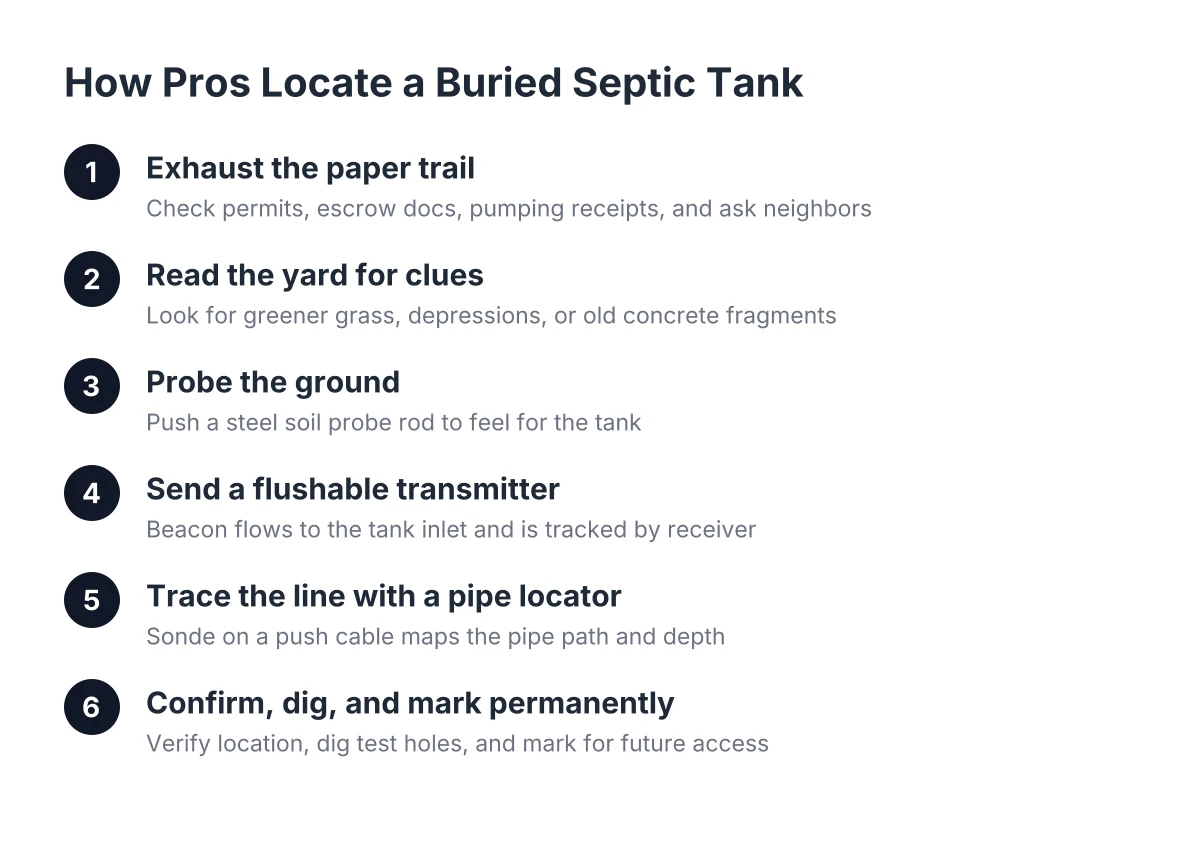
    Diagram of six steps in septic tank locating equipment process from paper trail to marking
    The six-step process professional crews use to find a septic tank with no records, as covered in this guide.

    If you own a Hesperia property with no septic records, the fastest path to a found tank is knowing what septic tank locating equipment the pros actually use and how each tool works. Older High Desert homes often changed hands three or four times before anyone thought to save a site map. The county may have nothing on file. That leaves you with a buried concrete tank somewhere in the yard and no lid in sight. This guide walks through the equipment step by step, in the order a professional crew typically uses it, so you know what to expect and how to help the process go faster.

    Step 1: Exhaust the Paper Trail Before Anyone Powers Up a Locator

    First, check every record source you can reach. Equipment is the answer when paperwork fails, but paperwork is free and sometimes fast.

    Look for these before scheduling a locate:

    • The property's original permit or "as-built" drawing from San Bernardino County Environmental Health
    • Home inspection or escrow documents from when you bought the house
    • Receipts from any past septic tank pumping visit; pumpers often note lid location
    • A previous owner or longtime neighbor who remembers where the truck parked

    Suppose you bought a 1978 ranch house off Ranchero Road five years ago and the seller handed you nothing. In that scenario, a county records request might turn up a rough sketch, or it might turn up empty. Either way, gather what exists. Even a partial drawing that shows which side of the house the tank sits on cuts locating time in half.

    If the paper trail dies, move to the physical clues, then the equipment.

    Step 2: Read the Yard the Way a Locator Tech Does

    Next, walk the property and note the signs a professional looks for before unloading a single tool. This step costs nothing and often narrows the search to a 200-square-foot patch.

    Watch for:

    • The point where the main sewer line exits the house, usually visible in the crawl space or at a cleanout
    • A patch of grass or weeds that grows greener or faster than the rest, common even in dry High Desert yards
    • A shallow depression or slight mound where soil settled over the tank after backfill
    • Old concrete fragments, riser rings, or a suspicious square of different-colored dirt

    The tank almost always sits along a straight line from where the sewer pipe leaves the house, typically 5 to 25 feet out. Mark that line with stakes or flags. Every tool in the next steps works faster when the search area is already narrow.

    Step 3: Probe the Ground With a Soil Probe Rod

    A soil probe is the simplest piece of septic tank locating equipment and often the first one out of the truck. It is a steel rod, usually four to five feet long, with a T-handle and sometimes a slightly bulged tip.

    The technician pushes the probe into the soil every couple of feet along the suspected line. Dirt gives way with steady resistance. A septic tank made of concrete stops the rod cold with a hard, flat clunk you can feel in your hands. Fiberglass and plastic tanks give a duller thud, so an experienced hand matters.

    However, Hesperia's soil creates a wrinkle here. Our decomposed granite and caliche layers can be hard enough to stop a probe on their own, which produces false positives. A pro learns to tell the difference between a caliche shelf and a tank lid by the sound and the way the rod skips. This is one reason a locate that looks simple on YouTube goes faster with someone who probes High Desert dirt every week.

    One caution: probing blind near a steel tank or an old cesspool can be risky, since corroded lids can collapse. If your home predates the 1970s and you have no idea what is down there, let a professional do the probing.

    Step 4: Send a Flushable Transmitter Down the Line

    When probing alone does not settle it, the crew moves to electronic septic tank locating equipment, and the workhorse is the flushable transmitter. This is a small waterproof beacon, about the size of a large pill capsule, that broadcasts a radio signal at a set frequency.

    Here is how a typical crew uses it:

    1. The technician flushes the transmitter down a toilet or drops it in through a cleanout.
    2. Water carries it along the sewer line toward the tank.
    3. Above ground, a handheld receiver picks up the signal and shows signal strength.
    4. The tech walks the yard, following the strongest reading until the transmitter stops moving.
    5. Where it stops is the tank inlet, and the crew marks that spot with paint or a flag.

    The transmitter usually parks itself at the tank's inlet baffle because the flow slows down there. From the inlet, the tech can estimate where the lid and the outlet sit based on typical tank layouts, then confirm with the probe from Step 3. As a result, digging is limited to one or two small test holes instead of trenching up half the yard.

    Step 5: Trace the Sewer Line With a Pipe Locator and Sonde

    Some properties fight back. Maybe the sewer line takes an unexpected turn around an old addition, or the transmitter hangs up on a root intrusion before reaching the tank. For those jobs, crews use a sonde on a push cable, paired with a pipe locator wand.

    A sonde works like the flushable transmitter, except it rides on the end of a semi-rigid cable the technician pushes through the line by hand. The receiver above ground tracks the sonde foot by foot, so the tech can paint the entire path of the pipe across the yard, including every bend. When the cable hits the tank baffle, the final signal marks the tank wall.

    In addition, this method tells you the depth of the line at each point, which matters before a remodel or a fence post project. If you are locating the tank because you plan to pour a slab, add a garage, or run irrigation, ask the crew to mark the full pipe run, not just the lid. It is the same visit and saves you a second locate later.

    Step 6: Confirm the Tank Location, Dig, and Mark It Permanently

    Finally, the crew confirms and exposes. Electronic tools narrow the target to a small circle; the shovel does the rest. The technician hand-digs a test hole at the marked spot, usually 12 to 36 inches down in this area, until steel or septic tank concrete appears.

    Once the lid is exposed, this is the moment to get the most from the visit:

    • Photograph the open hole with the house in the frame for reference
    • Measure from two fixed points, such as a house corner and a fence post, and write the distances down
    • Ask about adding a riser, which brings the lid access to grade so no one ever digs for it again
    • Have the tank pumped and inspected while it is open, since the hardest part of the job is already done

    The EPA recommends the average household have its septic system inspected at least once every three years, and more than one in five U.S. households rely on septic or small cluster systems. A found and marked tank is what makes that schedule realistic. Nobody keeps up with maintenance on a tank they cannot find.

    Why Professional Equipment Beats a Metal Detector for Tank Locating

    A common question from homeowners: can a metal detector from the garage find the tank? Usually not. Most tanks in the Hesperia area are concrete, and concrete gives a metal detector nothing to hit unless the lid has steel rebar or handles near the surface. Detectors also chirp on every buried nail, pipe scrap, and bottle cap in a yard that has seen fifty years of projects.

    By contrast, a professional septic tank locating service pairs the transmitter, the receiver, and local digging experience into one visit. The equipment finds the tank; the experience keeps the crew from probing through an inlet pipe or digging into an abandoned cesspool. On a property with no records, that combination is the difference between two marked flags in the yard and a weekend of random holes.

    There is a limit worth naming. Locating tells you where the tank is, not what condition it is in. A tank with a cracked lid, a failed baffle, or a saturated drain field needs an inspection to catch, and repair or replacement runs far beyond routine service; the EPA estimates $5,000 to $15,000 for repair or replacement, compared with routine pumping that Angi data puts at a $427 average. Finding the tank is Step 1 of staying on the cheap side of that math.

    Keep the Location From Getting Lost Again

    You did the locate once. Make sure the next owner, or future you, never has to repeat it. Sketch a simple site map with your two measured distances, store the photos with your house documents, and note the date of the pumping that followed. Then put the next service on the calendar so the tank gets attention on a schedule instead of during an emergency, which is exactly the outcome a maintenance-minded homeowner is after.

    If you need your septic tank serviced, Hesperia Septic can help.


    Related Reading

  • What Septic Tank Locating Does When Your Property Has No Records

    septic tank no records

    Suppose you just bought a rental in Hesperia, the tank has never been pumped on your watch, and nobody left you a map. Before any crew can pump, inspect, or repair that system, someone has to find it. That is what septic tank locating does: it pins down exactly where your buried tank and its lid sit, so the rest of the work can happen without digging up half the yard. For High Desert properties with septic tank no records, it is often the first job, not an extra.

    This matters more than most new owners expect. More than one in five U.S. households depend on individual septic systems or small community cluster systems to treat their wastewater, according to the U.S. Environmental Protection Agency. In Hesperia and the surrounding High Desert, that share runs higher, and many of those systems went in decades ago with paperwork that never followed the property through each sale.

    Here is a step-by-step guide to how a locate actually works, what you can do yourself first, and where a professional earns their fee.

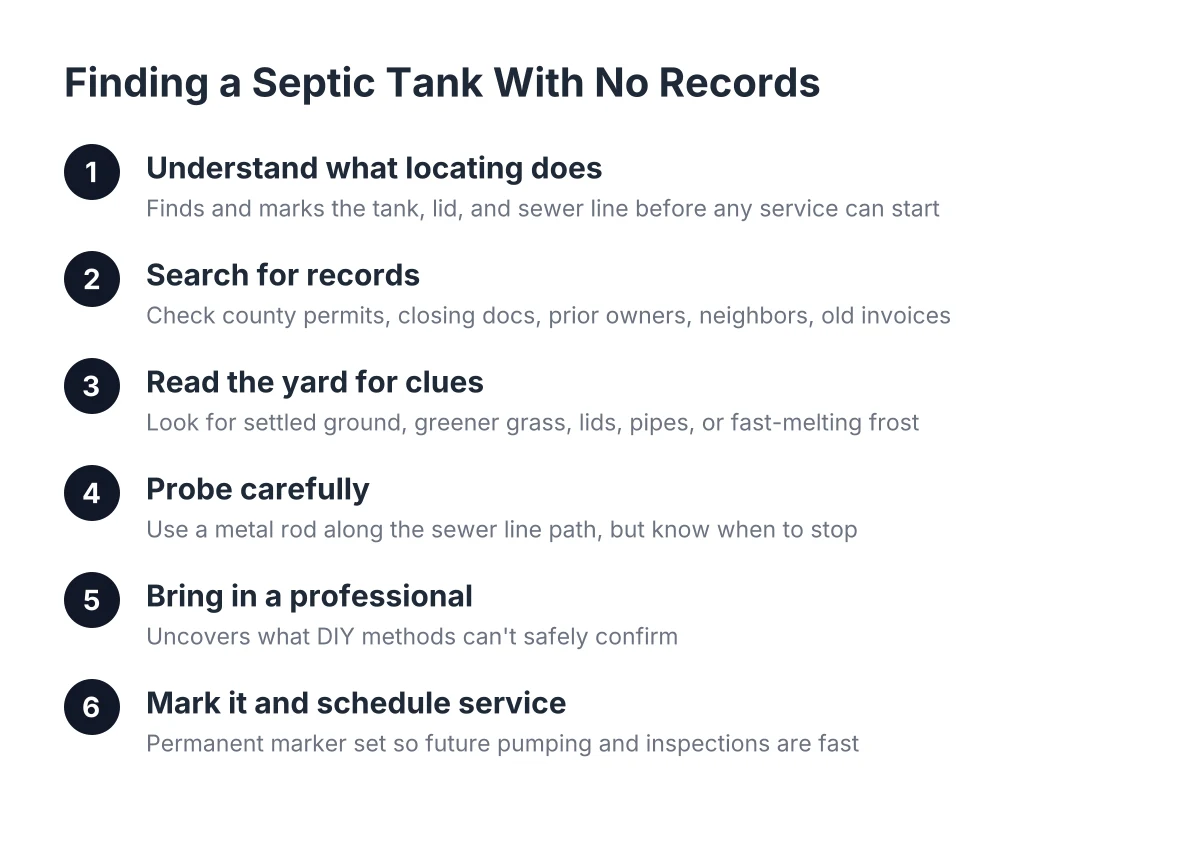
    Step 1: Understand What Septic Tank Locating Does and Why It Comes First

    Septic tank locating is the process of finding and marking a buried septic tank, its lid, and often its main sewer line when the location is unknown. A crew traces the line from the house, confirms the tank position, and marks the lid so it can be exposed for pumping, inspection, or repair.

    Why does this come before everything else? A pumping truck cannot pump what it cannot reach. An inspector cannot inspect a lid nobody can find. A remodel or addition cannot get approved if the county does not know where the system sits. Locating is the key that unlocks all of it.

    For a small landlord, the timing usually looks like one of these:

    • A tenant reports slow drains or a sewage smell, and you realize you have no idea where the tank is.
    • You are turning over a unit between leases and want the tank pumped before the next tenant moves in.
    • You are buying land or a house with a septic system and the seller has no records.
    • You are planning a remodel, a driveway, or a new structure and need the tank marked so nothing gets built over it.

    In each case, the locate is a one-time cost that pays off every time the system needs service afterward. Once the tank is found and marked, every future septic tank pumping visit gets faster and cheaper.

    Step 2: Searching for Records When You Have No Septic Tank Documentation

    Start with paper, not a shovel. San Bernardino County may have a permit or an as-built diagram on file showing where the tank was installed. Ask the county's environmental health or building department for any septic permit records tied to the parcel number.

    Next, work through these sources:

    1. The seller's disclosure packet or your closing documents, which sometimes include a septic inspection from the sale.
    2. The previous owner or their realtor, who may remember where the last pumping crew dug.
    3. Neighbors with similar-age homes, since tract-built houses in the same era often placed tanks in the same relative spot.
    4. Any old invoices from a septic company left in a kitchen drawer or garage, which sometimes sketch the tank location on the receipt.

    However, be ready for dead ends. Many High Desert homes were built before consistent record-keeping, and rural parcels changed hands with no paperwork at all. Situations where you find a septic tank with no records are common here, not a red flag about your property. If the paper trail runs out, move to the physical clues.

    Step 3: Read the Yard for Physical Clues

    Your yard often tells you where the tank sits, if you know what to look for. Walk the property, especially the area between the house and the property line on the side where the main bathroom plumbing exits.

    Look for these signs:

    • A rectangular patch of ground that settles lower or sits higher than the surrounding dirt.
    • Grass or weeds that grow greener or faster in one spot, even in dry High Desert conditions.
    • A concrete lid, a metal cap, or a white PVC pipe sticking a few inches out of the ground; that pipe may be a cleanout or an inspection port.
    • Snow or frost that melts faster over one area in winter, since tank contents run warmer than soil.

    In addition, check inside the house. Find where the main sewer line leaves the foundation, usually below the lowest bathroom or in the crawl space. The tank typically sits along that line's path, often within 10 to 25 feet of the house, though older rural installs can break that rule.

    Mark anything promising with a flag or a rock. Even a rough guess saves a professional crew time, and time is what you pay for.

    Step 4: Probe Carefully, and Know When to Stop

    If the clues point somewhere specific, you can probe by hand. Use a thin metal rod, push it into the soil at an angle, and feel for the hard, flat resistance of a concrete or fiberglass tank top. Work in a grid pattern along the suspected sewer line path.

    Stop probing if any of these apply:

    • The soil is soft, wet, or smells like sewage, which can mean a failing lid or a saturated area you should not stand on.
    • You hit anything that feels like pipe rather than tank; older clay and Orangeburg lines crack under a probe.
    • The tank might be steel, common in older installs, since a rusted steel lid can collapse under a person's weight.

    That last point is the honest limitation of every do-it-yourself method. An aging tank lid is a genuine safety hazard, and gases inside a tank can be fatal. If you have any doubt about the tank's age or material, or if probing turns up nothing after an hour, hand the job to a professional. This is one of the places where paying for expertise beats guessing.

    Step 5: What Professional Septic Tank Locating Uncovers

    A professional locate uses tools and pattern knowledge that a homeowner with a probe rod does not have. A typical crew flushes a small transmitter down a toilet, then follows its radio signal above ground with a receiver. The signal stops moving where the line enters the tank, which pins the location within inches. Crews may also use electronic line tracers or probe with experience behind every push.

    What professional septic tank locating does beyond finding the tank is the part most owners undervalue. A good locate visit should leave you with:

    • The tank position and lid marked, and usually the lid exposed for immediate pumping if you schedule both together.
    • A sense of the tank's orientation, since many tanks have separate access points over the inlet and outlet.
    • Notes on where the drain field likely runs, so you never park, build, or plant over it.
    • A record you can keep in your property file, which matters when you own two, three, or five septic-served rentals and cannot memorize every yard.

    For example, say a landlord owns a 1970s rental off Ranchero Road with a septic tank no records situation. In that hypothetical, a locate plus pumping in one visit might run a few hundred dollars total as a rough estimate, and the marked lid location cuts every future service visit down because nobody hunts for the tank again. Compare that with the alternative: pumping alone averages $427 according to Angi data, while the EPA estimates septic repair or replacement typically costs $5,000 to $15,000. Finding the tank so it can be maintained is the cheap end of that spectrum by a wide margin.

    Step 6: Mark It Permanently and Put the System on a Schedule

    Once the tank is found, never lose it again. Take photos with measurements from two fixed points, like a house corner and a fence post. Sketch the location and keep it with the property's records. Some owners set a flat paver or a discreet marker over the lid; others install a riser that brings the lid access to ground level so no digging is ever needed again.

    Therefore, the locate should flow straight into a maintenance plan. The EPA recommends a professional inspection at least once every three years for the average household, and once a year for systems with pumps, float switches, or other mechanical parts. For a rental, tie the inspection to something you already do, like lease renewal or an annual property walkthrough.

    As of 2026, there is no shortcut around this for High Desert properties with missing records. But the good news is that septic tank locating is a one-time problem. Solve it once, document it, and your septic system goes from a mystery under the dirt to a line item you manage on your own schedule, before a tenant ever calls about a backup.

    If you need your septic tank serviced, Hesperia Septic can help.


    Related Reading