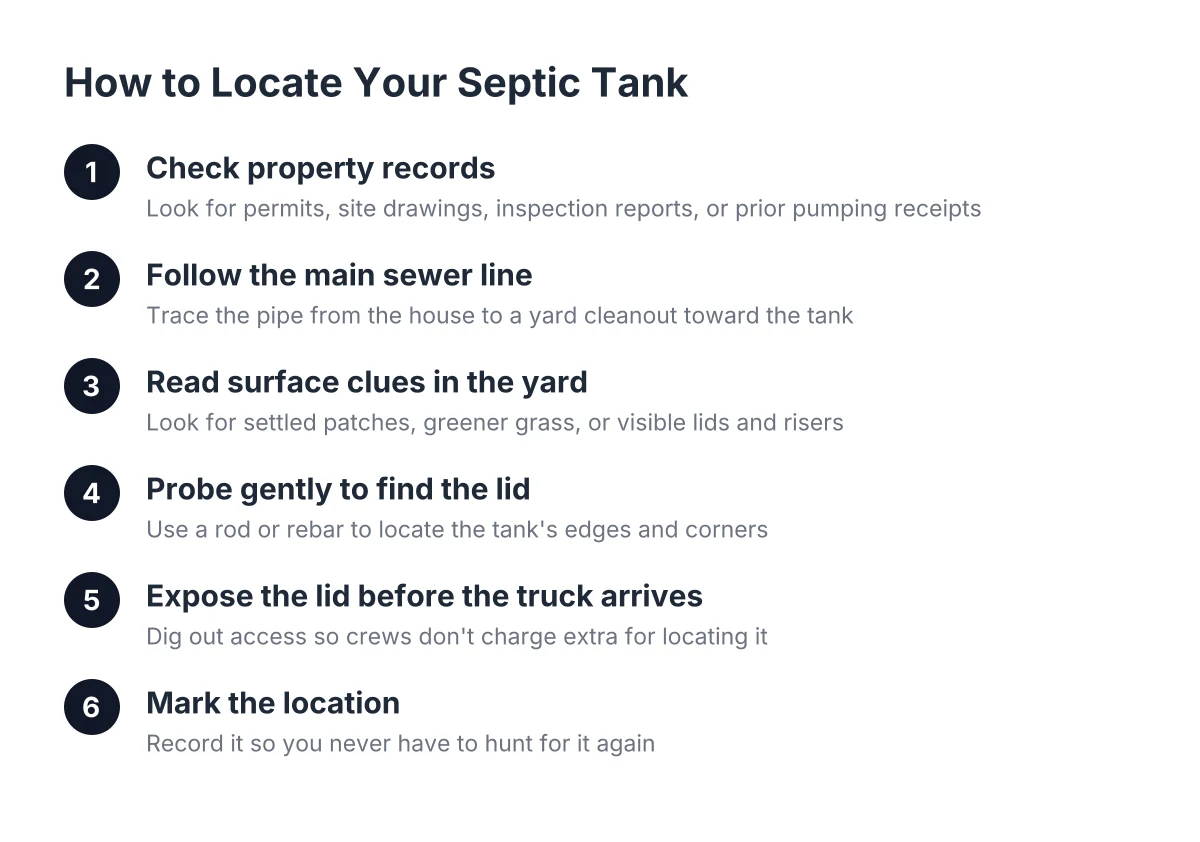
If sewage is backing up into your tub or a wet spot is spreading in the yard, the first thing a pumping crew will ask is where your tank is. Knowing how to locate your septic tank before the truck arrives saves time on the visit, can cut what you pay for digging and access, and gets the actual pumping started faster. This guide walks you through finding the tank step by step, using clues most Hesperia properties already have, whether you live in the house or own it as a rental.
Here is why it matters. Locating and uncovering the tank is the first part of any proper pumping job. If the crew has to spend an hour probing your yard and digging out a buried lid, that time usually shows up on the bill. If the lid is already exposed when the truck pulls up, the visit is shorter, cheaper, and a lot less stressful, especially during a backup.
Step 1: Check Your Property Records First
Start with paperwork, not a shovel. Most septic systems in San Bernardino County were permitted when they were installed, and that permit often includes a site drawing showing where the tank sits relative to the house.
Look in these places:
- Your home purchase documents, especially any septic inspection report from escrow
- The county environmental health department, which may have the original septic permit and as-built drawing on file
- Prior pumping receipts or invoices, which sometimes note the tank location
- A property survey or plot plan from your closing paperwork
For landlords, this step is worth doing for every septic property you own, not just the one with a problem today. Say you own three rentals in Hesperia and Oak Hills. Pulling the permit drawings once and keeping them in each property file means the next tenant complaint about slow drains does not turn into a two-hour tank hunt on a Saturday.
If the records exist, you may be done in twenty minutes. If they do not, move to the physical clues.
Step 2: Follow the Main Sewer Line Out of the House
Every drain in your house connects to one main pipe that carries wastewater to the tank. According to the US EPA, a single pipe connects all household drains to the septic tank, where solids settle out; the remaining liquid then flows out to perforated pipes in the drain field. Find that pipe and you can trace a straight line to the tank.
First, go to your basement or crawl space if you have one. Look for a 3 to 4 inch pipe exiting through the foundation wall or floor. Note which side of the house it leaves from. The tank will be somewhere along that line outside.
Next, look for a cleanout in the yard. That is a capped pipe, usually white or black plastic, sticking a few inches out of the ground between the house and where the tank likely sits. A cleanout is a strong clue; the tank is typically along the same line, farther from the house. Crews use cleanouts to trace the pipe quickly, so even if you cannot find the tank itself, knowing where the cleanout is helps.
Keep in mind the tank will not be right against the foundation. According to the Minnesota Pollution Control Agency, most local regulations require at least 10 feet between a septic system and the building it serves. In practice, many tanks sit 10 to 25 feet out from the house along the sewer line.
Step 3: Read the Yard for Surface Clues
High Desert yards give away tank locations more often than lawns in wetter climates. Walk the area along your traced sewer line and look for these signs:
- A rectangular patch where dirt has settled or sits slightly lower than the surrounding ground
- A spot where snow melts faster in winter, or where the ground stays greener than the rest of the yard
- Concrete or plastic lids, risers, or inspection ports flush with the ground, sometimes hidden under gravel or brush
- A mound or slight rise where the tank was backfilled after installation
- During a backup, a wet, soggy, or foul-smelling area, which often sits over the tank or the drain field
In addition, think about where the tank is not. Installers avoid putting tanks under driveways, patios, decks, and mature trees. If your traced line runs toward open dirt, that open dirt is your best candidate.
Step 4: Probe Gently to Locate Your Septic Tank and Find the Lid
Once you have a likely spot, confirm it with a probe before you dig. Use a thin metal rod, a length of rebar, or a soil probe. Push it into the ground gently every foot or two along your line. Buried septic tanks in this area typically sit anywhere from a few inches to a couple of feet down, and you will feel a solid thunk when the probe hits concrete or hard plastic.
Probe carefully and at an angle. Older tanks can have deteriorated lids, and inlet and outlet pipes near the tank are easy to crack with a hard jab. If the probe hits something solid, work outward to map the edges. A residential tank is usually a rectangle several feet long, so finding two corners tells you where the lids sit.
However, know when to stop. If you cannot get a solid hit, or the property is old and nothing matches the records, do not tear up the yard on a guess. Locating a buried septic tank with no records and no surface clues is a common situation, and it has a professional fix, covered in Step 6.
Step 5: Expose the Lid Before the Truck Arrives
Finding the tank is half the job. The pump truck needs the access lid uncovered, so if you are able, dig it out yourself before your appointment. Crews charge extra when they have to locate and dig out access on site, and during an emergency backup that digging time is time sewage keeps rising.
Dig by hand with a shovel, clearing dirt off the lid and a few inches around its edges so it can be lifted. Do not open the lid yourself. Septic gases are dangerous, and an open tank is a fall hazard for kids and pets. Exposed and closed is the goal.
For a sense of the money involved, according to Angi data, septic tank pumping averages $427, with a typical range of $250 to $1,250 depending on tank size and location. Digging out your own lid keeps you toward the lower end of whatever your local pricing is, because the crew spends its time pumping instead of excavating. As of 2026, that gap between an exposed lid and a buried one is one of the few pumping costs you can directly control.
Suppose a tenant calls on a Friday about sewage smell in the yard of your Hesperia rental. In that scenario, if you already know the tank location from your property file and can send a handyman to expose the lid that afternoon, the pumping visit is quick and the unit stays rentable through the weekend. If nobody knows where the tank is, the crew starts from zero.
Step 6: How to Locate a Septic Tank When You Can't Find It Yourself
A septic company can locate a tank that homeowners cannot, using tools built for the job. If your records are missing, probing finds nothing, and the yard gives no clues, a technician can run a plumbing camera with a locating transmitter through the sewer line and trace it above ground straight to the tank. This locating service carries its own fee, but it beats trenching random spots in your yard.
Locating is also worth paying for before big projects, not just before pumping. Knowing exactly where the tank and drain field sit before you pour a driveway, build a shop, or install a pool can prevent thousands of dollars in damage. And if a repair or replacement ever becomes necessary, the stakes are high; the EPA estimates septic repair or replacement typically runs $5,000 to $15,000, far more than routine service.
Step 7: Mark the Location So You Never Hunt Again
Once you locate your septic tank, make the find permanent. Sketch a simple map with two measurements from fixed points, for example, 18 feet from the northeast house corner and 12 feet from the fence post. Photograph the exposed lid with the house in the frame. Consider installing a riser that brings the access to grade so no one digs next time.
Then put the tank on a schedule instead of waiting for symptoms. Visible signs like backups and wet spots only show up after trouble has already started. The EPA recommends a professional inspection at least every three years for the average household, and Penn State Extension notes that pumping every two to three years is generally advisable for an active family of four. Rental properties with heavy use, or homes with garbage disposals, tend to need attention more often.
One honest trade-off: if you suspect the drain field is failing rather than the tank being full, locating and pumping the tank alone may not solve the problem, and you should have a professional assess the whole system. Pumping does buy time and lets a technician see the empty tank's walls and baffles clearly, which is often the most cost-effective first diagnostic step. Either way, it starts with knowing where the tank is. Find it once, mark it well, and every future service call in Hesperia gets faster and cheaper.
If you need your septic tank serviced, Hesperia Septic can help.
Prefer to talk it through? Call (760) 249-7872 — a quick call is usually the fastest way to get a straight answer for your situation.