If you own property in Hesperia, whether it is a home, a rental, or a small business on septic, you have probably wondered whether you need an inspection, a pumping, or both. Understanding the right inspection vs pumping schedule matters more than most owners realize. Schedule them wrong and you either pay twice for overlapping work or miss the one visit that would have caught a problem before it became a sewage backup. This guide breaks down what each service does, when to book them separately, when to combine them, and how the answer changes if you need documented reports for a home sale, a refinance, a lender, or a health inspector.
The short version up front: pumping removes waste, and inspection documents condition. One keeps the system working. The other proves it works, in writing, to a buyer, an escrow officer, a lender, or a county reviewer. Owners in the High Desert often need both, but not always at the same time, and not on the same schedule.
Inspection and Pumping Are Two Different Jobs
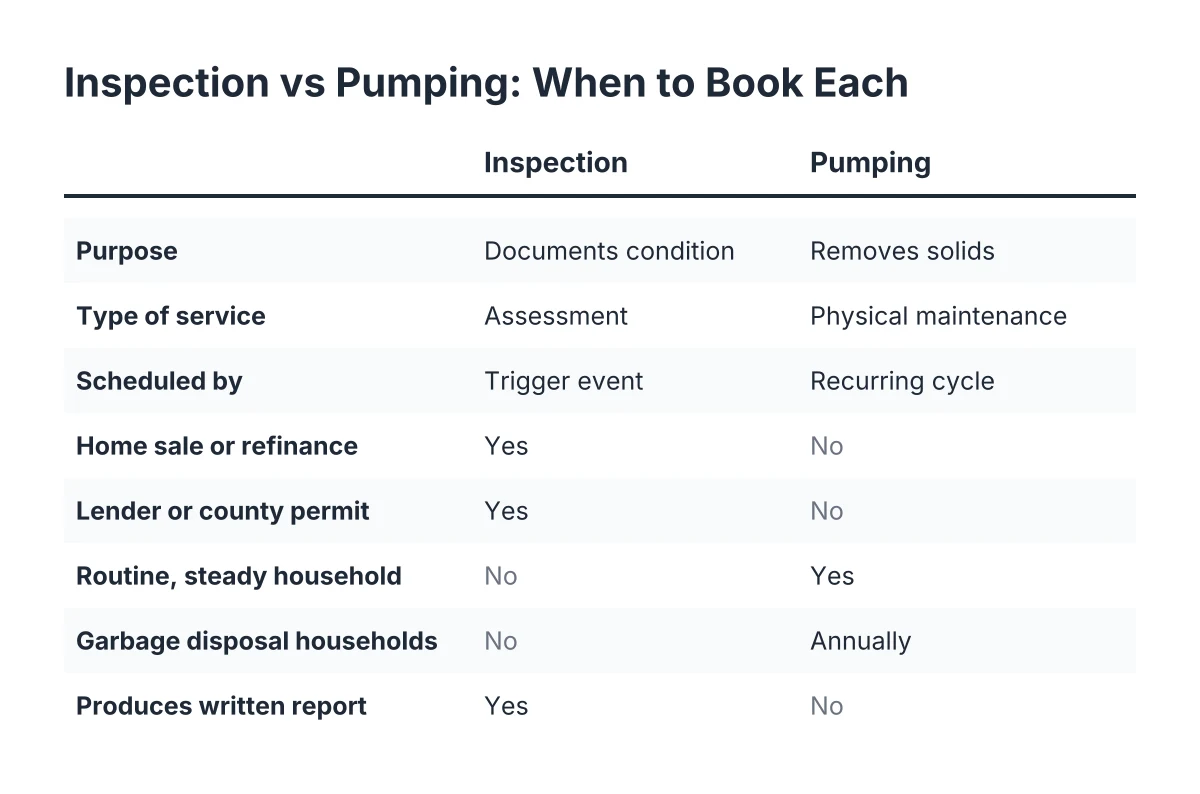
A septic inspection and a septic tank pumping solve two different problems, even though the same crew often performs both. Pumping is physical maintenance; a truck removes the sludge and scum that build up in your tank over time. Inspection is an assessment; a technician evaluates the tank, the pipes, and the drain field, then documents what they find.
According to the U.S. Environmental Protection Agency, a conventional septic system has two main components: the septic tank and the drain field. Pumping only touches the first one. All household drains feed a single pipe into the tank, where solids settle out and get removed by pumping, while the liquid flows out to perforated pipes in the drain field, according to US EPA. A pump truck cannot fix or even fully evaluate that second half of the system. That is inspection work.
Here is the practical difference for a Hesperia property owner:
- Pumping empties the tank of accumulated solids so wastewater keeps flowing and solids do not escape into the drain field.
- Inspection checks tank condition, baffles, inlet and outlet pipes, liquid levels, and signs of drain field trouble, then produces a written report.
- Pumping is routine maintenance you schedule on a recurring cycle.
- Inspection is due diligence you schedule around a trigger: a sale, a refinance, a permit, a tenant complaint, or a suspected problem.
Once you see them as separate jobs with separate purposes, the scheduling question gets easier to answer.
When an Inspection Should Come First, Without Pumping
Schedule a standalone septic system inspection when you need documented condition before a transaction or a decision, not when the tank is simply due for service. Buyers, sellers, lenders, and escrow officers all want the same thing: a written record of what is in the ground and whether it works. A pump-out receipt does not answer that question. An inspection report does.
Common situations where inspection leads and pumping waits:
- Buying a home or land in the High Desert. If the seller has no service records, an inspection tells you what you are inheriting before you sign. High Desert soil drains differently across short distances, and a system that looks fine on paper can hide a drain field near the end of its life.
- Selling a home on septic. A pre-listing inspection lets you fix small issues on your own timeline instead of during escrow, when every repair becomes a negotiation.
- Refinancing or lender requirements. Some lenders want documentation that the septic system functions before they close. A dated, written inspection report satisfies that request in a way a verbal "it seems fine" never will.
- Permits and county requirements. Additions, remodels, or new construction near an existing system often require documentation of the system's location and condition. County requirements vary, so confirm what your specific project needs before assuming a general report will do.
- Taking over a rental property. Say a landlord buys a four-unit property outside Hesperia with no septic records at all. An inspection establishes a baseline: tank location, tank condition, and drain field health. That baseline becomes the starting point for a realistic maintenance plan, instead of guessing until a tenant calls about a smell.
In each of these cases, the point of the visit is the report, not the pump-out. The inspector documents access points, measures sludge and scum layers, checks that the outlet sits lower than the inlet so only liquid leaves the tank, and notes any red flags in the yard above the drain field. For an escrow file or a lender, that document is the product.
One caveat: if the inspector finds the tank so full that they cannot evaluate the baffles or outlet, pumping may become necessary mid-inspection anyway. Plan for that possibility in your budget when the system has no service history.
When Pumping Should Come First, Without a Full Inspection
Book septic tank pumping on its own when the tank is due for routine service and nothing about the system has changed. If your household size is steady, drains run normally, the yard smells fine, and you pumped on schedule last time, you likely do not need a formal inspection report attached to every pump-out.
Pumping is the oil change of septic ownership. According to Penn State Extension, an active family of four generally benefits from pumping every two to three years because of higher solids and liquid production. Households with garbage disposals generate more sludge; the Massachusetts Department of Environmental Protection recommends annual pumping for those homes regardless of tank size. Your exact interval depends on tank size and how many people use the system, so a smaller household on a large tank can often stretch longer between visits.
Standalone pumping also makes sense for:
- Grease traps at restaurants and food businesses. Grease trap pumping runs on its own cycle, driven by kitchen volume and health code, not by the condition questions an inspection answers. If a health inspector flagged your trap, you need it pumped and documented, and you need a disposal record for your compliance file.
- RV and holding tanks. A holding tank has no drain field to inspect. It fills, you pump it. Cabin owners and RV operators around Hesperia mostly need a reliable pump-out schedule, not a condition report.
- Emergency backups. When sewage is backing into the house, pumping the tank relieves the immediate pressure. The diagnostic questions come after the crisis, not during it.
A worthwhile habit: even during a routine pump-out, a good crew looks at what the empty tank reveals. Cracks, corrosion, root intrusion, and a saturated drain field all show themselves more clearly with the tank empty. That informal look is not a formal inspection report, but it often catches problems early.
Building a Schedule: Inspection vs Pumping Frequency
A workable septic system care plan pairs a recurring pumping cycle with periodic professional inspections, then adds one-off inspections whenever a transaction or a symptom demands documentation. The U.S. Environmental Protection Agency recommends the average household have its septic system inspected at least once every three years by a professional. Alternative systems with pumps, float switches, or mechanical parts should be inspected once a year, according to the U.S. Environmental Protection Agency.
Here is a practical framework for 2026 planning:
- Set your pumping interval. Start from household size and tank size. A family of four on a standard tank lands in the two-to-three-year range per Penn State Extension. Adjust based on what the crew finds at each pump-out. Heavy sludge at two years means shorten the interval; a light tank means you can stretch it.
- Anchor inspections to the pumping visit when possible. Because an inspection-only visit often costs close to what pumping does, combining them on the same visit usually gives you more value per truck roll. The tank gets emptied and evaluated in one appointment, and you get gases released and a check for corrosion or root intrusion while the tank is open.
- Add standalone inspections for triggers. A sale, a refinance, a permit application, a new tenant complaint, or drains that slow across the whole house each justify an inspection outside the regular cycle.
- Check local requirements. Some jurisdictions require pump-outs or inspections at set intervals regardless of the system's actual condition. Verify what applies to your Hesperia property rather than relying only on general guidance.
- Keep every record. Pump-out receipts, disposal documentation, and inspection reports belong in one folder. For landlords and business operators, that folder is your habitability and health-code paper trail. For homeowners, it becomes the service history that makes your home easier to sell later.
The reason to formalize this instead of waiting for symptoms is simple: symptoms arrive late. By the time drains slow or the yard smells, solids may already be pushing into the drain field. Scheduled visits catch buildup before it travels, which is why a maintenance calendar beats a nose test every time.
What a Documented Inspection Report Should Contain
An inspection report worth handing to a lender or escrow officer documents the system's components, their condition, and the inspector's findings in writing, with dates. If you are ordering a septic inspection for a home sale, ask up front what the report will include. A one-line "system OK" note will not survive scrutiny from a buyer's agent or an underwriter.
A useful report typically covers:
- Tank location and access. Where the tank sits, how it was accessed, and whether locating work was needed. Properties with no records sometimes require septic tank locating before anything else can happen.
- Tank condition. Material, visible cracks or corrosion, baffle condition, and inlet and outlet pipe condition. According to University of Nebraska-Lincoln Extension, the outlet pipe must sit lower than the inlet, since solids float on the liquid and only liquid should exit toward the drain field. An inspector confirms that geometry still holds.
- Sludge and scum measurements. How full the tank was, which feeds directly into your future pumping interval.
- Liquid level observations. A level above the outlet suggests the drain field is not accepting water; a level below suggests a leak.
- Drain field indicators. Soggy ground, surfacing effluent, unusually green strips of vegetation, or odors over the field.
- Recommendations and date. What needs attention, what looks sound, and when the evaluation happened.
Context matters to the findings, so expect a thorough inspector to ask questions before the visit: the age of the house, repair history, how often the tank was pumped in the past, and where the property sits, whether on a rise or in a low spot. Those answers shape what they look for once they open the lids.
High Desert conditions add their own wrinkles. Soil that drains fast in one part of a parcel can drain slowly a hundred feet away, which is why a percolation test is required before installing any new system, according to University of Nebraska-Lincoln Extension, and why the local health department typically inspects as part of installation, per Caroline County Health Department. An inspector who knows how Hesperia-area soil behaves reads drain field symptoms differently than someone working from a generic checklist.
What Skipping Either Service Ends Up Costing
Skipping pumping lets solids overflow into the drain field, and skipping inspections lets hidden damage compound until it surfaces as a backup or a failed escrow. Both mistakes trade a modest, scheduled cost for a large, unscheduled one. The math is lopsided.
According to Angi, septic tank pumping averages $427, with a typical range of $250 to $1,250 depending on tank size and location. Compare that to repair or replacement: the EPA estimates septic repair or replacement typically costs between $5,000 and $15,000. A decade of on-schedule pumping costs less than a single drain field failure.
For a hypothetical example, suppose a Hesperia homeowner goes eight years without pumping because nothing seemed wrong. Solids fill the tank, then start flowing out with the liquid and clogging the drain field gravel. The first visible symptom is sewage backing into the shower on a Saturday. Emergency pumping relieves the backup, but the inspection that follows finds a saturated drain field that no amount of pumping will fix. In that scenario, a few skipped service visits turned into a five-figure replacement.
The reverse mistake costs money too. Pumping a lightly used tank every year wastes service calls, and paying for a full documented inspection at every routine pump-out adds cost without adding information. The goal is not maximum service; it is matched service, with each visit doing a job you actually need done.
There are also limits to what any schedule can promise. An inspection is a snapshot of condition on one date, not a warranty against future failure, and unusual situations, such as a suspected collapsed tank or a system with no locatable components, call for professional evaluation before anyone commits to a plan.
Quick Decision Guide: Which Service Do You Book This Time?
When you are staring at the phone deciding what to ask for, run through this list:
- Selling, buying, or refinancing? Book an inspection. Expect pumping may be added if the tank is too full to evaluate.
- Tank due on your regular cycle, no symptoms? Book pumping. Ask the crew to note anything unusual they see in the empty tank.
- Hit your inspection year on the calendar? Combine inspection with pumping in one visit to get full value from the appointment.
- Sewage backup, alarm sounding, or odors in the house? Book emergency pumping first. Schedule the diagnostic inspection once the immediate problem is relieved.
- Health inspector flagged your grease trap? Book grease trap pumping and keep the disposal documentation for your compliance records.
- New rental or land purchase with no records? Book locating plus inspection to establish a baseline, then set the recurring maintenance schedule from what the report shows.
- RV or cabin holding tank? Book pumping on a usage-based cycle; no drain field means no field inspection needed.
Treat the two services as tools with different jobs. Pumping keeps the system alive. Inspection tells you, and everyone who needs proof, exactly where the system stands. Owners in Hesperia who schedule each one deliberately, instead of lumping them together or skipping both, spend less over the life of the system and never find themselves explaining a surprise to an escrow officer or a health inspector.
If you need your septic tank serviced, Hesperia Septic can help.