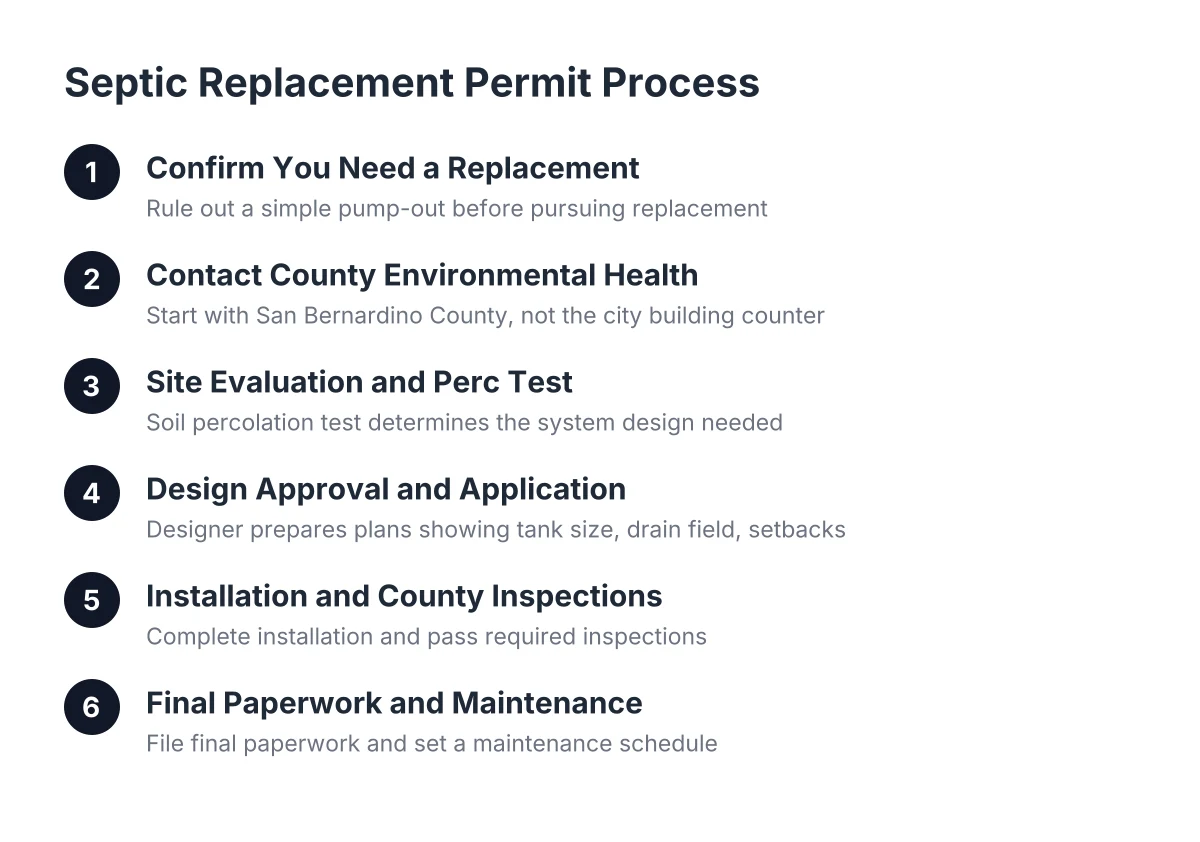
If your septic system in Hesperia has failed for good, the paperwork matters as much as the digging. Local septic replacement permits are required before any new tank or drain field goes in the ground, and San Bernardino County treats septic work as a public health issue, not a simple yard project. Skip the permit step and you risk fines, a stopped job, and problems when you sell or refinance the property. This guide walks you through the septic replacement permit process in order, from confirming the system is truly dead to passing the final inspection.
It is written for property owners who have already decided to replace, especially landlords with one or a few rental units on septic who need the job documented and done right. First, though, a quick honesty check, because replacement is not always the answer.
Step 1: Confirm You Actually Need a Replacement, Not a Pump-Out
Before anyone pulls a permit, make sure the system is genuinely failing. A full tank causing a septic backup is a pumping job, not a replacement job. A tank that fills again within days of septic tank pumping, sewage surfacing over the drain field, or wastewater that has nowhere to go are different problems, and those point to real failure.
Here is the practical test. Have the tank pumped and inspected. If the tank is structurally sound and the drain field accepts water again after pumping, you likely bought yourself years with routine service. According to the U.S. Environmental Protection Agency, the average household should have its septic system inspected at least once every three years, and that habit alone catches most problems before they become failures.
However, if the drain field stays saturated after pumping, or the tank itself is cracked or collapsing, no amount of pumping fixes that. Health regulations do not allow a polluting discharge from a failed system, and the county can require full septic system replacement rather than accepting an additive or restoration product as a permanent fix. Any company that jumps straight to "you need a new system" without pumping and inspecting first deserves a second opinion. So does any company that insists pumping will fix a drain field that is clearly done.
The cost gap is why this step matters. Angi data puts average septic tank pumping at $427, ranging from $250 to $1,250 or more depending on tank size and location. The EPA estimates septic repair or replacement typically runs $5,000 to $15,000. You do not want to pay replacement money for a pumping problem, and you do not want to pay for repeated pump-outs on a system that is already dead.
Step 2: Contact San Bernardino County Environmental Health First
For septic permitting in Hesperia, start with the county, not the city building counter. Unincorporated county areas and most High Desert septic questions route through San Bernardino County's environmental health and land use services. If your property sits inside Hesperia city limits, the city building department may also have a role, so confirm with both before you assume anything. Requirements vary by locality, and the rules that applied at a friend's property in another county will not necessarily apply to yours.
When you call or visit, have these ready:
- The property address and parcel number (APN)
- What you know about the existing system: tank location, approximate age, and any past permits
- The nature of the failure: backed-up tank, saturated drain field, or surfacing sewage
- Whether the property is a rental, since tenant health complaints can change the urgency
Ask three specific questions: what permits the replacement needs, whether a soil or percolation test is required, and whether current setback rules will force the new system into a different spot than the old one. As of 2026, getting these answers in writing before design work starts saves the most common delay, which is a plan the county rejects on the first pass.
Step 3: Understanding the Septic Replacement Permit Requirements and Site Evaluation
A percolation test measures how fast water drains through your soil, and it must be done before a new system is designed. According to University of Nebraska-Lincoln Extension, a perc test is performed before installing a septic system to confirm the soil drains well enough for the system to work. In the High Desert, soil conditions vary from sandy washes to hardpan, so the result on your lot drives the design.
The county typically dictates what the perc results mean for your project. Good drainage may allow a conventional system, which per the U.S. Environmental Protection Agency consists of two main components, a septic tank and a drain field. Poor drainage, a small lot, or tight setbacks can push you toward an engineered or advanced treatment design, which costs more and takes longer to approve. In addition, most local regulations require at least 10 feet between the septic system and the building it serves, according to the Minnesota Pollution Control Agency, and setbacks from wells and property lines add further constraints.
Suppose you own a rental on a half-acre lot off Ranchero Road and the old drain field sits where current setbacks no longer allow one. In that scenario, the perc test and site evaluation would identify a new drain field location on the other side of the lot, and the design would route new lines accordingly. That is exactly the kind of surprise you want to find on paper, not mid-excavation with a tenant asking when the toilets will work.
Step 4: Design Approval and the Septic Replacement Permit Application Process
With perc results in hand, a system designer or licensed installer prepares plans showing the tank size, drain field layout, and setbacks, then submits them to the county for approval. Approved design plans generally must be on file before construction can begin, and local septic replacement permits are issued against that approved design. Do not let anyone start digging on a promise that the permit is "in process."
This is also where you choose who does the work. Septic installation is not the same trade as septic tank pumping. Becoming a licensed septic installer requires certification beyond a pumping operation, including exams on soil types, percolation rates, system design, and local regulations, according to the New Hampshire Department of Environmental Services. A local pumping and inspection crew still plays a role, though: pumping and decommissioning the old tank, locating buried components, and documenting the system's condition for the permit file. Understanding the septic replacement permit process and keeping all documentation ensures the work is properly recorded and will be recognized by future buyers or lenders.
For landlords, ask for copies of everything at this stage. The approved plans, the permit number, and receipts become part of the property record. Suppose you sell that rental in five years; a buyer's inspector who finds a permitted, documented replacement treats it as an asset, while an undocumented system triggers renegotiation.
Step 5: Complete the Installation and Pass County Inspections
Once local septic replacement permits are issued, installation follows the approved plan: excavate, remove or abandon the old tank properly, set the new tank, lay the drain field, and connect the lines. Waste pumped from the old tank does not stay on site; per the New Hampshire Department of Environmental Services, pumped septic waste is trucked to a sewage treatment plant for disposal.
Expect the county to look at the work before it disappears underground. A health department or county inspection is typically required as part of the installation process, often before backfill, so the inspector can verify the tank, lines, and drain field match the approved design. Build a day or two of schedule slack around inspections; a failed or delayed inspection with an open trench is the worst place to be rushed, especially with tenants on the property.
One trade-off to be honest about: doing this correctly takes longer than an unpermitted rush job, sometimes by weeks when perc tests and plan reviews stack up. The unpermitted version can void insurance coverage, block a sale, and expose a landlord to liability if sewage contaminates a neighbor's well or property. The slower path is the cheaper one over the life of the investment.
Step 6: File the Final Paperwork and Set a Maintenance Schedule
After the final inspection passes, collect the closed permit, as-built drawing, and any inspection sign-offs, and store them with the property records. This is the file the next buyer, lender, or insurance adjuster will ask for, and it is also what saves the next owner from paying to locate a tank nobody mapped.
Then protect the money you just spent. A new drain field fails the same way the old one did if the tank never gets pumped. Put the property on a schedule now:
- Record the installation date, tank location, and lid depth while it is fresh.
- Book a professional inspection at least every three years, per U.S. Environmental Protection Agency guidance, or once a year if the new system has pumps or float switches.
- Schedule septic tank pumping based on what those inspections find, rather than waiting for a tenant to report slow drains.
- Give tenants a one-page sheet on what not to flush and where the system sits, so nobody parks a trailer on the new drain field.
Because homes on septic are the exception in California, about 10 percent statewide according to the U.S. Environmental Protection Agency, many owners and tenants have never lived with one. A little documentation and a standing pumping schedule keep this replacement the last one you deal with for a long time. The permit process for local septic replacement in Hesperia is paperwork-heavy, but each step exists to make sure the system you pay for actually works in High Desert soil. When in doubt at any step, a licensed installer or the county environmental health office is the right call; this guide covers the general process, not the specifics of your parcel.
If you need your septic tank serviced, Hesperia Septic can help.
Prefer to talk it through? Call (760) 249-7872 — a quick call is usually the fastest way to get a straight answer for your situation.