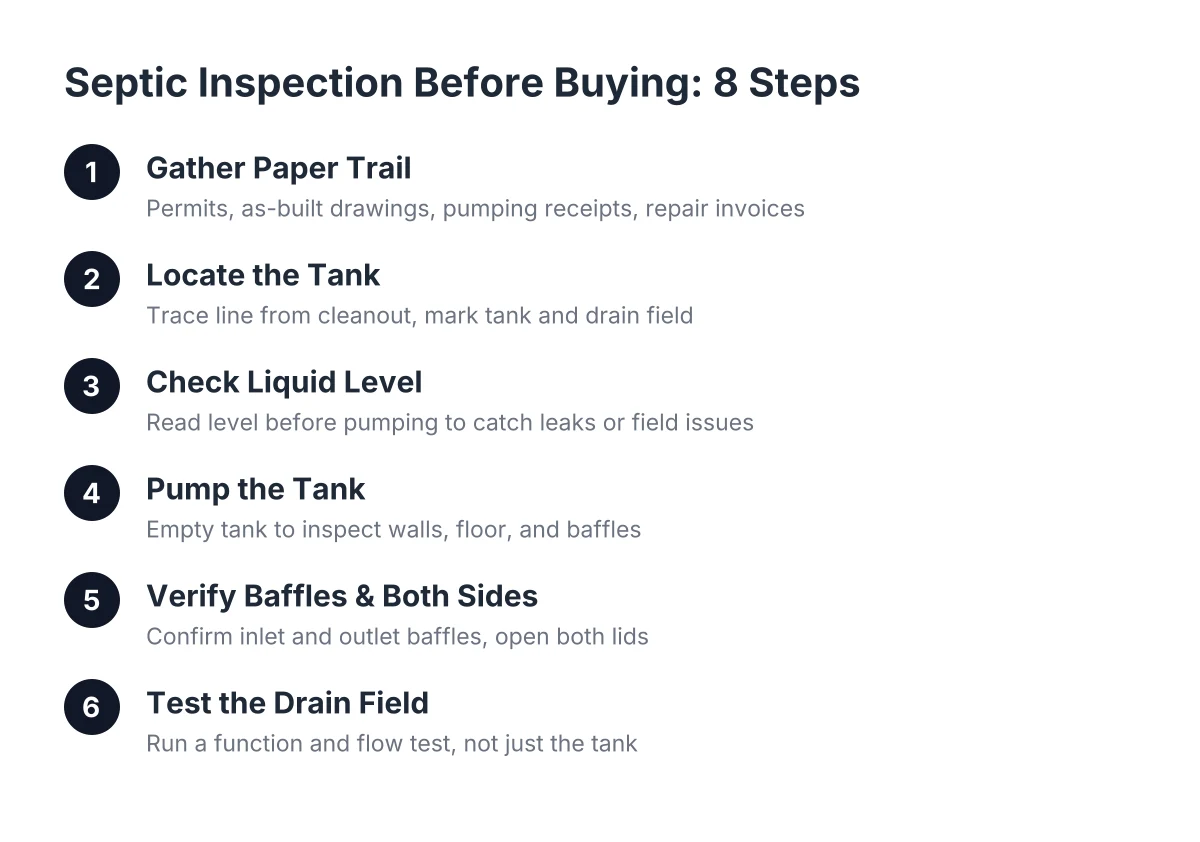
Buying property in Hesperia or anywhere in the High Desert with no septic records is a gamble most people don't realize they're taking. The seller shrugs, the listing says "septic," and there is no visible lid anywhere on the lot. Before you close, a full septic system inspection is the only way to know what's actually buried out there, and whether it works. A septic inspection before buying is the only way to know what's actually buried out there, and whether it works. This guide walks you through the process step by step, so you know what a real inspection covers before you commit money to the property.
Here is why this matters. According to U.S. Environmental Protection Agency, more than one in five U.S. households depend on individual septic systems or small community cluster systems to treat their wastewater. In the High Desert, that share runs high; whole neighborhoods here have never seen a sewer line. The EPA also estimates septic repair or replacement typically costs between $5,000 and $15,000. That is the size of the surprise you are trying to avoid.
Step 1: Gather Whatever Paper Trail Exists
Start before anyone touches a shovel. Ask the seller, the agent, and the county for anything on record: permits, as-built drawings, past pumping receipts, or repair invoices. San Bernardino County may have a permit on file showing where the tank was originally installed, even if the current owner has no idea.
Also collect the basics a septic crew will ask about anyway: the age of the house, whether any additions were built, and whether the lot sits on a hilltop or in a low spot. A house from the 1970s with zero pumping history tells a different story than a 2005 build with receipts every few years.
If nothing exists, that is your answer too. No records means the inspection has to do all the work, and you should budget for a locate as part of it.
Step 2: Locate the Tank and Mark It
You cannot inspect what you cannot find. On lots with no riser and no visible lid, a septic tank locating service traces the line from the house cleanout, follows it to the tank, and marks the spot. Crews use line locators, probe rods, and sometimes a flushable transmitter to pinpoint the lid under the dirt.
This step matters beyond the inspection itself. Knowing the exact tank and drain field location protects you later, when you park a trailer, pour a slab, or plan an addition. Digging or driving over an unknown tank is one of the more expensive mistakes a new owner can make.
For example, suppose a buyer is in escrow on a two-acre parcel off Ranchero Road with a 1980s house and no septic paperwork at all. A typical crew would locate the tank from the cleanout, dig to expose both lids, and mark the drain field area, all in the same visit as the inspection. That one appointment turns a total unknown into a documented system.
Step 3: Check the Liquid Level Before Anything Gets Pumped
This is the step that separates a real pre-purchase inspection from a quick pump-out. The inspector should open the tank and read the liquid level while the system is undisturbed. The level tells a story:
- Liquid at the normal operating line: the tank is holding and the outlet is likely flowing.
- Liquid above the outlet pipe: something downstream is not accepting water, often a drain field problem.
- Liquid well below the outlet: the tank may be leaking into the surrounding soil.
However, none of that can be read after the tank is emptied. If someone pumps first and inspects second, the most important evidence is already gone. Insist on the level check first.
Step 4: Pump the Tank So the Inspector Can See the Structure
Next, the tank gets pumped. Emptying it is not just maintenance; it is the only way to see the walls, the floor, and the baffles. A tank full of dark water hides cracks, root intrusion, and corroded concrete. Once the solids are out, the inspector can look at, and photograph, the true condition of the interior.
This is also where septic tank pumping earns its keep as part of the deal, not an add-on. As a rough national reference, Angi data puts the average cost of a pump-out at $427, with a range of $250 to $1,250 or more depending on tank size and location. Pumping during the inspection means the buyer starts with an empty, documented tank on day one.
Ask for interior photos with the report. Pictures of the inlet side, the outlet side, and any cracks or deterioration give you something concrete to bring to the negotiating table.
Step 5: Verify the Baffles and Both Sides of the Tank
Baffles are the small components that decide whether solids stay in the tank or wash out into the drain field. A thorough inspector confirms the inlet baffle and outlet baffle are present, intact, and correctly positioned. Missing or collapsed baffles are common in older High Desert tanks, and they quietly destroy drain fields over years.
In addition, both lids should be dug up and opened, not just one. The inlet side and outlet side can fail independently. An inspection that only looks down one hole is half an inspection.
Step 6: Test the Drain Field, Not Just the Tank
A conventional septic system has two main components, the septic tank and the drain field, according to U.S. Environmental Protection Agency. The tank is the cheaper half. The drain field is where the expensive failures live, so a full septic system inspection has to test it, not assume it.
A function and flow test does this. The inspector runs water through the system and watches how the drain field accepts it. Water backing up toward the tank, surfacing in the yard, or draining unusually slowly all point to a field that is saturated or failing. In our desert soil, a field can look fine from the surface for years while it quietly stops absorbing.
There is a limit to what any inspection can promise, though. An inspector can document current condition and flow, but no one can guarantee how many years an aging drain field has left. Treat the report as a snapshot, and lean on a professional to interpret borderline results before you close.
Step 7: Get a Written Report You Can Use in Escrow
The deliverable matters as much as the dig. Ask for a written report that includes:
- The marked location of the tank and drain field on the property
- Tank material, apparent condition, and interior photos after pumping
- Baffle condition on both the inlet and outlet sides
- Liquid level findings before pumping
- Flow test results for the drain field
- Any recommended repairs, with severity noted
That document does real work. Lenders and the county sometimes require it, and it gives you leverage. If the report turns up a cracked tank or a tired drain field, you can renegotiate the price, ask the seller to fund repairs, or walk away with your deposit intact. A bad report is not a wasted fee; it is the fee doing its job.
Worried about escrow timing? A locate, pump, and full septic system inspection is usually one visit once it is scheduled. Compared to a 30-day escrow, one on-site appointment is a small line item, and far faster than untangling a failed system after closing.
Step 8: Set a Baseline for the System Going Forward
Finally, once you own the place, put the inspection to work. Keep the report and photos with your property records, note where the lids are, and start a service history the next owner will thank you for. According to U.S. Environmental Protection Agency, the average household should have its septic system inspected at least once every three years by a professional, and Penn State Extension notes an active family of four generally does well pumping every two to three years.
The same logic applies if the property is commercial. Say the parcel comes with a small kitchen or you are eyeing it for an RV park; grease traps and holding tanks need the same treatment, a documented condition check up front and a recurring service schedule after. Compliance inspectors want records, and so will the next buyer.
What a Full Septic System Inspection Really Buys You
It buys certainty. Skipping the inspection to save a few hundred dollars, then discovering a failed system after closing, is the classic High Desert horror story. The 2026 reality is simple: a documented locate, pump-out, and inspection costs a fraction of the $5,000 to $15,000 the EPA cites for repair or replacement.
Why a Septic Inspection Before Buying Matters Most
If you are looking at land in Hesperia or the surrounding High Desert with no septic records, follow the eight steps above in order. A septic inspection before buying protects you by revealing the true condition of the tank and drain field. Find the tank, read it undisturbed, pump it, inspect it inside, test the field, and get it all in writing. Then you are buying a property, not a mystery.
If you need your septic tank serviced, Hesperia Septic can help.
Prefer to talk it through? Call (760) 249-7872 — a quick call is usually the fastest way to get a straight answer for your situation.