Most septic emergencies in Hesperia, CA start in the kitchen. Grease goes down the drain, hardens in the tank or the trap, and months later you have a backup at the worst possible time. That is why grease trap pumping in the kitchen matters more than most property owners realize. Whether you own a home with a heavy-use kitchen, manage a rental with septic, or run a small food operation out here in the High Desert, keeping grease out of your septic system is the single cheapest way to avoid an after-hours crisis. This guide explains how residential grease traps work, when they need pumping, what the service looks like, and how a local Hesperia crew handles the call when things have already gone wrong.
Why Grease Is the Hidden Cause Behind So Many Septic Backups
Grease does not dissolve, and it does not flow away. When hot cooking fat goes down the drain, it cools somewhere in your plumbing or your tank and sticks there. Over time it builds into a solid layer that blocks flow and starves your system.
The scale of the problem is bigger than most people think. According to the U.S. Environmental Protection Agency, grease from restaurants, homes, and industrial sources is the most common cause of reported sewer blockages, responsible for 47% of cases. Nearly half of all blockages trace back to fats, oils, and grease.
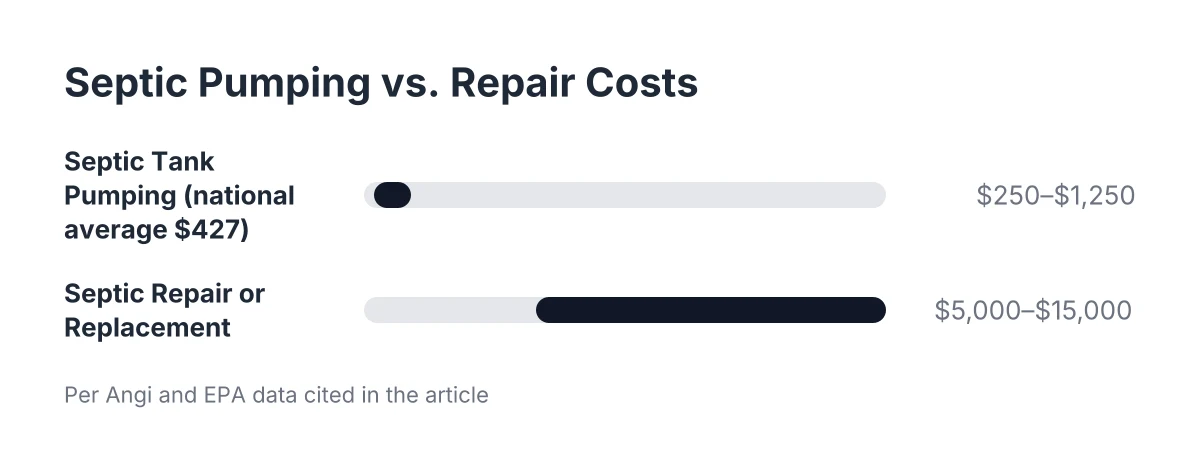
Inside a septic tank, the layers form the same way every time. According to the U.S. Environmental Protection Agency, fats, oils, and grease float to the top and form a scum layer, solids sink to the bottom as sludge, and the liquid in the middle is called effluent. When the scum layer gets thick enough, grease starts escaping into the drain field. Once grease clogs the soil out there, you are no longer talking about a pump-out. You are talking about a repair, and the EPA estimates septic tank repair or replacement typically costs between $5,000 and $15,000. Pumping is cheap by comparison.
Cutting back on the grease and paper that go down the drain is the most effective way to slow scum buildup and stretch the time between pump-outs. However, once grease is already in the tank or trap, the only fix is physical removal.
How Grease Trap Pumping in the Kitchen Prevents Septic Failure
A residential grease trap is a small holding box installed on the kitchen drain line, before wastewater reaches the septic tank. As greasy water flows in, the trap slows it down. The grease cools, floats to the top, and stays behind while the cleaner water continues on to the septic system.
Think of it as a filter for fats, oils, and grease. The trap can only hold so much. Once it fills past a certain point, grease starts flowing straight through, which defeats the purpose of having one. That is when the trap needs pumping.
Not every home in Hesperia has a grease trap. They are common in properties with commercial-style kitchens, guest houses, rentals with heavy kitchen use, and small food operations run from a residential property. If you are not sure whether your property has one, a septic inspection can locate it along with your tank. Many owners inherit a trap with a property purchase and never learn it exists until it overflows.
If your home has no separate trap, your septic tank itself is doing the grease-catching job. That makes regular septic tank pumping even more important, because every pan you rinse adds to the scum layer.
Warning Signs Your Grease Trap or Septic Tank Is Overloaded
Grease problems announce themselves before they turn into a full backup. Catch these early and you schedule a routine pump-out. Miss them and you are searching for 24 hour septic service at 11 p.m.
Watch for these signs at any Hesperia property you own or manage:
- Kitchen sink drains slower than the rest of the house
- A rancid or sour smell near the kitchen drain, cleanout, or trap lid
- Gurgling from the sink when the dishwasher or washing machine runs
- Water backing up into the sink when nothing is running
- Standing water or a greasy sheen near the trap or tank lid outside
- Slow drains across the whole house, which points to the septic tank rather than just the trap
The last one matters most. In addition to trap problems, whole-house slow drains suggest the septic tank itself is full or the drain field is struggling. Most emergency backup calls happen because a tank went years past its service interval and the sludge and scum layers finally choked off the flow. If drains are slow everywhere and there is an odor in the yard, treat it as urgent.
For landlords, tenant complaints are your early warning system. Suppose a tenant texts you about a smell near the kitchen and a slow sink. That is worth a service call this week, not a note for next quarter. A pump-out you schedule costs less than the emergency version, and far less than a habitability dispute.
What Happens During Residential Grease Trap Pumping in the Kitchen
Residential grease trap pumping is a straightforward service call. A crew arrives with a vacuum truck, opens the trap, removes all the contents, scrapes the hardened grease off the walls and baffles, checks that the trap components are intact, and closes it back up. Most residential traps take under an hour once the lid is open.
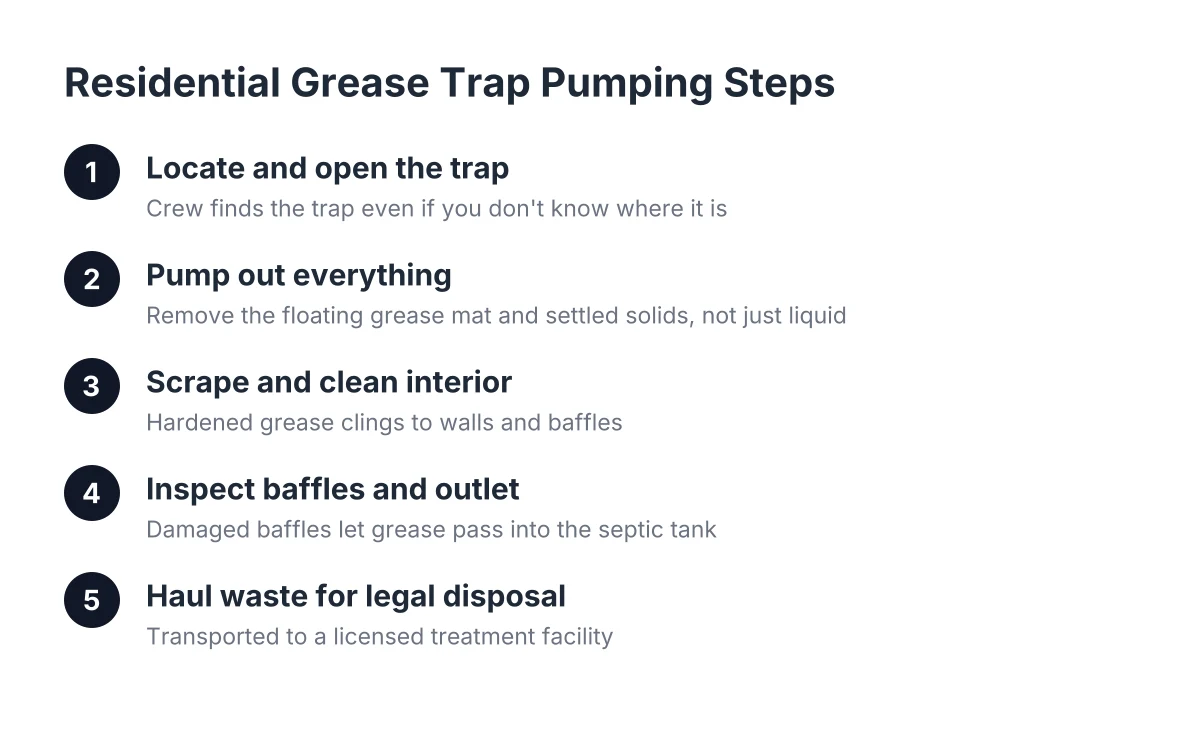
Here is the process step by step:
- Locate and open the trap. If you do not know where it is, the crew can find it, the same way they locate a buried septic tank.
- Pump out everything, not just the liquid. The floating grease mat and the settled solids are the whole point. Skimming liquid off the top and leaving the grease behind is a bad pump-out.
- Scrape and clean the interior. Hardened grease clings to walls and baffles and rebuilds the blockage fast if it stays.
- Inspect the baffles and outlet. Damaged baffles let grease pass straight through to your septic tank.
- Haul the waste for legal disposal. Grease and septic waste get transported by truck to a licensed treatment facility rather than handled on-site, consistent with how the New Hampshire Department of Environmental Services describes septic disposal.
That last step matters if you answer to a health inspector or need records for a rental property. Ask the crew for documentation of the service and disposal. A legitimate local operation provides it as a matter of course, and it becomes your paper trail for compliance.
The same principle applies to septic tank pumping itself. During an inspection, floating globs of kitchen grease in the tank should be scooped out and thrown away, not stirred back into the system. A thorough pump-out removes the sludge at the bottom and the scum at the top, because those solids cause the problems, not the water.
How Often Does a Residential Grease Trap Need Pumping?
A residential grease trap needs pumping whenever grease and solids fill about a quarter of its depth, and for most heavy-use kitchens that means a service every few months rather than once a year. Usage drives the schedule. A trap serving a home kitchen that fries often fills faster than one behind a light-use rental.
There is no single correct interval, so use the trap itself as the guide. Open the lid, or have a crew do it during a septic visit, and look at how thick the grease mat is. If it is approaching a quarter of the trap depth, pump it. Waiting longer lets grease bypass the trap and load your septic tank instead.
Your habits move the number more than anything else. For example, a household that scrapes pans into the trash and wipes them with a paper towel before rinsing might double the time between pump-outs. A household with a garbage disposal moves the other direction; the Massachusetts Department of Environmental Protection recommends annual septic pumping for homes with disposals regardless of tank size, because disposals push far more solids into the system.
For the septic tank itself, Penn State Extension advises that an active family of four generally pump every two to three years. Pair the trap schedule with the tank schedule and one local crew can handle both in a single visit, which is the low-effort setup most landlords and small operators want.
One caution on shortcuts. Additives sold to dissolve grease or sludge lack strong scientific backing, according to research summarized by Washington State University Extension. Money spent on additives is better spent on an actual pump-out.
What Grease Trap and Septic Pumping Costs in Hesperia, CA
Costs vary by trap size, tank size, access, and how bad the buildup is, so treat any number here as a general planning figure rather than a quote. For septic tank pumping specifically, Angi data puts the average at $427, with a range of $250 to $1,250 or more depending on tank size and location. Residential grease trap pumping on its own is typically a smaller job than a full tank pump-out, since traps hold far less volume.
Timing changes the price more than anything else. A pump-out you book in advance costs less than the same truck arriving at midnight. Emergency and same-day service commands a premium in 2026, as it always has, because the crew is dropping everything to get to you. That is the strongest financial argument for a maintenance schedule: the planned version of this service is always the cheap version.
A word about searching for the cheapest septic tank pumping near me. The lowest bid sometimes means a partial pump-out, where the crew removes liquid and leaves the sludge and scum that actually cause backups. You pay less today and call again in six months. Ask any company you hire whether they remove the full contents, clean the trap or tank walls, and provide disposal documentation. Those three questions separate a real service from a cheap skim.
For decision-making, weigh the numbers side by side. A few hundred dollars for scheduled pumping, versus the EPA's $5,000 to $15,000 estimate for repair or replacement if grease ruins a drain field. The math is not close.
When Grease Has Already Caused a Backup: The Emergency Call
Sometimes you find this article too late, and sewage is already backing up into the house or the septic alarm is going off. Here is what to do in the next ten minutes, before the truck arrives:
- Stop using water. Every flush, shower, and dishwasher cycle pushes more wastewater toward the blockage. Shutting off water use is the only reliable way to slow a septic backup temporarily.
- Keep people and pets away from any sewage, indoors or in the yard. Raw sewage is a health hazard, not just a mess.
- Do not pour anything down the drain. Chemical drain openers do not clear grease blockages in a trap or tank, and they make the tank contents hazardous for the crew.
- Call a local septic crew and describe what you see. Slow drains everywhere, sewage at the lowest drain, odor in the yard, alarm sounding. Those details tell the crew what to bring.
This is where working with a local, septic-focused company in Hesperia pays off. An emergency septic service call gets triaged over the phone: the person answering walks you through shutting down water use, asks where the backup is showing, and gets a truck moving. A national call center reads a script and books you a window. A local crew that answers at night knows the difference between an alarm that can wait until morning and sewage rising in a hall bathroom.
One honest limitation: pumping fixes a full tank or a loaded trap, but it does not fix everything. If grease has already migrated into and clogged the drain field, or if the tank has a structural problem, you need a diagnosis and possibly a repair specialist. A good pumping crew tells you that on-site instead of pumping the tank and hoping.
One Local Crew for the Trap, the Tank, and the Rental Down the Road
If you own or manage more than one drain-dependent property, the goal is to stop treating septic as a fire drill. The properties that never generate 2 a.m. calls are the ones on a schedule.
Consider an illustrative setup for a Hesperia landlord with a rental on septic plus a small food operation in a converted residential building. In that scenario, one local crew handles grease trap cleaning at the food site every few months, pumps the rental's septic tank on the interval its usage calls for, and keeps disposal records for both. The health inspector gets paperwork, the tenants get working drains, and the owner never has to be on-site for a service visit. A single restaurant can release between 800 and 17,000 pounds of grease into the sewer system each year, according to Wastewater Digest, so even a small food operation generates enough grease to justify a standing schedule rather than reactive calls.
The same logic scales down to a single home. Residential grease trap pumping and septic tank pumping use the same truck, the same crew, and often the same visit. Combining them costs less than two separate emergencies, and it turns your septic system from a background worry into a line item you handle once every couple of years.
Grease is patient. It builds up quietly until the night it does not. Getting the trap pumped, keeping fats out of the drain, and putting your tank on a real schedule are the three moves that keep a Hesperia septic system boring. Boring is exactly what you want.
If you need your septic tank serviced, Hesperia Septic can help.
Prefer to talk it through? Call (760) 249-7872 — a quick call is usually the fastest way to get a straight answer for your situation.