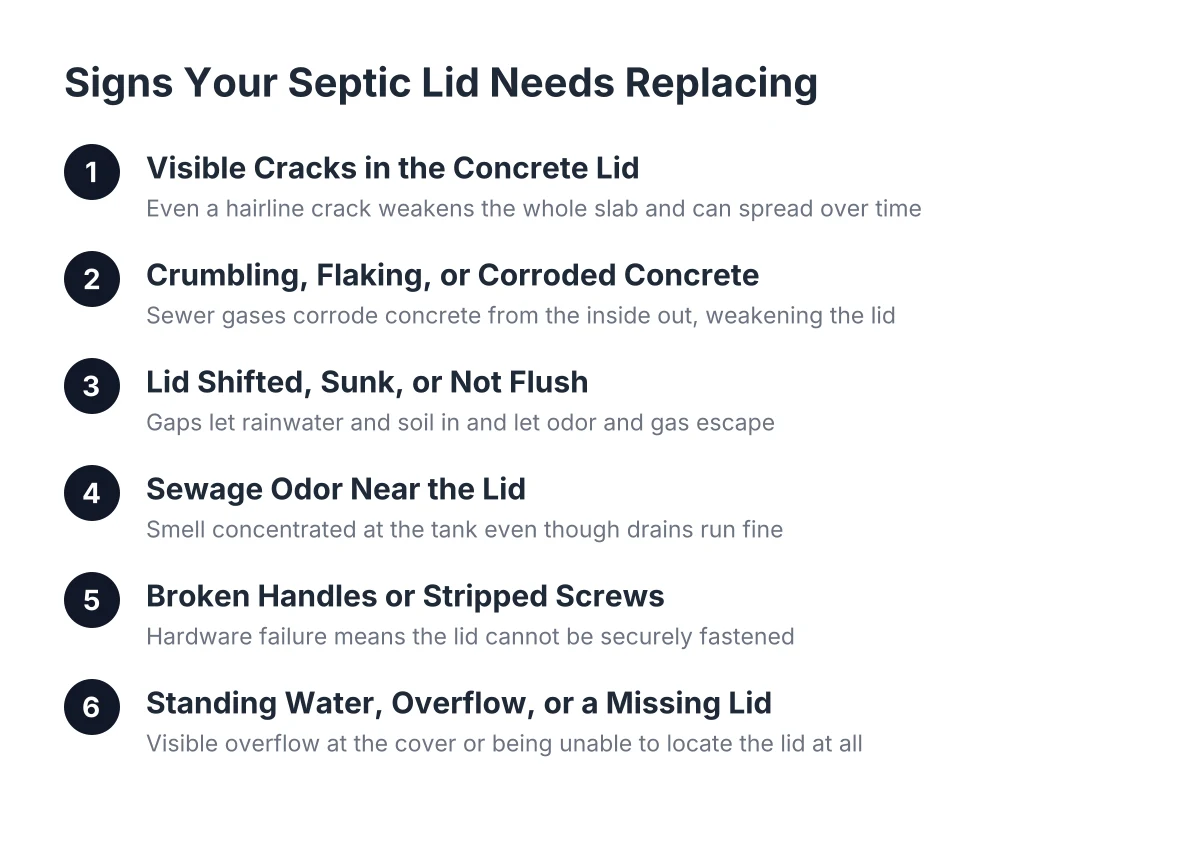
Most people watch for signs your septic tank is full, but far fewer check the lid sitting on top of it. That concrete cover is the only thing standing between your yard and an open tank of sewage. In Hesperia and across the High Desert, sun, heat swings, and dry soil are hard on concrete septic tank covers. A cracked or crumbling lid is a safety hazard first and a repair job second, and it often shows warning signs long before it fails completely. Understanding the signs that indicate a cracked septic lid is critical to protecting your home and property.
This list walks through seven signs your septic tank lid is damaged, deteriorating, or unsafe, plus what each one means for a homeowner dealing with a problem right now or a landlord managing a rental from a distance.
1. Visible Cracks Running Across the Concrete Lid
A crack in a concrete septic tank lid is never cosmetic. The lid carries its own weight plus whatever sits on it, so even a hairline crack weakens the whole slab. Concrete lids are heavy but structurally fragile; a crack that looks stable today can spread after one more hot summer or one vehicle rolling over the tank area.
Cracks usually come from two sources: age-related brittleness in the concrete, or weight the lid was never designed to hold, like a truck, trailer, or RV parked over the tank. If you can see a crack from the surface, assume the underside looks worse. Moisture and septic gas attack the lid from below, where you cannot see the damage.
The good news for the budget is that a broken lid does not mean a broken tank. Replacing just the cover is far cheaper than replacing the tank itself, and a new concrete lid can be poured or fitted to match the existing opening. For scale, the U.S. Environmental Protection Agency estimates full septic tank repair or replacement typically runs $5,000 to $15,000, which is exactly the bill a timely lid fix helps you avoid.
2. Signs of a Cracked Septic Lid: Crumbling, Flaking, or Corroded Concrete
Concrete septic covers do not fail all at once. They deteriorate. If the edges of your lid flake off when touched, or the surface has gone from smooth to sandy and pitted, the concrete is losing strength throughout, not just where you can see it.
Gas buildup inside the tank drives much of this. The sewer gases in a septic tank corrode concrete from the inside out, which is why a lid can look passable on top while the underside is soft and brittle. Round lids on some tank designs are especially prone to this; they turn fragile enough to break when someone pries them open for service.
Therefore, treat crumbling concrete the same as a crack. A deteriorated lid should be replaced promptly, because a weak cover, or worse, a makeshift one like a rock or plywood sheet, can be dislodged easily and creates a fall-in hazard, especially for children and pets.
3. The Lid Has Shifted, Sunk, or No Longer Sits Flush
A septic tank cover should sit level and flush on its opening. If your lid has sunk on one side, rocks when stepped near, or has a visible gap at the rim, the seal is broken. Gaps let rainwater and soil into the tank and let odor and gas out.
Settling soil is a common cause in the High Desert, where dry ground compacts and shifts over time. Proper installation matters here; the fill around a tank and its pipe connections needs thorough compaction to prevent settling damage, according to Onsite Installer. A lid that has shifted may also mean the riser or tank rim underneath is damaged, which is worth a professional look during the same visit.
In addition, a lid that no longer seats correctly is a sign your septic tank access was disturbed at some point. Landscapers, past service visits, or a vehicle can all knock a cover out of position without anyone noticing until the smell starts.
4. Sewage Odor Near the Lid, Even When the System Drains Fine
Odor around the tank area is one of the most searched signs your septic tank has a problem, and the lid is often the culprit. A sound, properly seated concrete cover contains most odor. A cracked or gapped one lets septic gas escape straight into your yard.
Here is the useful distinction. If drains inside the house run normally and the smell is concentrated right at the tank location, suspect the lid or riser seal before assuming the whole system is failing. If the odor comes with slow drains across the whole house or gurgling fixtures, those are classic signs your septic tank needs to be pumped, and the lid may be a separate issue found during the same service call.
For example, say a landlord in Hesperia gets a tenant call about a sewage smell in the side yard. The tenant reports the drains work fine. In that scenario, a crew can locate the tank, check the cover, and often find a cracked or unseated lid rather than a full or failing system. That is a one-visit fix instead of a habitability dispute.
5. Broken Handles, Stripped Screws, or Access Issues with a Cracked Septic Lid
A lid you cannot open safely is a lid that is due for attention. Plastic handles on septic covers are known for snapping off when pulled, and once that happens, service crews sometimes have to break the lid to get in, then replace it with a proper cover or an access riser. When homeowners observe signs of a cracked septic lid in the hardware—stripped mounting points or loose covers—the time to act has come.
The fastening hardware matters just as much as the slab. Screw mounts on risers and covers wear out, and once the mounting points are stripped or broken, the lid cannot be secured. An unsecured cover is the real danger; lids should always be fully screwed down or seated after service so nobody can dislodge them by accident.
Watch for these hardware-level warning signs:
- Handles that are cracked, loose, or already missing
- Screws that spin without tightening, or heads rusted beyond use
- A cover that lifts or slides when stepped on
- Riser rims with broken tabs or stripped mounting points
- Any lid held down by a rock, brick, or board instead of hardware
Any item on that list means the cover is not doing its job. If a crew had to force or break the lid on the last pumping visit, plan on concrete septic tank lid replacement before the next one.
6. Standing Water or Overflow Right at the Cover
Wastewater pooling at the lid is never normal. A functioning septic tank should not be overflowing when opened; liquid at the surface means the tank is overfull, the outlet is blocked, or the system downstream is struggling. A damaged lid makes this worse by giving that sewage a direct path into your yard.
However, sort the cause before deciding on the fix. Standing water at the cover is one of the strongest signs your septic tank is backed up or overdue for pumping, and no new lid will solve that. The sequence that works: pump the tank, inspect the tank and baffles while it is open, then replace the damaged cover so the repaired system stays sealed. Handling the lid during a pumping visit saves a second dig and a second service charge.
This is also the point where a professional inspection earns its cost. Overflow can trace back to a saturated drain field or a failed baffle, and those calls require someone looking inside the tank, not a guess from the surface. The EPA recommends the average household have its septic system inspected at least once every three years, and a lid replacement visit is a practical time to get that done.
7. You Cannot Find the Lid at All
A missing or buried lid is its own warning sign. If you bought a home in Hesperia and have no idea where the tank sits, or the previous owner buried the access under landscaping, you have two problems: you cannot service the tank, and you have no idea what condition the cover is in.
Septic tank locating solves the first problem, but the method matters for the second. Probing for a buried tank has to be done carefully, because jabbing a rod into an aged concrete cover can punch right through it. A crew that locates tanks regularly knows to ease off once they hit the lid rather than break a brittle cover while finding it.
Once the tank is uncovered, this is the moment to decide on the lid's future. If the old cover is intact, it can be reburied with a protective layer over it, or upgraded with a riser that brings access to grade so nobody has to dig next time. If it is cracked or crumbling, replace it while the hole is already open. For a rental owner or small business operator managing property remotely, a riser is worth weighing; it means future grease trap or septic tank pumping visits happen without excavation and without you standing in the yard supervising.
What a Septic Lid Replacement Visit Looks Like
Replacing a septic tank cover is a contained job when the tank itself is sound. A typical crew will locate and expose the tank, remove the damaged concrete, measure the opening, and fit or pour a new concrete cover to match. Tank openings vary; some areas run rectangular concrete tanks while others use circular ones, according to the International Code Council, so the replacement has to match your specific tank rather than a one-size stock part.
Expect a few decision points during the visit:
- Pump first or not: if the tank is full or backed up, pumping comes before any lid work.
- Lid only or riser upgrade: a riser costs more up front but ends the digging on every future visit.
- Concrete or heavy-duty composite: concrete matches most existing High Desert tanks; either way, the cover must be rated for burial and secured.
- Backfill protection: a proper crew covers the new lid with plastic sheeting before backfilling so soil and debris cannot fall into the tank.
One honest caveat: a new lid fixes a lid problem, nothing more. If the tank walls are cracked, the baffles have failed, or the drain field is saturated, the cover is the least of your concerns, and you need a full septic system inspection before spending on cosmetics. A local crew that pumps and inspects tanks daily can tell you which situation you have while the tank is open.
The Bottom Line for Hesperia Property Owners
The lid is the cheapest part of your septic system to replace and the most dangerous to ignore. Cracks, crumbling concrete, gaps, broken hardware, odor at the tank, overflow, and a lost access point are all signals worth acting on this season, not next year. In 2026, with full system replacement running into five figures by EPA estimates, a concrete cover swap is one of the few septic jobs that is both urgent and affordable.
Whether you are a homeowner staring at a cracked cover after a backup or a landlord fielding a tenant complaint from across town, the path is the same: get the tank located, get it inspected while it is open, and get a solid, secured concrete cover on it before someone finds the weak spot the hard way.
If you need your septic tank serviced, Hesperia Septic can help.
Prefer to talk it through? Call (760) 249-7872 — a quick call is usually the fastest way to get a straight answer for your situation.