If you're standing in a Hesperia yard with a wet spot over your tank, or your tub just filled with gray water, the first question after "who do I call" is "what is this going to cost." The honest answer is that understanding septic pumping cost factors helps you navigate service decisions, since several elements affect the final bill and most of them have nothing to do with a company trying to pad it. This list walks through the eight factors that move the price up or down in Hesperia and the High Desert, so you can make smart calls in the middle of a stressful day instead of guessing.
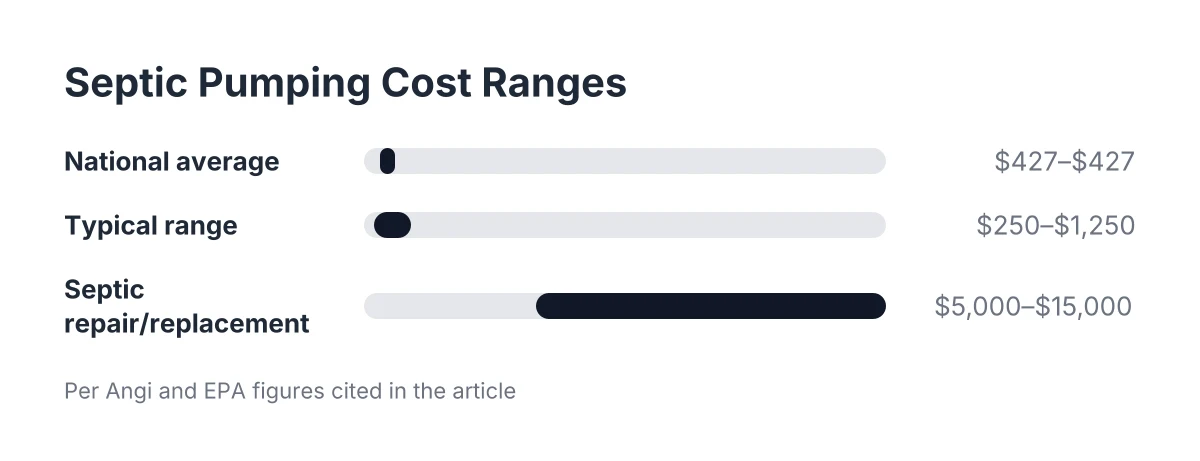
For a rough baseline, according to Angi, septic tank pumping averages $427 nationwide, with a range of $250 to $1,250 or more depending on tank size and location. Where your job lands in that range comes down to the factors below.
What Drives Septic Pumping Cost Factors
Tank size is the single biggest factor that affects septic tank pumping cost, because the truck charges for what it hauls away. A larger tank holds more waste, takes longer to pump, and fills more of the truck's capacity before it heads to the treatment plant. According to the New Hampshire Department of Environmental Services, everything pumped from a residential tank gets trucked to a sewage treatment plant for disposal, so disposal volume is baked into the price.
Most homeowners don't know their tank size off the top of their head, and that's normal. If you have permit records from San Bernardino County or paperwork from a past pump-out, have it handy when you call. If not, the crew can usually tell you the size once the lid is open, and a straight-shooting company will quote you a range up front rather than a single number they can't stand behind.
2. How Hard the Tank Is to Find and Reach
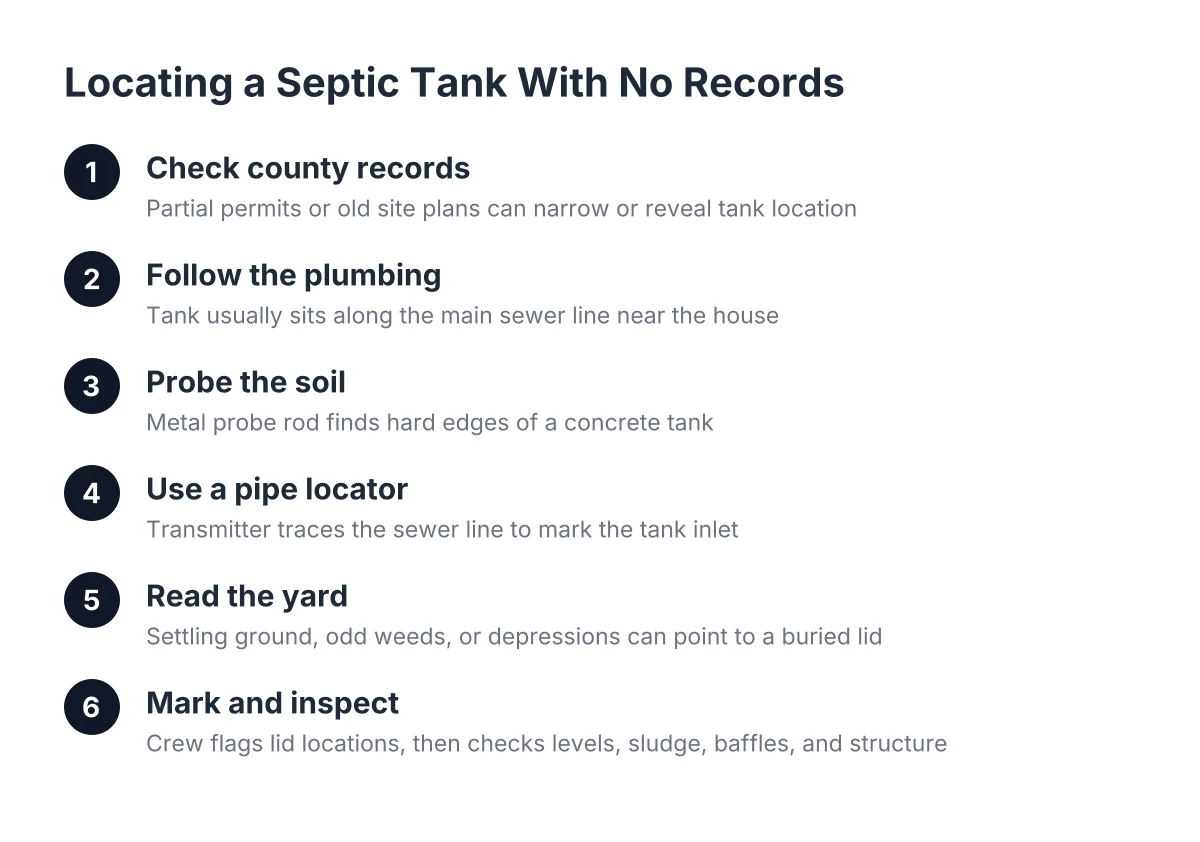
A tank with risers at grade level is a quick job. A tank buried under two feet of hard-packed High Desert soil with no visible lids is a digging job, and digging takes time. Some visits in Hesperia start with septic tank locating before any pumping can happen, especially on older properties where the original owner is long gone and nobody marked the lids.
If your tank needs serious excavation every time it's serviced, ask about installing risers. The extra digging cost tends to repeat with every pump-out, so risers often pay for themselves over two or three visits. In addition, risers make an emergency call faster, which matters when sewage is backing up into the house and every hour counts.
Access and Location Impact Pumping Costs
The pump truck needs to park close enough for its hose to reach the tank. Long hose runs, locked gates, tight rural driveways, or a tank located far behind the house can add setup time. When you call, mention where the tank sits relative to the street; it helps the crew show up prepared instead of discovering the problem on arrival.
3. Emergency Timing Versus a Scheduled Visit
An after-hours emergency call usually costs more than a pump-out scheduled two weeks in advance, and that's true across the industry, not just in Hesperia. Emergency septic pumping means a crew and truck mobilizing outside normal routing, often at night or on a weekend. Multiple cost factors converge during emergencies, as the urgency increases both crew and equipment availability demands.
However, if sewage is actively backing up into your tub or pooling in the yard, waiting until Monday can turn a pumping bill into a cleanup and repair bill. Raw sewage in the house creates its own costs. The smart move is to ask two questions when you call: what the visit will cost, and whether the situation can safely wait for a regular-hours slot. A local crew that pumps tanks daily can usually tell you which one you're dealing with.
4. How Long You Waited Between Pump-Outs
Time between services affects septic tank pumping in two ways: how thick the sludge is, and whether solids have started migrating where they shouldn't. A tank pumped on a regular schedule empties fast. A tank that hasn't been touched in a decade may have compacted sludge that takes extra time and water to break up and remove, and that extra time can show up on the bill.
Penn State Extension notes that for an active family of four, pumping every two to three years is generally advisable because of the higher volume of solids and liquid the household produces. Skipping that schedule doesn't save money; it defers cost and adds risk. The EPA estimates septic repair or replacement typically runs $5,000 to $15,000, which makes even the priciest routine pump-out look cheap by comparison.
5. The Condition of Your Baffles and Filter
Every septic tank has a baffle at the inlet and outlet. According to the University of Nebraska-Lincoln Extension, these downward-facing tees stop solids from floating out and force them to settle at the bottom of the tank. When the inlet baffle clogs, wastewater can't get into the tank, and it backs up toward the house. The Washington State Department of Health lists a clogged inlet baffle as one of the first things to check when a line into the tank is blocked.
Why does this affect price? A pump-out that also involves clearing a clogged baffle or cleaning an effluent filter takes more time than a straight pump. On the other hand, catching a damaged baffle during a routine visit is far cheaper than finding out about it when solids have already washed into your drain field.
6. What the Crew Finds Once the Lid Is Open
Sometimes a full tank is just a full tank. Other times the tank is full because the drain field isn't accepting water, and pumping alone won't fix that. A typical residential system has two parts, a tank that clarifies wastewater and a drain field that disperses the liquid into the soil, according to the US EPA. If the drain field has failed, the tank refills fast no matter how recently it was pumped.
This is where homeowners fear the upsell, and the fear is fair. Here is a useful rule: a pump-out that stays fixed for years points to a tank that just needed service. A tank that backs up again within days or weeks points to a drain field or line problem, and that diagnosis deserves a real inspection, not a guess. Suppose a Hesperia homeowner gets pumped in March and is backed up again by May; in that scenario, paying for another pump-out without asking why is throwing money at a symptom.
One more practical note: since an inspection visit often costs close to what a pump-out costs, it frequently makes sense to have the tank pumped during the same visit rather than paying separately for a look-only diagnosis. An empty tank is also easier to inspect properly.
7. Residential Tank, Grease Trap, or Holding Tank
Not every pump-out is a house septic tank, and the type of tank changes the price. Restaurants and commercial kitchens in Hesperia run grease traps on recurring schedules tied to health code compliance. RV parks and campgrounds have holding tanks that fill based on occupancy, not time. Grease and holding tank waste is handled differently than residential septic waste, and pricing reflects volume, frequency, and disposal requirements.
For a business owner, the cost question is less about a single visit and more about the schedule. A grease trap pumped on a set monthly or quarterly rotation with a reliable local vendor costs less over a year than one serviced reactively after an odor complaint or a failed inspection. If you manage a restaurant or RV park, ask about recurring scheduling when you get your first quote; consistency is where the savings live.
8. Local Market Conditions in the High Desert
Regional supply and demand affects septic tank pumping prices as much as anything on the truck. Areas with many pump trucks competing for a dense population of septic homes see tighter pricing; areas with few operators see higher rates. California sits at about 10 percent of homes on septic systems, one of the lowest shares in the country, according to the U.S. Environmental Protection Agency. However, the High Desert is one of the pockets where septic is common, since many Hesperia properties sit outside centralized sewer service. As the Environmental Finance Center Network notes, septic tanks serve areas without municipal sewer connections, which describes a large share of this region.
For you, the takeaway as of 2026 is simple. Get a quote from a local operator who actually runs trucks in Hesperia, ask what's included, and be suspicious of any price quoted sight unseen with no questions about tank size or access.
Quick Checklist Before You Call
You'll get a more accurate quote and a faster visit if you can answer a few things up front:
- Do you know where the tank is, and does it have risers or buried lids?
- When was it last pumped, if ever?
- What symptoms are you seeing: slow drains, sewage backup in the house, wet spots in the yard, or an alarm going off?
- Can a truck park within reasonable hose distance of the tank?
- Is this a house tank, a grease trap, or an RV or holding tank?
Finally, know the limits of a pump-out. Pumping removes waste; it does not repair a failed drain field, replace broken baffles, or fix a crushed line. The EPA recommends a professional inspection at least every three years for the average household, and once a year for systems with pumps, floats, or other mechanical parts. If your system backs up repeatedly after service, bring in a professional to inspect the whole system before anyone talks about replacement. Understanding these factors influencing septic pumping costs and repair expenses puts you in control of the conversation, whether it's a scheduled visit or an 8pm emergency.
If you need your septic tank serviced, Hesperia Septic can help.
Prefer to talk it through? Call (760) 249-7872 — a quick call is usually the fastest way to get a straight answer for your situation.