
Tag: 25 percent rule

  • Grease Trap Pumping Terms Explained: A Plain-English Glossary

    grease trap pumping glossary

    If you own a property with a grease trap, the first quote you get can read like a foreign language. This grease trap pumping glossary breaks down the terms you will hear from providers, see on invoices, and find in inspection paperwork. Each entry starts with a plain definition you can read in seconds, then explains why the term matters to your wallet or your kitchen. Use it to read a quote line by line, ask sharper questions, and spot a problem before it becomes a backup.

    • Grease Trap
    • Grease Interceptor
    • FOG (Fats, Oils, and Grease)
    • Baffle
    • Inlet and Outlet Tees
    • How Grease Trap Pumping Works
    • Full Evacuation
    • Skimming
    • Grease Cap
    • Scraping and Cleaning
    • Hydro Jetting
    • The 25 Percent Rule
    • Manifest
    • Pumping Frequency
    • Effluent
    • Backup
    • Trap Locating

    The Trap Itself: Parts and Types

    Grease Trap

    A grease trap is a box installed in a drain line that catches fats, oils, and grease before they reach the sewer or septic system. Water flows through it slowly, so grease floats to the top and food solids sink to the bottom, while cleaner water exits the middle. Traps range from small under-sink units to large in-ground tanks. Knowing which type you have shapes everything else, including how often it needs service and what a provider will charge to pump it.

    Grease Interceptor

    A grease interceptor is a large grease trap, usually installed in the ground outside the building, that handles higher volumes of wastewater. Providers often use "trap" and "interceptor" interchangeably, but an interceptor is the bigger in-ground version. If a quote mentions an interceptor, expect a truck-based pump-out rather than a quick under-sink cleaning. Size drives cost, so ask the provider to confirm the capacity before you compare quotes.

    FOG (Fats, Oils, and Grease)

    FOG stands for fats, oils, and grease, the kitchen waste a grease trap exists to catch. FOG hardens as it cools, which is why it clogs pipes and coats the inside of drain lines. When a provider or inspector talks about "FOG levels" or "FOG discharge," they mean how much grease is getting past your trap. High FOG readings are the usual reason a property fails an inspection or gets a warning from the sewer authority.

    Baffle

    A baffle is a wall or plate inside a grease trap that slows water down and forces grease to separate from it. Baffles are what make a trap work; without them, grease would flow straight through. A damaged or missing baffle is a common finding during a pump-out, and it means the trap is passing grease downstream even if it looks clean. If a provider mentions a baffle problem, ask whether it needs repair before the next service.

    Inlet and Outlet Tees

    Inlet and outlet tees are the pipe fittings where wastewater enters and leaves a grease trap. The inlet tee directs incoming water downward so it does not stir up the grease layer, and the outlet tee pulls water from the middle of the trap where it is cleanest. Broken or clogged tees let grease escape into the drain line. A good provider checks both during a pump-out, and it is fair to ask if they did.

    The Service: What Actually Happens

    How Grease Trap Pumping Works

    A pump-out is the process of using a vacuum truck to remove the grease, solids, and water from a trap or interceptor. It is the core of any grease trap service and the line item you will see on most invoices. Some providers pump only the floating grease, while a full pump-out empties everything. The section below on full evacuation explains why that difference matters. If you are not sure how the whole visit works, the Hesperia grease trap pumping service page walks through it.

    Full Evacuation

    Full evacuation means removing all contents of the grease trap, including the grease layer, the solids on the bottom, and the water in between. This is the standard most inspectors and sewer authorities expect. The cheaper alternative, skimming, leaves solids behind and lets the trap fill up faster. If two quotes differ a lot in price, ask each provider whether they do a full evacuation. That one question often explains the gap.

    Skimming

    Skimming means removing only the floating grease layer from the top of a trap and leaving the water and solids behind. It costs less per visit but the trap refills faster, and settled solids keep building on the bottom. Some jurisdictions do not accept skimming as proper maintenance at all. If a low quote seems too good, skimming is often the reason.

    Grease Cap

    A grease cap is the hardened layer of fats, oils, and grease floating on top of the wastewater inside a trap. Providers measure its thickness to judge how full the trap is and whether it is overdue for service. A thick, crusted grease cap can take extra time and effort to break up and remove, which can affect the cost of the visit. If your provider mentions a heavy cap, that is a sign your service interval is too long.

    Scraping and Cleaning

    Scraping means physically cleaning the walls, baffles, and lid of the trap after pumping to remove stuck-on grease, which is part of thorough grease trap pumping maintenance. Pumping alone leaves a coating behind, and that residue speeds up the next buildup. Ask whether scraping is included in the quoted price or billed separately. Providers who skip it are not doing anything wrong exactly, but you should know what you are paying for. If you are tempted to handle the cleaning yourself, read this DIY grease trap cleaning guide before you decide.

    Hydro Jetting

    Hydro jetting means cleaning drain lines with a high-pressure water hose that scours grease and buildup off the pipe walls. It is a separate service from grease trap pumping, usually added when grease has escaped the trap and coated the lines downstream. If a provider recommends jetting, ask what they saw that justifies it, such as slow drains or grease in the outlet line. It is a legitimate add-on, but it should come with a reason.

    Rules, Measurements, and Paperwork

    The 25 Percent Rule

    The 25 percent rule is a common industry guideline that says a grease trap should be pumped once grease and solids fill a quarter of its total depth. Past that point, the trap loses its ability to separate grease, and FOG starts slipping into the drain line. Many sewer authorities use this rule as their enforcement standard. A provider who measures your trap against it is following standard practice, and it is a useful benchmark for setting your pumping and cleaning schedule.

    Manifest

    A manifest is the document that records what was pumped from your trap, how much, and where the waste was taken for disposal. It is your proof of proper service if an inspector ever asks. Legitimate providers issue one after every pump-out because grease waste must go to an approved disposal site. If a provider cannot or will not give you a manifest, treat that as a red flag.

    Pumping Frequency

    Pumping frequency means how often a grease trap needs to be emptied, which depends on the trap's size and how much grease your kitchen produces. There is no single right interval; a busy kitchen fills a trap faster than a light-use one. Your local sewer authority may set a minimum schedule, so check what applies to your property. Tracking how full the trap is at each service helps you and your provider dial in the right frequency instead of guessing.

    Effluent

    Effluent is the water that flows out of a grease trap after the grease and solids have separated inside it. Clean effluent means the trap is working; greasy effluent means FOG is escaping downstream. Inspectors sometimes sample effluent to check compliance. If a provider mentions your effluent quality, they are telling you whether the trap is doing its job, not upselling you.

    Backup

    A backup means wastewater rising out of drains, floor sinks, or the trap itself because a clog or a full trap has blocked the flow. It is the emergency scenario every grease trap owner wants to avoid, since it can shut down a kitchen and create a health hazard. Slow drains and sour odors usually show up first. If you are seeing early symptoms, these warning signs of a clogged grease trap can help you judge how urgent it is.

    Trap Locating

    Trap locating means finding a buried or hidden grease trap when the owner does not know where it is. Older properties often have in-ground traps with lids covered by soil, pavement, or landscaping. A provider may charge for locating time before pumping can start, so mention upfront if you do not know where your trap sits. Knowing the location before the truck arrives keeps the visit shorter and the bill smaller.

    Using These Terms

    You now know enough to read a grease trap quote line by line and ask the questions that separate a thorough service from a quick skim. Keep this grease trap pumping glossary handy the next time a provider or inspector uses a term you have not heard. Come back to it whenever a line item does not make sense, and ask the provider to explain it in plain words; a good one always will.

    If you need your septic tank serviced, Hesperia Septic can help.
    Related Reading

  • 7 Signs Your Grease Trap Is Clogged: Odors, Slow Drains, and Backup Warnings

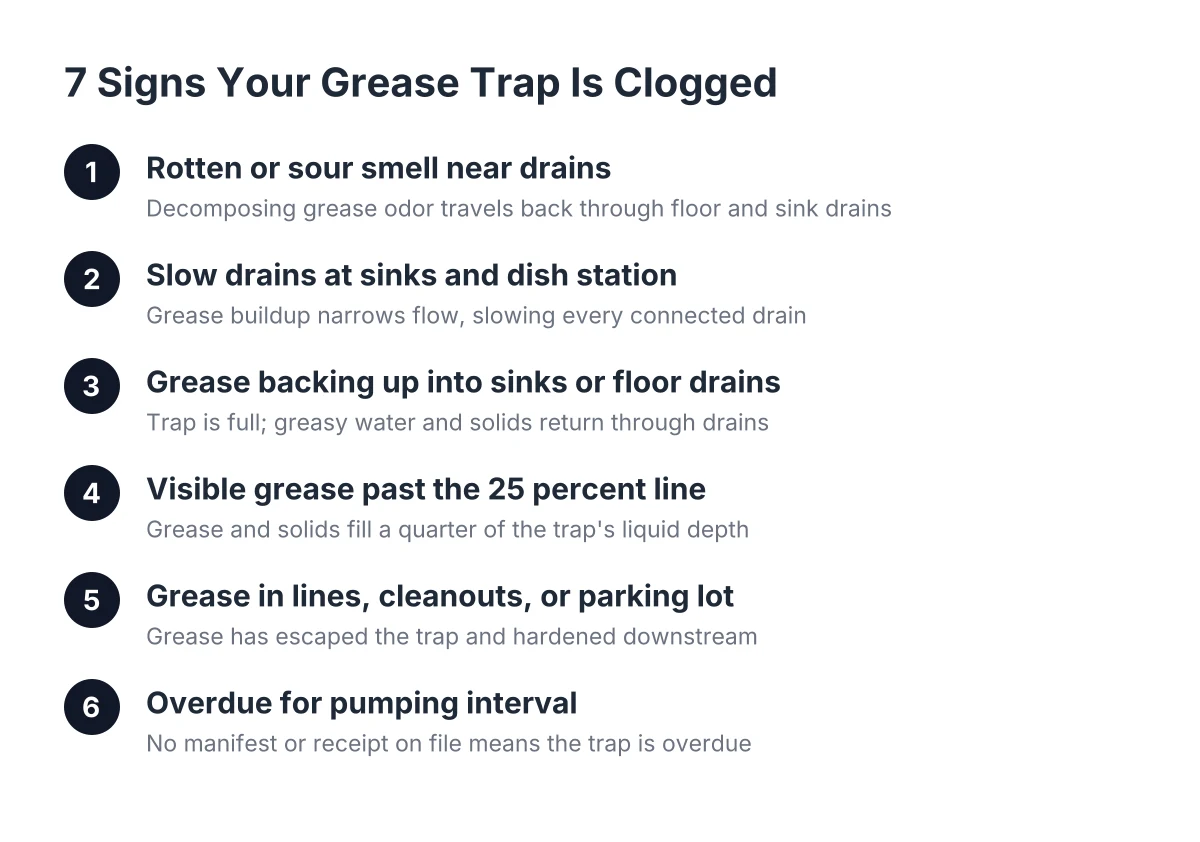
    Sequence of signs a grease trap is clogged, from odor to overdue pumping
    These warning signs, in order of severity, show when a grease trap needs pumping.

    If you run a restaurant or commercial kitchen in Hesperia, the signs grease trap clogged issues show up before the health inspector does. Odors near the drains, water that takes too long to leave the sink, and grease showing up where it should not be are all warnings that the trap is past due for pumping. Catch these early and you protect your inspection record, your kitchen schedule, and your plumbing.

    This list covers the seven warning signs that matter most, why each one happens, and what to do when you spot it. It is written for operators who cannot afford a failed health inspection, so each item includes the compliance angle, not just the plumbing one.

    1. A Rotten or Sour Smell Near the Kitchen Drains

    Odor is the first sign most operators notice, and it is the one customers notice too. A grease trap works by holding fats, oils, and grease so they separate from wastewater. When the trap fills up, that trapped grease starts to decompose, and the smell travels back up through floor drains and sink lines.

    A faint grease smell right at the trap is normal. A sour, rotten-egg odor in the dish pit, the prep area, or worse, the dining room, means the trap is overloaded and the decomposing layer is thick. Health inspectors treat persistent sewage or grease odors as a red flag, so if your staff can smell it, assume an inspector will too.

    2. Slow Drains at the Sinks and Dish Station

    Slow drainage is the clearest mechanical sign your grease trap is losing capacity. As grease builds up inside the trap, less room is left for water to flow through. Water backs up in the line, and your three-compartment sink or dish machine drains slower every week.

    Here is the pattern to watch: one slow sink might be a clogged line at that fixture, but when every drain connected to the trap slows down at the same time, the trap itself is the bottleneck. Do not wait for a full stoppage. Slow drains during a Friday dinner rush turn into standing water in the dish pit by Saturday.

    3. Grease Backing Up Into Sinks or Floor Drains

    A backup is the sign that has already crossed the line from warning to emergency. When the trap is completely full, greasy water has nowhere to go but backward. It comes up through floor drains, sink drains, or the trap lid itself, and it brings food solids and odor with it.

    For a commercial kitchen, a grease backup during service can mean shutting down the line. It can also mean a failed inspection if it happens while an inspector is on site, since wastewater on the floor is a critical violation in most health codes. Backups also stress the wider system; according to the U.S. Environmental Protection Agency, grease is the most common cause of reported sewer blockages, responsible for 47% of cases.

    4. Visible Grease Past the 25 Percent Line

    Many jurisdictions and grease haulers use the 25 percent rule: when the combined layer of floating grease and settled solids fills a quarter of the trap's liquid depth, it is due for pumping. Past that point, the trap stops separating grease effectively and starts passing it downstream into your lines or the sewer.

    You can check this yourself between service visits. Open the trap lid and use a simple measuring stick, one of the most useful grease trap cleaning tools an operator can own. Push it to the bottom, note where the grease layer starts and stops, and log the reading. Inspectors in many areas ask for exactly this kind of log, so a weekly measurement does double duty as a compliance record.

    5. Grease Showing Up in Lines, Cleanouts, or the Parking Lot

    When a trap is full, grease escapes it and hardens wherever the water cools. Look for these secondary signs your grease trap has been passing grease downstream:

    • Grease buildup visible at cleanout openings outside the building
    • Greasy residue or staining around outdoor drain covers
    • Repeated line clogs downstream of the trap, even after snaking
    • A greasy sheen or solids near the sewer connection or, on septic properties, near the tank lids

    Any of these means the problem has moved beyond the trap. The scale is bigger than most operators expect; Wastewater Digest notes that a single restaurant can release between 800 and 17,000 pounds of grease into the sewer system each year. That is why regular grease trap pumping exists as a requirement, not a suggestion.

    6. It Has Been Longer Than Your Pumping Interval

    Sometimes the clearest sign is the calendar. Most commercial kitchens land on a pumping interval based on their volume of fried and greasy food, the size of the trap, and local requirements. If you cannot remember the last pump-out, or you have no manifest or receipt on file, treat the trap as overdue.

    This matters for inspections as much as for plumbing. Health inspectors and sewer authorities in many areas ask for proof of service, such as pumping manifests showing when the trap was serviced and where the waste went. As of 2026, documentation expectations have only tightened in most jurisdictions. A crew that provides service records after every visit gives you the paper trail that keeps an inspection from turning into a citation.

    7. Your Water or Sewer Bill Jumps Without Explanation

    A clogged trap can change how water moves through your system in ways that show up on paper before they show up on the floor. Partially blocked lines can cause fixtures to run longer, dish machines to cycle inefficiently, and in some cases slow leaks at stressed joints. A month-over-month jump in water use with no change in business volume is worth investigating.

    However, a high bill alone is not proof of a grease trap problem. Check the trap level first since it is the cheapest thing to rule out, then look at fixtures and lines if the trap checks out.

    What to Do When You Spot the Signs Your Grease Trap Is Full

    Knowing how to know if your grease trap is full is only half the job; acting on it quickly is the other half. Here is the sequence that keeps a warning sign from becoming a shutdown:

    1. Check the trap level with a measuring stick and log the reading with a date.
    2. Stop putting extra grease down the drain; scrape pans into the trash and dry-wipe before washing.
    3. Schedule a full pump-out, not a skim. A proper service removes the grease cap, the settled solids, and the water in between, then scrapes the walls and baffles.
    4. Ask for documentation. Get a service record showing the date, the volume removed, and disposal information for your compliance file.
    5. Set the next service date before the truck leaves, based on how fast your trap actually filled.

    Suppose a taco shop manager in Hesperia notices the dish sink draining slow on a Tuesday and a sour smell by Thursday. In that scenario, calling for a pump-out that week likely costs a routine service visit. Waiting until Saturday, when greasy water comes up through the floor drain mid-rush, means an emergency call, lost service hours, and a mess to document if an inspector follows up.

    How Often Should a Commercial Kitchen Pump Its Grease Trap?

    A commercial kitchen should pump its grease trap either when the grease and solids layer reaches 25 percent of the trap's depth or on the schedule its local health or sewer authority requires, whichever comes first. High-volume kitchens that fry heavily often need service far more frequently than low-grease operations.

    The honest answer is that the right interval is specific to your kitchen. A burger-and-fries operation fills a trap much faster than a coffee shop with the same size trap. That is why the measuring-stick log matters; two or three readings tell you your real fill rate, and you can set a schedule around facts instead of guesses. If your trap fills faster than seems reasonable, have a professional inspect it, since a damaged baffle or an undersized trap can look like an overuse problem when it is really an equipment problem.

    Grease traps for commercial kitchens also wear out. How long grease traps last depends on the material and how well they are maintained, but steel units can corrode and concrete interceptors can crack over years of service. If pumping no longer solves recurring grease trap issues, ask your service crew whether repair or a new grease trap installation makes more sense than another pump-out.

    Do Houses Have Grease Traps Too?

    Most single-family houses do not have a dedicated grease trap; the fixture is standard in commercial kitchens but rare in homes. A house on a septic system relies on the septic tank itself to capture grease, which is one reason kitchen habits matter so much for septic health.

    For Hesperia homeowners on septic, the same warning signs apply in a different form. Slow kitchen drains, odors near the tank, and greasy buildup at the lids are signals that the septic tank is due for pumping. Households that send heavy grease or garbage-disposal waste down the drain build sludge faster; the Massachusetts Department of Environmental Protection recommends annual pumping for homes with garbage disposals regardless of tank size. If you own both a restaurant and a home on septic, the habit is the same: watch the early signs, keep records, and pump on a schedule instead of after a backup.

    The Bottom Line for Hesperia Operators

    The signs your grease trap needs pumping follow a predictable order: odor first, slow drains next, then escaped grease, and finally a backup. Every step down that list costs more to fix and creates more compliance risk than the one before it. A measuring stick, a simple log, and a standing relationship with a local pumping crew turn grease trap care from a recurring fire drill into a line item you barely think about.

    For operators in Hesperia and the surrounding High Desert, that local relationship also matters practically. A crew that handles grease traps, septic tank pumping, and holding tanks in the same area can service a restaurant, a rental property, and an RV account without you standing on site for any of them, and can leave the service records your compliance file needs.

    If you need your septic tank serviced, Hesperia Septic can help.

    Related Reading