Category: septic tank cleaning

  • Grease Trap Pumping for Restaurants in Hesperia: A Step-by-Step Service Guide

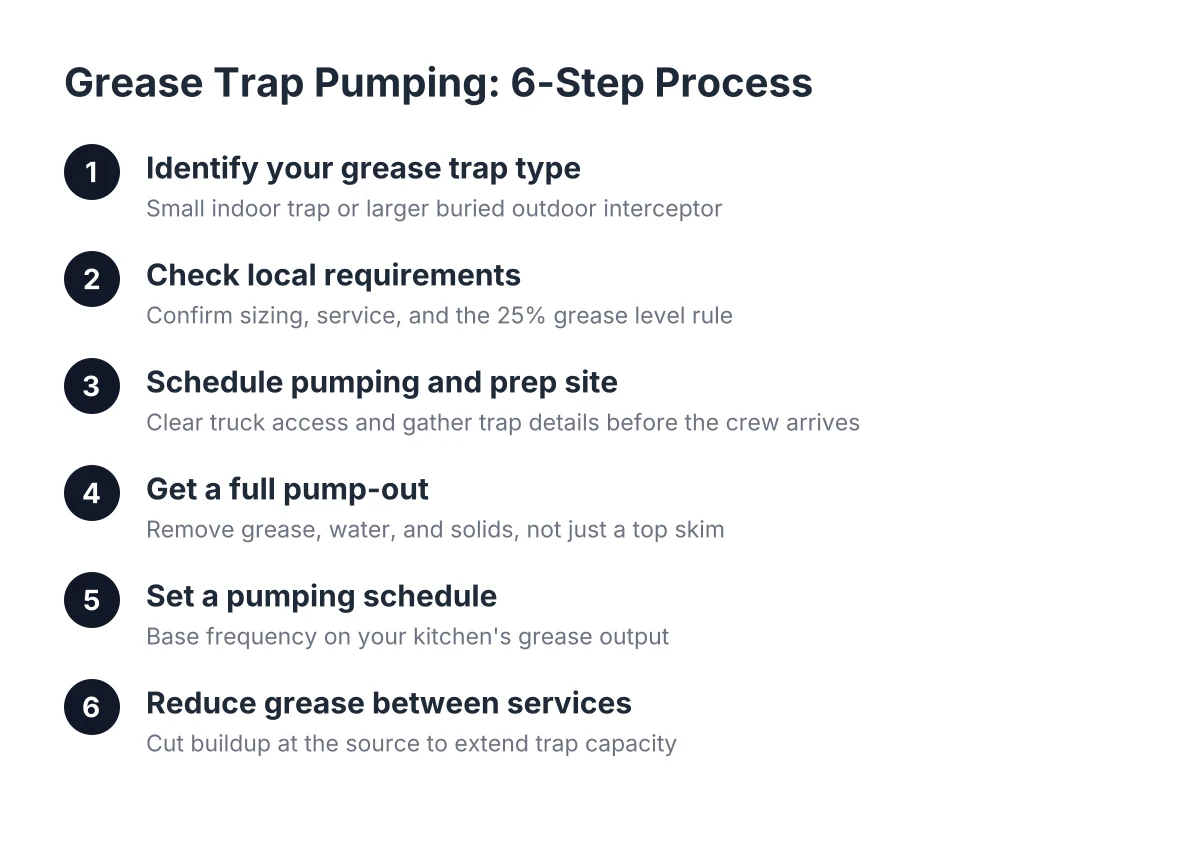
    Six-step process diagram for grease trap pumping in restaurants
    The step-by-step process for keeping a restaurant’s grease trap compliant and clog-free, as outlined in this guide.

    If you run a restaurant, a diner, or a commercial kitchen in Hesperia, grease trap pumping restaurants depend on is not optional. It keeps your drains flowing, keeps inspectors satisfied, and keeps grease out of the sewer or your septic system. This guide walks you through the whole process step by step, from figuring out what size trap you have to setting a pumping schedule that keeps you compliant. If you bought a commercial property with no service records, this is written for you too. The same crews that handle septic tank pumping in the High Desert also handle grease traps, and the process has a lot in common.

    The stakes are real. According to the U.S. Environmental Protection Agency, grease from restaurants, homes, and industrial sources causes 47% of reported sewer blockages, making it the most common culprit. And according to Wastewater Digest, a single restaurant can send between 800 and 17,000 pounds of grease into the sewer each year. That is why regular pumping is a requirement, not a suggestion.

    Step 1: What Kind of Grease Trap Your Restaurant Has

    First, figure out what is actually in the ground or under your sink. Restaurants generally have one of two setups. Small indoor traps sit under or near the three-compartment sink and hold a limited amount of grease. Larger outdoor interceptors are buried in the ground, often near the back of the building or in the parking area, and hold far more.

    Here is how a grease trap works in a restaurant: kitchen wastewater flows in, the water cools, and fats, oils, and grease float to the top while food solids sink to the bottom. The cleaner water in the middle flows out to the sewer or septic system. That layering is the same physics that happens inside a septic tank, where scum floats and sludge settles, as the U.S. Environmental Protection Agency describes it.

    If you just bought the property and have no records, you may not even know where the interceptor is. Look for metal or concrete lids near the kitchen's exterior wall or the dumpster area. A service crew that does septic tank locating can find a buried interceptor the same way they find a hidden septic tank, so an unmarked lot is not a dead end.

    Step 2: Check the Grease Trap Requirements for Restaurants in Your Area

    Grease trap requirements for restaurants come from your local sewer authority, health department, or county, and they vary by location. Most jurisdictions require food service businesses to have a properly sized trap, keep it serviced, and hold onto pumping records. Many also set a maximum grease level, commonly described as the 25% rule, meaning the trap must be pumped before grease and solids fill a quarter of its capacity.

    Do not assume the previous owner was compliant. Suppose you bought a small burger spot in Hesperia and the seller handed over zero paperwork. In that scenario, your first calls should be to the local sewer or health authority to ask what applies to your address, and to a pumping service to open the trap and assess where you stand. As of 2026, inspectors in most areas expect to see a service log or manifest showing when the trap was last pumped and where the grease went.

    Keep in mind that if your building is on a septic system rather than city sewer, the rules can differ, and grease control matters even more. Grease that escapes the trap ends up in your septic tank and drain field, and that is an expensive place for it to go.

    Step 3: Schedule Pumping and Prepare Your Site

    Next, book the service. When you call, have a few details ready so the crew shows up with the right truck:

    • The type of trap: small indoor unit or buried outdoor interceptor
    • The trap size in gallons, if you know it
    • When it was last pumped, if you have any record at all
    • Where the trap or its lids are located, or whether you need help finding them
    • Whether you are dealing with a backup right now or scheduling routine service

    Before the truck arrives, clear vehicle access to the trap. A vacuum truck needs to park within hose range of the lids, so move dumpsters, delivery pallets, or parked cars out of the way. If your trap is indoors, clear the area around it and plan the visit for a slow period, since the kitchen drains connected to the trap should not be in heavy use while it is open.

    Timing matters for your business too. Morning appointments before lunch prep, or a visit after close, keep the smell and the open lid away from customers.

    Step 4: Know What Full Grease Trap Pumping Includes

    Complete grease trap pumping for restaurants removes everything in the trap, not just the liquid. The crew vacuums out the floating grease layer on top, the water in the middle, and the settled food solids on the bottom. Skimming only the top layer, sometimes called a skim service, leaves solids behind that harden and cut the trap's working capacity.

    This is the same distinction that matters in septic tank cleaning, where pulling liquid alone leaves the sludge and scum that cause problems. A thorough grease trap service should include:

    1. Opening the lids and measuring the grease and solids layers
    2. Vacuuming out all contents, top layer through bottom sludge
    3. Scraping the walls, baffles, and lids to remove hardened buildup
    4. Checking the inlet and outlet tees and baffles for damage or clogs
    5. Closing the trap and providing a service record or manifest for your files

    Watch the crew work if you can, especially the first visit on a property you just took over. You will learn where the lids are, how deep the trap sits, and what condition the baffles are in. Ask for the grease depth measurement in writing; that number tells you whether your pumping interval is right.

    One honest trade-off: a full pump-out costs more than a quick skim, and on a tight month the skim looks tempting. However, skims let solids accumulate until the trap stops working, and a blockage that backs sewage into your kitchen during dinner rush costs far more than the difference.

    Step 5: Set a Pumping Schedule Based on Your Kitchen's Output

    After the first service, set a recurring schedule instead of waiting for a problem. How often restaurants need grease trap pumping depends on trap size, menu, and volume. A fry-heavy kitchen fills a trap much faster than a coffee shop. Use the grease depth measurement from each visit to adjust: if the trap hit the 25% mark early, shorten the interval; if it was well under, you may be able to stretch it.

    Watch for these signs that your trap needs pumping sooner than scheduled:

    • Slow drains at the sinks connected to the trap
    • Grease odors near floor drains or the trap location
    • Visible grease in the trap's outlet side when the lid is opened
    • Water backing up in floor sinks during dish washing

    In addition, keep every service manifest in one folder. If a health or sewer inspector asks for records, you hand them the file. If you sell the business someday, that folder answers the exact question you could not answer when you bought the place.

    Step 6: Reduce Grease at the Source Between Services

    Finally, cut down what reaches the trap in the first place. Dry-wipe pans and plates into the trash before they hit the sink. Collect fryer oil in a separate container for recycling pickup instead of pouring it down a drain. Train staff on both habits, because one dishwasher pouring oil into the floor sink can undo everything.

    Less grease into the trap means longer intervals between pump-outs and lower annual service costs. It also protects whatever is downstream. On a septic property, floating grease that gets past the trap collects in the septic tank's scum layer, and heavy grease loads there shorten the life of the whole system. The EPA estimates septic repair or replacement typically runs $5,000 to $15,000, so keeping grease out of the system is cheap insurance by comparison.

    When to Bring In a Local Crew Instead of Guessing

    Grease trap service for restaurants is not a do-it-yourself job. The waste has to be hauled and disposed of at an approved facility, and most jurisdictions require a licensed hauler and a paper trail. If you cannot find the trap, do not know when it was last serviced, or are seeing backups now, a local Hesperia crew that handles both grease traps and septic systems can locate the trap, pump it fully, and tell you plainly what condition it is in.

    For anything involving sizing a new interceptor, repairing damaged baffles, or interpreting a specific county requirement, consult the local authority or a qualified professional directly rather than relying on general guidance. Rules change, and your address is what determines which ones apply. Get the trap found, get it pumped, get the record in your file, and put the next service on the calendar. That is the whole system, and it works.

    If you need your septic tank serviced, Hesperia Septic can help.

    Related Reading

  • Septic Tank Backup Response in Hesperia: 8 Steps When Your System Fails

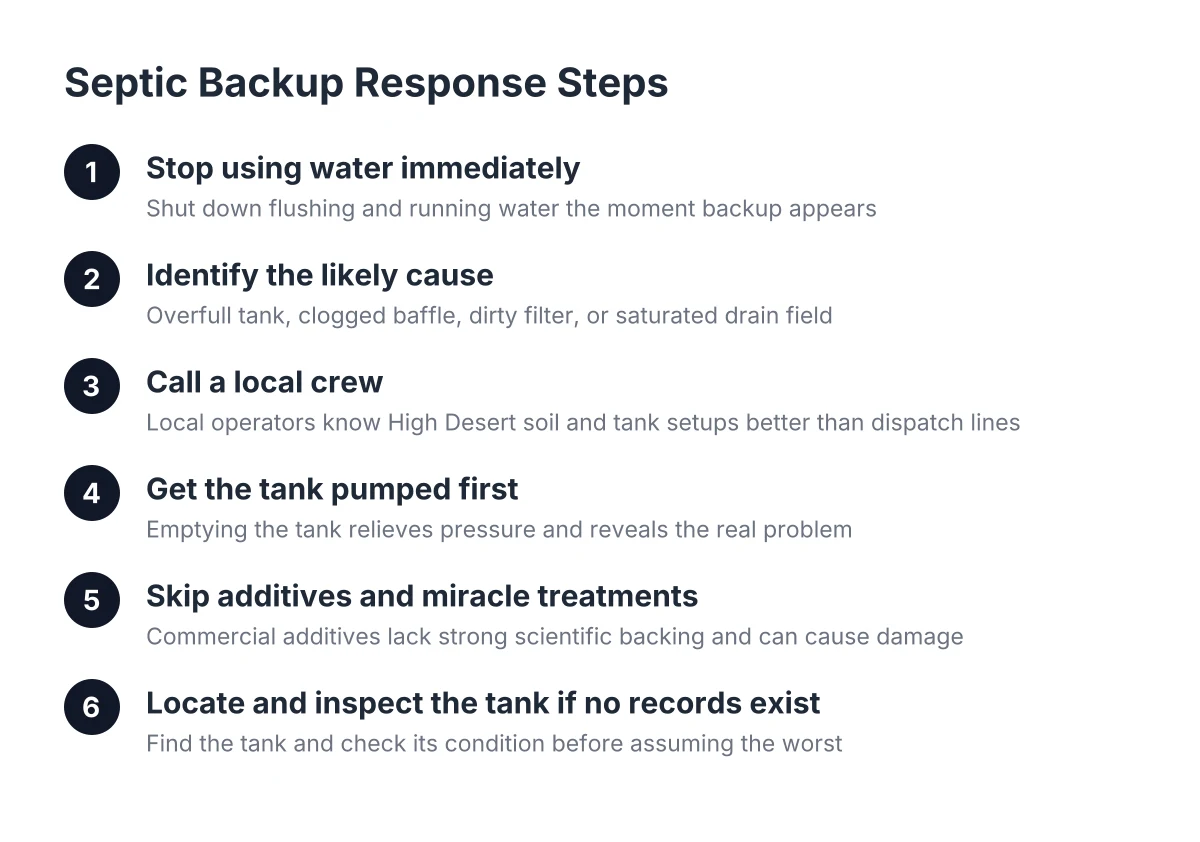
    Numbered diagram of septic backup response steps for a failed system in Hesperia
    The eight-step sequence for handling a septic backup, as outlined in this Hesperia guide.

    A septic backup does not wait for a convenient time. Sewage rises in a tub, a toilet stops flushing, or a tenant calls about a smell in the yard, and suddenly you need answers fast. This guide walks through septic tank backup response steps: what causes backups, what you can do in the first hour, and how a local Hesperia crew actually clears the problem. If you own rental property on septic, or you just bought High Desert land with no records on the system, knowing this sequence before trouble hits can save you thousands in cleanup and repair.

    The stakes are real. According to the U.S. Environmental Protection Agency, more than one in five U.S. households depend on individual septic systems or small community cluster systems to treat their wastewater. Out here in Hesperia and the surrounding High Desert, that share runs higher, and most backups trace back to a tank that went too long without service.

    Here are eight things to know, in the order you will need them.

    1. Stop Using Water the Moment You See a Backup

    The first move in any septic backup response is to shut down water use in the building. Every flush, shower, and load of laundry pushes more wastewater into a tank that has nowhere to send it. That water will exit through the point of least resistance, which is usually the lowest drain in the house, often a tub or shower.

    Tell everyone in the household, or your tenants, to stop flushing and running water until the system is checked. If sewage has already surfaced indoors, keep kids and pets away from it and ventilate the room. Raw sewage carries bacteria, so treat any contact area as contaminated until it is cleaned and disinfected.

    One hidden culprit worth checking right away: a running toilet. According to the U.S. Environmental Protection Agency, a single leaky or running toilet can add as much as 200 gallons of extra water per day into a septic system. In a rental, a tenant may have lived with a running toilet for months without reporting it, quietly flooding the tank the whole time.

    2. Know the Most Common Causes Before You Assume the Worst

    A backup does not automatically mean a failed system. In most cases, the cause falls into one of a few categories, and several of them are fixable in a single service visit:

    • An overfull tank. Sludge and scum built up past the point where the tank can do its job. Most emergency calls trace back to a tank left unpumped far beyond its service interval.
    • A clogged inlet baffle. According to the Washington State Department of Health, a clogged inlet baffle is a common cause of septic backups and should be one of the first things checked when a line into the tank is blocked.
    • A dirty effluent filter. If your tank has one, a clogged filter can hold water back into the house even when the tank itself is fine.
    • A saturated drain field. After heavy rain, soil can become too wet to absorb effluent, and the water backs up toward the house.
    • A failing drain field. The most serious cause, where the soil absorption area no longer accepts water at all.

    When a technician troubleshoots a backup, the two most likely suspects are a clogged effluent filter that needs cleaning or a drain field that is starting to fail. The first is a quick fix. The second is a bigger conversation, and the sooner you know which one you have, the better your options.

    3. Call a Local Crew to Execute Septic Backup Response Steps

    For a backup in Hesperia, a local septic crew matters more than it does for almost any other trade. Septic tank backup response depends on knowing High Desert soil, local tank setups, and how to find a buried lid on a lot with no markers. A national call center routes your emergency to whoever is on their list; a local operator answers questions about your actual system.

    A good septic service does more than pump. Expect the technician to answer questions about what caused the backup, whether additives help, how often the tank should be serviced, and what shape the drain field is in. If the person on the phone can only schedule a truck and cannot talk through the problem, keep looking.

    Emergency septic pumping exists for exactly this situation. Pumping the tank down relieves the immediate pressure on the system, gets toilets working again, and gives the technician a clear view of what went wrong inside the tank.

    4. Expect Pumping First, Then Diagnosis

    The standard septic tank backup response sequence starts with getting the tank empty. A typical crew arrives with a truck that combines a vacuum pump and storage tank, opens the lid, and pumps out the contents. The waste is then hauled to a treatment plant for disposal; according to the New Hampshire Department of Environmental Services, septic waste pumped from residential tanks goes by truck to a sewage treatment plant rather than being processed on site.

    With the tank empty, the technician can actually see the problem. Is the inlet baffle clogged? Is the outlet damaged?Additionally, is water flowing back into the tank from the drain field, which points to saturated or failing soil? An empty tank turns guesswork into a diagnosis.

    This is also where full septic tank cleaning earns its keep over a basic pump-out. Effective service means removing the settled sludge at the bottom and the floating scum layer at the top, not just the liquid in the middle. Those solid layers are what cause most system problems, and leaving them behind sets up the next backup.

    5. Skip the Additives and Miracle Treatments

    When sewage is backing up, a bottle of tank treatment from the hardware store looks tempting. Resist it. According to Washington State University Extension, commercial septic tank additives marketed to decompose or dissolve sludge lack strong scientific backing. Some treatments can even harm the beneficial bacteria the tank needs, or corrode tank components, causing damage instead of improvement.

    The physics of a backup do not change with chemicals. If the tank is full of solids, or the drain field cannot accept water, no additive fixes that. The money is better spent on pumping and a proper look inside the tank.

    6. If You Have No Records, Get the Tank Located and Inspected

    Suppose you are buying five acres outside Hesperia, the listing says "septic," and the seller has no paperwork, no lid in sight, and no memory of the last pump-out. In that scenario, a septic tank locating service is the first call, before escrow closes if possible. A crew finds the tank, marks it, exposes the lid, and can then pump and inspect the system so you know what you are actually buying.

    This matters even more if the property is a rental or will become one. An unknown system is an unbudgeted liability. The EPA estimates septic tank repair or replacement typically costs between $5,000 and $15,000, far more than routine pumping. A locate-and-inspect visit that turns up a bad drain field before closing is leverage in the deal; the same discovery after closing is your bill.

    A written inspection report also travels well. Lenders, county permit offices, and future buyers all respond to documentation, and for a small landlord it starts the maintenance file for that unit.

    7. Watch the Rain, Especially on Marginal Systems

    Heavy rain and backups go together, even in the High Desert. In a working system, water leaves the tank and disperses into the soil through the drain field. According to the U.S. Environmental Protection Agency, a conventional septic system consists of two main components, the septic tank and the drain field, and the drain field only works when the soil around it can absorb water.

    When a storm saturates that soil, effluent has nowhere to go and backs up toward the house. If your system only backs up during or after rain, that pattern is a diagnostic clue in itself. It suggests the drain field is marginal, and a technician should evaluate it before the problem becomes permanent.

    In the meantime, cut water use hard during storms on any system with a history of rain-related trouble. Spacing out laundry and shorter showers keep the load light while the soil drains.

    8. Prevent the Next One With a Real Schedule

    Almost every emergency backup was preventable. High water in the tank, dirty filters, bad odors, and overloaded systems nearly all trace back to skipped routine maintenance. The fix is boring and cheap compared to the alternative: put each septic property on a service schedule and keep records.

    For planning purposes, the U.S. Environmental Protection Agency recommends a professional inspection at least once every three years. Penn State Extension notes that for an active family of four, pumping every two to three years is generally advisable because of higher household solids and liquid production. A rental with heavy occupancy sits closer to the frequent end of that range.

    For a small landlord with three or four septic-served units around Hesperia, a workable routine looks like this:

    1. Get every tank located, marked, and documented, so no future service call starts with a hunt for the lid.
    2. Pump and inspect each tank on a set cycle, adjusted for how many people live in each unit.
    3. Log every service date, tank condition note, and repair in one file per property.
    4. Tell tenants what not to flush, and ask them to report slow drains and running toilets early.

    Routine septic tank pumping is a line item; an emergency is a crisis with tenant displacement attached. According to Angi data, septic tank pumping averages $427, ranging from $250 to $1,250 or more depending on tank size and location. Set against a five-figure repair, the schedule pays for itself many times over.

    When a Backup Means More Than a Pump-Out

    Be honest about the limits here. If the tank is pumped and water still will not drain, or the tank refills from the drain field side, the problem sits beyond what a pump-out fixes. Drain field evaluation and repair need a qualified professional, and in 2026 any drain field work in San Bernardino County will run through local permitting. Guessing at that stage costs more than asking.

    The good news is that most backups never get that far. Stop the water, call a local crew, get the tank pumped and properly cleaned, and let the empty tank tell you what happened. Whether you are a landlord fielding a tenant call or a buyer staring at a lot with no visible lid, a clear understanding of septic backup response steps turns a bad afternoon into a manageable service visit.

    If you need your septic tank serviced, Hesperia Septic can help.

    Related Reading

  • Septic Tank Cleaning Terms Explained: A Plain-English Glossary

    septic tank cleaning glossary

    If you own a home with a septic system in Hesperia or anywhere in the High Desert, you will run into words on quotes and inspection reports that nobody ever explained to you. This septic tank cleaning glossary breaks down the terms you actually meet when you call a provider, read an estimate, or watch a crew work in your yard. Each entry gives you a plain definition first, then tells you why the term matters for your wallet or your property. Use it to read a quote line by line, ask better questions, and spot a problem before it becomes a backup.

    • Septic Tank
    • Drain Field
    • Baffle
    • Riser
    • Inlet and Outlet
    • Scum Layer
    • Sludge
    • Effluent
    • Effluent Filter
    • Septic Tank Pumping
    • Pumping vs. Cleaning
    • Vacuum Truck
    • Septic Tank Locating
    • Backwash or Backflushing
    • Septic Backup
    • Slow Drains
    • Septic Inspection
    • Grease Trap

    Parts of Your Septic System

    Septic Tank

    A septic tank is a buried, watertight container that receives all the wastewater from your home and holds it long enough for solids to settle out. Most tanks are concrete, fiberglass, or plastic. Everything that goes down your drains ends up here first, so the tank's condition affects your whole system. If you have a concrete tank, this step-by-step maintenance guide covers how to keep it working longer.

    Drain Field

    A drain field is the network of buried pipes and gravel trenches where liquid wastewater from your septic tank soaks into the soil. It is also called a leach field. The drain field does the final cleanup by filtering wastewater through the ground. A failed drain field is one of the most expensive septic repairs, so protecting it with regular pumping is worth the effort.

    Baffle

    A baffle is a barrier inside your septic tank that keeps floating grease and scum from flowing out into your drain field. Tanks have an inlet baffle where wastewater enters and an outlet baffle where liquid leaves. If a baffle breaks or rots away, solids can escape and clog the drain field. A provider who checks your baffles during service is looking out for your system, not padding the bill.

    Riser

    A riser is a pipe that extends from the top of your buried septic tank up to ground level, capped with a lid you can open. Without a riser, a crew has to dig down to the tank lid every time they pump it. Adding a riser costs money up front but saves digging fees on every future visit. If your quote mentions "riser installation," that is what it means.

    Inlet and Outlet

    The inlet is where wastewater from your house enters the septic tank, and the outlet is where the settled liquid leaves for the drain field. Providers check both during service because a clog at either point causes backups. If a crew says your outlet is blocked, expect the conversation to turn to what has been going down your drains.

    What's Inside the Tank

    Scum Layer

    The scum layer is the floating mat of grease, oils, and light solids that sits on top of the liquid in your septic tank. It builds up over time and is one of the two layers a pumping crew measures to decide if your tank needs service. A thick scum layer that reaches the outlet baffle can push grease into your drain field, which is where real damage starts.

    Sludge

    Sludge is the layer of heavy solids that sinks and collects at the bottom of your septic tank. Bacteria break some of it down, but sludge always builds up over time and can only be removed by pumping. When sludge gets deep enough to reach the outlet, solids flow into the drain field and clog it. Sludge depth is the main number a provider uses to tell you whether your tank is due.

    Effluent

    Effluent is the liquid wastewater that flows out of your septic tank into the drain field after the solids have settled out. It sits between the scum on top and the sludge on the bottom. Clean, mostly clear effluent means your tank is doing its job. If a provider mentions cloudy effluent or solids in the effluent, your tank is overdue for service or has a broken part.

    Effluent Filter

    An effluent filter is a screen installed at the tank's outlet that catches small solids before they can reach the drain field. Not every tank has one. If yours does, it needs cleaning during routine service, and a provider may list that as a line item. It is cheap protection for the most expensive part of your system.

    The Service Itself and Common Cleaning Terms

    Septic Tank Pumping

    Septic tank pumping is the process of removing the liquid, sludge, and scum from your tank with a vacuum truck. It is the core maintenance task for any septic system, and skipping it is how drain fields fail. Most homeowners search for pumping when drains slow down or smells appear, but pumping on a schedule is cheaper than pumping in an emergency. This walkthrough of the pumping process shows what happens from the moment the truck arrives.

    Pumping vs. Cleaning

    Pumping means removing the liquid and loose solids from your tank, while cleaning goes further by removing the compacted sludge stuck to the bottom and walls. Some providers use the words interchangeably, so ask which one your quote covers. When you're comparing cleaning services in our septic tank cleaning glossary, full tank cleaning takes more time and effort than a basic pump-out, and the price usually reflects that. If your tank has gone years without service, cleaning is often what it actually needs; this cost guide explains what drives the price up or down.

    Vacuum Truck

    A vacuum truck is the tanker truck a septic crew uses to suck the contents out of your tank through a large hose. It is also called a pump truck. The truck needs to park within hose reach of your tank, so access matters. If your tank sits far from the driveway or behind a fence, mention it when you call so the crew arrives prepared.

    Septic Tank Locating

    Septic tank locating means finding exactly where your buried tank and its lids sit on your property. Many homeowners, especially recent buyers, have no idea where their tank is. A provider may use records, probing, or locating tools to find it. If nobody has ever shown you your tank lids, expect locating to be part of your first service call.

    Backwash or Backflushing

    Backflushing means spraying some of the pumped liquid back into the tank to break up hardened sludge so the vacuum can remove it. It is a normal part of a thorough pump-out, not the crew putting waste back in your tank. If you see it happen and worry, ask; a good crew will explain it on the spot.

    Problems and Paperwork

    Septic Backup

    A septic backup is wastewater flowing the wrong way, coming up through your drains, toilets, or lowest fixtures instead of leaving the house. It usually means the tank is full, a line is clogged, or the drain field can no longer accept water. A backup is the loudest warning your system gives you. Learn the quieter warnings first in this list of signs your tank needs pumping.

    Slow Drains

    Slow drains are fixtures throughout the house that empty sluggishly at the same time, which points to a septic problem rather than a single clogged pipe. One slow sink is a plumbing issue. Every drain slow at once means the tank or drain field is struggling. Catching this early can mean a routine pump-out instead of an overflow in your yard.

    Septic Inspection

    A septic inspection is an evaluation of your tank and system condition, checking levels, baffles, lids, and how the system handles water. Buyers often order one before closing on a home, and owners use them to catch problems early. An inspection is different from pumping, though the two are often done together since an empty tank is easier to examine.

    Grease Trap

    A grease trap is a container that catches fats, oils, and grease from kitchen drains before they reach the septic tank or sewer line. They are common at restaurants and some larger properties. Grease traps need their own pumping on a regular schedule. If your property has one, make sure your provider services it, since a full grease trap causes its own backups.

    Using These Terms

    You now know what the words on a septic quote actually mean, from sludge depth to riser installation. When a provider in Hesperia hands you an estimate, you can read each line, ask whether the price covers pumping or full cleaning, and understand the answer. That is the whole point of this glossary: fewer surprises, sharper questions, and a system that lasts longer because you knew what to ask for.

    If you need your septic tank serviced, Hesperia Septic can help.
    Related guide: septic tank cleaning — Complete Guide

    Related Reading

  • Concrete Septic Tank Maintenance: A Step-by-Step Guide to Cleaning and Longevity

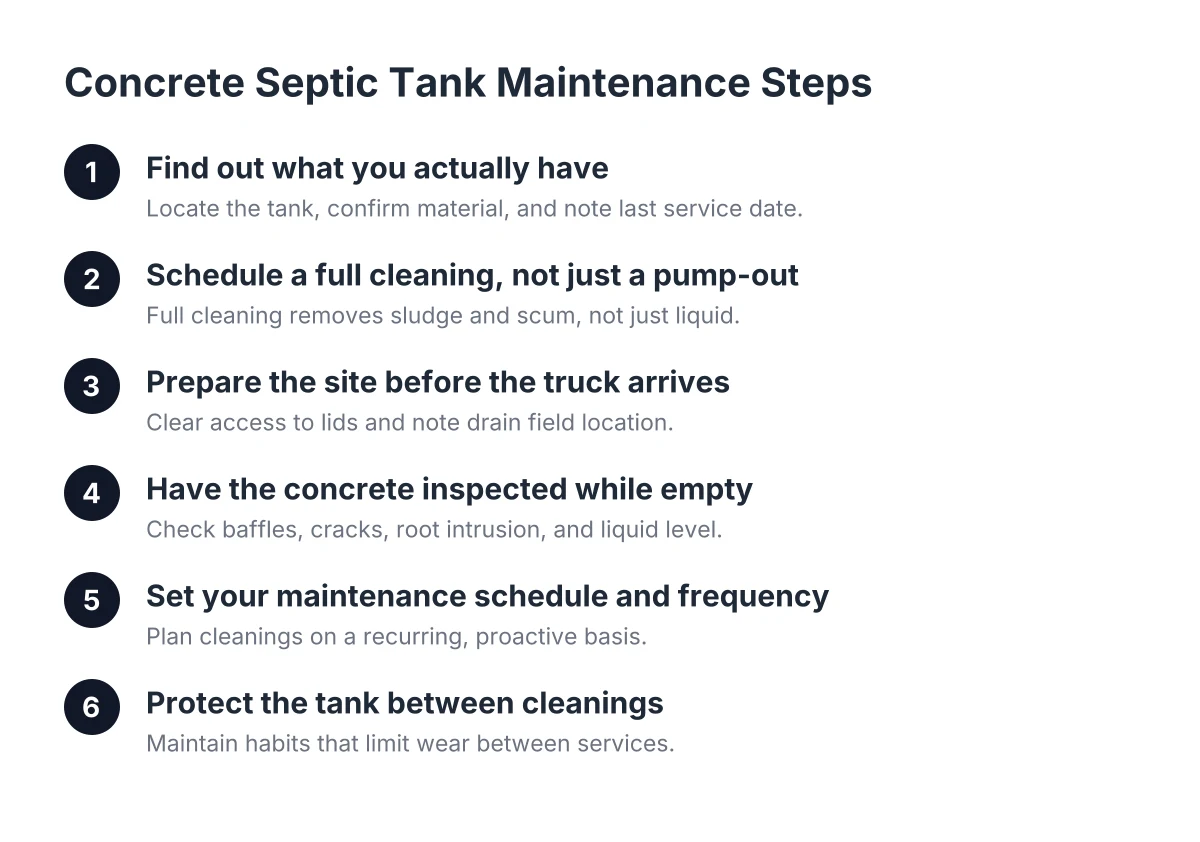
    concrete septic tank maintenance

    Concrete septic tank maintenance comes down to a handful of steps done on a schedule: pump the tank before solids build up, remove the sludge and scum a basic pump-out can leave behind, check the concrete and baffles for wear, and keep good records so you never have to guess again. Most homeowners search for "septic tank cleaning near me" only after something goes wrong. This guide is for doing it the other way, before the yard smells and the drains slow down.

    One thing to clear up first, because it changes what you pay for. Pumping removes the liquid and whatever solids come out easily with it. Full cleaning goes further: the crew breaks up the compacted sludge layer on the bottom, removes the floating scum layer, and gets the tank interior down to where it can be inspected. If you own a concrete tank in Hesperia or the surrounding High Desert, that inspection step matters, because concrete wears in ways you can only see when the tank is empty.

    Here is the full process, step by step.

    Step 1: Find Out What You Actually Have

    Before you schedule anything, figure out where your tank is, what it is made of, and when it was last serviced. If you just bought the house, check your closing paperwork; some inspections note the tank location and condition. County permit records can also show where the system was installed.

    However, plenty of Hesperia homeowners have no records at all. In that case, a septic tank locating service can find the tank, mark the lids, and confirm whether it is concrete, plastic, or fiberglass. Concrete is the most common material in older High Desert homes, and it is durable, but it is not maintenance-free. The baffles inside a concrete tank and the concrete itself can degrade over decades, which is exactly why concrete septic tank maintenance is worth doing on purpose instead of by accident.

    Write down what you learn: tank location, lid depth, material, and last known service date. That one page of notes makes every future service visit faster and cheaper.

    Step 2: Schedule a Full Cleaning, Not Just a Pump-Out

    If you do not know when the tank was last serviced, book a full septic tank cleaning rather than a basic pump. Here is why the distinction matters for your wallet and your tank.

    A basic pump-out pulls the liquid contents through the vacuum hose. That is fine for a tank on a regular schedule. But in a tank that has gone five or ten years, the bottom sludge layer compacts into something the truck cannot pull out without extra work. Pump only the liquid and you leave that hardened layer behind, which means less working capacity and a faster return trip.

    A full cleaning includes:

    • Pumping out all liquid contents
    • Breaking up the compacted sludge layer on the tank bottom, usually with backflushing or agitation
    • Removing the floating scum layer of grease and solids
    • Rinsing the tank walls enough to see the concrete
    • A visual check of the inlet and outlet baffles

    Ask the company directly whether the quote covers sludge removal and agitation or just pumping. A straight answer to that question tells you a lot about who you are dealing with. It also protects you from paying twice, once for a pump-out that skips the sludge and again when the tank fills back up early.

    Step 3: Prepare the Site Before the Truck Arrives

    You can shave time off the visit with a little prep. First, clear a path to the tank lids. Move vehicles, trailers, and anything stored over the tank area. If the lids are buried, ask ahead whether digging is included or whether you should expose them yourself.

    Next, make sure the truck can get within hose range of the tank. Vacuum hoses have limits, and a locked gate or a parked RV between the truck and the tank slows everything down. In addition, note where your drain field is so nobody parks or drives over it; vehicle weight can crush drain field lines.

    For example, suppose a homeowner in Hesperia bought a place two years ago with no septic records. On service day, say the crew spends the first forty minutes probing for buried lids because nobody marked them. That is time and money spent on locating instead of cleaning. A homeowner who marked the lids after step one skips that cost entirely.

    Step 4: Have the Concrete Inspected While the Tank Is Empty

    This is the step that separates concrete septic tank maintenance from generic tank service, and it only takes a few extra minutes when the tank is already empty. Once the sludge and scum are out, the interior is visible. That is the only time anyone can check the things that actually end a concrete tank's life:

    • Baffle condition. Concrete baffles erode over time. A failed outlet baffle lets solids flow into the drain field, and drain field damage is the expensive failure. Concrete septic tank baffle repair is a manageable job when caught early.
    • Cracks and deterioration. Hairline cracks, spalling, or soft spots in the walls point toward concrete septic tank repair needs down the road. Small problems in concrete are fixable; ignored ones are not.
    • Root intrusion. Roots that find a crack will widen it every year.
    • Liquid level behavior. A tank that will not hold liquid, or one that was flooded above the outlet, tells the inspector something is wrong beyond the tank itself.

    The U.S. Environmental Protection Agency recommends a professional inspection at least once every three years for the average household, and once a year for systems with pumps, float switches, or other mechanical parts. Pairing the inspection with a cleaning visit is the practical way to hit that schedule, since inspection requires an empty tank anyway.

    Be aware of one trade-off: an honest inspection sometimes finds problems you were not budgeting for. That is still better than the alternative. According to the U.S. Environmental Protection Agency, septic repair or replacement typically runs $5,000 to $15,000, far more than routine service. A cracked baffle found during a cleaning is a small fix; the same baffle found after the drain field fails is not. If the inspection turns up structural cracks or a failing baffle, get a second opinion before major repair work; that is a reasonable ask and a legitimate company will not push back on it.

    Step 5: Set Your Maintenance Schedule and Frequency

    How often a septic tank needs cleaning depends on tank size, household size, and what goes down the drains. There is no single number that fits every home, which is why the visit you just completed is your best data point. Ask the crew two questions before they leave: how thick were the sludge and scum layers, and based on that, when should we come back?

    A few factors push the schedule shorter:

    • More people in the house means more solids, period.
    • Garbage disposals add sludge fast. The Massachusetts Department of Environmental Protection recommends annual pumping for households with disposals, regardless of tank size.
    • Heavy grease habits fill the scum layer sooner.
    • Commercial use is its own category. A restaurant grease trap or an RV park's holding tanks fill on a schedule measured in months, not years, and usually need a recurring service agreement rather than an as-needed call.

    Once you have a date, treat it like a smog check. Put it on the calendar, or better, ask whether the company will track it and call you. The whole point of a maintenance schedule is that you stop thinking about it.

    Step 6: Protect the Tank Between Cleanings

    Ongoing concrete septic tank maintenance is mostly about what you do not do. Between service visits, a few habits stretch the time until the next cleaning and protect the concrete itself:

    • Keep grease, wipes, coffee grounds, and harsh chemicals out of the drains. Strong chemicals kill the bacteria that break down waste, and some can attack concrete over time.
    • Spread out laundry loads instead of running four in one day; flooding the tank pushes solids toward the drain field.
    • Keep vehicles, sheds, and heavy equipment off the tank and drain field.
    • Fix running toilets and dripping faucets. Constant water flow through the tank shortens the time solids have to settle.
    • Watch for warning signs: slow drains throughout the house, gurgling, sewage odor in the yard, or wet spots over the tank or drain field. Any of those means call before the schedule says to.

    Step 7: Keep a Simple Service Record

    Finally, keep every invoice and inspection note in one folder, paper or digital. Record the date, what was done, sludge and scum levels if the crew measured them, and anything flagged for watching, like a hairline crack or a worn baffle.

    Therefore, the next visit starts from knowledge instead of guesswork, and if you ever sell the house, that folder answers the buyer's inspector before the question comes up. You bought a house with no septic history and felt the uncertainty firsthand. The record you keep now is the fix for the next owner, and for you in three years when you cannot remember whether it has been two years or four.

    A concrete tank that gets cleaned on schedule, inspected while empty, and protected between visits can serve a home for decades. The work is not complicated. It just has to happen before the problem does.

    If you need your septic tank serviced, Hesperia Septic can help.


    Related Reading

  • How Much Does Septic Tank Cleaning Cost?

    cost of septic tank replacement

    How much does septic tank cleaning cost? The honest answer depends on three things: the size of your tank, how easy it is to reach, and how long it has been since the last pumping. Nobody can hand you an accurate number without knowing those details, and the difference between routine cleaning and the cost of septic tank replacement is the difference between a maintenance bill and a construction project. This guide walks through what actually drives the price for Hesperia homeowners, so by the end you will know exactly how to get a real quote instead of a guess.

    What Drives the Cost of Septic Tank Cleaning

    Every honest quote comes down to a handful of factors. Here are the ones that matter most, and how to tell which side of each one you are on.

    Tank Size

    Bigger tanks hold more waste, and more waste means more time on site and more volume hauled away. A larger home usually has a larger tank, which pushes the price up. If you have your home's original permit paperwork or a past pumping receipt, the tank size is often listed there. If you do not know your size, say so when you call; a good septic company can figure it out on site.

    How Full the Tank Is

    A tank that gets pumped on a regular schedule costs less to service than one that has gone years without attention. When solids build up and harden, cleaning takes longer and requires more work to break up the sludge layer. If you cannot remember the last time your tank was pumped, or you are already seeing backups and slow drains, expect the job to sit on the higher end. Our guide to the warning signs your septic tank needs pumping can help you judge how far along things are.

    Access to the Tank

    The crew has to find your tank, uncover the lid, and get the truck's hose to it. A tank with a riser at ground level and a clear path from the driveway is a quick job. A tank buried under two feet of dirt, hidden under a deck, or sitting far from where the truck can park takes more labor. If you do not know where your tank is, septic tank locating is a service we offer, and finding it before the pump truck arrives keeps the visit efficient.

    Routine Cleaning vs. an Emergency

    A scheduled septic tank cleaning on a Tuesday morning costs less than an emergency call when sewage is backing up into your shower. Emergency septic pumping means a crew responds outside the normal schedule, and backup and overflow response often involves more than just pumping. If your system is still working, booking service before it fails is the single biggest lever you control.

    Condition of the System

    Sometimes pumping reveals a bigger problem: a cracked tank, a failed baffle, or a drain field that no longer absorbs water. The drain field is the buried network of pipes that lets treated water soak into the soil. The true cost of replacing a septic tank system stems from excavation, new installation, permits, and drain field work—expenses that far exceed routine cleaning. Repair or replacement is a different category entirely, and replacement pricing depends on soil, permits, and excavation, which is why no page can honestly quote it. A septic system inspection during pumping tells you where your system stands before you are forced to find out the hard way.

    Extra Services on the Same Visit

    Some visits are just pumping. Others add an inspection, tank locating, or work on a second tank or grease trap. Each added service adds to the bill, but bundling them into one visit usually beats paying for separate trips. Decide what you want checked before the truck arrives.

    Cost Factor Table

    Factor Pushes the price down when… Pushes it up when…
    Tank size The tank is small or standard for the home The tank is large or the property has multiple tanks
    Time since last pumping The tank is on a regular pumping schedule Years have passed and solids have hardened
    Access The lid has a riser and the truck can park close The lid is deeply buried, hidden, or far from truck access
    Timing Service is scheduled before a problem starts Sewage is already backing up and it is an emergency call
    System condition Pumping is all the system needs The inspection finds damage or drain field trouble
    Scope of visit The job is pumping only You add locating, inspection, or grease trap service

    How to Get an Accurate Cleaning Estimate

    The fastest path to a real number is a short phone conversation with specifics. Before you call, gather what you can:

    • Tank size, if you know it. Check old receipts or your county permit records.
    • When it was last pumped. Even a rough year helps.
    • Where the tank sits. Front yard, back yard, under landscaping, unknown.
    • What you are seeing. Slow drains, odors, wet spots over the drain field, or nothing at all.

    A good quote spells out what is included: pumping the full tank (not just the liquid layer), disposal of the waste, and whether locating or digging to the lid costs extra. If a quote seems low, ask what happens when the crew finds a buried lid or a fuller tank than expected. Vague quotes grow on site; detailed quotes hold.

    Estimates differ between providers because each company prices disposal, drive time, and labor differently. That is normal. What matters is that the quote matches your actual tank and situation, not a generic figure. For a personalized starting point, try our Septic Tank Pumping Cost Calculator, then confirm the number with a phone call.

    If you want to know what you are paying for, our walkthrough of how septic tank pumping works step by step shows what the crew does on site.

    Strategies to Lower Replacement and Maintenance Costs

    You cannot change your tank size, but you control more of the price than you might think.

    1. Pump on a schedule, not on a crisis. Routine service costs less than emergency response, and it prevents the drain field damage that turns a pumping bill into a replacement project.
    2. Know where your tank is before the truck arrives. Mark the lid, or install a riser so future visits skip the digging. Access is one of the easiest price factors to fix once.
    3. Get two or three quotes with the same details. Give each company identical information so you compare real numbers, not guesses against guesses.
    4. Bundle work into one visit. If you want an inspection or a grease trap pumped, schedule it with the cleaning instead of paying for a second trip.
    5. Watch what goes down the drain. Grease, wipes, and heavy garbage disposal use fill the tank faster, which means paying for septic tank pumping more often than you should.

    Cost Questions People Ask

    Why is replacing a septic tank so much more expensive than cleaning one?

    Cleaning is a service call: a truck, a crew, and a few hours. Replacement is excavation, a new tank, permits, and often drain field work, which makes the cost of replacing a septic system a construction expense rather than a maintenance one. Regular septic tank cleaning exists partly to keep you out of that category.

    Does an inspection add to the cost, and is it worth it?

    Adding a septic system inspection to a pumping visit costs more than pumping alone, but it is the only way to check the tank's condition while it is empty. Finding a failing baffle early costs far less than finding it after a backup. If your system is older or you just bought the home, the inspection usually earns its price.

    Why did I get such different quotes from different companies?

    Providers price labor, drive time, and disposal differently, and some quotes leave out digging, locating, or disposal fees that get added on site. Ask each company exactly what the price includes and what triggers extra charges. The most useful quote is the most detailed one, not the lowest one.

    Will insurance cover septic pumping or repairs?

    Routine pumping is maintenance, and homeowner policies generally treat maintenance as your responsibility. Coverage for damage varies by policy and by cause, so check with your insurer before assuming anything. Budget for pumping the way you budget for other regular home upkeep.

    The Bottom Line

    Septic tank pumping costs come down to tank size, access, and how long you waited, and the only accurate number is one based on your actual property. Run your details through the cost calculator, then get two or three detailed quotes and compare what each one includes. Scheduling service before a backup is the cheapest version of this job you will ever get.

    If you need your septic tank serviced, Hesperia Septic can help.
    Related Reading

  • 7 Signs Your Septic Tank Needs Pumping: Backups, Odors, and Slow Drains

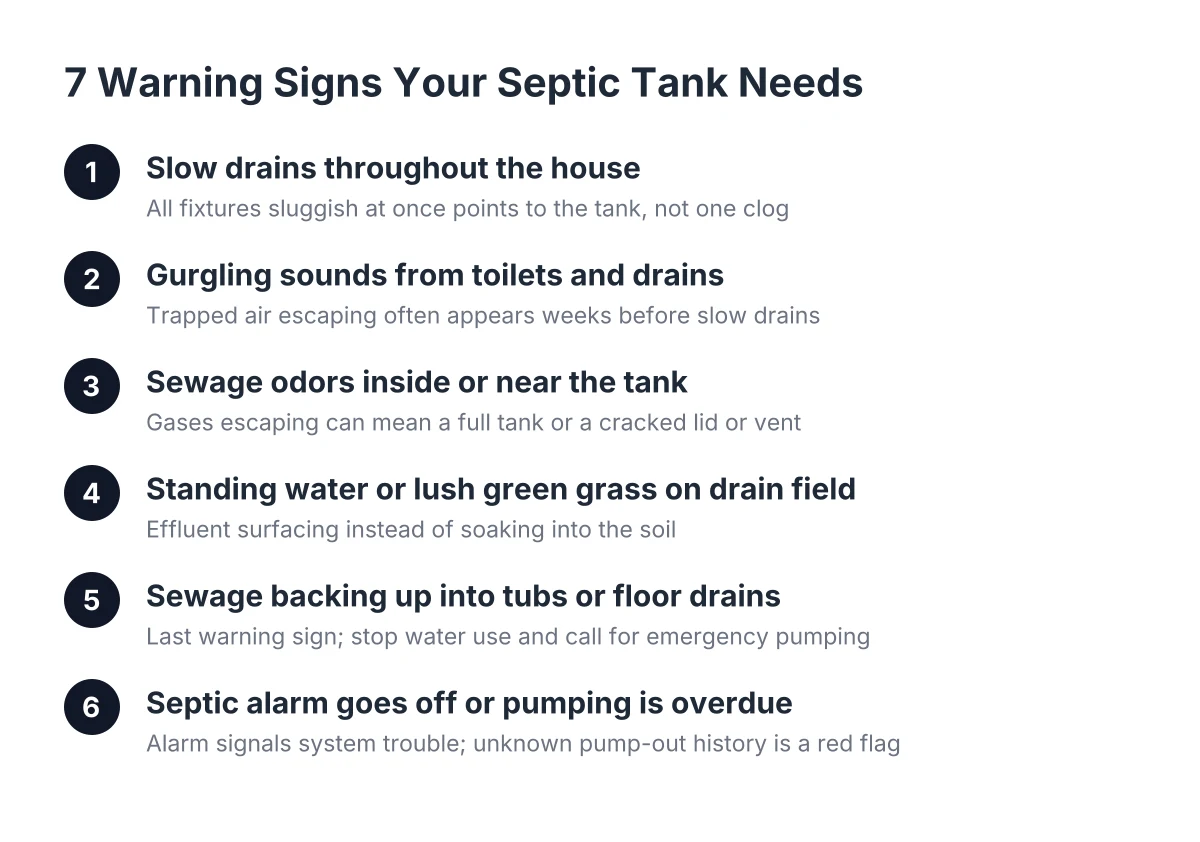
    Sequence of septic backup warning signs from slow drains to sewage backup
    The warning signs tend to appear in this order, from slow drains to a full backup.

    Most septic problems announce themselves before sewage ever reaches your tub. The signs your septic tank needs pumping usually show up in a predictable order: drains slow down, odors creep in, the yard gets wet, and then a backup hits at the worst possible time. Recognizing septic backup warning signs early is the difference between a routine septic tank pumping visit and a weekend emergency with a tenant calling you at 8pm. If you own a home or a rental in Hesperia, catching these signals early helps you act before a costly emergency develops.

    This list walks through the seven warning signs in the rough order they tend to appear, plus what each one usually means. Some point to a full tank that just needs pumping. Others point to a clog or a drain field problem that pumping alone will not fix. Knowing the difference helps you evaluate what you are actually paying for when a truck shows up.

    1. Slow Drains Throughout the House, Not Just One Fixture

    One slow sink is usually a plumbing clog. Every drain in the house running slow at the same time is one of the earliest signs your septic tank is getting full. When sludge builds up in the tank, wastewater has nowhere to go, so it backs pressure into every line connected to the system.

    Here is the quick test: if the master bathroom tub, the kitchen sink, and a toilet on the other side of the house are all sluggish, the problem is downstream of all of them. That points to the tank or the line leading to it. A landlord hearing "all the drains are slow" from a tenant should treat that differently than "the bathroom sink is slow," because the first one gets worse on its own.

    Therefore, do not spend money on drain cleaner or a plumber snaking one fixture if the whole house is affected. A regular plumber will often tell you they do not handle septic anyway. Whole-house slowness calls for a septic inspection or pumping visit first.

    2. Gurgling Sounds From Toilets and Drains

    Gurgling is trapped air escaping through your plumbing because wastewater cannot flow freely into the tank. You will hear it when a toilet finishes flushing, or from a tub drain while the washing machine empties. It sounds minor, but it is the system telling you the pipes are fighting for space.

    In addition, gurgling often shows up a week or two before slow drains become obvious. Tenants tend to ignore it, so if you own rental property, it is worth asking specifically about strange drain noises during any maintenance visit. Catching the problem at the gurgling stage usually means a straightforward pump-out instead of a backup cleanup. These early warning signs of septic backup prevent much costlier repairs.

    3. Sewage Odors Inside the House or Near the Tank

    A healthy septic system should not smell. Sewage odor near drains, around the tank lid, or drifting across the yard means gases are escaping where they should not, and often means the tank is full enough that the scum layer is pushing waste toward the outlet. Odor inside the house is the more urgent version; it usually means wastewater is sitting in the lines.

    For example, a common Hesperia scenario looks like this: a homeowner notices a faint sewage smell in the hall bathroom for a few days, assumes it is a dry trap, and pours water down the drain. The smell comes back. A week later the toilet will not flush and water is rising in the tub. The odor was the warning; the backup was the bill.

    However, odor alone does not always mean a full tank. A cracked lid, a damaged vent, or a leaking tank can also cause smells. If pumping does not resolve a persistent odor, ask the crew to inspect the tank and lids while it is open.

    4. Standing Water or Lush Green Grass Over the Drain Field

    Wet, soggy ground over the tank or drain field when it has not rained is one of the clearer signs your septic tank is either overfull or failing to drain. In the High Desert, this one stands out. Hesperia yards are dry most of the year, so a soft, muddy patch or a stripe of bright green grass in an otherwise brown yard is hard to miss.

    That green stripe happens because wastewater is surfacing and fertilizing the grass above the drain field. It looks healthy, but it means effluent is not soaking into the soil the way it should. Sometimes pumping the tank buys time. Other times the drain field itself is saturated or failing, which is a bigger conversation.

    This is the point where an honest assessment matters. According to the U.S. Environmental Protection Agency, septic repair or replacement typically costs between $5,000 and $15,000, far more than routine pumping. A crew that opens the tank and checks liquid levels can usually tell you whether you are looking at a pump-out or a drain field problem, and you should expect them to explain which one and why.

    5. Sewage Backing Up Into Tubs, Showers, or Floor Drains

    Sewage backing up into the house is the last warning, not the first. Wastewater follows gravity, so it surfaces at the lowest drains first: a ground-floor tub, a shower, or a floor drain in a laundry room. When you spot septic backup warning signs like gray or black water rising in a tub when the toilet flushes, stop running water immediately. Every gallon you use has nowhere to go but back inside.

    At this stage you need emergency septic pumping, not a drain snake. Pumping the tank relieves the pressure and stops the backup in most cases where a full tank is the cause. If the tank is not full and sewage is still backing up, the blockage is likely in the line between the house and the tank, or the drain field is refusing water. A crew that pumps tanks daily can tell the difference at the site.

    While you wait for a truck, three things help:

    • Stop all water use, including laundry, dishwashers, and showers, and ask tenants to do the same.
    • Keep people and pets away from any sewage on floors or in the yard; raw sewage carries bacteria.
    • Note where the water came up first, because that detail helps the crew find the problem faster.

    6. The Septic Alarm Is Going Off

    If your system has a pump or an alarm and it is sounding, the tank has reached a high water level and needs attention soon. Systems with float switches and pumps are designed to warn you before sewage surfaces. The alarm going off does not always mean an immediate overflow, but it does mean the normal draining process has stopped working.

    First, check whether anything obvious tripped it, such as a power outage affecting the pump. If power is fine and the alarm stays on, silence the buzzer if there is a switch, cut back water use, and get the tank checked. The U.S. Environmental Protection Agency recommends that alternative systems with float switches, pumps, or mechanical components be inspected once a year, precisely because these parts fail quietly until the alarm sounds.

    7. It Has Been Years Since the Tank Was Pumped, or You Do Not Know

    No visible symptoms does not mean an empty tank. Sludge builds up silently, and by the time you see the signs your septic tank is backing up, the cheap window has closed. If you bought a Hesperia home or rental and have no pumping records, assume the clock started before you did.

    The U.S. Environmental Protection Agency recommends a professional inspection at least once every three years for the average household. Households with garbage disposals build sludge faster; the Massachusetts Department of Environmental Protection recommends annual pumping for homes with disposals regardless of tank size. For a landlord, an inspection at tenant turnover is a cheap way to reset that clock and get documentation for your files.

    Cost is the other reason to act before symptoms appear. According to Angi data, septic tank pumping averages $427, ranging from $250 to $1,250 or more depending on tank size and location. Compare that to an after-hours backup at a rental: pumping, cleanup inside the unit, an unhappy tenant, and possibly a vacancy while you remediate. The math favors the scheduled visit every time.

    Do These Signs Mean Pumping or Full Septic Tank Cleaning?

    Pumping removes the liquid and floating waste from the tank; full cleaning also removes the compacted sludge layer from the bottom and lets the crew see the tank's interior. If your only symptom is that time has passed, routine pumping usually covers it. If you have had backups, odors, or years of neglect, ask about full septic tank cleaning so the hardened sludge does not stay behind and shorten the interval until your next problem.

    The signs on this list do not always separate the two on their own. As a result, the honest answer often comes only once the lid is open and the crew can see the sludge and scum layers. A good crew will show you what they find and explain whether the tank, the line, or the drain field is the issue, rather than defaulting to the most expensive fix. If someone recommends a full system replacement based on symptoms alone, without opening and evaluating the tank, get a second opinion.

    When to Call a Professional in Hesperia

    Any sign on this list is worth a phone call; two or more at once is worth a same-day call. Slow drains plus gurgling means the tank is likely near capacity. Odor plus a wet spot in the yard means wastewater is already escaping. Sewage in a tub or an alarm sounding means stop using water and get a truck out.

    One limitation worth stating plainly: no article can diagnose your system from a distance. Soil conditions, tank size, household habits, and system age all change the picture, and some problems, like a collapsed line or a failed drain field, require an on-site inspection to confirm. What you can do as of 2026 is know these seven signs, keep pumping records for every property you own, and call before the last warning becomes a backup in the hallway.

    If you need your septic tank serviced, Hesperia Septic can help.
    Related Reading

  • How Septic Tank Pumping Works: The Step-by-Step Process Explained

    septic pumping process steps

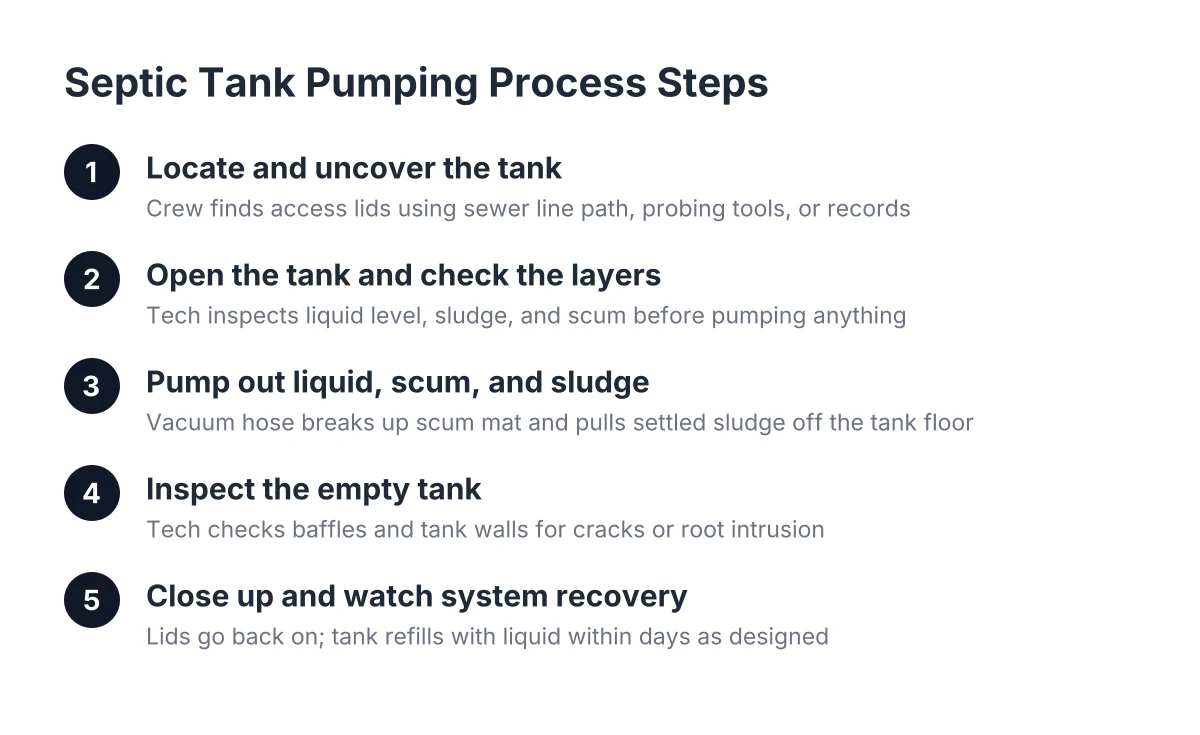
    If sewage is backing up into your tub, or there's a wet, smelly spot spreading in your yard, you need to understand one thing fast: the septic pumping process steps and whether they will fix your problem. Most backups in Hesperia homes trace back to a tank that filled up with solids nobody removed. The fix is usually a pump truck, not a whole new system. This guide walks through the process step by step, from the moment the truck pulls up to what happens after the tank is empty, so you know exactly what you're paying for and what to expect.

    According to the U.S. Environmental Protection Agency, more than one in five U.S. households depend on individual septic systems or small community cluster systems to treat their wastewater. If you're on septic in the High Desert, this process applies to you.

    First, Understand What's Actually Happening in Your Tank

    Before the steps, you need the 60-second version of how your system works. Everything that goes down your drains flows into a buried concrete or plastic tank in your yard. Inside, the waste separates into three layers.

    • Scum floats on top. This is grease, soap residue, and anything lighter than water.
    • Effluent sits in the middle. This is the liquid that flows out to your drain field.
    • Sludge settles on the bottom. These are the solids that never break down.

    The liquid layer drains out to the drain field on its own. The sludge and scum do not. They build up year after year until they take up so much space that solids start pushing out into the drain field lines, or wastewater has nowhere to go and backs up into the house. That's the moment most people meet their septic system for the first time, at 8pm on a Friday with a toilet that won't flush.

    Pumping removes those built-up layers. Now here's how the process actually goes.

    Step 1: Locate and Uncover the Tank

    The crew can't pump what they can't reach. If you know where your tank lids are, point them out. Many Hesperia homeowners don't, especially if they bought the house recently, and that's normal. A crew that offers septic tank locating can find the tank using the sewer line's path from the house, probing tools, or records if they exist.

    Once found, the access lids get uncovered. On older properties this can mean digging down a foot or two of dirt. If your lids are buried deep, ask about adding risers after the pump-out; they bring the access up to ground level so the next service is faster and cheaper.

    Step 2: Open the Tank and Check the Layers

    Next, the technician opens the lid and looks before pumping anything. This quick inspection tells the real story of your system.

    A liquid level sitting above the outlet pipe suggests the drain field isn't taking water. A low liquid level can point to a leak or a crack in the tank. Thick sludge and a heavy scum mat mean the tank was overdue. This is also when a tech measures how much of the tank is solids, which tells you whether your pumping schedule needs to change.

    Therefore, don't skip this part or rush the crew past it. Two minutes of looking can be the difference between "you just needed a pump" and catching a drain field problem early.

    The Core Steps of the Septic Pumping Process

    Here's where the actual work happens. The technician runs a large vacuum hose from the truck to the tank and pulls out the contents: liquid, floating scum, and bottom sludge. A good operator doesn't just skim the liquid. They work the hose to break up the scum mat and pull the settled sludge off the floor of the tank, sometimes using the liquid itself to stir and loosen compacted solids.

    This distinction matters. A quick liquid-only pump-out leaves the hardened sludge behind, and that's the stuff causing your problem. When people search for septic tank cleaning versus pumping, this is the difference they're asking about: full cleaning means getting the solids out and the tank interior cleared, not just draining the water. If you're paying for service, confirm the solids are coming out, not just the liquid.

    For cost context, Angi reports septic tank pumping averages $427, with a range of $250 to $1,250 or more depending on tank size and location. Emergency or after-hours work can run higher, but a pump-out is still a fraction of major repair costs.

    Step 4: Inspect the Empty Tank

    Once the tank is empty, the technician can see things that were hidden under three feet of wastewater. They check the baffles, which are the fittings that keep solids from escaping into the drain field, and look at the tank walls for cracks or root intrusion.

    An empty tank is the only time this inspection is possible, so it should happen at every pump-out. The EPA recommends the average household have its septic system inspected at least once every three years, and systems with pumps or float switches inspected once a year. Pairing inspection with pumping is the practical way to hit that schedule. If your system has an alarm or an effluent pump and the alarm is going off, that pump may have stopped working; that's an electrical and mechanical issue a septic professional should diagnose, not something to troubleshoot from a blog post.

    Step 5: Close Up and Watch How the System Recovers

    After pumping, the lids go back on and the dirt goes back over them, unless you added risers. Then comes the part homeowners always ask about: what to do after the septic tank is pumped.

    The honest answer is simple. Use water normally but don't flood the system the first day or two. The tank refills with liquid within days, and that's normal; a septic tank is designed to be full of liquid. What you're watching for is whether drains run freely and the yard stays dry. If sewage backs up again within days of a full pump-out, the problem is downstream, usually a clogged line or a failing drain field, and that needs a professional diagnosis.

    Here's a scenario we see in Hesperia all the time. A homeowner has guests arriving Saturday, and Thursday night the shower starts backing up when the washing machine drains. The tank hasn't been pumped since they bought the house six years ago. A pump-out Friday morning removes the sludge, the drains clear, and the weekend is saved. The follow-up conversation is about getting on a schedule so it never gets to that point again.

    How Often You Need to Schedule Septic Tank Pumping

    There's no single answer for every home, because frequency depends on tank size, household size, and habits. A house with two people produces far less sludge than a house with six. Garbage disposals speed up sludge buildup. So do heavy grease and "flushable" wipes, which are not flushable in a septic system.

    The reliable approach is measurement, not guessing. Have the tank checked, and let the actual sludge level set your schedule. Once you've done that twice, you'll know your home's real interval.

    The same logic applies to businesses. A restaurant grease trap or an RV park's holding tanks fill on a predictable cycle, and recurring scheduled pump-outs keep a kitchen out of health code trouble and keep odors away from paying customers. Waiting for a backup is the expensive version of the same service.

    Why Skipping the Pump-Out Costs More Than the Pump-Out

    Is septic tank pumping necessary? Yes, because a septic tank has no other way to get rid of solids. Skip it long enough and solids flow into the drain field, where they clog the soil that treats your wastewater. Pumping is routine maintenance; a drain field is not.

    The EPA estimates septic repair or replacement typically costs $5,000 to $15,000, far more than routine pumping. As of 2026, that gap is the whole argument for staying on a schedule. A few hundred dollars every few years protects a five-figure system buried in your yard.

    Plan Your Pump-Out: Costs, Fees, and When Pumping Isn't Enough

    Before you book, a few more resources answer the questions that usually come next:

    The Bottom Line for Hesperia Homeowners

    Septic tank pumping works by vacuuming out the sludge and scum your tank has no way to remove on its own, and a proper service includes locating the tank, checking the layers, removing the solids, and inspecting the empty tank before closing it up. If you're in a backup right now, a pump-out is the first move and often the only one needed. If you're not in a backup, the cheapest septic service you'll ever buy is the one you schedule before the toilet stops flushing.

    If you need your septic tank serviced, Hesperia Septic can help.


    Related Reading